Section 504 and the Americans with Disabilities Act (ADA) are federal laws that protect children with disabilities, including autism, from discrimination. While they share similarities, they apply in different contexts and offer distinct protections.
Here’s a quick breakdown:
- Section 504: Focuses on federally funded programs, like public schools, ensuring equal access to education through accommodations such as extra test time or sensory breaks.
- ADA: Covers both public and private spaces (except religious entities), ensuring access to public areas like parks, restaurants, and workplaces.
Both laws often overlap, but knowing when and where each applies can help you advocate for your child’s rights effectively.
Quick Comparison
| Feature | Section 504 | ADA |
|---|---|---|
| Covers | Federally funded schools, colleges | Public spaces, private businesses |
| Focus | Education access | Broader access to public life |
| Protections Continue | After high school | Lifelong |
| Enforced By | Dept. of Education (OCR) | Dept. of Justice (DOJ) |
Both laws aim to ensure children with autism have equal opportunities in education and daily life. Keep reading to learn how they differ and how to use them to support your child.
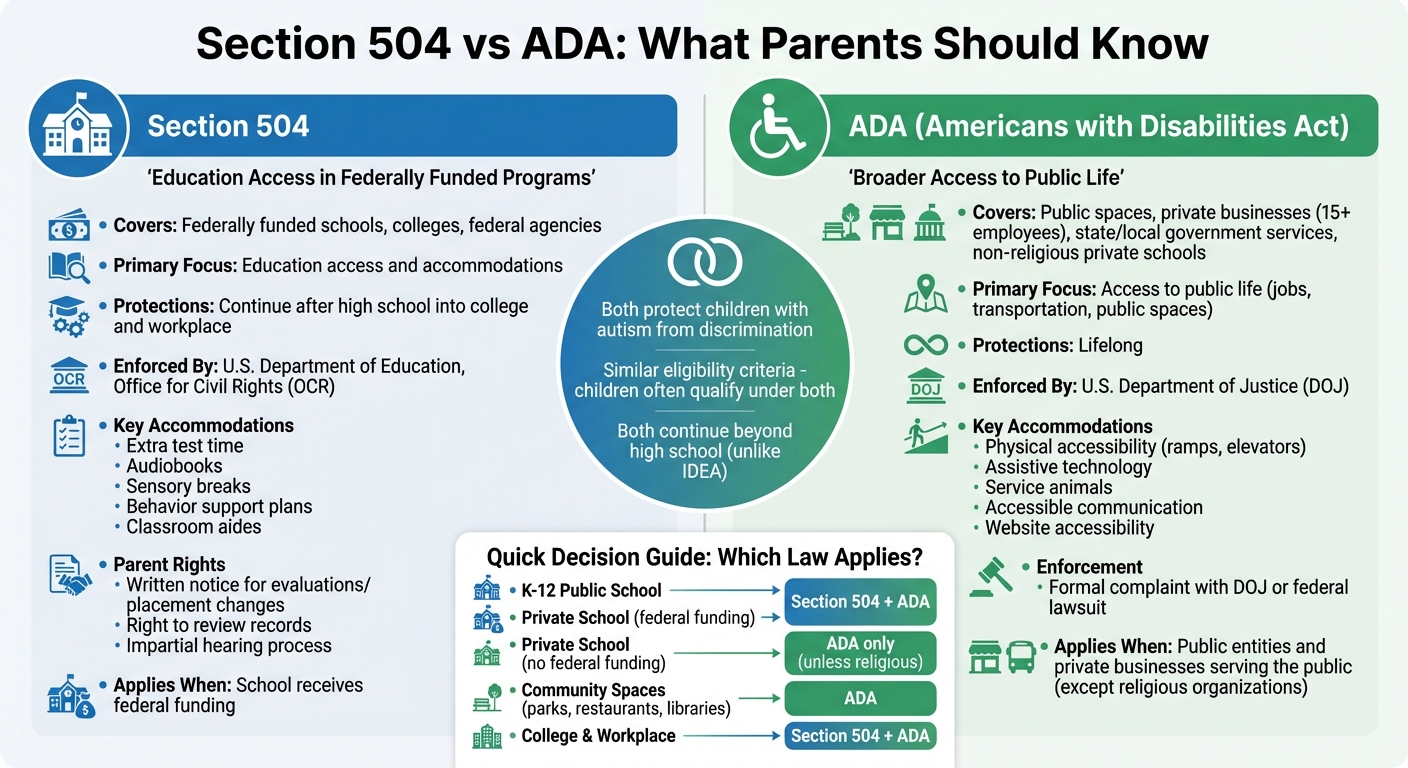
Section 504 vs ADA: Key Differences for Parents of Children with Disabilities
How Section 504 and ADA Differ
What Each Law Covers
Section 504 applies to programs and activities that receive federal funding. This includes public schools, colleges, federal agencies, and even some private schools if they accept federal funds. Essentially, if an institution benefits from federal financial assistance, it must comply with Section 504.
On the other hand, the Americans with Disabilities Act (ADA) casts a wider net. It applies to both public and private entities, including state and local government services, businesses like restaurants and retail stores, and workplaces with 15 or more employees. However, organizations run by religious entities are not required to follow ADA regulations.
"Section 504 of the Rehabilitation Act… prohibits discrimination on the basis of disability in programs and activities, public and private, that receive federal financial assistance." – DREDF [2]
Finding the right autism parent resources can help you navigate these legal requirements. Next, let’s explore where these laws come into play.
Where Each Law Applies
For a child with autism, Section 504 primarily impacts their education. It ensures they have access to an education that’s on par with their peers in public schools, and its protections carry over into college and the workplace. In contrast, the ADA goes beyond the classroom, ensuring access to public spaces like parks, libraries, restaurants, and movie theaters. It also applies to private businesses that serve the public.
This difference in scope highlights how these laws function in distinct ways, which is summarized in the table below.
Side-by-Side Comparison
Here’s a breakdown of how Section 504 and the ADA differ:
| Feature | Section 504 | Americans with Disabilities Act (ADA) |
|---|---|---|
| Primary Purpose | Prevents discrimination in federally funded programs | Prevents discrimination in public life (e.g., jobs, schools, transportation) |
| Covered Entities | Public schools and entities receiving federal financial aid | Public and private non-religious schools, workplaces, and public spaces |
| Workplace Coverage | Applies to employers receiving federal funding | Applies to private employers with 15+ employees |
| Enforcement Agency | U.S. Department of Education, Office for Civil Rights (OCR) | U.S. Department of Justice (DOJ) |
| Federal Funding Provided | None | None (though tax credits may help with barrier removal) |
| Written Plan Required | Not legally required (though 504 plans are common) | No specific requirement; focuses on reasonable accommodations |
Both laws place the responsibility for covering accommodation costs on the organizations themselves, as neither provides direct federal funding to implement these services.
sbb-itb-d549f5b
Does Your Autistic Child Qualify?
Qualifying Under Section 504
An autistic child qualifies for Section 504 protections if they have a physical or mental impairment that significantly limits one or more major life activities. For children with autism, these activities often include learning, reading, concentrating, thinking, communicating, or engaging in social interactions.
Eligibility under Section 504 doesn’t require specialized instruction. Instead, it hinges on demonstrating that autism imposes substantial limitations. A diagnosis of autism, supported by proper documentation or evidence showing a history or perception of the impairment, is enough to meet the criteria for protection [6].
Qualifying Under ADA
The Americans with Disabilities Act (ADA) ensures your child qualifies if a disability significantly limits a major life activity, if there is a record of such a disability, or if they are perceived as having one [2]. The "regarded as" provision is particularly important because it protects against discrimination based on how others perceive autism.
While Section 504 protections are tied to schools receiving federal funds, the ADA extends its reach to non-religious private schools, public spaces like restaurants, websites, movie theaters, and more [2]. This broader scope ensures your child’s rights are upheld not just in the classroom but in everyday life as well. Since the eligibility criteria for both laws are similar, children often qualify under both.
How the Two Laws Overlap
Autism, as a neurological developmental condition, impacts communication and social interaction – both recognized as major life activities. Because of this, children who qualify under Section 504 almost always meet the ADA’s requirements too [2].
"ADA provided additional protection in combination with actions brought under Section 504." – DREDF [2]
One key advantage is that while IDEA protections end when a child graduates high school or turns 22, Section 504 and ADA protections continue throughout life [3][6]. This overlap ensures that children with autism benefit from consistent civil rights protections, both in educational settings and as they navigate the broader community.
School Accommodations Under Each Law
What Section 504 Requires in Schools
Section 504 ensures that students with disabilities receive a Free Appropriate Public Education (FAPE), which means their education must be on par with what is provided to students without disabilities. To achieve this, schools are required to create a 504 Plan that outlines the necessary accommodations for the student. If you’re seeking a 504 Plan for your child, it’s best to make the request in writing to avoid any confusion.
Accommodations under a 504 Plan could include:
- Extra time on tests
- Audiobooks
- Preferential seating
- Sensory breaks
- Behavior support plans
- Classroom aides
However, it’s important to note that Section 504 does not provide specialized instruction. Its purpose is to ensure equal access to education by removing barriers. While related services like speech or occupational therapy may be included in a 504 Plan, the focus remains on accessibility rather than the tailored instruction offered under IDEA.
What ADA Requires in Schools
The Americans with Disabilities Act (ADA) is designed to prevent discrimination and ensure equal access to all school programs and activities. Title II of the ADA applies to all public schools, regardless of whether they receive federal funding.
The ADA places a strong emphasis on physical accessibility and effective communication. Schools must provide tools and services to ensure that communication with your autistic child is as effective as it is with other students. Examples include:
- Assistive technology
- Sign language interpreters
- Real-time transcription services
Additionally, the ADA requires schools to accommodate service animals trained to perform tasks related to the student’s disability. This right is separate from any 504 Plan and cannot be denied based on other accommodations.
"In determining what types of auxiliary aids and services are necessary, a public entity shall give primary consideration to the requests of individuals with disabilities." – ADA National Network
The ADA and Section 504 often complement one another. While Section 504 focuses on ensuring equal access within the educational program, the ADA addresses access to facilities, communication, and technology on a broader scale.
Accommodation Examples Compared
Although both laws aim to ensure access and support for students with disabilities, they address different aspects of accessibility. Here’s a comparison of accommodations under each law:
| Accommodation Type | Section 504 Examples | ADA Examples |
|---|---|---|
| Learning & Testing | Extra time on tests, modified assignments, audiobooks, quiet testing environments | Written materials in Braille or large print |
| Behavior & Support | Behavior support plans, classroom aides | Allowing service animals in school buildings |
| Physical Access | Education alongside peers in the least restrictive environment | Ramps, elevators, accessible desks, facility redesigns |
| Technology & Communication | Assistive technology for classroom use | Real-time transcription (CART services), accessible websites |
Section 504 is centered on providing classroom-level accommodations to support learning, while the ADA ensures that all school facilities, activities, and communications are accessible. Together, these laws create a strong framework to protect your child’s right to participate fully in school life.
Introduction to the ADA and Section 504
Your Rights and How to Advocate
Understanding your rights and knowing how to advocate effectively are key to ensuring your child receives the support they need.
What Section 504 Gives You
Section 504 provides specific rights designed to help your child access appropriate educational support. For instance, you have the right to receive written notice whenever the school identifies, evaluates, or changes your child’s placement. This ensures you’re kept informed about decisions that affect your child’s education [2][5].
Additionally, you can review all relevant school records to confirm the accuracy of the information used in making placement decisions [5]. If you disagree with the school’s evaluation or placement decisions, you have the right to request an impartial hearing [2][3][5]. During this process, you are allowed to have legal representation [2].
However, Section 504 does not require schools to invite parents to 504 planning meetings. To ensure your involvement, you should request written notification. As Special Education Consultant Pat Howey explains:
"Section 504 requires schools to develop a system of procedural safeguards that includes notice (presumably to parents), an opportunity for the parent to review records, and an impartial hearing and review procedure" [3].
To strengthen your advocacy, submit all requests in writing and keep a detailed record of communications. Document your child’s challenges and the specific support they need to build a compelling case for accommodations [4].
How to Take Action Under ADA
The ADA offers broader protections against discrimination but follows a different process for enforcement. If you believe your child’s rights under the ADA have been violated by a school, public space, or other entity, you can file a formal complaint with the U.S. Department of Justice (DOJ) or the U.S. Department of Education’s Office for Civil Rights (OCR) [2][5].
These agencies often recommend informal mediation and voluntary compliance to resolve issues quickly and with less conflict [2]. If mediation doesn’t resolve the problem, you can escalate the matter by filing a lawsuit in federal court with legal representation [2].
Unlike Section 504, the ADA doesn’t include procedural safeguards specific to special education planning. Instead, it emphasizes administrative complaint procedures and penalties for noncompliance in areas like services and employment [2]. Advocacy under the ADA focuses on addressing discrimination rather than participating in detailed planning meetings. Understanding this distinction is crucial for ensuring that your child’s accommodations are upheld.
Advocacy Process Comparison
The processes and rights under Section 504 and the ADA differ significantly. Knowing these distinctions can help you determine the best course of action when advocating for your child.
| Feature | Section 504 | ADA (Title II) |
|---|---|---|
| Primary Focus | Programs receiving federal financial assistance (public schools) [2] | All public entities and private "public accommodations" [2][1] |
| Notice to Parents | Required for identification, evaluation, and placement [2][5] | Not specifically addressed for school procedures [5] |
| Parental Consent | Not strictly required for evaluation (notice is required) [2] | Not addressed [5] |
| Written Plan | Not federally required, but common practice (504 Plan) [2][3] | Not addressed [5] |
| Dispute Resolution | Impartial hearing and review procedure [2][5] | Formal complaint with DOJ or lawsuit in federal court [2][5] |
| Right to Counsel | Parents may be represented by counsel at hearings [2] | Individuals may be represented by counsel in court [2] |
Section 504 emphasizes involving parents in the educational planning process, while the ADA provides broader protection against discrimination across public spaces. Unlike IDEA, which ends at graduation or age 22, both Section 504 and the ADA continue to offer protections beyond high school [3]. This makes it essential to understand how these laws work together for long-term advocacy.
What This Means in Daily Life
Section 504 and the ADA play a key role in shaping daily experiences, from school activities to community outings. Together, these laws ensure that children with disabilities, including autism, have the support they need to thrive in both educational and public settings.
How This Affects School Life
Section 504 is designed to eliminate obstacles in public schools and programs that receive federal funding. It ensures that children with disabilities receive an education comparable to their peers without disabilities. As Special Education Consultant Pat Howey explains:
"Under Section 504, an ‘appropriate’ education means an education that is comparable to the education provided to students without disabilities." [3]
In practical terms, this could mean providing audiobooks, extended time for tests, or sensory-friendly seating arrangements. Even if a child doesn’t qualify for specialized instruction, they may still receive related services like speech therapy or behavioral support. These adjustments allow students to fully engage in classroom activities and benefit from their education.
Section 504 also emphasizes education in the least restrictive environment. Schools are encouraged to integrate children with disabilities alongside their non-disabled peers whenever possible. This can influence decisions about classroom placement, recess, lunch, and participation in extracurricular activities like clubs and sports.
Similar principles extend beyond the classroom, ensuring support and accessibility in broader community settings.
How This Affects Community Access
The ADA ensures that protections extend beyond school to public spaces and private businesses, making them accessible to children with disabilities. This includes places like libraries, playgrounds, museums, restaurants, and even websites.
For example, a public library may provide accommodations such as materials in alternative formats, sensory-friendly hours, or staff assistance to help navigate the space. In community sports leagues or recreation programs, the ADA mandates accessibility, which could involve physical adjustments or assigning aides. The law also applies to off-site school programs, like internships or job training, and may require modifications to policies, such as accommodating sensory-driven dietary needs.
Real Examples of Support
These legal protections translate into meaningful changes in both school and community life. Schools might offer quiet spaces for testing, assistive technologies like speech-to-text tools, or flexible schedules to accommodate therapy sessions or manage fatigue.
In public settings, the ADA ensures both physical and policy changes. Playgrounds might feature accessible equipment, community programs could assign aides, and written materials may be offered in alternative formats. Public facilities may also be retrofitted to meet accessibility standards, ensuring equal opportunities for all.
Ultimately, both Section 504 and the ADA work toward inclusion, helping children with disabilities participate alongside their peers – whether in the classroom, on field trips, or at local events. These laws aim to remove barriers so every child can enjoy the same opportunities and experiences.
Which Law Applies to Your Situation?
The law that applies to your situation depends on your child’s specific support needs. Often, both Section 504 and the ADA work together, but understanding their individual focus can help you decide which to rely on.
For K-12 public schools or federally funded private schools, Section 504 is your go-to for securing a 504 Plan. This plan ensures your child gets classroom modifications, testing accommodations, and related services. Meanwhile, the ADA strengthens these protections by addressing physical accessibility – things like ramps, accessible restrooms, or meeting communication needs within the school environment.
However, if the school does not receive federal funding, Section 504 doesn’t apply. Instead, the ADA (Title III) steps in – unless the school is religiously controlled. Nonsectarian private schools are required to provide accommodations under the ADA.
Outside the school setting, the ADA takes the lead. It governs access to community spaces like restaurants, libraries, and summer camps. It also ensures protection for your child in college and the workplace, where IDEA no longer applies. As Pat Howey points out, Section 504 remains in effect after public school, unlike IDEA [3].
FAQs
Should my child have an IEP or a 504 Plan?
Choosing between an IEP (Individualized Education Program) and a 504 Plan comes down to understanding your child’s specific needs. If your child’s disability significantly affects their ability to learn, an IEP might be the right choice. It provides specialized instruction and services tailored to help them succeed academically. On the other hand, a 504 Plan focuses on accommodations, ensuring your child can fully participate in general education without requiring specialized instruction.
It’s a good idea to talk with school professionals or even consult a special education advocate to figure out which option aligns best with your child’s situation.
Can a private school deny accommodations for autism?
Private schools can deny accommodations for autism because federal laws like the ADA (Americans with Disabilities Act), Section 504 of the Rehabilitation Act, and IDEA (Individuals with Disabilities Education Act) primarily focus on public schools or institutions that receive federal funding. Unless a private school accepts federal funds or falls under specific legal requirements, it is generally not obligated to provide accommodations for students with autism.
On the other hand, public schools are legally required to support students with autism through tools like 504 plans or IEPs (Individualized Education Programs), ensuring their educational needs are met.
What can I do if a school or business refuses accommodations?
If a school or business denies accommodations, there are steps you can take under federal laws such as the ADA or Section 504. You can file a complaint with the U.S. Department of Justice, request an impartial review, or even consider legal action. Make sure to keep thorough documentation of all communications – this can be crucial in building your case. If the process feels overwhelming, seek guidance from an advocate or attorney experienced in disability rights to help ensure accommodations are enforced for you or your child.