You may be in this spot right now. Your child had a hard trip to the grocery store, a family member said, “People just need more autism awareness,” and you were left wondering why that comment felt incomplete.
Most parents already know awareness matters. People need to recognize autism, challenge obvious myths, and understand that autistic children aren't being “difficult on purpose.” But many families discover that recognition alone doesn't help much when a child is overwhelmed by noise, needs extra processing time, communicates with AAC, or melts down after too many transitions.
That's where the conversation around autism acceptance vs awareness becomes important. Awareness says, “I know autism exists.” Acceptance asks, “What needs to change so this child can participate, communicate, and feel safe?” For parents, that shift can change everyday life. It can influence how you respond to behaviors, how you set up your home, and how you talk with schools and relatives.
Table of Contents
- The Evolution From Awareness to Acceptance
- Comparing Autism Awareness and Acceptance
- Why This Shift Matters for Your Child and Family
- Practical Steps to Foster Autism Acceptance at Home
- Using Tools to Put Acceptance into Practice
- Extending Acceptance to Schools and the Community
The Evolution From Awareness to Acceptance
You tell a family member that your child is autistic. They nod, say they understand, and then keep the music loud, change plans at the last minute, and expect eye contact during conversation. They are aware. Your child is still unsupported.
That gap explains why many families began pushing for different language.
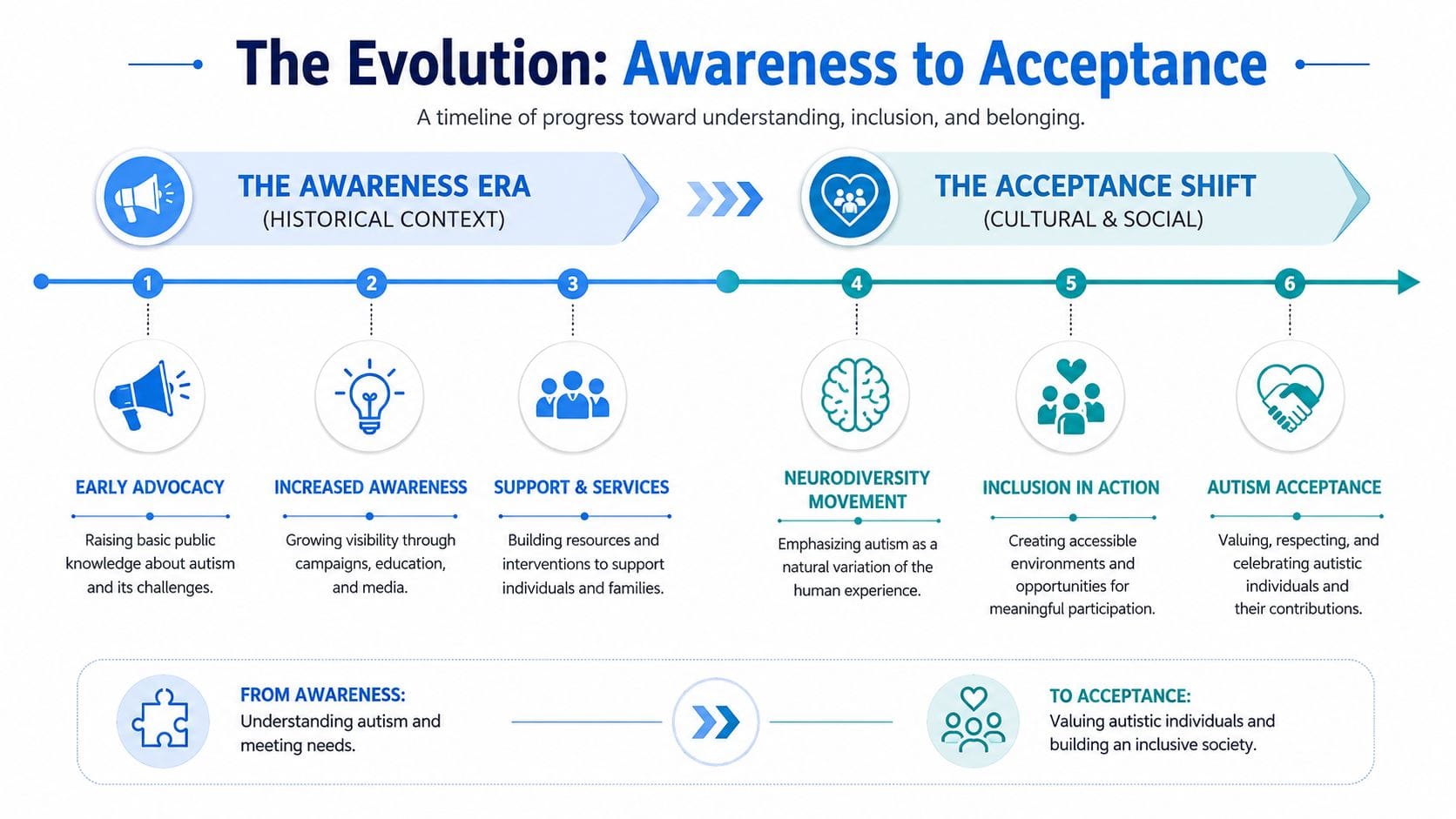
For years, public conversation centered on awareness. At that stage, basic recognition mattered. Many parents were still trying to find words for what they were noticing, and many communities had little understanding of autistic development, sensory needs, or communication differences.
Awareness helped bring autism into public view. It gave families a starting point. It also had a clear limit. Knowing autism exists does not tell a teacher how to adjust a classroom routine, help a grandparent understand stimming, or prepare a child for a noisy haircut appointment.
When the language changed
The shift toward acceptance grew from autistic advocates asking for more than recognition. They were asking for belonging, respect, and real changes in daily life. A useful way to understand the shift is this: awareness names the map. Acceptance helps your child get through the day.
A commonly cited part of that history is the move in 2011, when the Autistic Self Advocacy Network began using Autism Acceptance Month for April. Later public messaging also reflected this change, including themes focused on celebrating differences and building inclusion, as described in Neurology Advisor's history of Autism Acceptance Month.
Why the shift matters
Words shape goals. If the goal is awareness, success can stop at recognition. If the goal is acceptance, the next question becomes, “What does this child need in order to participate, communicate, and feel safe here?”
For parents, that changes daily decisions. You spend less energy asking how to make your child appear more typical and more energy noticing patterns. What helps before transitions? Which environments drain them? What support makes family outings more manageable? That is the beginning of acceptance in practice.
A simple rule can help. If people know your child is autistic but routines, expectations, or supports stay exactly the same, your family is still being met with awareness, not acceptance.
This shift also gives parents a more workable role. You do not have to become a public spokesperson overnight. You can start at home, like adjusting the bedtime routine, preparing for sensory-heavy errands, or tracking what leads to overload and what helps your child recover. If you want guidance for building that kind of daily support plan, parent autism training that focuses on practical home strategies can help turn the idea of acceptance into specific actions.
Comparing Autism Awareness and Acceptance
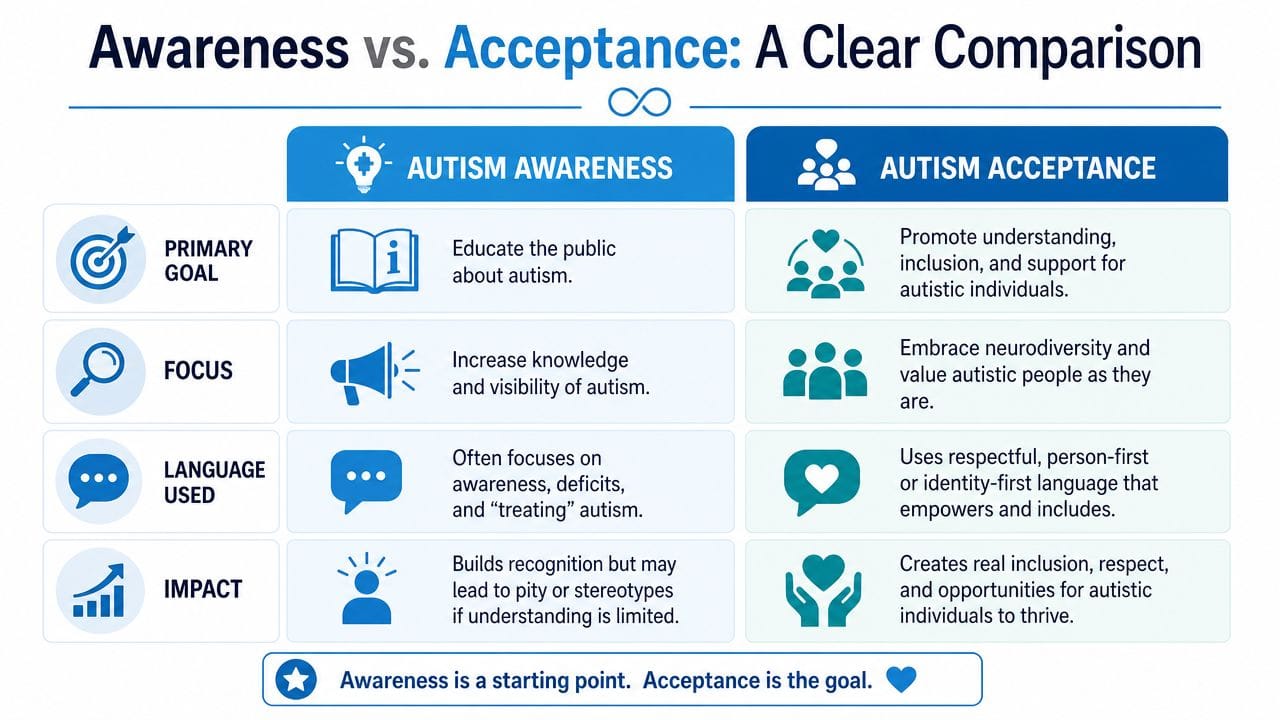
The easiest way to understand autism acceptance vs awareness is to compare what each one leads to in real life. Awareness is mostly about information. Acceptance is about changing environments, expectations, and supports so autistic people can function with dignity.
According to The Arc's explanation of Autism Acceptance Month, autism awareness is primarily informational, while autism acceptance is expressed through system-level inclusion. That includes removing barriers in school, work, and healthcare, respecting communication differences such as AAC, and offering concrete accommodations like predictable routines, plain-language instructions, quieter spaces, and reduced waiting times.
Autism Awareness vs. Autism Acceptance at a Glance
| Criterion | Autism Awareness | Autism Acceptance |
|---|---|---|
| Primary goal | Public recognition that autism exists | Inclusion, respect, and participation |
| Main focus | Information and identification | Removing barriers and supporting access |
| Typical response | “I know this child is autistic” | “What changes will help this child succeed here?” |
| Communication | May notice differences | Respects communication differences, including AAC |
| Daily supports | Often stops at understanding labels | Uses routines, plain language, quieter spaces, and other accommodations |
| Effect on environments | Limited change | Expects schools, healthcare, and community settings to adapt |
Where parents often get stuck
Parents often hear messages that sound supportive but still sit in the awareness category.
For example:
- At school: “We understand he has autism” sounds positive, but it isn't enough if the classroom remains loud, unpredictable, and rushed.
- At family events: “We know she doesn't like crowds” isn't acceptance if no one offers a quiet room or a shorter visit.
- At appointments: “We're familiar with autism” doesn't help if staff still use long waits, fast instructions, and sensory-heavy settings.
Acceptance becomes visible when adults make adjustments.
Awareness identifies. Acceptance accommodates.
That's one reason peer relationships matter too. Children often do better when adults shape environments that support belonging, flexibility, and understanding. If you're thinking about social support in a broader way, this guide on the benefits of peer support for autistic children offers useful ideas for building more connected experiences.
A common point of confusion is this: parents worry that acceptance means lowering expectations. It doesn't. Acceptance means setting appropriate, individualized expectations and giving the support needed to reach them. You can still teach skills, encourage growth, and work on hard things. The difference is that you're no longer asking your child to earn dignity by acting less autistic.
Why This Shift Matters for Your Child and Family
Your child's teacher says, “We know he has autism.” Then the day still includes a loud classroom, fast directions, and a rushed transition to lunch. A relative says, “We understand she gets overwhelmed,” but family gatherings stay long, crowded, and unpredictable. Parents notice this gap quickly. Being known is not the same as being supported.
That difference matters at home, too. In its discussion of acceptance vs. awareness, ASAN explains that awareness often stops at stereotypes, while acceptance asks for individualized support and accommodation. You can see that same shift reflected in the Autism Society of America's change from “Autism Awareness Month” to “Autism Acceptance Month” in 2020.
The question to ask after identification
A helpful way to measure this shift is to look for what changed after your child was identified.
Ask yourself:
- Did communication change? Were directions shorter, clearer, or supported with visuals?
- Did expectations become more individualized? Did adults allow extra processing time or offer another way to participate?
- Did the environment change? Was noise reduced, waiting shortened, or a quiet space offered?
- Did adults interpret behavior differently? Did they get curious about stress, sensory load, or confusion instead of assuming defiance?
These questions work like a home thermometer. They do not judge anyone. They help you see whether the adults around your child are adjusting the conditions, not just naming the diagnosis.
How acceptance changes family life
For many families, awareness alone can lead to a pattern of constant correction. A parent may spend the day reminding a child to sit still, make eye contact, tolerate noise, answer quickly, or stop a repetitive movement. Over time, everyone gets worn down. The child feels watched. The parent feels like they are always putting out fires.
Acceptance changes the goal. Instead of asking, “How do I make this look more typical?” parents start asking, “What is my child telling me, and what support would help right now?” Hand-flapping may work like a pressure valve. Silence may mean your child needs more time to process. A meltdown may signal that the day asked for more than your child could carry.
A child who feels understood is often easier to support because the adults around them are responding to the real problem.
This shift can lower conflict because it helps families respond earlier. You start noticing patterns before a hard moment peaks. Maybe homework always falls apart after a noisy bus ride. Maybe grocery trips go better with headphones, a short list, and a clear exit plan. Maybe bedtime struggles reflect sensory overload, not refusal.
Parents often need practical support to make this shift stick. Stress can blur observation and make every hard moment feel urgent. If that sounds familiar, this guide on how to manage stress raising an autistic child can help you build steadier routines for yourself as you support your child. Some families also benefit from broader parenting tips for children with autism, especially when they are trying to turn new understanding into daily habits.
That is why acceptance matters so much. It gives parents a practical roadmap. You stop guessing that every struggle is a behavior problem and start tracking what helps your child feel safe, regulated, and understood. That is also where simple tools, such as a daily tracker, become useful because they help you spot patterns and turn acceptance into action.
Practical Steps to Foster Autism Acceptance at Home
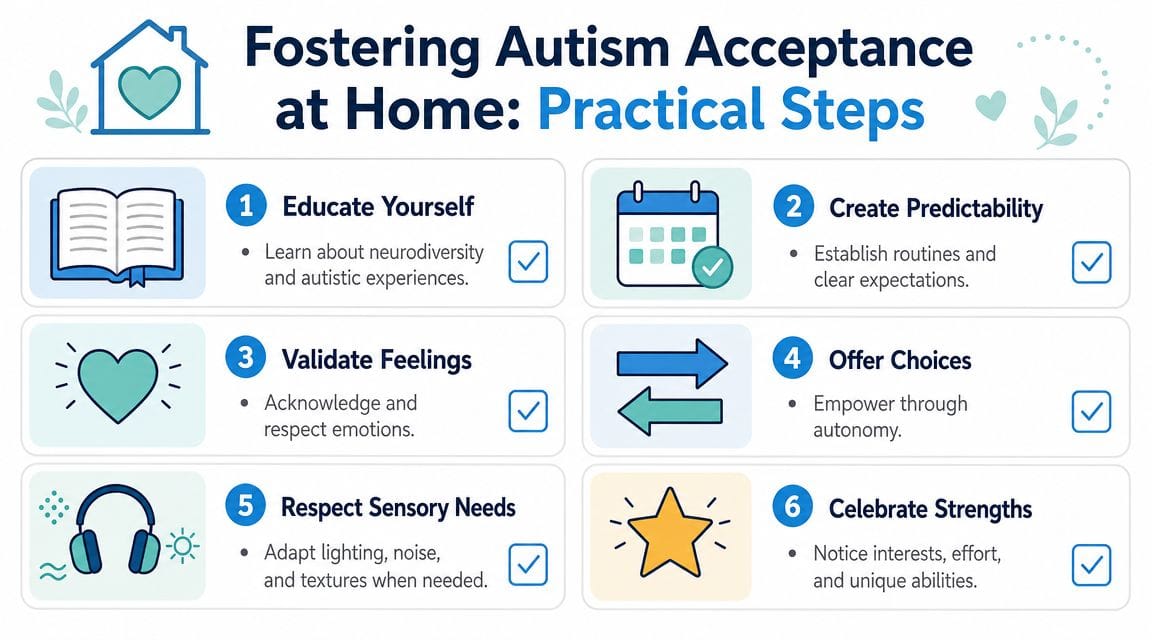
At home, acceptance shows up in small decisions repeated every day. It's less about having the perfect philosophy and more about making your child's world more understandable, more manageable, and more respectful.
Major guidance on this topic describes acceptance as changing behavior, adapting environments, and respecting communication preferences rather than forcing autistic people to conform. It also notes that supports and accommodations can absolutely coexist with intervention when they're chosen with autistic input, as explained by Mass General Aspire's discussion of moving from awareness to acceptance.
Start with observation, not correction
One of the most powerful home shifts is this: pause before you try to stop a behavior.
Ask:
- What might my child be communicating? Behavior often carries a message about overload, confusion, anxiety, pain, excitement, or the need for control.
- What happened just before this? Transitions, noise, hunger, fatigue, and social demand all matter.
- Is this harmful, or just different? A behavior that looks unusual isn't automatically a problem.
For many families, this simple pause reduces unnecessary conflict.
Daily changes that support regulation
You don't need a complete household overhaul. Start with a few practical adjustments.
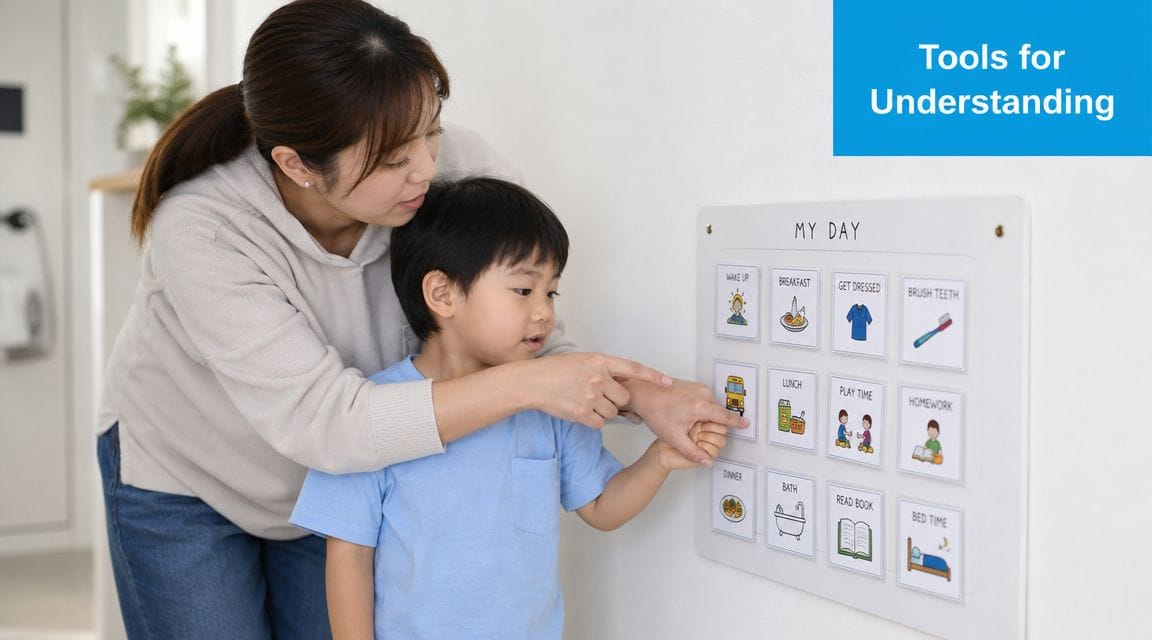
- Create predictable routines. Many autistic children regulate better when they know what's coming next. Use a visual schedule, simple verbal previews, or a consistent order for difficult parts of the day.
- Make communication easier. If your child uses AAC, gestures, scripts, echolalia, or limited verbal speech, treat those as real communication. Slow down. Leave space for response. Don't force speech as proof of understanding.
- Build in sensory relief. A quieter corner, headphones, dimmer lighting, movement breaks, or preferred textures can make home feel safer.
- Offer choices where you can. Acceptance includes autonomy. Small choices about clothes, snacks, order of tasks, or rest breaks can lower stress.
- Use plain language. Short, direct phrases are often easier to process than long explanations, especially during stress.
- Plan for recovery, not just performance. After school, errands, or therapy, many children need decompression before they can handle more demands.
Home reminder: Support doesn't always look like teaching. Sometimes it looks like reducing the load.
Parents often ask whether acceptance means ignoring challenges like meltdowns, shutdowns, or demand avoidance. It doesn't. It means responding in a way that preserves dignity and improves fit. You can still work on coping skills, flexibility, and communication. You're just doing it with your child, not against them.
If you want another practical resource with family-focused strategies, these parenting tips for children with autism offer additional ideas that fit well with an acceptance-based approach.
Using Tools to Put Acceptance into Practice
Acceptance works best when it's specific. Parents usually know their child well, but daily life is busy, patterns blur together, and hard moments can feel random.
That's why tracking can help. It gives you something more solid than memory.
Why tracking matters
One underserved question in this whole conversation is whether acceptance changes real outcomes or mostly changes language. Major autism organizations describe acceptance as requiring concrete system change, not just better wording, and they increasingly point to validated tools to track attitudes and supports over time as a way to see whether acceptance-based changes are working, as noted by Judson Center's discussion of autism acceptance.
For parents, that idea translates well into everyday life. If you change routines, adjust sensory input, or shift how adults communicate, you need a way to see whether those changes are helping.
What to track in real life
Useful tracking doesn't have to be complicated. Focus on patterns that affect participation and regulation.
You might track:
- Sleep and next-day behavior
- Meals, hunger, and food preferences
- Transitions that go well and transitions that fall apart
- Sensory load in places like stores, restaurants, or family events
- Meltdowns, shutdowns, and recovery time
- Which supports helped, such as visuals, movement, quieter spaces, or reduced demands
A pattern might emerge that you couldn't see in the moment. Maybe hard evenings follow long school days with too many transitions. Maybe waiting rooms are manageable when your child has a visual countdown and a quiet activity. Maybe “sudden” meltdowns aren't sudden at all.
This kind of information also makes your advocacy clearer. Instead of saying, “School is hard lately,” you can say, “We're seeing more distress after unpredictable schedule changes,” or “Reduced waiting and plain-language instructions seem to help.”
A short visual walkthrough can make this more concrete:
The primary value of any tracker is that it supports an acceptance mindset. It helps you respond to your child's actual patterns instead of guessing, reacting, or relying on generic advice.
Extending Acceptance to Schools and the Community
Home matters, but your child also needs acceptance in classrooms, clinics, activities, and extended family spaces. Parents often become the bridge between settings.
The most effective advocacy is usually concrete. Instead of telling others to “be more understanding,” describe what support looks like for your child.
Simple ways to advocate clearly
Try language like this:
- For teachers: “My child does better with predictable routines and plain-language directions. If the schedule changes, a short warning helps.”
- For relatives: “He may need a quiet space during visits. That doesn't mean he isn't enjoying being here.”
- For coaches or group leaders: “She may participate differently. Giving her time to watch first often helps.”
- For medical staff: “Waiting is difficult for him. A shorter wait, quieter area, or step-by-step explanation can make the visit go better.”
You can also share what helps regulation:
- Name the support. “Headphones help in noisy spaces.”
- Name the communication preference. “Please give him extra processing time before repeating the question.”
- Name the goal. “We want participation, not forced compliance.”
Acceptance in the community becomes real when other adults know what to do, not just what label your child has.
When families use clear examples, people are often more willing to help because they understand the request. That's especially true when you explain accommodations as access supports rather than special treatment.
If you want one place to organize routines, behavior notes, sleep, food patterns, appointments, and shareable insights for everyone supporting your child, Guiding Growth can help turn acceptance into action. It gives parents a practical way to notice patterns, reduce guesswork, and advocate with more clarity at home, at school, and in the community.