A child with autism is far more likely to have motor coordination difficulties than many parents realize. In one peer-reviewed adult study, 6.9% of adults with autism spectrum conditions reported a dyspraxia diagnosis, compared with 0.8% of adults without autism, and the odds were about 8.7 times higher in the autistic group (study on dyspraxia and autism overlap). That changes the conversation from “my child is just clumsy” to “motor planning may be part of the neurodevelopmental picture.”
For families, that distinction matters. When coordination, handwriting, dressing, sports, or imitation stay hard despite practice, the issue may be more than frustration or low confidence. It may be dyspraxia, an autism-related motor phenotype, or both, and the support plan changes depending on which pattern is present.
Table of Contents
- Why Dyspraxia Matters in Autism Care
- Understanding the Overlap Between Dyspraxia and ASD
- Recognizing Signs and Symptoms in Daily Life
- Navigating Assessment and Diagnosis Pathways
- Evidence-Based Therapies and Everyday Strategies
- Tracking Progress and Identifying Patterns
- Coordinating Care Across Your Support Team
Why Dyspraxia Matters in Autism Care
The numbers alone make motor skills impossible to ignore. The CDC's ADDM Network reported autism in about 1 in 150 children in 2004, 1 in 88 in 2006, 1 in 68 in 2014, 1 in 59 in 2018, 1 in 36 in 2023, and most recently about 1 in 31 children aged 8 years, or 3.2% (CDC autism data). At the same time, dyspraxia in the general child population is commonly estimated around 5% to 6%, so a larger diagnosed autism population naturally includes more children with motor coordination needs.
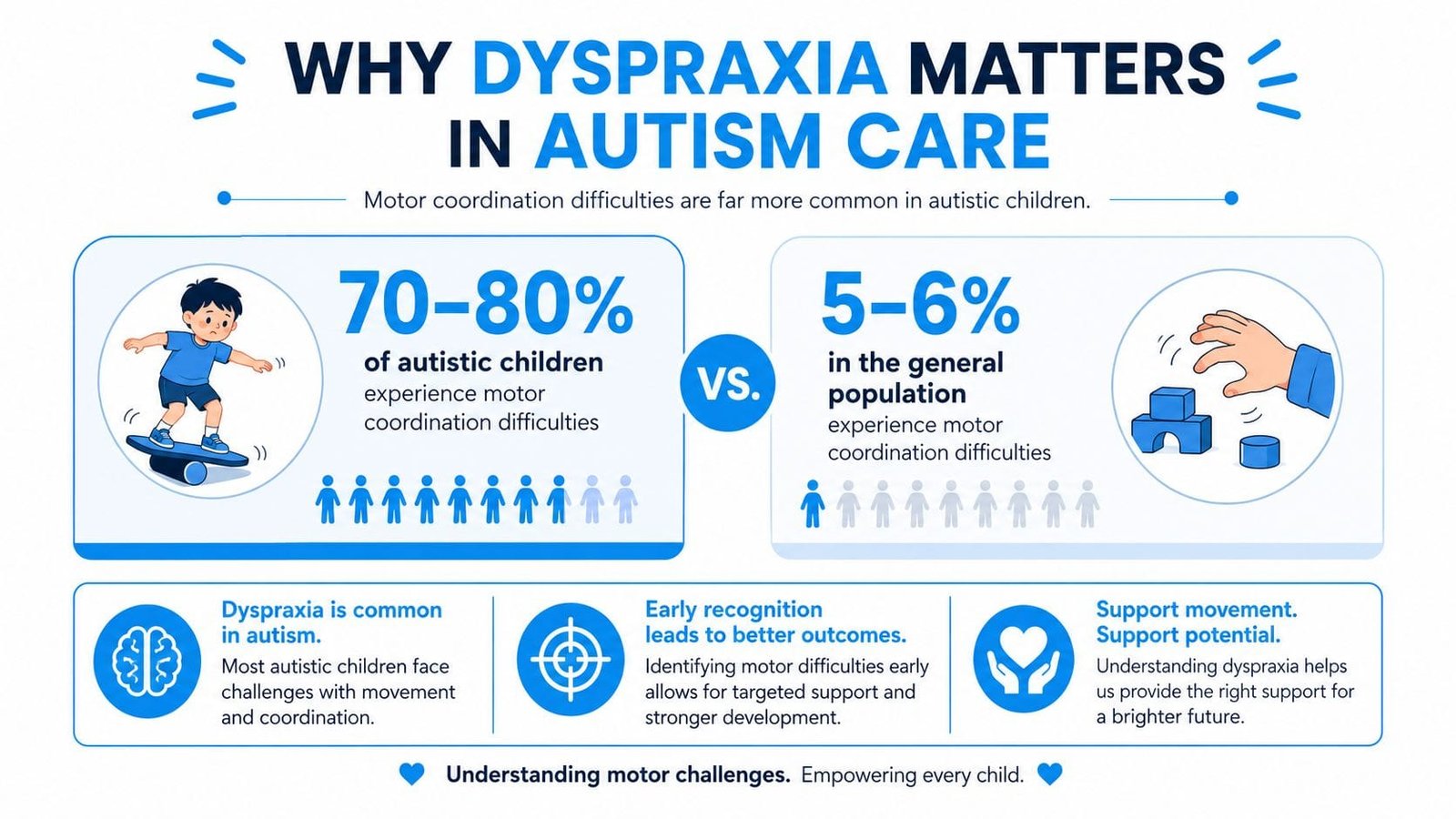
Motor skills shape everyday life
Motor planning affects more than sports. It affects handwriting, getting dressed, using utensils, managing school routines, and joining play with other children. When those skills are hard, children can look unmotivated or avoidant even when they're trying very hard. That misunderstanding often delays support.
Practical rule: if a child needs repeated help for tasks that peers have already automated, treat the motor skill as a support need, not a character flaw.
Dyspraxia has also been described as a hidden or under-recognized condition, which helps explain why families often get vague feedback like “he's a bit clumsy” or “she'll grow out of it.” The better frame is that motor coordination belongs inside the broader autism support plan, not off to the side. That matters because movement challenges can affect confidence, classroom access, and participation in group activities.
The rise in autism identification also changes what clinicians need to look for. As more children receive an autism diagnosis, more children will also show motor coordination problems, sensory-motor planning issues, or developmental coordination disorder features. Families don't need a second explanation that competes with autism. They need a clearer map of how the child moves through daily life.
Understanding the Overlap Between Dyspraxia and ASD
Dyspraxia, also called Developmental Coordination Disorder or DCD, is about motor planning. A child may know exactly what they want to do, but the brain has trouble organizing the sequence, timing, and body position needed to carry it out smoothly. That's different from muscle weakness. The body is willing, but the plan doesn't assemble cleanly.
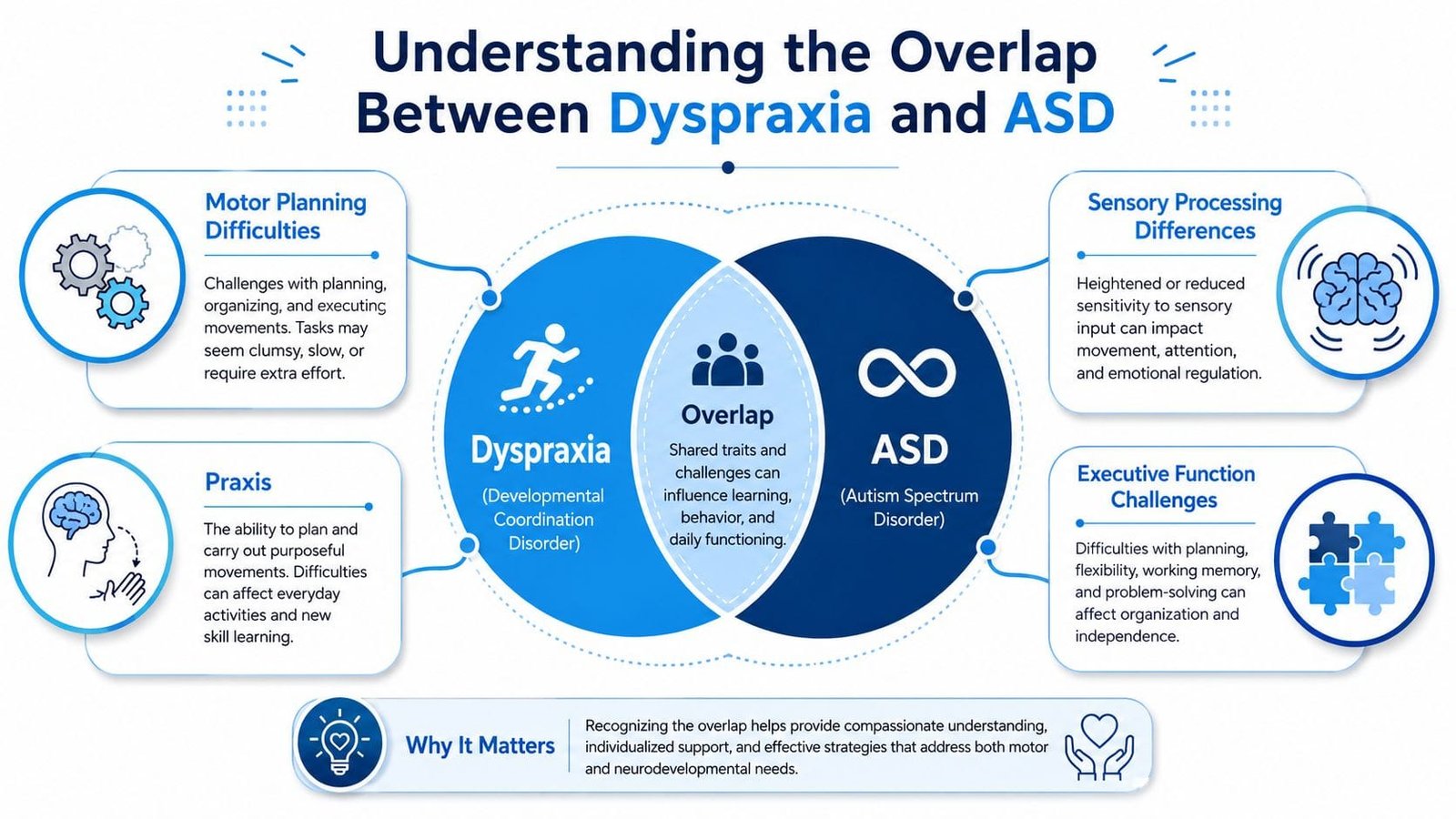
Overlap doesn't mean the same thing
Autism-related motor differences and dyspraxia overlap, but they're not identical. Research on gesture performance found impaired skilled gesture performance in children with ASD, including a 2.6-fold larger performance decrement for simultaneous versus serial gestures in ASD than in controls, and another study concluded that impaired formation of perceptual-motor action models is relatively specific to autism compared with ADHD (motor planning and gesture research). That helps explain why a child may struggle more with copying a sequence of actions than with strength or endurance.
A useful analogy is a recipe. Basic motor control is having the stove and ingredients. Praxis is organizing the recipe in the right order, using the right timing, and adjusting when a step changes. If that planning network is fragile, the child may freeze on multi-step actions, copy movements slowly, or miss pieces of a gesture.
Motor issues in autism often show up as a coordination problem between action, timing, and sensory feedback, not just as “clumsiness.”
Why the distinction matters
Children with ASD can show impaired imitation and complex gesture coordination, while some basic motor control problems can also appear in ADHD. That's why parents often feel confused when they're told the child is “just autistic” or “just clumsy.” The important question is whether the main challenge is motor planning, sensory-motor processing, or both.
If you want a practical overview of that distinction, the article on the autism and clumsiness connection is a helpful companion. It fits the same clinical reality parents see at home, where a child can be bright, verbal, and cooperative, yet still struggle with movements that should have become automatic long ago.
For some families, the answer is not either-or. It's both. When dyspraxia and ASD overlap, intervention needs to target planning, imitation, sequencing, and visual-motor integration, not just “more practice.”
Recognizing Signs and Symptoms in Daily Life
The clearest signs usually show up in ordinary routines, not in a clinic. A child may panic over buttons, avoid zippers, knock over cups, struggle to copy movements in gym class, or need far more time to learn a bike. Those patterns matter more than a single bad day.
What to watch for at home and school
- Dressing tasks: buttons, zippers, shoelaces, and clothing orientation take longer than expected or require constant prompting.
- Schoolwork: handwriting stays messy, slow, or tiring even after lots of practice.
- Play and sports: catching, throwing, balancing, or following a movement sequence looks awkward or inconsistent.
- Self-care: cutlery use, toothbrush control, or getting ready independently seems harder than peers' routines.
- Copying movements: gestures, dance steps, PE drills, or classroom motions break down when there are several steps.
The pattern matters. A child who avoids handwriting because it hurts their hand is different from a child who avoids it because the social setting feels overwhelming. Some children have both experiences at once, and that's where careful observation helps. Parents often notice that performance varies by setting, with worse coordination when the room is noisy, rushed, or socially demanding.
When to take it seriously
If the same skill keeps failing despite practice, that's a clue. If a child can explain the task but can't organize the movement, that points toward a motor planning issue rather than a lack of understanding. Teachers may see this first in PE, art, classroom copying, or timed work.
For some children, the stress of visible mistakes can spill into bigger emotional reactions. That can look like avoidance, tears, or shutdowns in social settings, especially when a child already feels watched. If you're also trying to understand why social situations can feel so intense, why social situations trigger anxiety is a useful lens for seeing how motor embarrassment and social stress can reinforce each other.
The practical test is simple. If the skill is hard across settings, over time, and despite teaching, it deserves professional attention.
Navigating Assessment and Diagnosis Pathways
A good assessment doesn't start with a label. It starts with a question: what exactly is breaking down, planning, coordination, imitation, sensory processing, or all of the above? That's why the right team often includes an occupational therapist, a developmental pediatrician, a neurologist, and sometimes an educational psychologist.
What parents can expect
The evaluation usually looks at developmental history, fine and gross motor tasks, and how the child manages daily activities. Clinicians may ask about dressing, handwriting, balance, sports, and copying movement. They're trying to separate a general skill delay from a more specific praxis problem.
A recent survey of child neurologists found many were not confident that motor impairments are an associated feature of ASD, did not routinely evaluate them, and lacked sufficient tools and training (clinical evaluation gap). That's one reason families can leave appointments without clear answers. The issue isn't always that the concern isn't real. Sometimes it just isn't being measured.
Language that helps in appointments
Use this phrasing: “My child understands the task, but the movement falls apart when it needs planning, sequencing, or imitation.”
That wording helps separate motor planning from behavior, defiance, or general inattention. It also gives clinicians a concrete reason to look beyond the autism diagnosis and check for dyspraxia or coordination difficulties.
For families preparing for autism-related evaluations, the process described in preparing for your first ABA appointment can also help you organize observations and questions before you walk into a clinic.
If you're still trying to understand who can make what diagnosis, the guide on who can diagnose autism is worth reading before you schedule the next visit. That kind of clarity matters, because the right referral can save months of circular conversations.
Evidence-Based Therapies and Everyday Strategies
Motor support works best when it targets planning, sequencing, and real-world participation, not just strength. A child who can do isolated exercises in therapy but still can't manage shoes, lunch packaging, or PE needs a broader plan. That's why occupational therapy often focuses on task analysis, visual supports, and repeated practice in meaningful routines.
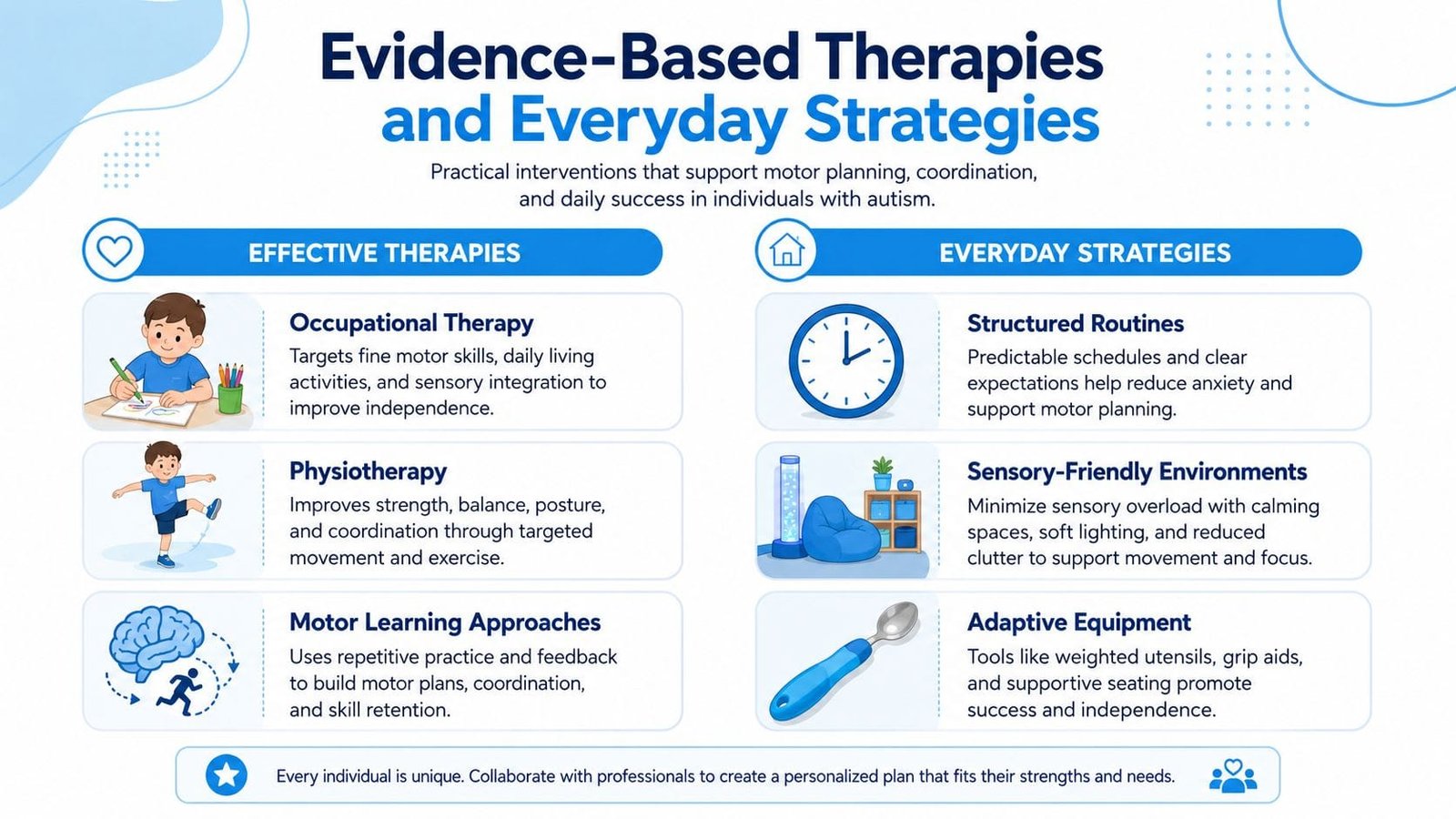
What tends to help
Occupational therapy can break a task into smaller parts, then teach those parts in a consistent order. Physiotherapy can support balance, coordination, and body awareness when gross motor skills are affected. Motor learning approaches matter because the goal is not just repetition, it's building a plan the child can reuse in daily life.
School accommodations matter too. A child may need extra time for written work, typing instead of long handwriting tasks, fewer copied notes, or a movement break before demanding fine motor work. These aren't special favors. They reduce the motor load so the child can show what they know.
Everyday support at home
- Break tasks down: Shoe tying becomes one step at a time, not a whole morning battle.
- Use visuals: Picture cues or a simple checklist can reduce the memory load of multi-step routines.
- Make the environment calmer: Less noise and clutter can make movement planning easier.
- Choose tools strategically: Adaptive cutlery, grips, or clothing with easier fasteners can lower daily friction.
- Practice in real context: Rehearse the exact routine your child needs, not just a similar exercise.
For families working on dressing independence, task analysis for tying a shoe is a strong example of how to turn a hard skill into small, teachable actions.
A practical way to judge progress is to look at daily life, not just clinic performance. Is the child faster, less upset, or more independent during the routine that used to fail? That's the outcome that matters most.
Guiding Growth is one option families use to log routines, behaviors, and therapy notes in one place, with voice logging and shared updates for caregivers and professionals. Tools like that can make it easier to compare what happens on therapy days versus school days, or when a task is introduced with visual support versus without it.
Tracking Progress and Identifying Patterns
One parent I worked with thought the mornings were “randomly bad.” After a few weeks of structured notes, a pattern emerged. The hardest dressing days followed poor sleep, rushed transitions, and a noisy breakfast table, which meant the issue wasn't just the shoe laces. It was the whole chain around them.
What to record
Track the task, the setting, the trigger, the response, and the outcome. Write down whether the child was tired, anxious, hungry, or already overloaded before the struggle started. That gives you a better picture than a simple note that says “had a meltdown.”
You can also look for what helps. Maybe the child does better with visual steps, more time, or a quiet room. Maybe the same skill fails in the classroom but works at home because the pace is slower. Those details help therapists and teachers adjust support without guessing.
How structured logging changes the conversation
When observations are scattered across sticky notes, texts, and memory, patterns stay hidden. When they're organized, you can start seeing whether handwriting frustration rises after a poor night, or whether self-care tasks break down during busy afternoons. That's the kind of information that changes decisions.
The best tracking doesn't just record what went wrong. It shows what made the task possible.
Guiding Growth fits this need because it lets parents log behaviors with context, capture routines like sleep and appointments, and share updates with other caregivers. The value isn't in collecting data for its own sake. It's in making the child's motor profile visible enough to guide real changes at home and at school.
This approach also helps you speak more clearly in appointments. Instead of saying “he's always clumsy,” you can say “he has the most trouble with multistep tasks after poor sleep, and he improves when we slow the sequence and use pictures.” That kind of detail gives clinicians something concrete to work with.
Coordinating Care Across Your Support Team
Motor support falls apart when every adult works from a different version of the problem. The teacher sees handwriting fatigue, the therapist sees motor planning strain, and the pediatrician hears “clumsy,” but nobody connects the dots. Coordination keeps those observations aligned so the child isn't starting over in every setting.
Keep goals shared and simple
The same target should show up in school, therapy, and home routines. If the goal is zipper independence, the teacher can note whether the child can manage coat changes, the therapist can work on sequencing, and the parent can log what happens at home before school. That consistency matters more than adding more goals.
Meetings go better when you bring specific examples. A short summary of recent patterns, what's been tried, and what changed is far more useful than a long story told from memory. It also helps everyone decide whether the concern is motor planning, sensory overload, or a broader daily living issue.
If your child also has healthcare needs outside autism care, the same coordination logic applies. Families looking for an autism friendly dentist Tampa resource often discover that routine sensory and motor accommodations matter just as much in medical settings as they do in school.
Make coordination routine
Use one shared system: when parents, therapists, and teachers see the same notes, they can stop repeating the same questions and start adjusting the plan.
That's why ongoing tracking and communication matter. Not every week will look the same, and a one-time meeting won't capture changing needs across fatigue, growth, or school demands. A shared record turns care into a process instead of a guessing game.
If your family wants a simpler way to keep observations, routines, and updates in one place, Guiding Growth can help you organize what's happening, spot patterns, and share them with the adults who support your child.