You remember the crackers, half a banana, and the yogurt pouch. You remember that dinner ended in tears, but you can't reconstruct when the distress began, how much was eaten, whether the room was noisy, or who was present. A useful nutrition log example doesn't ask you to document every detail forever. It gives you a focused way to answer one practical question, such as whether a symptom follows a food, whether a child's accepted range is shrinking, or which mealtime conditions support eating.
The seven templates below focus on reactions, restriction, medication timing, behavior patterns, sensory conditions, nutritional adequacy, and demand avoidance. A correlation can guide a conversation, but it isn't a diagnosis or proof that a food caused a behavior. Guiding Growth can bring voice logging, meal details, behavior context, medication records, and caregiver collaboration into one timeline. Families exploring related routines can also browse ADHD nutrition plans for additional planning context.
Table of Contents
- 1. Food Sensitivity & Allergy Tracking Log
- 2. Selective Eating & Restricted Diet Log
- 3. Medication & Nutrient Interaction Log
- 4. Behavioral Pattern & Food Mood Correlation Log
- 5. Sensory-Friendly Meal Preparation & Acceptance Log
- 6. Nutritional Adequacy & Supplementation Tracking Log
- 7. Mealtime Routine & Demand Avoidance Pattern Log
- 7 Nutrition Log Types Compared
- Build a Log That Supports Better Decisions
1. Food Sensitivity & Allergy Tracking Log
When a child's mood, digestion, skin, or behavior changes after meals, memory alone rarely gives you enough detail to identify a reliable pattern. A focused reaction log records the food, the amount, the timing, and what happened afterward without assuming that every difficult episode came from the meal.
Use fields such as:
- Date and time: Record when the food was eaten and when symptoms appeared.
- Food and ingredients: Include brand, preparation, sauces, dyes, and mixed ingredients where known.
- Portion: Use a practical description such as “two bites,” “half pouch,” or “one small bowl.”
- Response: Note physical symptoms, mood, irritability, anxiety, sleepiness, bowel changes, or behavior.
- Intensity and duration: Describe whether the response was mild, moderate, or severe, and how long it lasted.
- Other context: Add sleep, illness, medication, pain, activity, and sensory stress.
A real-world entry might read: “2:10 p.m., fruit drink with red coloring, several sips. At 3:25 p.m., increased irritability and pacing during a busy afternoon. Poor sleep the night before.” That record is more useful than “bad behavior after a drink,” because it preserves competing explanations.
Safety boundary: A log can help organize observations, but suspected allergic reactions require medical guidance. Don't deliberately reintroduce a food that has caused a potentially serious reaction without direction from a qualified clinician.
Voice logging in Guiding Growth lets a caregiver capture the meal and response without stopping to type. Tags for meal type and ingredient categories make later review easier, while a photo can preserve the serving size and presentation. The app's nutrition and behavior records can be viewed together, and focused entries can be shared with a healthcare professional. For additional background, see this guide to identifying food sensitivities and consult professional advice about food allergy testing.
2. Selective Eating & Restricted Diet Log
A selective eating log should record what was offered, what was accepted, and the exact features that made the food tolerable. “Ate pasta” leaves out the details that may determine whether the same meal works tomorrow, such as brand, shape, temperature, sauce, and texture.
Food selectivity is common in autistic children, with reported estimates ranging from 46% to 89% in one systematic literature review (Norwegian medical journal review). That range varies by study design, so it shouldn't be used to predict an individual child. It does show why accepted foods and refusals deserve equal space in the record.
Fields that reveal the acceptance rules
Record the food name, brand, color, texture, temperature, shape, preparation method, portion offered, portion eaten, and response. Add the child's mood before the meal, time of day, location, and who was present. For a new-food trial, include whether the child tolerated seeing, touching, smelling, tasting, or swallowing the food. Those stages matter because “refused” can describe very different experiences.
A useful entry could say: “Cold plain pasta, specific brand, smooth texture, offered in a divided tray. Child touched one piece and ate two. Accepted while watching a familiar program. Declined the same pasta when warm and mixed with sauce.” The record supports gradual adaptation without labeling the child difficult.
Guiding Growth can use custom tags such as Crunchy Beige or Cold Smooth, helping caregivers describe a sensory profile in terms that fit the child. Alma AI, the app's autism parenting companion, can provide feeding strategy suggestions based on logged preferences and responses. Photos help preserve exact presentation, and secure sharing gives feeding therapists and nutritionists access to the accepted-food list and introduction history.

3. Medication & Nutrient Interaction Log
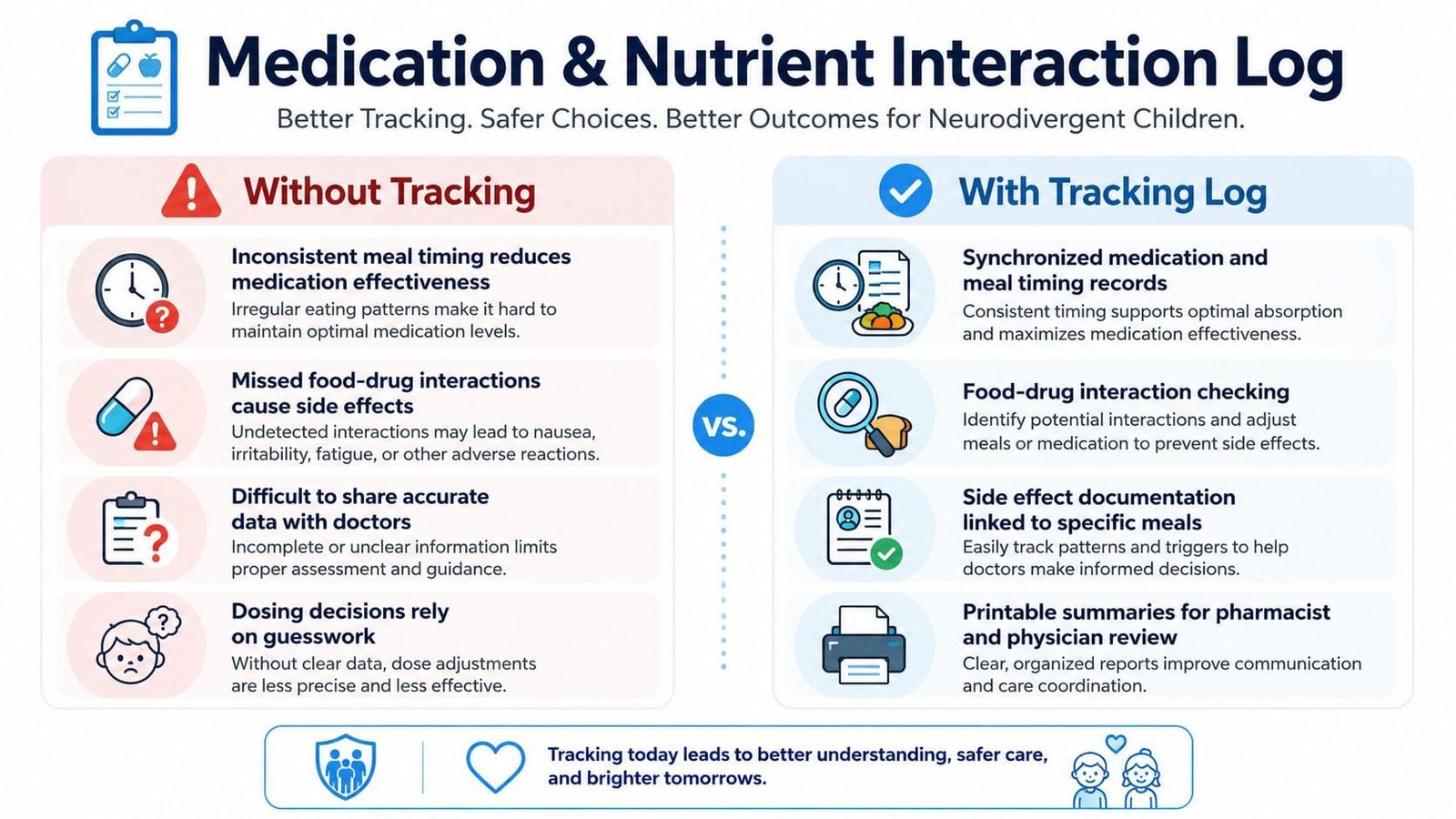
A meal can look adequate on paper and still be poorly timed for a child's medication routine. This log places food, medication, appetite, supplements, and side effects on the same timeline, so a prescribing clinician can see what happened rather than relying on a caregiver's difficult-to-reconstruct memory.
Start with these fields:
- Medication name and dose: Record the prescribed details exactly as directed.
- Administration time: Note whether the medicine was taken before, during, or after food.
- Associated meal: Record the food, portion, and whether the child finished it.
- Appetite and symptoms: Include nausea, stomach discomfort, fatigue, appetite change, or sleep effects.
- Supplements: Record the product, amount, and time, without changing it independently.
- Relevant context: Add illness, poor sleep, missed doses, or unusual stress.
For example, a child taking stimulant medication might eat breakfast but show little interest in lunch. The log should not declare that the medication caused the appetite change. Instead, it can show breakfast time, medication time, lunch intake, afternoon energy, and the pattern that repeats across entries. That gives the prescribing physician or pharmacist a clearer basis for discussion.
Ask before changing anything: Food and medication interactions depend on the specific medicine, dose, formulation, and child. A nutrition log supports clinical review. It doesn't replace prescribing advice.
Guiding Growth can centralize medication reminders and the meals associated with them. A caregiver can use voice logging to capture timing in real time, then connect appetite or side-effect observations to the medication record. Medication adherence monitoring in Guiding Growth can help keep those details together for an appointment or care-team review. Ask the child's pharmacist about any specific food, supplement, or absorption concern before creating custom tags for it.
4. Behavioral Pattern & Food Mood Correlation Log
A behavior log becomes more useful when it describes the meal and the child's experience without reducing behavior to a food reaction. Record the food, time, amount, behavior, sensory response, demand level, sleep, and activity. The aim is to compare repeated situations, not to find a single culprit after one difficult afternoon.
A 2016 smartphone diet-tracking study recorded adherence over 56 days at 53%, 61%, and 69% across three app groups, and its authors noted that monitoring on more than 60% of days may matter for behavior change (study in PubMed Central). The practical lesson is not that every family must track perfectly. It's that a log needs to be quick enough to repeat. A short entry made consistently can be more informative than an elaborate record abandoned after a few meals.
A balanced entry
“12:30 p.m., chicken, rice, and cucumber. Ate rice and some chicken. At 2:00 p.m., covered ears and shut down during a noisy transition. Slept poorly. No clear food-specific response.” This entry protects against confirmation bias because it records both the suspected food context and other plausible contributors.
Guiding Growth's voice logging can capture observations while the caregiver stays present with the child. Custom behavior tags such as shutdown, meltdown, hyperfocus, anxiety spiral, or happy stim can match the child's actual presentation. A unified timeline can help families review meals and behaviors together, while visualizations support a weekly pattern review. Share a focused summary with a therapist, school staff member, or healthcare provider rather than sending an overwhelming stream of raw notes.
5. Sensory-Friendly Meal Preparation & Acceptance Log
Sometimes the food isn't the only variable. Lighting, noise, seating, plate color, utensil, arrangement, temperature, smell, and texture can determine whether a child can approach a meal. A sensory acceptance log makes those conditions visible to every caregiver, including people who weren't present when a meal succeeded.
Record:
- Food qualities: Texture, temperature, smell, color, shape, and preparation.
- Presentation: Plate color, arrangement, portion size, separation of foods, and utensils.
- Environment: Room, lighting, noise, seating, and people present.
- Child response: Looked at, touched, smelled, tasted, swallowed, accepted, or refused.
- Afterward: Signs of enjoyment, distress, fatigue, or recovery time.
A sample entry might say: “Steamed carrot coins on a white plate, arranged separately from preferred toast. Quiet room, soft lighting, one caregiver present. Child touched and ate one coin. Refused when foods were mixed.” That observation can guide the next attempt without turning the meal into a test.
A photo is especially valuable here because words like “neat” or “separate” mean different things to different adults. Guiding Growth's photo feature can preserve successful plate arrangements, serving temperatures, portion sizes, and utensil choices. Voice notes can capture comments such as “smooth texture accepted” or “crunching sound caused distress.” Sharing the visual format with school staff and other caregivers supports consistency across settings.
A short demonstration can also help caregivers think about how presentation changes the eating experience.
Review the log for conditions that make eating possible, not only foods that are refused. That shift often produces more actionable next steps.

6. Nutritional Adequacy & Supplementation Tracking Log
A child can grow within expected patterns and still have nutritional risk. In an autism cohort involving a 3-day food diary, parents recorded all foods and beverages, dietitians verified entries, and nutrient software analyzed intake. The children could have normal growth while remaining at significant nutritional risk, which is why food type, portion, timing, context, and acceptability matter alongside weight and growth measures (cohort study on feeding disorder).
This template works best when a pediatric dietitian or clinician defines the relevant nutrition questions. Record the food group, food, portion, preparation, supplement, time, acceptance, and symptoms. A weekly diary can help capture accepted categories across fruits, vegetables, legumes, meat and dairy, and grains or cereals, an approach recommended in a clinical review of feeding selectivity (review in Nutrients).
What to track without overloading the caregiver
- Daily intake: Include foods and beverages, not just meals that look balanced.
- Supplements: Record product, amount, time, and whether it was tolerated.
- Observable health context: Note energy, bowel patterns, skin or hair changes, and clinician-monitored growth.
- Professional targets: Add only nutrient targets that the child's care team has identified as relevant.
Avoid calculating nutrient totals from memory or starting supplements because a log looks incomplete. The record can identify a question, such as consistently low variety in a food group, but a clinician should interpret the finding and recommend testing, supplementation, or food changes.
Guiding Growth can support barcode or voice-based food entry, scheduled adequacy check-ins, and reports for pediatric review. Keep the app record alongside, rather than instead of, clinical measurements and professional recommendations.
7. Mealtime Routine & Demand Avoidance Pattern Log
A child may refuse a meal because the food is unacceptable. Another child may refuse because eating has become a direct demand, especially when anxiety, loss of control, or previous pressure is part of the context. This log records how the meal was offered, not merely whether the child ate.
Food selectivity research supports recording offered foods and refusals. In a 2010 study, children with autism refused 41.7% of foods offered compared with 18.9% among typically developing children, while 63% of children with autism were described as eating a restricted range (study in PubMed Central). Those figures describe groups, not an individual child. For a family, the practical value is the ability to distinguish a food problem from a presentation or autonomy problem.
Use fields for:
- Before the meal: Hunger cues, anxiety, fatigue, pain, and transitions.
- Offer wording: Write the exact phrase, tone, proximity, and number of prompts.
- Demand signals: Note whether the child was told to sit, taste, finish, or discuss hunger.
- Strategy: Choice-based, indirect offer, social eating, neutral availability, or autonomy-first.
- Outcome: Food approached, touched, eaten, refused, or followed by distress.
- Recovery: Record what helped the child regulate afterward.
A useful entry might read: “Meal placed within reach without comment. Child chose toast, ignored eggs, and remained at the table briefly. Direct prompting led to leaving the room on a previous occasion.” The log supports a lower-pressure approach without treating acceptance as obedience.
Guiding Growth can capture the exact language used through voice logging, track pre-meal emotion, and tag strategies for comparison. Its sharing tools can help caregivers, therapists, and school teams use consistent approaches. Families can also review autism PDA strategies for additional context, while remembering that individualized support should come from professionals familiar with the child.
7 Nutrition Log Types Compared
| Log / Template | Implementation Complexity (🔄) | Resource Requirements (⚡) | Expected Outcomes & Impact (⭐📊) | Ideal Use Cases (💡) | Key Advantages (⭐) | Quick Tips (💡) |
|---|---|---|---|---|---|---|
| Food Sensitivity & Allergy Tracking Log | 🔄 Moderate, consistent, detailed entries | ⚡ Medium, time + observation; voice/photo speeds entry | ⭐📊 High, reveals hidden sensitivities; reduces behavior episodes | Children with GI issues or suspected food triggers | Identifies non-obvious triggers; supports clinician collaboration | Use voice logging; tag ingredients; sync with behavior logs |
| Selective Eating & Restricted Diet Log | 🔄 Moderate–High, structured categories & long-term tracking | ⚡ High, repeated food trials, patience over months | ⭐📊 Moderate–High, gradual diet expansion; better meal planning | Highly restrictive eaters; sensory-based preferences | Validates preferences; supports feeding therapy; documents progress | Create custom tags (texture/color); log brands; record environment |
| Medication & Nutrient Interaction Log | 🔄 High, time-sensitive and clinically informed logging | ⚡ Medium, requires reminders and clinician input | ⭐📊 High, optimizes medication efficacy; reduces side effects | Children on meds with known food-drug interactions | Syncs meds/meals; interaction checks; printable clinician reports | Set med reminders; log meal timing; consult pharmacist for tags |
| Behavioral Pattern & Food Mood Correlation Log | 🔄 High, frequent post-meal observations (e.g., 30‑min) | ⚡ High, sustained observation; AI visualization helps | ⭐📊 High, uncovers food-behavior links; guides interventions | Behavior influenced by blood sugar, textures, or ingredients | Reveals subtle correlations; aids therapists and families | Use unified timeline; custom behavior tags; review weekly |
| Sensory-Friendly Meal Preparation & Acceptance Log | 🔄 Moderate, documents prep, presentation, environment | ⚡ Medium, photo library and templates speed replication | ⭐📊 Moderate, improves acceptance by modifying presentation | Sensory-sensitive eaters where presentation matters | Identifies presentation factors; reduces mealtime stress | Capture photos of successful plates; create shareable templates |
| Nutritional Adequacy & Supplementation Tracking Log | 🔄 High, nutrient calculations and RDA comparisons | ⚡ High, food database, nutritionist input, barcode/voice tools | ⭐📊 High, detects deficiencies; guides supplementation | Restricted diets; growth or deficiency concerns | Automated nutrient tracking; clinician-ready reports | Work with a nutritionist; use barcode/voice logging; run periodic reports |
| Mealtime Routine & Demand Avoidance Pattern Log | 🔄 Moderate, context-rich logging of presentation & response | ⚡ Medium, consistent context and phrasing records | ⭐📊 High, reduces conflict; reveals demand-avoidance triggers | PDA/demand-avoidant children; mealtime anxiety/refusal | Guides low-demand approaches; aligns caregiver strategies | Log exact phrasing and strategy; tag approaches; share playbook |
Build a Log That Supports Better Decisions
Choose the template according to the question that needs an answer now. If you're concerned about a physical response, start with the reaction log. If the diet is narrowing, use the selective eating template. If appetite changes around medication, record timing. If the main difficulty appears during transitions, noise, lighting, or direct prompting, the sensory or demand-avoidance template may be more useful than a calorie-focused diary.
Start with the smallest useful set of fields. Food, amount, time, setting, and outcome are usually a workable foundation. Add brand, texture, preparation, medication timing, mood, or behavior only when those details relate to the question you're investigating. A record that takes too long to complete won't support consistent observation, especially during school handoffs, therapy appointments, or a difficult evening.
A 2008 PubMed study found that food diaries predicted weighted energy intake within ±17% for 70% of individuals, and concluded that diaries can help measure intake, identify undernutrition risk, and monitor nutritional support (study on dietary intake recording). The finding supports careful, consistent logging, but it doesn't make a home diary perfectly accurate. Portion estimates, forgotten bites, shared foods, and stressful meals can all limit interpretation.
Review entries across multiple occasions and record refusals as carefully as accepted foods. A review of autistic youth reported food selectivity at 62%, restricted variety at 72%, and food refusal at 57% in studies without comparison groups, while another sample of 1,462 youth reported atypical eating behaviors in 70.4% of autistic children (feeding and eating problems review). These findings explain why offered food, exact brand, texture, preparation, and setting can matter. They don't prove that a specific child's behavior has a single nutritional cause.
Guiding Growth can reduce scattered documentation by bringing voice-logged meals, photographed food, behavior observations, sensory conditions, supplements, medications, and caregiver collaboration into one place. Use the resulting summary to support a conversation with a pediatrician, dietitian, feeding therapist, pharmacist, or school team. For meal ideas that fit your family's broader planning needs, you can also explore this cookbook resource blog.
The best nutrition log is not the longest one. It's the record you can maintain, understand, and use to make the next decision less uncertain.
Guiding Growth combines quick voice logging, nutrition details, behavior context, medication timing, sensory observations, and caregiver sharing for neurodivergent family routines. Visit Guiding Growth to turn scattered mealtime notes into focused information you can review with the people supporting your child.