DSM-5 replaced five separate pervasive developmental disorder diagnoses with one autism spectrum disorder diagnosis, consolidated symptom domains from three to two, and added sensory reactivity. That means historical DSM-IV labels aren't interchangeable with current diagnoses unless the underlying symptoms are reviewed.
You may be holding an old evaluation that says autistic disorder, Asperger disorder, or PDD-NOS, while a school team or clinician now uses only “autism spectrum disorder.” The label changed, but the document still contains useful developmental history. The practical question is not merely, “Which diagnosis is correct?” It's, “What does this history tell us about the support this child needs today?”
That distinction matters at a pediatric appointment, during an IEP review, and when a specialist asks why a child struggles with transitions, communication, sensory input, or daily routines. A historical diagnosis can open the conversation, but current observations should guide support planning.
| DSM-IV framework | DSM-5 framework |
|---|---|
| Five pervasive developmental disorder diagnoses | One autism spectrum disorder diagnosis |
| Three symptom domains | Two symptom domains |
| Autistic disorder, Asperger disorder, PDD-NOS, childhood disintegrative disorder, and Rett syndrome | Autism spectrum disorder encompasses the principal autism-related categories, while historical records retain their original labels |
| Restricted and repetitive behavior criteria did not formally include sensory reactivity as its own type | Sensory hyperreactivity or hyporeactivity is included within restricted or repetitive behaviors |
| Developmental delay or abnormal functioning had to be evident before age 3 for autistic disorder | Symptoms may be supported by current or historical evidence within the developmental framework |
The comparison reflects the historical DSM-IV structure and the DSM-5 changes described by the American Psychiatric Association's DSM criteria overview.
Table of Contents
- Understanding the DSM-IV Autism Framework
- How DSM-5 Changed the Diagnostic Picture
- Evaluating Diagnostic Sensitivity and Specificity Trade-offs
- Interpreting an Old DSM-IV Autism Diagnosis Today
- Turning Historical Criteria Into Actionable Family Evidence
- Preparing for Evaluations and School Reviews with Data
- Recognizing Cultural, Linguistic, and Camouflaging Factors
Understanding the DSM-IV Autism Framework
A parent brings an evaluation from childhood to a meeting. The report uses language such as “autistic disorder,” lists social and communication findings, and refers to behavior that seems familiar today. Yet the school psychologist uses “ASD,” and nobody explains whether the old diagnosis still counts. That confusion is common because DSM-IV was a classification system with separate boxes, not a single spectrum diagnosis.
Published by the American Psychiatric Association in 1994, DSM-IV placed autism-related conditions under pervasive developmental disorders, or PDDs. It recognized five diagnoses: autistic disorder, Asperger disorder, childhood disintegrative disorder, Rett syndrome, and pervasive developmental disorder not otherwise specified, commonly called PDD-NOS. DSM-IV-TR appeared in 2000 and retained this basic structure until DSM-5 changed it in 2013. These historical details are summarized in a clinical review of the transition from DSM-IV to DSM-5. Read the review of the diagnostic shift.
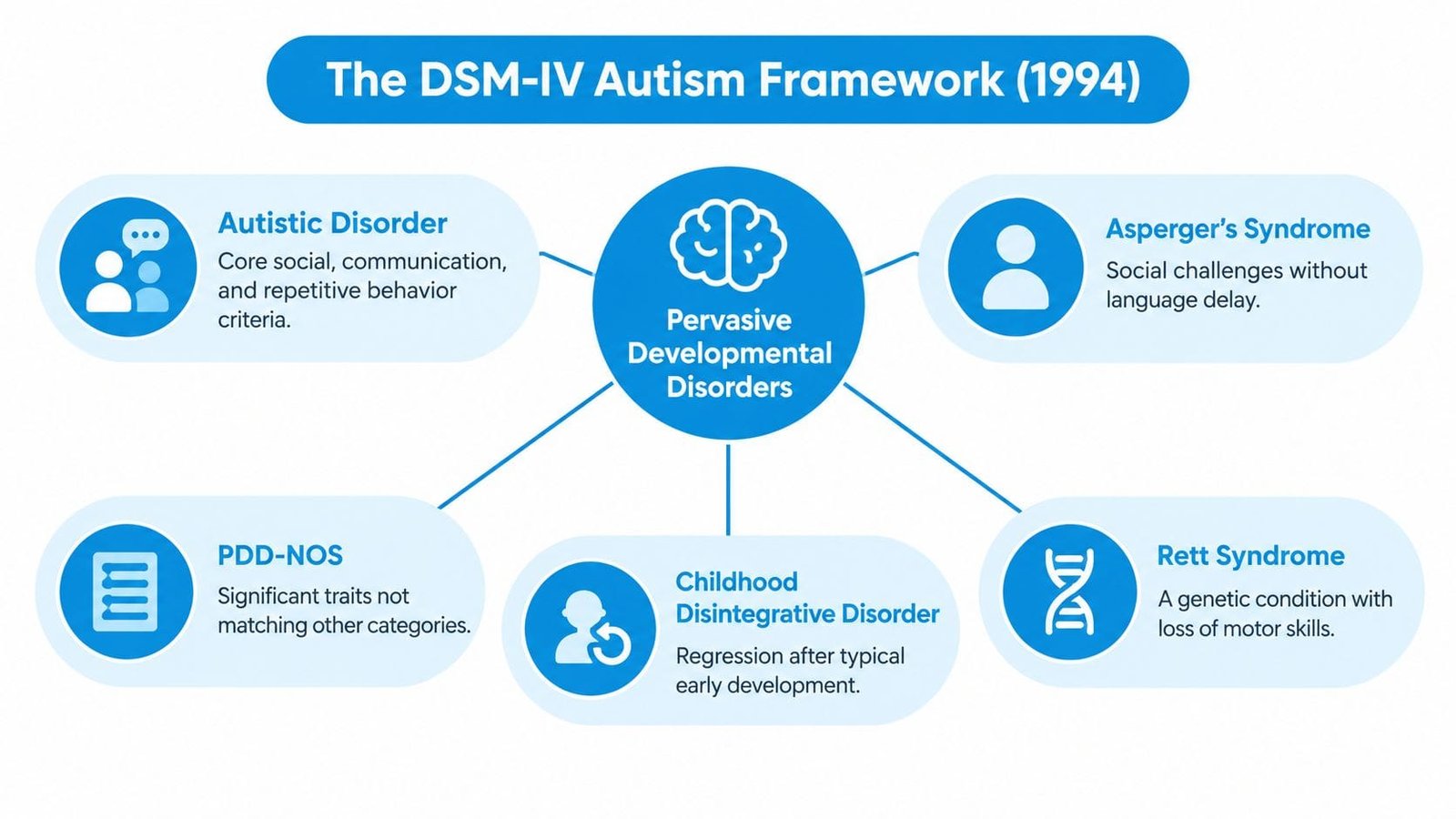
What autistic disorder required
Under DSM-IV-TR, autistic disorder required at least six symptoms from twelve possible criteria. Those criteria came from three domains:
- Social interaction: difficulties such as limited eye contact or gestures, trouble developing peer relationships, or reduced social reciprocity.
- Communication: delayed or absent spoken language, difficulty sustaining conversation, or unusual communication patterns.
- Restricted or repetitive behavior: repetitive movements, inflexible routines, or unusually intense interests.
The threshold also required a particular distribution. At least two symptoms had to involve social interaction, at least one had to involve communication, and at least one had to involve restricted or repetitive behavior. The child also needed evidence of developmental delay or abnormal functioning before age 3 in social interaction, language used for social communication, or symbolic or imaginative play. The original criteria are reproduced in an accessible clinical reference from Cambridge University Press. Review the DSM-IV-TR criteria details.
That structure explains why an old report may appear more specific than a current one. It records which domain supplied each symptom and whether the developmental history met the early-onset requirement. When families are gathering confidential treatment and evaluations, they should preserve the original report instead of replacing it with a newer summary.
Why the old subtype matters, but isn't enough
A diagnosis of Asperger disorder, for example, communicated something about the criteria the clinician used at that time. PDD-NOS indicated that clinically significant traits were present but the overall pattern did not fit the narrower categories in the same way. Neither label, however, tells a school team exactly how a child handles a noisy cafeteria, an unexpected schedule change, group work, sleep disruption, or a demanding communication task today.
Keep the report as historical evidence. Then add present-day observations that show what happens, where it happens, how often it occurs, and what support changes the outcome.
How DSM-5 Changed the Diagnostic Picture
At a school meeting, a parent may bring an old Asperger's disorder report while the team uses current autism terminology. The apparent mismatch does not mean the earlier evaluation was meaningless. DSM-5 reorganized the categories in 2013, bringing autistic disorder, Asperger's disorder, childhood disintegrative disorder, and PDD-NOS under one autism spectrum disorder diagnosis. The historical label still identifies the framework used during the original assessment.
The symptom model changed as well. DSM-IV assessed three domains separately. DSM-5 groups social interaction and communication into one domain, social communication and interaction, and pairs it with restricted or repetitive patterns of behavior, interests, or activities. Clinicians consider social-emotional reciprocity, nonverbal communication, and relationships in the first domain. The second includes repetitive movements or speech, insistence on sameness, highly focused interests, and unusual sensory responses.
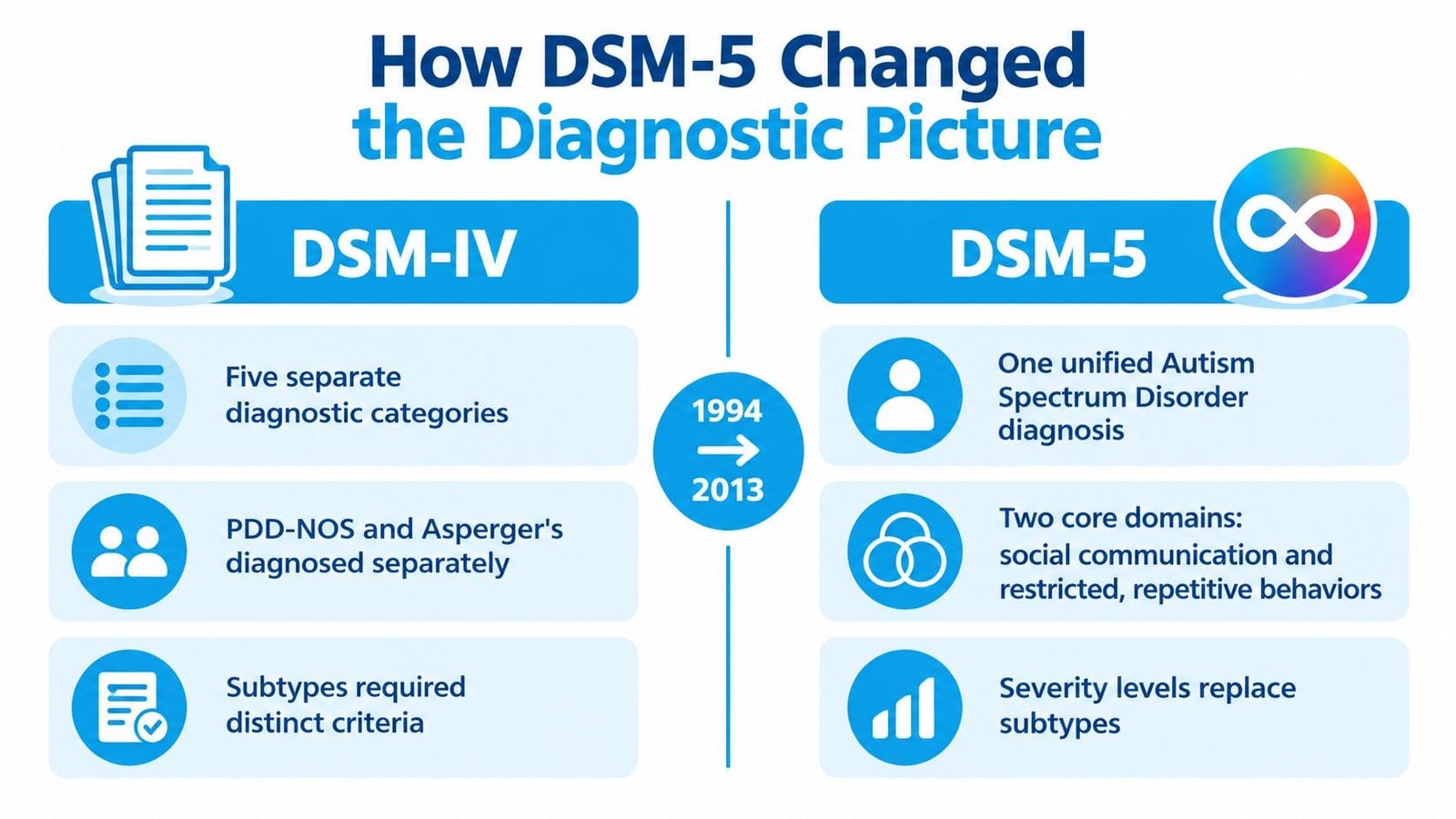
A useful way to read the shift is to compare what each framework asks a clinician to assemble:
- DSM-IV used three domains. Social interaction, communication, and restricted or repetitive behavior were reviewed separately.
- DSM-5 combines social interaction and communication. Evidence must cover all three social-communication areas.
- DSM-5 requires at least two of four restricted or repetitive behavior types. Sensory hyperreactivity or hyporeactivity is included among those types.
- Delayed language is no longer an independent autism criterion. An autism diagnosis does not require the language-delay profile that often shaped older evaluations.
- Severity and support context carry greater weight. One spectrum diagnosis cannot describe every person's communication, intellectual development, language, or daily assistance needs.
These changes explain why an old diagnosis cannot be converted mechanically into a current support level. Asperger disorder does not automatically describe present functioning, and PDD-NOS does not automatically indicate limited support needs. Families can use this DSM-5 autism checklist for parents to organize questions, while treating it as a discussion prompt rather than a substitute for evaluation.
Sensory responses also become easier to place in the clinical picture. A child may speak clearly in a quiet room, then lose access to communication amid loud sound, crowded movement, bright lighting, or an unexpected texture. Earlier descriptions might mention social difficulty or repetitive behavior without making sensory reactivity a formal criterion.
Daily logging preserves the details that a historical checklist may leave out. Record the setting, trigger, observable response, frequency, and support that changes the outcome. “Doesn't like assemblies” gives limited guidance. “Covers ears, leaves the group, and cannot follow instructions when the room becomes loud” gives educators a starting point for accommodation and gives clinicians concrete evidence to consider with the developmental history.
Evaluating Diagnostic Sensitivity and Specificity Trade-offs
A diagnostic framework can become more specific while still missing some people identified under an earlier framework. That is the central trade-off families should understand when an old DSM-IV diagnosis appears not to map neatly onto a DSM-5 assessment.
One large analysis included 4,453 children with DSM-IV clinical PDD diagnoses and 690 comparison children without PDD. Using parent-report data, DSM-5 criteria identified 91% of DSM-IV PDD cases. In the same analysis, DSM-5 specificity was 0.53 overall, while DSM-IV specificity ranged from 0.24 for PDD-NOS to 0.53 for autistic disorder. When parent report was combined with clinical observation, DSM-5 specificity increased to 0.63. Review the DSM-IV and DSM-5 performance analysis.
Why subgroup results matter
The overall result can hide important differences. In one reviewed sample, sensitivity was approximately 0.76 for autism, 0.25 for Asperger's disorder, and 0.28 for PDD-NOS. Other reviewed studies reported DSM-5 specificity as high as 94.9%, showing that performance varied across samples, methods, and participant groups.
Those figures don't tell a parent whether a particular child is autistic. They do show why a brief conclusion such as “the new criteria didn't confirm the old label” may be inadequate. A child with a prior Asperger disorder or PDD-NOS diagnosis may require careful review of developmental history, current observation, language, intellectual ability, and the information available to the evaluator.
Classification isn't the same as outcome
Diagnosis is a classification variable, not a complete measure of wellbeing, progress, or support success. It tells a clinician how a pattern fits a diagnostic framework. It doesn't measure whether a child can participate in class, communicate pain, sleep consistently, tolerate transitions, eat safely, or recover after overload.
For longitudinal records, preserve:
- The original label and date: Keep the DSM-IV terminology exactly as written.
- The source of evidence: Separate parent report, teacher report, therapy notes, and direct clinical observation.
- The developmental history: Record what was present early and what became visible as demands increased.
- The current functional effect: Describe what the child can do independently, with prompting, or only after environmental changes.
- The context: Note language exposure, setting, sensory conditions, fatigue, and social expectations.
A later evaluation should add to that record rather than erase it. The most useful question is not whether two labels look identical. It's whether the evidence across time explains the child's current needs accurately.
Interpreting an Old DSM-IV Autism Diagnosis Today
A parent brings a DSM-IV report to a school review. The document describes Asperger disorder or PDD-NOS, while the team asks what the child needs in class now. The parent sees a diagnosis that has guided years of care. The school needs current, observable evidence. Both are looking at the same developmental story from different points in time.
DSM-5 changed the diagnostic categories, but it did not erase the experiences recorded in an earlier evaluation. A person with an old DSM-IV diagnosis may meet current criteria for autism spectrum disorder, yet the historical label alone cannot show present support needs or service eligibility. It functions like an old map. It helps explain how the route was first understood, while current observations show where support is needed today.

Read the diagnosis as a starting point
Return to the report and ask what it described. Look for observations about social reciprocity, communication, relationships, repetitive behavior, routines, and restricted interests. Check whether developmental differences were evident before age 3, then compare those findings with what appears at home, school, therapy, and in the community.
A structured daily log can preserve details that an older checklist may not capture. Record what happens during a transition, group activity, noisy period, or unexpected change. Note whether a visual schedule, movement break, communication support, or extra processing time changes the outcome. These details connect the historical criteria to present functioning.
The difference matters because an Asperger disorder label does not specify whether the person now needs help with executive functioning, emotional regulation, sensory overload, or unstructured peer interaction. A PDD-NOS label does not show whether communication strategies are working, or whether rising demands have exceeded them.
Keep the historical diagnosis, but advocate with current examples.
Compare the old description with daily life
Create a two-part record. Copy a relevant observation from the original report on one side. On the other, describe the current pattern and its effect, using dated examples from ordinary routines.
An older report might mention difficulty sustaining conversation. A current entry could show that the child answers direct questions but cannot maintain back-and-forth discussion during group work, especially when the topic is not a preferred interest. An earlier note about insistence on sameness might connect with distress after a substitute teacher, changed bus route, or altered bedtime routine, followed by a prolonged recovery period.
This comparison does not let a family reinterpret the diagnosis independently. It gives a clinician or school team concrete material for deciding whether updated assessment, accommodations, or targeted support is appropriate. The label opens the conversation. Functional evidence keeps the conversation focused.
Turning Historical Criteria Into Actionable Family Evidence
A child's old DSM-IV report may describe “difficulty with transitions” in a few lines. Years later, the family may see the same pattern during a changed bus route, a substitute teacher, or an unexpected appointment. The label preserves a historical description, while a structured daily record shows how that pattern affects participation now.
Start with one recurring situation. Record what happened immediately before the event, what the child did, how long it lasted, who was present, and what helped. Include the child's communication method and conditions that may have shaped the response, such as fatigue, hunger, illness, noise, or a change in routine. A short entry made soon after the event usually gives a clearer picture than trying to reconstruct it before a meeting.
Use observable language. “Defiant” could describe pushing materials away, covering the ears, and moving under a table after the classroom became noisy. “Poor social skills” could become a record that the child approached peers with a preferred topic, did not respond when the subject changed, and left after the interaction stalled.
A practical entry answers six questions in one compact line or form:
- Trigger: What demand, transition, sensory input, interaction, or change came first?
- Behavior: What actions and communication could another person observe?
- Intensity: What does the family's scale, such as calm, noticeable, or severe, mean in practice?
- Duration: When did the event begin, and when did the child return to a workable state?
- Context: Where did it happen, who was there, what activity was underway, and what environmental conditions mattered?
- Response: What did adults try, and did it help, partly help, or make no difference?
This record is a practical bridge between historical criteria and current support planning. It does not ask the family to reinterpret the diagnosis. It gives clinicians and school staff specific examples for considering updated assessment, accommodations, or targeted support.
Before an IEP meeting or specialist appointment, sort entries by the question the team needs to answer. A communication summary can show requests, conversation, nonverbal communication, and repair after misunderstanding. A sensory summary can group sound, clothing, food textures, lighting, and recovery after overload. A transition summary can compare warnings, visual supports, schedule changes, and adult prompts.
Families can also use this guide to organize autism records for evaluations. Bring the original DSM-IV report, current examples, notes from other settings, and questions about the difference between diagnostic interpretation and practical recommendations.
Functional evidence keeps the conversation focused. The strongest advocacy record connects a behavior to its setting, its effect on participation, and a support that can be tested.
Preparing for Evaluations and School Reviews with Data
A parent arrives at a school meeting with an old DSM-IV diagnosis, recent messages from teachers, and several weeks of daily notes. The diagnosis explains part of the child's developmental history. The notes show what participation looks like now, which supports change the outcome, and where school and clinical questions differ.
A diagnostic report asks whether a developmental pattern fit the criteria used at that time. An IEP, accommodation plan, therapy plan, or home support plan asks what adults should change so the child can communicate, learn, and take part. Treat the historical label as a reference point, then build the current discussion around observable needs.
Keep records from home, school, therapy, and community settings. A child may manage a familiar routine at home yet lose access to communication during a medical visit. Another child may struggle mainly during classroom transitions. These differences help a team distinguish a broad support need from a barrier tied to a particular environment.

Build a meeting-ready record
A useful packet should let another person understand the pattern without reading months of scattered messages. Include:
- Historical evaluations: Bring the full DSM-IV report, including the observations and reasoning, rather than only the diagnosis page.
- Current observations: Group dated entries under communication, sensory response, repetitive behavior, flexibility, sleep, feeding, or emotional regulation.
- Setting differences: Record what changed across home, school, therapy, appointments, and public spaces.
- Effective supports: Note whether visual schedules, reduced language, movement breaks, preferred communication tools, quiet spaces, or advance warnings improved participation.
- Open questions: Write the specific issue you want the clinician or school team to clarify.
A short summary can show how an older checklist connects, or fails to connect, with present-day functioning. Resources such as autism parenting tips Ohio may offer general ideas for organizing daily support. Adapt them to the child rather than treating them as a prescription.
Use evidence according to the meeting's purpose
Bring examples that answer the team's actual question. If a child completes a task with a visual schedule but not with spoken instructions alone, record both conditions and the resulting difference. If a support works at home but not in class, note the people, setting, demands, and changes that may explain the gap.
Review the difference between school and medical autism evaluations and their legal implications. A medical diagnosis and an educational eligibility decision can draw on related information while serving different purposes. The packet should therefore include both developmental history and evidence of educational or daily-life impact.
The video below offers another visual prompt for considering how records and review meetings fit together.
Clear, exportable reports leave more meeting time for accommodations, communication access, safety, participation, and measurable next steps.
Recognizing Cultural, Linguistic, and Camouflaging Factors
DSM-IV-style descriptions can look objective on paper, but adults interpret behavior through cultural expectations. Eye contact, conversational turn-taking, physical distance, emotional expression, peer relationships, and politeness don't have identical meanings in every family or community. Language exposure also affects how a child responds to questions, tells a story, follows social language, or participates in an assessment.
This doesn't mean autism criteria are unusable across cultures. One cross-cultural study found that cultural and linguistic factors had modest-to-no impact on the validity of established diagnostic instruments, while also emphasizing the need to evaluate cultural and language context carefully. The study is discussed in research on cultural and linguistic factors in autism assessment.
Ask what the behavior means in context
A multilingual child may use different languages with different people and show different levels of comfort across settings. A child who has moved between cultural environments may follow one set of conversational rules at home and another at school. An evaluator needs developmental history, language exposure, family expectations, and observations from more than one environment before interpreting a social behavior.
Gender and camouflaging add another layer. Some children, including girls and women, may study peers, copy conversational scripts, suppress repetitive movement, or hold distress until they reach a safe setting. The assessment room may capture a carefully managed presentation rather than the effort required to maintain it.
Recent analysis reported in 2025 found that several DSM socialization criteria, including emotional reciprocity, nonverbal communication, and relationship development, were not highly specific to autism when diagnosed and non-autistic assessment groups were compared. That finding doesn't invalidate those criteria. It reinforces the need to examine the entire developmental and functional pattern instead of treating one social behavior as decisive.
Document differences across settings
Record what changes when the child is with family, familiar peers, unfamiliar adults, or in a demanding group. Include:
- Language context: Which languages are spoken, understood, or preferred in each setting?
- Social demand: Is the child responding to direct questions, joining open-ended play, or managing a group conversation?
- Camouflaging signs: Does the child appear composed outside the home and then experience exhaustion, shutdown, or distress later?
- Cultural expectations: Could eye contact, gesture, personal space, or conversational style reflect family or community norms?
- Functional consequence: What does the child miss, avoid, or need help completing because of the difficulty?
Families seeking additional perspective on when to seek autism assessment in Italy should still treat online guidance as a starting point, not a diagnosis. The most useful record respects identity and culture while documenting observable support needs.
A DSM-IV report can explain where the child was in an earlier diagnostic system. It can't replace careful listening, culturally informed assessment, or current evidence from daily life. Parents who bring both pieces, the historical record and the lived pattern, give care teams a stronger basis for planning meaningful support.
Guiding Growth gives families one place to log behaviors, triggers, duration, sensory experiences, sleep, meals, therapies, and daily context, then turn those entries into shareable summaries for clinicians and school meetings. Visit Guiding Growth to preserve the concrete history behind an autism DSM-IV diagnosis and bring clearer, current evidence to your child's next evaluation or IEP review.