A child can eat enough to maintain a typical growth pattern and still rely on a narrow range of foods. That's why “just get them to eat more” or “check their weight” can miss the more useful questions: What foods are regularly accepted? Which textures or ingredients are avoided? And what happens around meals and across the rest of the day?
A calm tracking plan does not need to turn food into a test or a child's behavior into evidence against a particular ingredient. It can preserve observations in context, so caregivers and clinicians have something clearer than memory to discuss.
Table of Contents
- Why Tracking Matters Beyond Calories
- Understanding Nutrition With a Limited Food Set
- Choose What to Track Each Day
- Build a Consistent Tracking Routine
- Read Real Meal Patterns Without Jumping to Conclusions
- Compare Weak Logs With Clinically Useful Records
- Evaluate Restrictive Diets and Supplements Safely
- Turn Weekly Patterns Into Useful Clinical Questions
Why Tracking Matters Beyond Calories
Normal weight, or a child eating what seems like enough, doesn't prove that their diet covers all their nutritional needs. Two children may eat similar amounts and grow along similar patterns while relying on very different foods. One may accept foods from a broad range; another may depend on a few familiar items. Their body size alone won't show those differences.
For autistic and neurodivergent children, eating can be shaped by texture, smell, color, temperature, presentation, routine, and comfort. A child might eat pasta reliably but refuse it when the shape or sauce changes. A caregiver might also be trying to understand recurring constipation, limited drinking, supplement use, or possible reactions to a food. Each observation means more when it's recorded alongside what happened before and after the meal.

A record is not a verdict
A useful dietary and nutrition record isn't a calorie score, a list of “good” and “bad” foods, or a way to prove that a food caused a behavior. It's a structured observation tool. The point is to notice repeated omissions, food-group restrictions, sensory conditions, hydration, bowel patterns, supplements, and changes across the day without assigning blame.
Memory is especially unreliable when family life is busy. A short note made near the meal can preserve details that may be hard to recall later, such as whether a food was accepted only from a particular package or whether the child drank less than usual.
A practical rule: Record what happened, not what you think it means. A clinician can help interpret a pattern; a log can help make the pattern easier to see.
Some families also use meal-planning tools to organize food choices for their household. For general meal-planning ideas, Recipe One's guide to the best meal planner for weight loss offers a different perspective on planning meals. For a child with selective eating, though, an adult weight-loss plan isn't a substitute for an individualized nutrition discussion.
Understanding Nutrition With a Limited Food Set
Think of a child's reliable foods as a small toolbox. The tools in it may work well for familiar situations, but a limited set can leave certain jobs uncovered. The aim isn't to throw out the tools the child trusts. It's to understand what those foods contribute, where the gaps might be, and what support could make new experiences more manageable.
Follow the questions in order
Start with food exposure. List the foods your child accepts repeatedly, including meaningful details such as brand, preparation, temperature, shape, or packaging. “Pasta” may be too broad if one shape is reliable and another is refused.
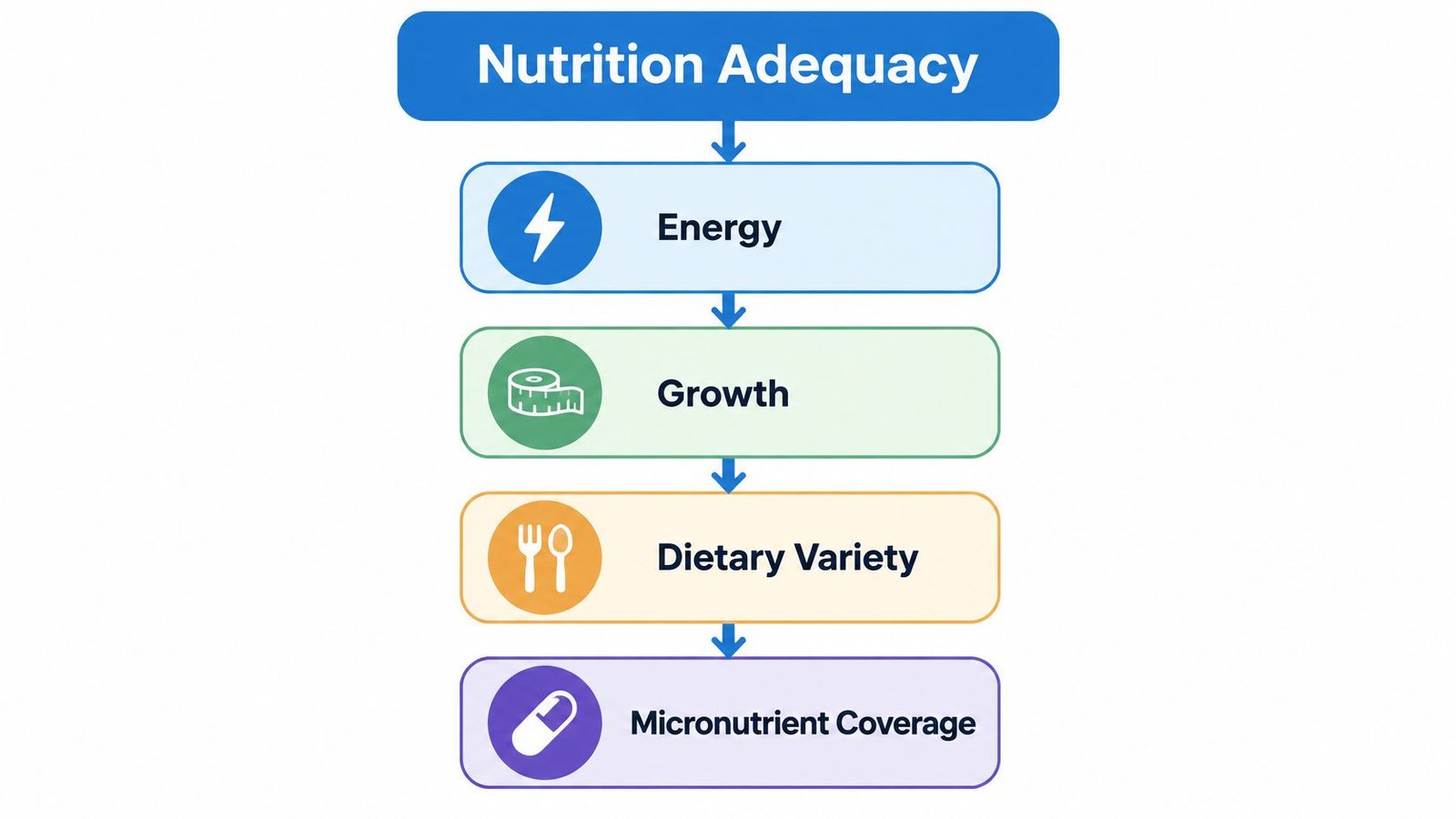
Then consider energy and growth. These are important pieces of the picture, but they don't tell you everything about variety or micronutrient intake. A child may get enough energy from a narrow set of foods while missing opportunities to consume nutrients found in foods they rarely eat. Conversely, a short food list doesn't by itself establish that a child has a deficiency.
A systematic review found that autistic children had significantly lower intake of protein, calcium, vitamin A, vitamin D, vitamin K, folate, riboflavin, thiamine, and niacin than comparison groups, despite no significant difference in total energy intake; this pattern doesn't mean every autistic child has a deficiency (systematic review of dietary intake). The finding is a reason to look beyond calories, not a reason to assume a specific child has a nutrient problem.
Connect foods to practical questions
Notice recurring omissions. If a child's dependable foods are mainly rice, pasta, or other cereal foods, record that pattern and note which other foods are rarely accepted. Don't jump from a short list to a diagnosis. A pediatrician or registered dietitian can consider the whole record, the child's growth, symptoms, medical history, and whether further assessment is appropriate.
Include hydration and digestion in the same picture. A simple note about drinking and bowel movements can help a clinician understand whether a concern recurs alongside particular routines or meals. Keep growth observations grounded in information from the child's care team rather than trying to interpret body size on your own.
Safe foods matter. Removing a dependable food without a clinically guided replacement plan can make eating harder and reduce options that currently help the child meet their needs. For practical ideas on offering new foods without making mealtimes a contest, see this guide to introducing new foods to autistic kids.
Choose What to Track Each Day
Published estimates of food selectivity vary because researchers use different definitions and measurement tools. One review reported a range of 17%–83%, while another reported 51%–89%; these differences underline why a family record should describe the child's specific eating patterns rather than label eating with a simple yes or no (review of food selectivity estimates).
A useful record has five parts. You don't need to capture every detail at every meal. Start with what will answer a real question or help your child's care team understand the pattern.
| Tracking field | Details to capture | Useful question |
|---|---|---|
| Meals and foods | Food, preparation, approximate portion, and accepted or refused | What does my child reliably eat, and what's regularly missing? |
| Texture and presentation | Texture, temperature, color, brand, packaging, and serving style | Was the food accepted only under particular conditions? |
| Sensitivities and allergens | Suspected food, observed response, timing, and known allergy information | Is there a repeatable observation to discuss with a clinician? |
| Supplements and medications | Product, amount as directed, timing, and whether it was taken | Could missed or changed routines affect the record? |
| Whole-day events | Hydration, bowel movements, sleep, mood, and behavior | What else was happening around the meal or symptom? |
Describe what you can observe
For a meal, write “plain pasta, familiar brand, small bowl, ate most” rather than “ate well.” The more specific note distinguishes the food from a broad category and gives the caregiver something concrete to compare with another day.
Record texture or presentation when it matters to acceptance. A child who eats a crunchy apple but refuses a soft one isn't necessarily refusing the food in every form. Likewise, note whether the same item came from a preferred package or was served in a familiar bowl if those details seem relevant.
Keep suspicions separate from diagnoses
A food that's refused is not automatically an allergen, and a suspected sensitivity isn't the same as a confirmed allergy. Note what was eaten and what you observed afterward, without naming a cause. If there's a known allergy, follow the child's clinician-provided guidance and record exposures or concerns as advised.
Distinguish an occasional refusal from a consistent exclusion. A single untouched serving tells you what happened at that meal; it doesn't establish a lasting pattern. Repeated entries can show whether refusal recurs with a particular food, texture, or setting.
Make the minimum version sustainable
On difficult days, record just the food, approximate amount, and anything unusual. Add a brief note if the child drank much less than usual, had a bowel movement concern, took a supplement, slept poorly, or seemed different from their typical self. A modest, consistent record is more useful than an elaborate form that becomes too tiring to maintain.
Build a Consistent Tracking Routine
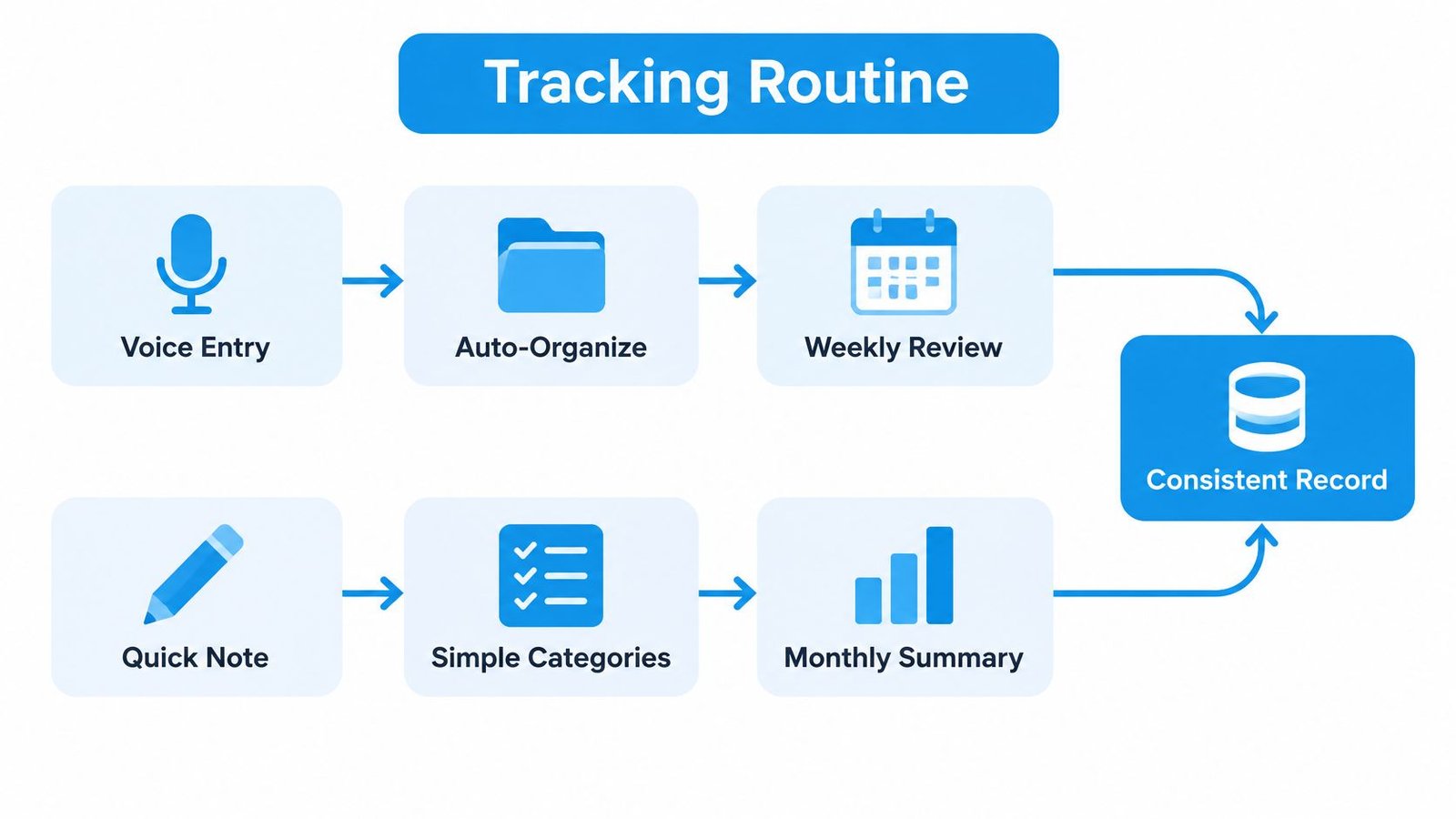
A tracking routine should fit around family life, not create another task that waits until everyone is tired. The easiest time to record a meal is often close to when it happens, while the food and context are still easy to recall. If that isn't practical, a quick voice note or a photo can preserve the basic details for review later.
Choose the entry that fits the moment
With a voice entry, a caregiver can describe the day in ordinary language: “Pasta for lunch, familiar brand, ate most of it. Drank a little water. No bowel movement yet.” Guiding Growth's Quick Log can organize a spoken description into entries for meals, sleep, mood, behavior, and medications. The caregiver can review what was captured, correct anything inaccurate, and save it; the process takes about a minute.
A snap-to-log meal photo offers another option. Guiding Growth can identify foods in the image, estimate portions and nutrition, match items to the child's known foods, and record 24 dietary factors and allergens. Estimates and recognition can be wrong, so review the captured details before saving. A photo can help preserve what was served, but it can't tell you why a child accepted or refused it.
Add context when something stands out
A usual meal may need only a short food entry. Add context after an unusual meal or a cluster of symptoms: a new preparation, a change in routine, low fluid intake, a difficult bowel movement, or an unusual night of sleep. Include the time if it will help you compare what happened and when.
The app can place meals beside hydration, bowel movements, supplements, sleep, mood, and behavior in one timeline. That keeps different observations together without making them into a conclusion. If you use a paper notebook or another tracker, the same principle applies: make the entry easy to find and update.
Review without turning it into homework
Ultimately, check for missing details that matter, such as whether a supplement was taken or whether a meal was refused because of a changed texture. Once a week, scan for repeats and questions worth raising at an appointment. Avoid treating every fluctuation as meaningful; an unusual day may be just that.
Before a meeting with a pediatrician or dietitian, select the relevant period and prepare a concise summary of the entries that relate to the concern. A useful record should help the conversation, not require a caregiver to reconstruct every meal from memory.
Read Real Meal Patterns Without Jumping to Conclusions
A meal note becomes more informative when it includes what was served, how it was presented, and what happened around it. The following examples are hypothetical. They show how to record observations without assuming that timing alone proves a cause.
Pasta accepted in one presentation
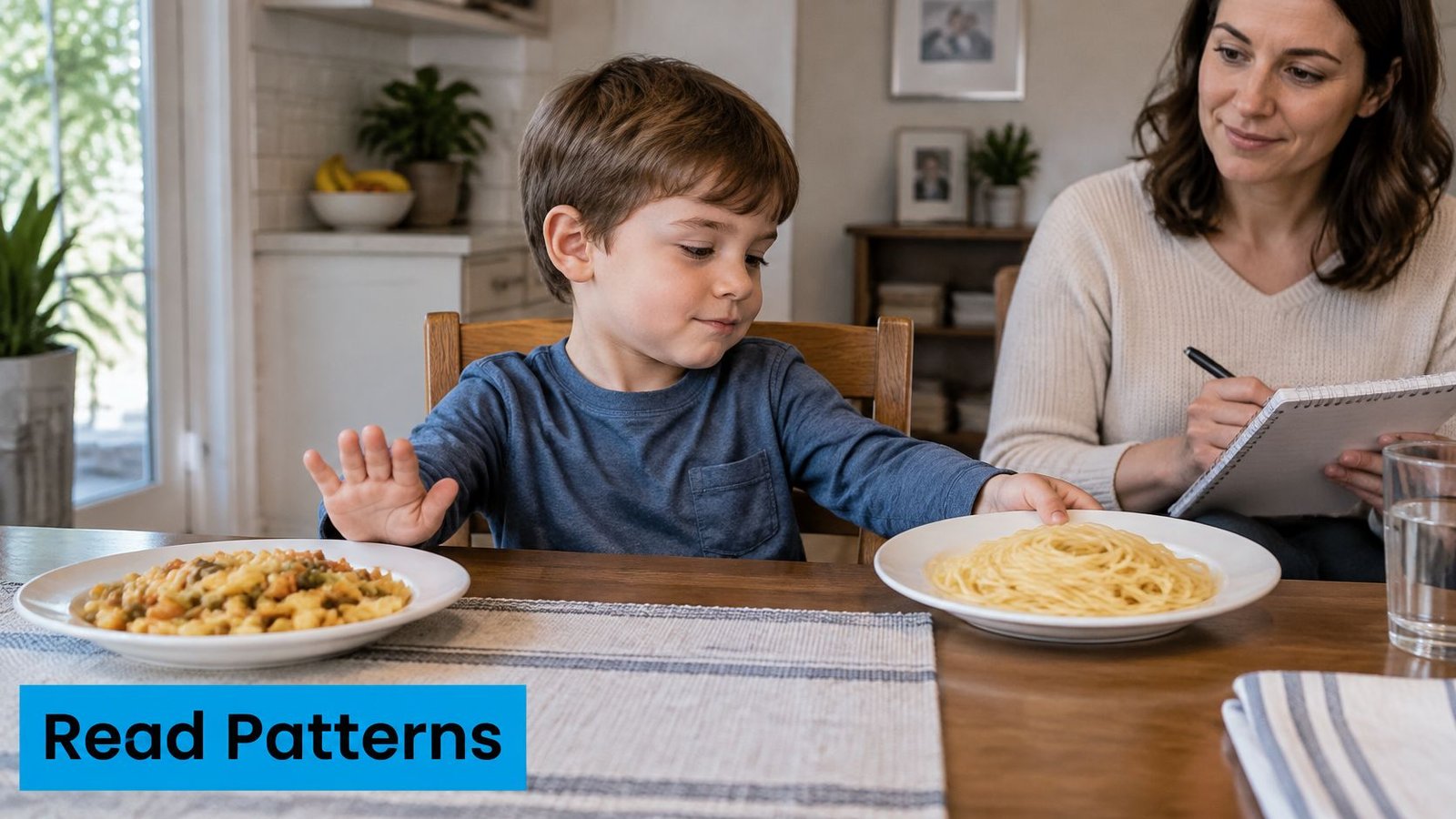
A flat note might read, “Ate pasta, refused vegetables.” A richer entry could say that the child accepted a familiar brand of plain pasta from a preferred bowl, refused vegetables served beside it, and ate a different pasta shape only on another occasion. If that presentation recurs, the family has a clearer question: does acceptance depend on shape, sauce, bowl, or another feature?
The record still can't establish why the child refuses the vegetables or whether pasta is the cause of anything else. It can help a feeding specialist understand the circumstances and consider safe, gradual ways to broaden food experiences.
A suspected sensitivity alongside bowel or sleep changes
Suppose a caregiver suspects that a particular food is linked to discomfort. Rather than remove it immediately and rely on memory, note when it was eaten, what else was served, hydration, bowel movements, sleep, and any observed behavior or symptoms. If a similar sequence appears again, bring the entries to the child's clinician and ask what should be assessed.
A repeated association is a reason to ask a question, not proof of intolerance. Other factors, including routine changes or an existing gastrointestinal concern, may also matter. This guide to identifying food sensitivities can help caregivers think about observations to discuss, but a log can't diagnose a sensitivity.
A supplement tied to dinner
A supplement may be easy to overlook when the family's routine changes. Record whether it was taken and when, rather than assuming it was given because it's usually part of dinner. If the child's appetite, bowel pattern, or sleep also seems different, keep those observations separate and share them with the care team.
Keep uncertainty visible: “This happened after that meal” describes timing. “That food caused this change” is a conclusion the record alone can't establish.
Across all three examples, look for what repeats and what changes. The context may help a clinician decide what question to explore next, while protecting the child from an unsupported diagnosis or unnecessary food restriction.
Compare Weak Logs With Clinically Useful Records
Consider a hypothetical day when a child eats chicken, refuses another food, and has a difficult evening. A weak note might say, “Difficult today. Ate chicken.” It preserves a general impression, but not enough detail to understand what was served, what “difficult” means, or whether anything else changed.
A stronger record separates observations. It might note that the child ate a small portion of baked chicken in familiar pieces at dinner, refused a new side dish, and took a regularly used supplement with the meal. It could also record the child's sleep, water intake, bowel movements, and what the caregiver observed in the evening, with approximate times where useful.
What each version can tell you
The short note can remind the caregiver that chicken was eaten and the day felt hard. It can't show whether the child rejected a particular texture, whether the meal differed from usual, or whether the evening concern followed a change in sleep or bowel pattern.
The more detailed record can support a better conversation, but it still can't prove that dinner caused the evening behavior. Don't edit out an inconvenient detail because it seems to contradict a theory. Don't change several foods at once if you're trying to understand what may be related, since multiple changes make observations harder to interpret.
Nutritional vulnerability can exist without low body weight. Studies reviewed from the Middle East and North Africa reported both underweight and overweight alongside inadequacies involving energy, protein, omega-3 fatty acids, fiber, calcium, iron, and several vitamins (review of nutrition in the Middle East and North Africa). That's one reason a clinician may want to consider food records and growth history together, rather than treating body size as a complete nutrition assessment.
Prepare a focused summary
Guiding Growth lets families review logged trends, filter a selected period, and create a Smart Summary for a relevant meeting. A caregiver can choose which event types to include and export the summary as a PDF for a pediatrician, dietitian, therapist, or school meeting.
Bring the summary as an organized account of observations, not a diagnosis. A focused question, such as “Does this recurring bowel pattern warrant assessment?” can help the care team decide what information or next steps are appropriate.
Evaluate Restrictive Diets and Supplements Safely
A restrictive diet shouldn't begin with the assumption that it will improve a child's autism-related traits. Start by asking what specific problem the proposed change is meant to address. A confirmed allergy, celiac disease, gastrointestinal condition, or documented nutrient concern may call for a clinician-guided dietary plan. A hope that an elimination diet will broadly change behavior needs a different kind of evidence and careful discussion.
A recent research review reports insufficient high-quality evidence for routinely using gluten-free and casein-free diets to improve core autistic traits. It also warns that unnecessary restriction can contribute to calcium and vitamin D deficiencies and create substantial family burden (review of gluten-free and casein-free diets). That doesn't mean every dietary change is inappropriate. It means the reason, possible trade-offs, and monitoring plan should be clear before major foods are removed.
Ask before changing the menu
Discuss four points with the child's clinician:
- The purpose: What diagnosed condition or specific symptom is this change intended to address?
- The support: What clinical guidance or evidence makes this approach reasonable for this child?
- The replacement: Which foods or nutrients could be displaced, and how will they be replaced?
- The review plan: What observations will be tracked, and when will the family and clinician reassess?
If a clinician recommends a trial, keep a record of food exposures, bowel symptoms, sleep, behavior, and growth. Avoid making several changes at once when possible, since that can make a pattern harder to interpret. A change that coincides with improvement doesn't automatically show that the removed food was the cause.
Use supplements as targeted support
Supplements may be useful when a clinician identifies or strongly suspects an inadequacy, but they don't replace food variety, texture-sensitive feeding support, hydration, or attention to bowel patterns. Record what the child takes and whether the routine was followed. Ask the child's clinician or dietitian whether the product and plan fit the child's needs.
For a practical discussion of what supplement evidence can and can't establish, see what studies show about supplements and autism. Don't remove a major food group or start a supplement regimen based only on an online claim. A planned replacement strategy and clinical oversight help protect nutrition while keeping the family's observations useful.
Turn Weekly Patterns Into Useful Clinical Questions
A weekly review doesn't need to be a second job. Set aside a short moment to ask whether the record shows a recurring pattern worth discussing, rather than trying to explain every difficult meal. Food selectivity is a meaningful concern for many families: one scoping review reported atypical eating behaviors in 70.4% of autistic children, compared with 13.1% of children with other disorders and 4.8% of children in the general population. The same review found autistic children were six times more likely to be described as picky eaters and were especially likely to avoid fruits and vegetables (scoping review of atypical eating behaviors). These group findings don't predict an individual child's needs.
Review the week with a few practical questions:
- Variety and omissions: Which accepted foods recur, and which foods or food groups are rarely represented?
- Eating conditions: Do texture, temperature, brand, or presentation seem to matter?
- Whole-day context: Are hydration, bowel movements, sleep, supplements, mood, or behavior changing alongside meals?
- Clinical concerns: Is restrictive intake, a recurring gastrointestinal issue, a possible deficiency, or a proposed elimination diet worth discussing?
Bring persistent concerns to a pediatrician, registered dietitian, or other qualified clinician. Guiding Growth gives families and care teams a private, secure, exportable place to organize observations and prepare meeting-ready summaries. It's available on iOS and Android, but it doesn't diagnose food intolerance, prescribe diets, or replace medical advice.
Use Guiding Growth to keep meal details alongside hydration, sleep, bowel movements, supplements, mood, and behavior, then review the record before your child's next appointment. Visit Guiding Growth to organize observations and prepare a clearer, more useful conversation with your child's care team.