The meeting ran 90 minutes. You asked good questions, the special education teacher nodded, someone said speech services "would increase," and the clock ran out. Now you're in the parking lot with a notebook of half sentences and no record of who agreed to send you what, or when.
That gap between what you heard and what you can prove later is where most IEP problems start. A working IEP meeting notes template closes it. Not a transcript, not a legal filing, just one or two pages organized so every decision carries a status, an owner, and a date you can check against the paperwork that follows.
What goes in each block, how to write it while people are still talking, and what to do when the draft IEP and Prior Written Notice land in your inbox three weeks later, that's the whole job.
Table of Contents
- What Belongs in an IEP Meeting Notes Template
- Goal Numbers Worth Writing Down
- How to Prepare Notes Before the Meeting
- How to Take Notes While the Team Talks
- Decisions Disagreements and What Happens Next
- Use the Notes at the Next Meeting
What Belongs in an IEP Meeting Notes Template
A parent leaves a 90-minute meeting with a notebook of half sentences and no record of who agreed to what. Three weeks later the draft IEP arrives, and there's no way to tell whether the conversation matched the paperwork.
A useful template is a dated process record built around the structure the Individuals with Disabilities Education Act established, reauthorized in 2004. Not a word-for-word transcript, and not a replacement for the school's official IEP. Under 34 CFR §300.320, an IEP must include measurable annual goals covering both academic and functional needs, a description of how progress will be measured, and the timing of periodic progress reports to parents. Quarterly reports, or reports issued alongside ordinary report cards, are the regulation's own example of an acceptable schedule.
Eight blocks, one page, one pen
Set these up on one or two pages before you walk in. Each one exists because something goes missing without it.
- Header. Date, start and end time, purpose, location or video link, notice date, every attendee and role, participation method, interpreter or other access support.
- Present levels. Strengths, needs, baseline numbers with the data source and the date range they cover.
- Parent input. Each concern or request, the team's response, data still wanted, and whether the item was resolved, deferred, or written into the IEP.
- Goals. Skill, baseline, target, conditions, and the report schedule.
- Services and supports. Service or accommodation, provider, setting, minutes, frequency, start date.
- Decision log. Issue, proposal or refusal, evidence reviewed, options rejected, status.
- Disagreements. Unresolved issue, each party's position, interim support, next deadline.
- Follow-up. Owner, document owed, due date, and where you'll file it.
The header does more work than it looks like. A team member can be excused from all or part of a meeting only when you and the district agree in writing that the member's curriculum or related service area won't be modified or discussed, and the IDEA statutory language on IEP team meetings makes that written parent agreement part of the record. So write the excused member's name, the portion missed, the service area, and whether written input was submitted. "Staff unavailable" tells you nothing a year from now.
| Notes block | Write this | Check later against |
|---|---|---|
| Header | Date, time, purpose, place or link, notice date, attendees, participation method, access support | The meeting notice and who actually attended |
| Present levels | Strengths, needs, baseline numbers, data source, date range | Evaluation results and the IEP present levels page |
| Parent input | Each concern or request, team response, data still wanted | Parent participation and Prior Written Notice |
| Goals | Academic or functional skill, baseline, target, conditions, report schedule | Annual goals and progress reports |
| Services and supports | Service or accommodation, provider, setting, minutes, frequency, start date | Service grid and accommodations page |
| Decisions | Issue, proposal or refusal, evidence, options rejected, status | Prior Written Notice and the signed IEP |
| Disagreements | Unresolved issue, each position, interim support, next deadline | Follow-up email and draft IEP |
| Follow-up | Owner, document owed, due date, where you file it | What actually arrives after the meeting |
The working rule: your notes help you compare the conversation with the signed IEP. They don't replace it.
The same discipline shows up in other meeting records. A good meeting minutes template built for execution separates what was decided from what was merely discussed, and that logic transfers straight to an IEP table.
Copy-ready skeleton, eight lines, one page, HEADER: date | start and end time | purpose | place or video link | notice date | attendees and roles | participation method | interpreter or access support. PRESENT LEVELS: strengths | needs | baseline numbers with data source and date range. PARENT INPUT: concern or request | team response | data still wanted | resolved, deferred, or incorporated. GOALS: skill | baseline | target | conditions | report schedule. SERVICES: service or accommodation | provider | setting | minutes | frequency | start date. DECISIONS: issue | proposal or refusal | evidence | options rejected | status. DISAGREEMENTS: issue | each position | interim support | next deadline. FOLLOW-UP: owner | document owed | due date | where it gets filed.
Goal Numbers Worth Writing Down
"Will improve reading comprehension" cannot be checked in March. "Reads 18 of 25 grade-level words on a classroom probe" can. Federal regulations require measurable annual goals and specify that progress must be measured and reported, and state guidance commonly translates measurable into three parts: observable behavior, the conditions under which it happens, and a performance criterion.
The Bureau of Indian Education's IEP manual lays out two rules that make the difference between a goal you can track and a goal you can only argue about. An annual goal cannot span more than 365 calendar days. And progress must be reported in the same measurement format the goal was written in. A 4-out-of-5 criterion comes back as a count out of five. A percentage goal comes back as a percentage.
The fields that make a goal checkable
For each goal, capture baseline, target, numerator and denominator, percentage or duration, observation conditions, data source, date range, and how often you'll be told. Then keep academic and functional goals separate in the record. Reading accuracy and math facts sit next to requesting a break, hallway transitions, self-regulation, and the morning routine, and they're measured differently.
| Style | Write in the notes | Sample target | Matching progress note |
|---|---|---|---|
| Count of opportunities | Numerator, denominator, and conditions | 4 of 5 trials | 3 of 5 trials this quarter |
| Percentage | Percent, task, and accuracy rule | 80% accuracy on grade-level probes | 72% accuracy this quarter |
| Duration | Minutes or seconds and setting | On task for 10 minutes | On task for 6 minutes |
| Frequency | Count per day or week | 1 prompt per class period | 4 prompts per class period |
| Rubric or level | Scale points and what each point means | Level 3 of 4 on the writing rubric | Level 2 of 4 |
| Prompt level | Independent, gesture, verbal, or full physical | Independent in 4 of 5 | Verbal prompt in 4 of 5 |
Worked row: Transitions | baseline 2 of 5 independent hallway transitions | target 4 of 5 across 4 weeks | conditions: arrival and lunch, general education hallway | measured by the case manager with a checklist | reported quarterly.
Notice what the row does. It preserves the denominator, the setting, the person collecting data, and the reporting interval, so the next progress report either matches it or visibly doesn't.
When a report arrives, ask three questions. Did the number move? Did the conditions change? Were the minutes delivered? A goal rewritten in percent after a year of tally data can't answer the first one, because the unit shifted mid-stream and the comparison breaks. If you want a broader look at how targets get set before the paperwork starts, setting academic goals in CBE is a useful read on writing criteria that hold up.
Home observations belong in the same units. Instead of "a hard week," write the count, the duration, and the trigger. If you're framing functional goals around daily living or communication, IEP targets for autism covers how those get written and measured.
How to Prepare Notes Before the Meeting
The draft arrives two days out, or the night before. The prep routine still works, because most of it doesn't depend on the school.
Start with the notice. Under 34 CFR §300.322, the district must notify you early enough to attend, schedule at a mutually agreed time and place, and name the purpose, time, location, and expected attendees. If you can't be in the room, the district must use alternative methods such as individual or conference telephone calls, and it must take whatever action is necessary for you to understand the proceedings, including arranging an interpreter when a parent is deaf or doesn't speak English. Write the notice date in your header the moment it arrives.
Then run the week.
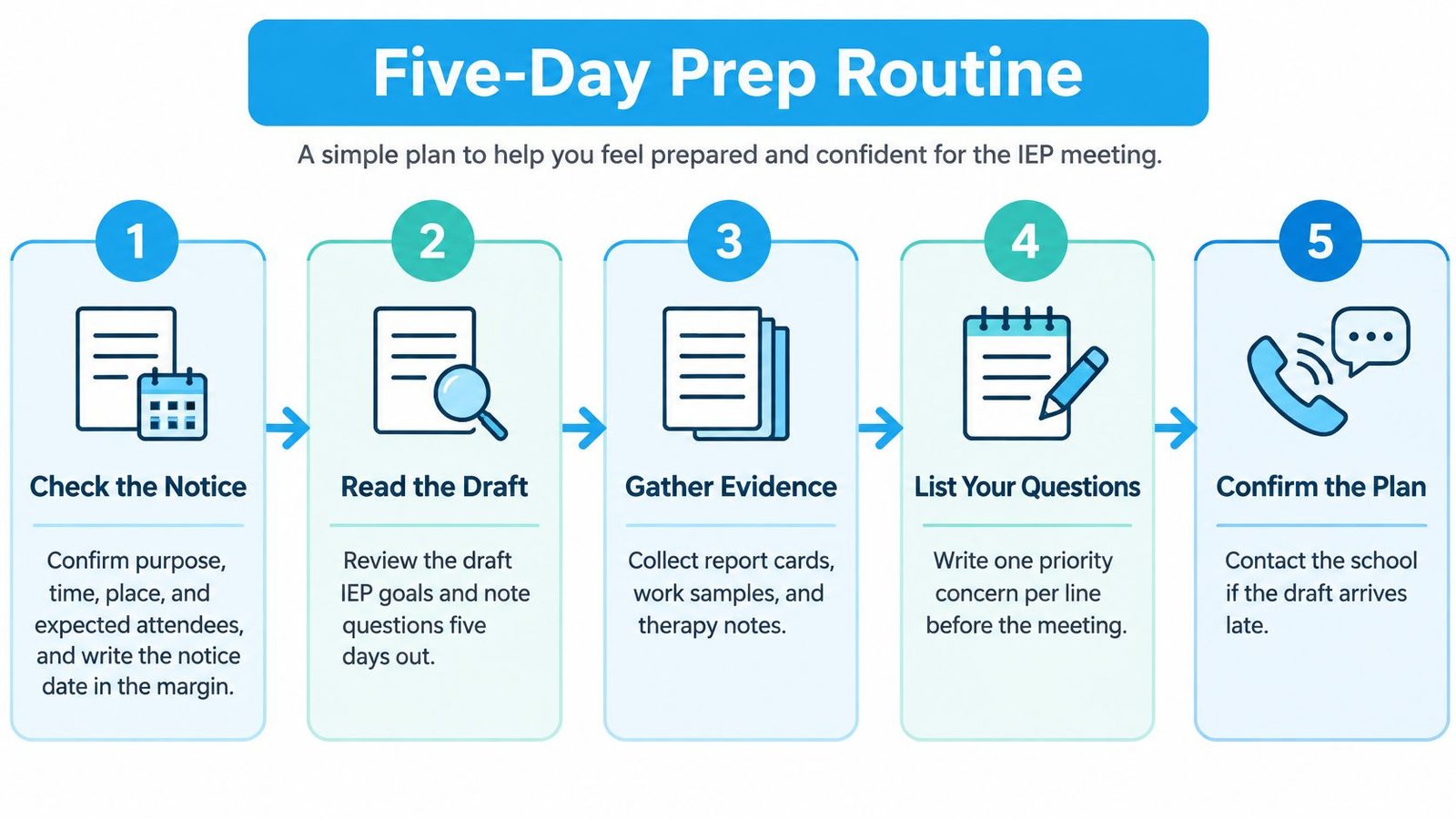
- Confirm the four notice facts. Purpose, time, place, expected attendees. If one is missing, you've found your first question and it belongs in the parent-input block.
- Read the draft and pick three priorities. Reading accuracy, transitions, a sensory break. Three, not fifteen. A page of priorities gets discussed; a stack of worries gets deferred.
- Pull a date range of home observations. Behavior, sleep, meals, communication, therapy notes. Turn each into one line with date, frequency, duration, trigger, and setting. Bring the list even if the district asks for concerns in advance, because federal guidance states a district may not impose a blanket rule requiring parents to submit concerns three days before the meeting in order for those concerns to be addressed.
- Pre-fill present levels and last year's goals from the most recent progress report. Flag any goal reported in a different format than it was written in.
- Draft your questions in the parent-input block, one issue per line, with a blank space for the team's answer. The blank matters. It's the difference between a question and a speech.
- Decide who writes. If you're bringing a partner or advocate, one of you talks and one of you records. Both of you talking and nobody writing is how decisions evaporate.
Here's the routine laid out as a checklist you can screenshot before the week starts.
When the draft shows up late
Call the case manager and ask for the documents before you agree to discuss changes. You can also ask to reschedule, though that has a cost in goodwill. If the meeting goes ahead, write "draft received [date]" in the header and note which sections you're seeing for the first time. That single line protects you later when someone says the team reviewed everything together.
If you want a longer walkthrough of the pre-meeting phase, how to prepare for an IEP meeting covers records requests and what to bring.
A one-page concern list beats a stack of screenshots you can't find in the meeting.
How to Take Notes While the Team Talks
A defensible set of notes works as a structured process record, not a transcript. That's the framing ASHA's school documentation guidance supports: document the date, time, and participants, record parent participation and whether the team reached consensus or disagreement, and maintain performance data or a goal portfolio rather than a narrative of impressions.
That pattern is shown across a table.

Eight moves for the meeting itself
- Start a new line when the topic changes. Put the clock time in the margin. Time stamps settle "we never discussed that" faster than anything else.
- Tag every line with one status word. If the team is still talking, it's discussed. Full definitions are in the table below.
- Capture numbers with their conditions. "Reading 18 of 25 words, classroom probe, special education teacher, March." A number without its source and setting is unusable in six months.
- Answer each parent question in the same row. Note any data requested and who owes it.
- Finish each service before the conversation moves. Provider, setting, minutes, frequency. "Speech will increase" is not a note. "Speech, 30 minutes weekly, pull-out, SLP, starting September 8" is.
- Park side topics in the margin. Don't break the current row to chase a tangent. Margins are for parking, not for losing.
- Read back the decisions in the last five minutes. Names, dates, wording. Ask the team to correct anything wrong before anyone stands up.
- Note who sends the draft IEP and by when. Plus the Prior Written Notice, if one is owed.
The field separation is what makes the page auditable: evidence, discussion, decision, follow-up, each in its own column. Skip clinical conclusions ("appears dysregulated," "seems anxious") because they aren't yours to draw, and never describe your notes as the legal IEP.
If you want a short refresher on how a team meeting runs before you sit down, this recorded session walks through the structure.
| Status | It means | Write next | Do not treat it as |
|---|---|---|---|
| Discussed | The topic was raised and no decision was made | Who spoke and what data was mentioned | Agreement |
| Agreed | The team, including you, accepted a specific action | Exact wording, start date, and owner | A vague promise |
| Proposed | The school offered an action you haven't accepted | The offer, the reason, and notice status | A signed change |
| Refused | The school declined your request or a change | Request, reason, records used, alternatives rejected | A closed topic with no notice |
| Deferred | The team postponed the decision | Missing evidence, interim support, new date | Silence or consent |
Decisions Disagreements and What Happens Next
A signature page is not a decision record. It proves you were in the room. It doesn't prove what the room decided.
Under IDEA, you're entitled to Prior Written Notice describing the proposed or refused action, the reasons, the evaluations or records relied upon, alternatives considered and rejected, relevant factors, and procedural-safeguard information. The Center for Parent Information and Resources guide to prior written notice is worth reading before the meeting, because notes aren't automatically a substitute for that notice.
So build a decision log, one row per issue. Issue, your request, the school's response, data reviewed, options considered and rejected, the rationale stated aloud, status, responsible person, start date, and whether formal written notice is still pending.
Worked refusal: Issue: weekly speech consultation. Parent request: 30 minutes weekly, starting in March. School response: refused. Data reviewed: six weeks of progress probes. Options rejected: monthly consult, classroom-only support. Rationale stated: current minutes meet need. Status: refused, written notice pending. Owner: case manager. Start date: none.
Add an interim support row for anything still open, so your child isn't left without a plan while paperwork moves. And keep your own account in a separate section from the school's record, so the notes show what was discussed without implying you agreed.
Unresolved disagreement is common enough to plan for. Pennsylvania's Office for Dispute Resolution reported 196 requests for IEP, IFSP, gifted-IEP, or Section 504 facilitation in FY2025, up 41% from 139 the prior year, and 91% of facilitated meetings produced either a complete or partial IEP draft. A template that assumes one clean set of agreed actions doesn't fit that reality. Build the disagreement block instead.
| Status | What it means for the record | Capture next | Never read it as |
|---|---|---|---|
| Discussed | Raised, no decision made | Speaker and data referenced | Agreement |
| Agreed | A specific action accepted by the team and you | Wording, start date, owner | A soft promise |
| Proposed | An offer you haven't accepted | The offer, stated reason, notice status | A signed change |
| Refused | Your request or a change was declined | Request, reason, records used, rejected alternatives | Closed with no notice |
| Deferred | Decision pushed to a later date | What evidence is missing, interim support, new date | Consent by silence |
Before anyone leaves, list who sends the finalized IEP, the notice, the progress data, and any correction to the notes.
Use the Notes at the Next Meeting
Finish the page the same day, while names and numbers are still sharp. Within 24 hours, send a short recap listing agreements, refusals, owners, and dates, and ask the school to correct anything wrong. That email is what turns your notes into a shared record.
When the draft IEP and Prior Written Notice arrive, put them beside the template and mark mismatches. Goals that changed units. Minutes that shrank. A rejected option that vanished from the rationale. Three columns, one pass, ten minutes.
Then track delivery, not attendance. Implementation research on COMPASS consultation treats fidelity as multidimensional, covering adherence, dosage, quality of delivery, and student responsiveness, and found fidelity was stable and could increase over time with consultation support. Practically, that means converting each service or accommodation into one observable unit: the intervention, the provider, the setting, the frequency and duration, the materials, the student-response measure, and the evidence source. Then record actual dosage, quality, and barriers at each review.
Monitoring unit: visual schedule used in mathematics, 4 of 5 observed opportunities, reviewed weekly by the case manager.
Two traps worth naming. Recording that a service was "provided" without dosage or outcome evidence tells you nothing in April. And treating stalled progress as proof your child didn't respond, before checking whether delivery changed or a provider was out for a month, gets the goal rewritten when the schedule was the problem.
A daily log earns its keep through consistent use. Guiding Growth is a mobile app where you record behavior, sleep, routines, and therapy observations with dates, triggers, and outcomes, all in one place. Behavior Tracking captures meltdowns, shutdowns, demand avoidance, and other challenging behaviors, and it also keeps a log of echolalia, hand flapping, and other stimming behaviors along with their triggers and outcomes. Medications, doctor appointments, and therapy sessions live in the same app. Before the next IEP, filter the log to the meeting date range and bring a one-page summary beside your recap and concern list. If you want a deeper method for tracking delivery between meetings, special education progress monitoring walks through it.
The app organizes your family's observations. It doesn't replace the school's IEP or give medical advice.
You don't need a law degree to walk into the next meeting with a page that holds up. You need fields, status words, and numbers that match the paperwork. Guiding Growth gives you the raw material: dated observations of behavior, sleep, meals, therapy, and stimming triggers, summarized into a shareable report you can put next to the draft IEP instead of relying on memory. Download it on iOS or Android at Guiding Growth and bring a date range, not a hard week, to your next IEP meeting.