The newest pooled analysis of the casein free diet for autism reports a small but statistically significant behavioral effect, a standardized mean difference of -0.27 with a 95% confidence interval from -0.424 to -0.116 and a P value of 0.001 across 8 studies, as catalogued in Norway's national handbook of systematic reviews. Read alone, that number looks like a verdict in favor of a diet thousands of families have already attempted. Read beside the reviews that came before it, it becomes something more useful: a demonstration of how a pooled headline can drift away from the trials underneath it.
That drift is the practical problem with nearly every casein free diet autism headline a parent meets. A family is asked to change a child's food, budget and daily routine on the strength of one summary sentence, usually one that leaves out what was measured, who measured it, and what else changed during the same weeks.
Table of Contents
- What Trials Show About Casein-Free Diets and Autism
- What Casein Is and Why Studies Mix It With Gluten
- Nutrients at Risk When Dairy Is Removed
- Tracking Symptoms and Meals Without Losing the Thread
- How to Run a Casein-Free Trial Step by Step
- Who Reviews the Trial and Which Changes End It
- Decide With Your Care Team Before Changing the Diet
What Trials Show About Casein-Free Diets and Autism
The bottom line from the most recent reviews is that removing casein hasn't produced a reliable benefit for the core traits of autism, and the reviewers rate the evidence as limited or very low quality, according to the 2021 systematic review and meta-analysis indexed on PubMed. The individual studies are worth reading in order, because the way their numbers move explains why a mostly null field can still throw up an occasional positive result.
| Review or Analysis | Trials or Studies | Children or Participants | Main Result |
|---|---|---|---|
| 2017 systematic review | 6 randomized trials | 214 children | No significant difference on standardized core symptom measures |
| 2021 meta-analysis | 6 randomized trials | 143 participants | No significant effect on clinician-rated core symptoms (SMD -0.31, 95% CI -0.89 to 0.27) |
| 2024 meta-analysis | 8 studies | Significant behavioral effect (SMD -0.27, 95% CI -0.424 to -0.116, P = 0.001) |
The 2017 systematic review pooled six randomized controlled trials covering 214 children and found, with few exceptions, no statistically significant differences between diet and control groups on standardized measures of core autism symptoms. The 2021 meta-analysis narrowed the question to clinician-rated outcomes across six trials and 143 participants and landed in the same place: a standardized mean difference of -0.31, with a 95% confidence interval from -0.89 to 0.27 that comfortably crosses zero.
Parent ratings told the same story in that analysis. Functional level moved by a mean difference of 0.61 (95% CI -5.92 to 7.14) and behavioral difficulties by 0.80 (95% CI -6.56 to 10.16), both intervals wide enough to contain no effect at all.
Why a significant pooled result isn't a green light
The 2024 analysis included eight studies and measured behavior rather than the core traits the earlier reviews targeted. Pooling studies that use different diets, durations and rating scales can produce a statistically significant pooled number even when the trials inside the pool disagree with each other, and the whole confidence interval here, from -0.424 to -0.116, sits inside the small-effect band.
An effect that small is invisible at the level of one child. Every child's behavior swings from week to week for reasons that have nothing to do with milk, so a calm fortnight after removing dairy is exactly what normal fluctuation predicts even when the diet does nothing. The pooled figure also prices in none of what the diet removes nutritionally, which is the cost most headline summaries skip.
What to check in any headline: which outcome was measured, how many children were actually studied, and whether the rating came from a clinician or a parent.
There's a safety signal tangled up in the same analysis. The 2021 review reported a possible increase in gastrointestinal adverse effects with a relative risk of 2.33, though the confidence interval ran from 0.69 to 7.90, wide enough that the direction of the effect is uncertain.
Length and follow-up matter as much as the pooled number. A Cochrane summary of one randomized study followed 20 children aged 5 to 10 for 12 months, pairing them by symptom severity before assigning a combined gluten- and casein-free diet or a standard diet, and found no clear differences in cognitive skills, language ability or motor ability. Over a year, a calmer stretch can come from development, a school change, an illness, better sleep or a new therapy, which is why that study needed predefined measures instead of impressions.
What Casein Is and Why Studies Mix It With Gluten
Casein is the milk protein that lets milk set. It's what forms the curd in cheese and the body in yogurt, so taking it out of a child's diet takes out milk, cream, yogurt, cheese, ice cream, custard, every sauce built on butter or cream, and the processed foods that hide milk derivatives such as caseinates. What looks like one protein on a label is usually the whole dairy aisle on a plate.
A food label is the first place the definition gets tested, and milk solids turn up in places most parents don't expect.

The early clinical research on removing casein was very small. The 2008 Cochrane review of casein-free and gluten-free diets found only two randomized controlled trials, totalling 35 children, one with 20 participants and one with 15. Those samples were too small and too different in method for the reviewers to run a meta-analysis at all. One 20-participant trial reported a statistically significant improvement in overall autistic traits, a mean difference of -5.60 points with a 95% confidence interval from -9.02 to -2.18, but the reviewers were clear that an isolated result like that couldn't establish that removing casein causes meaningful improvement.
The gluten problem that never went away
Most of the studies removed gluten and casein at the same time. That single design choice makes the independent effect of casein impossible to separate, because every child who improved also stopped eating wheat.
Say a family clears both wheat and dairy out of the kitchen on the same Monday, and by the third week the child is calmer at dinner and falling asleep faster. The improvement is real and worth noticing. The attribution isn't. Gluten removal, dairy removal, the extra attention, the new routine and the passage of three ordinary weeks are all inside that change, and nothing in the family's notes tells them which one did the work.
So when another parent says casein removal fixed their child, the useful question is a short one: was gluten removed at the same time? If the answer is yes, the claim is about two proteins, not one. Check the ingredient list the way you'd check it for a school lunchbox, and if dairy is the only thing being removed, this food label allergen safety guide walks through the names milk hides behind. Families rebuilding a lunchbox around the swap will find nut-free treats for school lunches a practical starting list of swaps that don't depend on dairy at all.
Nutrients at Risk When Dairy Is Removed
Many autistic children already accept a narrow list of foods. Take dairy out of that list and the margin for error gets thinner, not just different. The French food-safety agency ANSES concluded that exclusion diets such as removing cow's-milk proteins carry potential risks to nutritional status and growth, noted insufficient evidence to confirm long-term safety, and recommends monitoring by a qualified nutrition professional, in its assessment of exclusion diets in autism. Removing conventional dairy can lower intake of calcium, vitamin D, protein, iodine and riboflavin at the same time.
| Nutrient | Main Dairy Source | Replacement to Check | What to Monitor |
|---|---|---|---|
| Calcium | Milk, yogurt, cheese | Fortified soy or oat drink, calcium-set tofu, leafy greens | Intake in the food log and bone health questions for the pediatrician |
| Vitamin D | Fortified milk | Fortified alternative drinks; supplement only if prescribed | Blood level, if the clinician orders one |
| Protein | Milk, yogurt, cheese | Eggs, beans, lentils, fish, meat, fortified soy products | Growth on the standard chart |
| Iodine | Milk, dairy desserts | Iodized salt in moderation, fish, eggs | Intake, with clinician review if the diet is restricted |
| Riboflavin | Milk, yogurt | Eggs, lean meat, fortified cereals | Intake from the food log |
Why the swap is harder than the label suggests
Bone-building nutrients carry extra weight here. The U.S. National Institute of Child Health and Human Development notes that available research doesn't support casein-free diets as a primary autism treatment and warns that removing dairy may further limit bone-building nutrients, adding that autistic children tend to have thinner bones, in its summary of nutritional therapy for autism.
Then comes the part that catches families out. A "nutritionally equivalent substitute" only counts if the child drinks it. Fortified soy or oat drinks get rejected on texture, unfortified plant beverages fill the cup without filling the gap, and a child who refuses mixed meals won't suddenly accept a lentil stew because a chart says so.
Before any full switch: list the nutrients your child currently gets from dairy, then pick one accepted replacement per nutrient and test it for a week while dairy is still on the plate.
Supplements belong to that plan, not to guesswork. Calcium, vitamin D and iodine doses are set by the clinician who knows the child's blood work, growth curve and current intake.
If protein is the hole the dairy removal leaves, a comparison of whey and plant protein helps narrow which fortified option matches what the child was getting. The diet and nutrition guidance here covers how to keep intake visible while foods are being swapped.
Tracking Symptoms and Meals Without Losing the Thread
Memory fails a multi-week trial. By week three, nobody accurately recalls how Monday's stools compared with the week before casein left the kitchen, and scattered notes in three apps and a notebook can't be compared to anything. One daily log, filled in the same way, is the backbone of a trial that produces an answer.
Record the same five groups every day:
- Gut signs. Stool type against a Bristol-style scale, bloating, and the non-verbal signals of stomach pain, such as arching at the table, pushing the plate away, or waking with gas.
- Sleep. Bedtime, how long it took to fall asleep, night wakings, and wake time. Sleep latency is one of the few outcomes a parent can measure without arguing about definitions.
- Behavior. For each meltdown or irritable stretch, log the count, intensity, duration and the likely trigger, so a bad afternoon can be tied to something specific instead of to the diet.
- Feeding. Foods accepted, foods refused, and roughly how much went in. Refusals matter as much as acceptances during a restriction.
- Mood between events, not only during them. Irritability, energy and interest in preferred activities fill in the days when nothing dramatic happens.
Hidden dairy causes more muddled results than deliberate exceptions. Cheese baked into a sauce, butter on bread, milk powder in mashed potato, yogurt in a marinade and chocolate at a birthday party all count as exposures, and each one should be logged with the date and what happened afterwards.
A food and behavior tracker keeps the pieces on a single timeline. If you use Guiding Growth, a photo of the plate and a spoken note about the day land in the same record as the sleep and behavior entries, so a pattern like irritability clustering after certain meals becomes visible instead of anecdotal.
Log the same outcomes at the same time each day, and don't add new categories halfway through. A consistent narrow log beats a thorough one that changes shape every week.
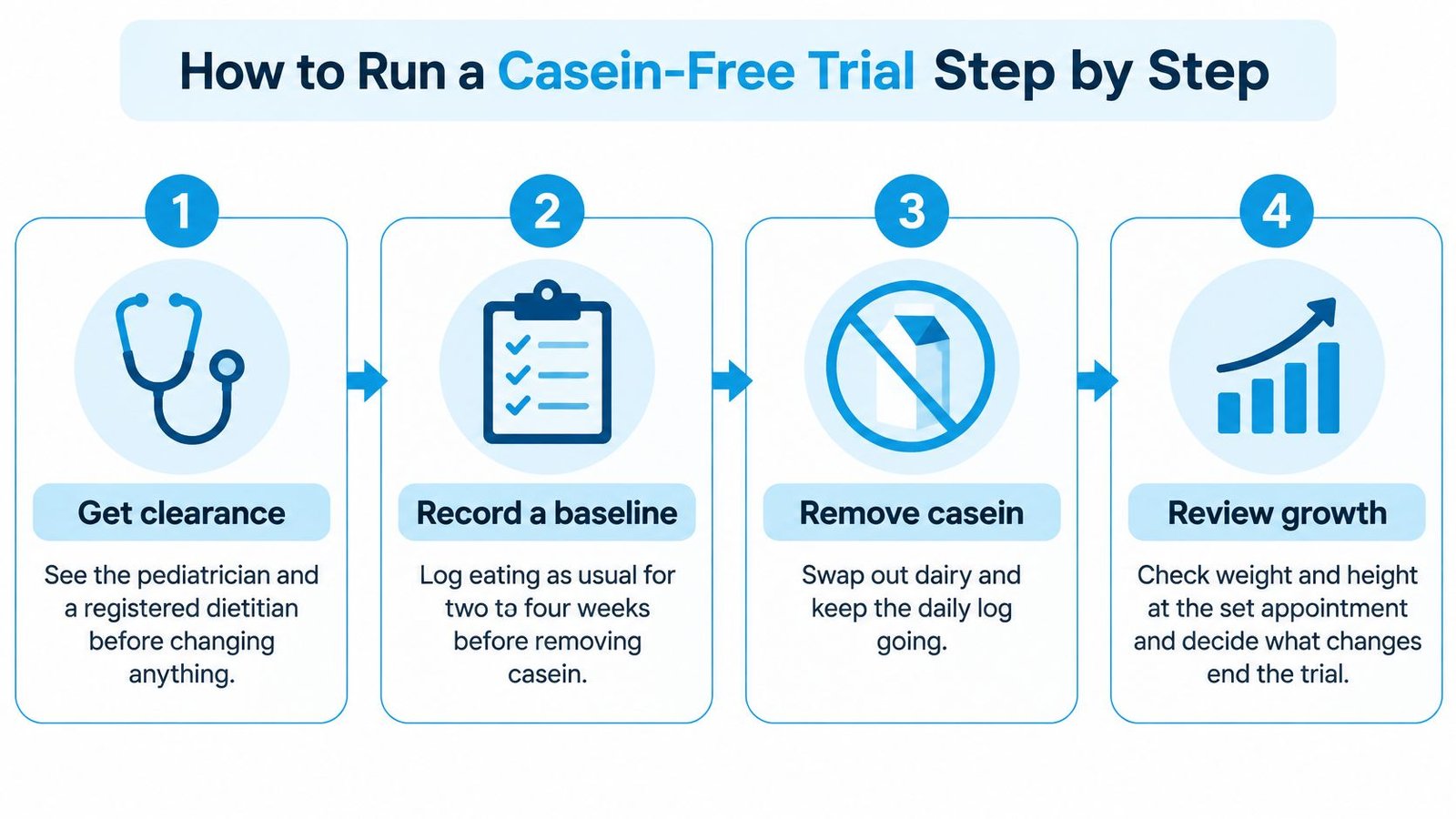
Here's how the sequence looks in practice when the whole trial is laid out end to end.
How to Run a Casein-Free Trial Step by Step
The evidence on casein-free diets does not treat elimination as a clean yes-or-no experiment. Reviews of the research describe a mixed picture: some studies report mild behavioral or gastrointestinal improvements, others find no measurable change, and the outcomes families report are often subjective. That makes the design of the home trial matter more than the decision to try one. The clinically useful question is whether this child shows a reproducible change in a clearly defined symptom, and whether the change is large enough to justify the nutrition cost of removing dairy.
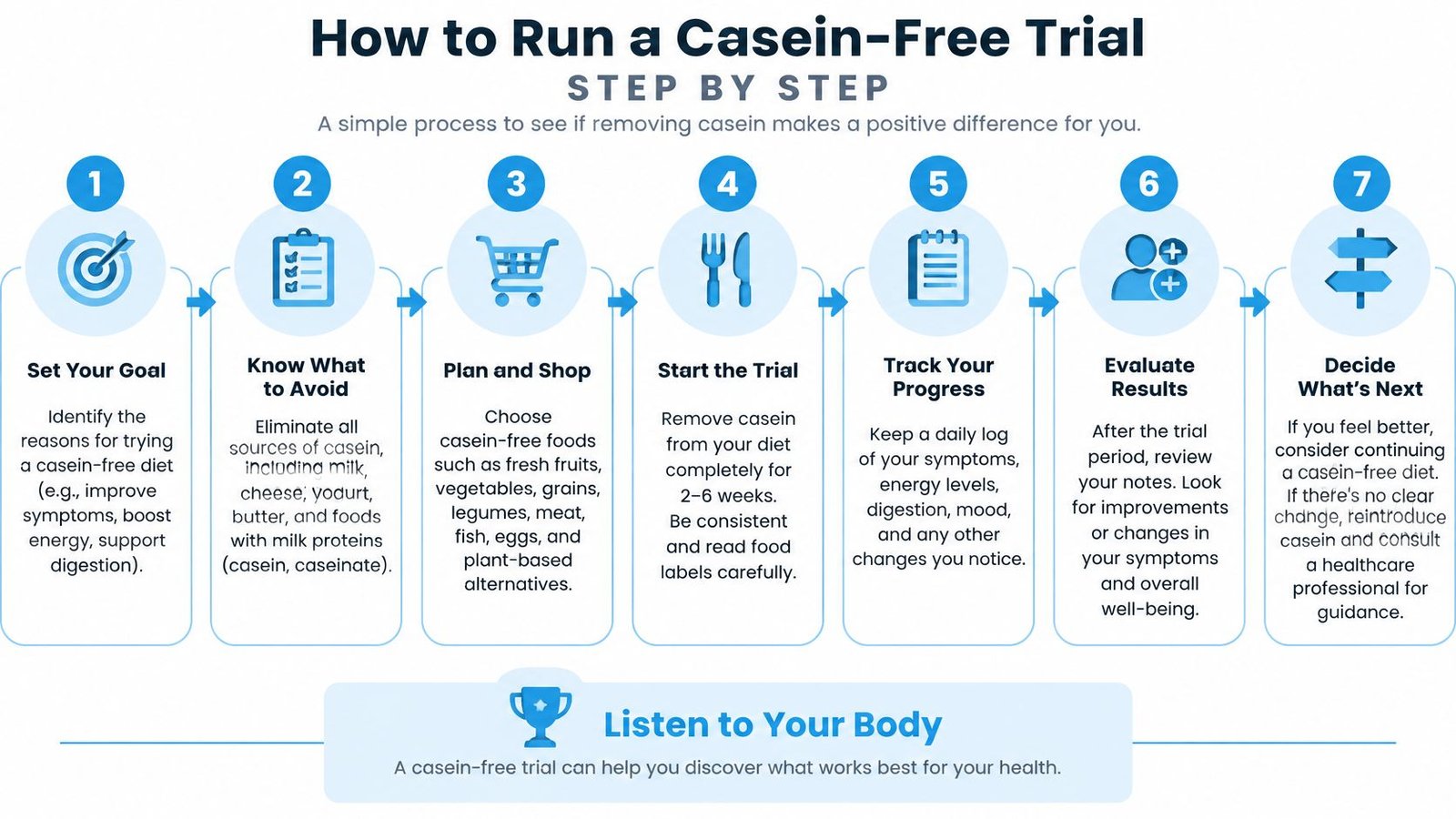
Before anything leaves the kitchen
- Get clearance first. The pediatrician and a registered dietitian sign off before the first dairy-free day, because growth and nutrient gaps need a plan that exists before the restriction, not after a problem shows up.
- Record a baseline for two to four weeks while eating as usual. No change can be judged against nothing. A baseline also captures the ordinary bad weeks that would otherwise be credited to the diet or blamed on it.
- Choose two or three outcomes in advance. Stool pattern, time to fall asleep, and the number of meltdowns in a day are countable. "Seems better overall" isn't, and it invites the family to chase whatever happened to move.
- Change one variable. Remove casein while therapies, medications, school routines and bedtimes stay where they are.
That fourth step is where most home trials fail. Two simultaneous changes produce one result that can't be attributed to either, and a new supplement started in the same week destroys the comparison. Expectation distorts too: parents who have invested effort in a restriction tend to notice improvement, which is why the baseline numbers, not memory, have to carry the verdict.
During the trial and at the review point
- Expect normal fluctuation. Symptoms vary week to week on their own, so a calmer stretch can arrive by chance. Judge the trial on the pattern across all its weeks, not on the best day or the worst one, and mark suspected dairy exposures so a flare can be checked against the record rather than against the diet.
- Set the stop rule before day one. Weight loss, constipation that doesn't ease, or worsening food refusal ends the trial, no debate required at the appointment.
- Compare the trial weeks with the baseline at the review point. If nothing reproducible has changed, the honest answer is to stop restricting rather than to extend it indefinitely in hope of a late response.
- Reintroduce casein under guidance. Watching whether the symptoms return is the strongest check a family has, and it converts a vague improvement into a testable one.
Families planning the logistics of a staged removal, including how to reintroduce foods one at a time afterwards, will find the elimination diet walkthrough a useful companion to the numbered steps above.
Who Reviews the Trial and Which Changes End It
A log nobody reads changes nothing. The trial needs named people who act on it, and a written list of what sends the family back to the clinic before the scheduled review.
The pediatrician records baseline weight and height, reads the growth chart at the appointment, and sees the child promptly if weight falls. A registered dietitian sets the calcium, vitamin D, protein, iodine and riboflavin replacements before dairy is removed, and checks the food log if the list of accepted foods shrinks. An allergist assesses a suspected milk allergy, which is a diagnosis in its own right and a separate question from a behavior trial. The developmental team keeps current autism supports in place and agrees which outcomes will be counted. The school team adjusts lunch if milk, cheese or yogurt comes off the menu.

Red flags that end a trial early: weight loss, constipation that doesn't ease, signs the clinician links to low calcium or vitamin D, or worsening food refusal.
Write those four triggers down before day one, along with the name of the clinician who will read the log and the date of the review appointment. The French food-safety agency's assessment found that long-term safety of excluding cow's-milk proteins isn't established and recommends monitoring by a qualified nutrition professional, which is the reason the end date stays fixed rather than rolling forward while everyone waits for something to happen.
Decide With Your Care Team Before Changing the Diet
A casein-free trial is a reasonable move in two situations: a clinician identifies a specific reason, such as a suspected intolerance, or the family agrees to a supervised test with defined outcomes, a fixed review date and stop rules written down in advance. In every other case, the evidence supports a different decision. Keep the existing behavioral supports in place, feed the child the widest diet they will accept, and revisit the question at the next review.
That bar exists because of what the trial data shows. Behavior in autistic children fluctuates on its own, and families who change a diet are usually changing other things at the same time: new routines, new supplements, more attention at mealtimes. A baseline log with agreed outcomes is what separates a real effect from those explanations. Removing dairy also carries a cost most parent guides skip: it takes a package of nutrients off the plate, so the dietitian's replacement plan belongs in place before day one.
The next step is small. Bring the baseline log and a one-page summary to the next appointment so the conversation runs on dates and counts instead of memory and worry. If milk allergy is suspected, it goes to the allergist as its own diagnostic question, separate from the behavior trial. And if the trial raises questions about whether the current picture of the child still fits, guidance for families seeking autism evaluations explains how a formal assessment works alongside the behavioral work already in place.
Guiding Growth is an all-in-one app for tracking behavior, nutrition, health and sleep. Its diet and nutrition tracking records a child's eating habits and helps identify sensitivities or preferences that may affect their well-being and daily routines, and it turns those entries into reports you can export as a PDF for a pediatrician, dietitian or school team. It is available on iOS and Android, and it organizes the data you collect rather than offering medical advice.
If you are weighing a casein-free trial, the deciding asset is a clean baseline: a week of ordinary eating logged before anything changes, meal photos tied to behavior and sleep entries, and a summary you can hand to the dietitian instead of reconstructing meals from memory. Start logging now and walk into the next appointment with evidence. See how the tracking works at Guiding Growth.