It's Tuesday evening. One caregiver writes, “Big meltdown after homework.” Another says, “Refused, screamed, and wouldn't calm down.” The after-school aide reports, “Cried briefly during the transition.” By the time the BCBA reviews the notes, the team has three descriptions, no shared start time, and no clear answer about what changed.
That situation is common because families are often asked to remember behavior instead of being trained to measure it. Effective ABA data collection training turns observations into records that different people can score, review, and discuss across home, school, and therapy. The standard is not a fuller diary. It's a practical system that stays accurate when people are tired, routines change, and several caregivers share responsibility.
Table of Contents
- Why Home ABA Data Breaks Down
- Writing Operational Definitions People Can Actually Use
- Choosing the Right Recording Method for Each Behavior
- Training Caregivers Using Behavioral Skills Training
- Running Interobserver Agreement and Procedural Fidelity Checks
- Building a Weekly System That Keeps Data Reliable
- Knowing When Less Logging Is the Better Answer
Why Home ABA Data Breaks Down
A caregiver reports a difficult morning from memory, while an RBT records a successful transition in a session note. By evening, a parent may describe the same day in a group chat using different terms. The team then has information, but not a consistent measurement record.
Memory-based notes arrive late, vary by observer, and often omit who saw the event. A clinician may learn that an episode occurred without knowing whether it lasted five minutes or an hour, followed a demand or a denied item, or happened once rather than repeatedly. Fatigue makes this problem worse, especially when one caregiver is supervising routines while another is documenting them.
ABA measurement uses a shared definition and a repeatable recording process. The BACB BCBA and BCaBA Task List identifies measurement, reliability, sampling, and graphical display as core competencies. At home, that standard does not require turning every evening into a clinical session. It requires agreement on what counts, recording close to the event, and retaining enough context for the care team to interpret the result.
Practical rule: A note can describe an experience, but a measurement system must support the same decision when another person records the next event.
A useful home record identifies the behavior, date, time, observer, setting, and relevant context. “Non-compliant” is difficult to score because it might mean silence, leaving the area, arguing, or failing to begin. “After the instruction to put on shoes, the child remained seated for two minutes and said ‘no' twice” gives different observers something concrete to record.
For families coordinating multiple services, this positive behaviour support NDIS guide applies the same principle: shared support depends on clear descriptions, consistent implementation, and records everyone can read.
Training must continue after orientation. A parent, RBT, teacher, or grandparent should practice the rule, record the same fields, and compare scoring again weeks later across home, school, and clinic routines. When entries are incomplete, the system should identify that limitation before anyone draws a clinical conclusion.
Writing Operational Definitions People Can Actually Use
An operational definition describes behavior in observable terms. It tells the observer what to look for, when the behavior starts, when it ends, and what should not be counted. A workable definition usually answers five questions:
- Who is being observed?
- What exactly does the person do?
- When does the behavior begin?
- When does it end?
- What context should be recorded before and after it?
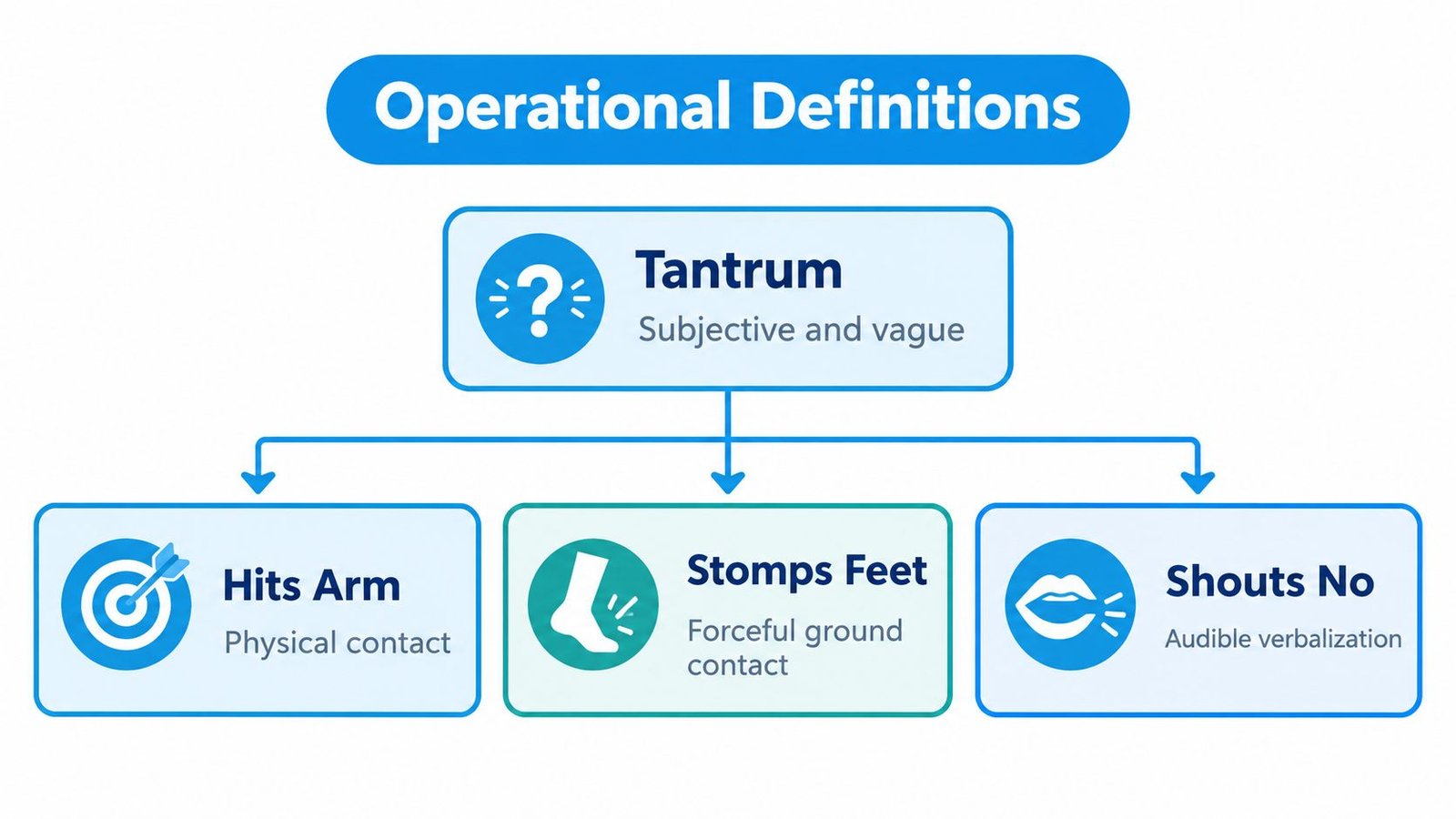
“Tantrum” is a label, not a measurement. A usable definition might specify that the target begins when the child screams above conversational volume, drops to the floor, hits another person, or throws an item with force. It might end after a defined period without those actions. The treatment team must set those boundaries, because the right definition depends on the clinical goal.
Examples and nonexamples
A definition needs nonexamples because observers often agree on obvious events and drift on borderline ones.
- Target: Hits arm with an open or closed hand, making physical contact. Do not count: moving a hand near the arm without contact.
- Target: Stomps one or both feet forcefully against the floor. Do not count: ordinary walking or shifting weight.
- Target: Says “no” at an audible volume after a request. Do not count: asking a clarification question or repeating a modeled word.
A request isn't automatically a tantrum. “Can I have a break?” may be appropriate communication, even when it follows a demand. Likewise, combining escape-related behavior and attention-seeking behavior under one broad label can make the record less useful. Record the observable action first, then capture the request, consequence, and setting as context rather than guessing the function.
The topography of behaviour reference can help teams focus on what an action looks and sounds like before assigning an interpretation. Keep definitions narrow when the team needs to compare changes in a specific response. A broad category may help during initial screening, but it becomes harder to graph and interpret when several different actions are combined.
For a structured app entry, use fields such as behavior, start time, end time or count, antecedent, consequence, location, and observer. Write one example and one nonexample into the training record, then ask each caregiver to score practice scenarios independently. If they disagree, revise the wording before collecting important treatment data.
Choosing the Right Recording Method for Each Behavior
The measurement method should match the dimension that matters. Counting an episode can hide whether it lasted seconds or most of the afternoon. Timing every event can overwhelm a caregiver who only needs a practical trend. The wrong method doesn't merely create inconvenience. It can systematically distort the graph.
| Method | Best for behavior that is | Scoring rule | Known error direction |
|---|---|---|---|
| Frequency or rate | Occurs as separate, countable events | Count each occurrence, or relate count to observation time | Frequency can mislead when observation periods differ |
| Duration | Has a meaningful start and end | Record elapsed time from onset to offset | Missed onset or offset changes the estimate |
| Latency | Follows an instruction, cue, or event | Time from the cue to response initiation | Delayed timer starts or stops affect the result |
| Partial interval | Occurs rapidly or is difficult to count continuously | Mark the interval if behavior occurs at any point | Tends to overestimate occurrence |
| Whole interval | Needs to occur throughout an interval | Mark the interval only if behavior lasts the entire time | Can underestimate occurrence |
| Momentary time sampling | Must be sampled in busy settings | Score whether behavior occurs at the end of each interval | Can miss behavior between checks |
Match the tool to the question
If elopement has a clear beginning and end, event recording can count each occurrence. If the team needs to know whether episodes are becoming shorter, duration is more informative. For a meltdown, start timing at the agreed onset and stop at the agreed recovery point, rather than relying on a later estimate.
Latency answers a different question. If the target is task initiation, record the time from the instruction to the first defined action. A family can capture the instruction time and response time without labeling the child “unmotivated” or “non-compliant.”
Partial interval recording can be practical for high-rate scripting or vocal behavior. The observer marks whether the behavior occurred during each interval, even briefly. Recommended-practice guidance identifies 5-to-10-second intervals as an optimal range for some partial-interval applications and explains that the method tends to overestimate behavior (measurement guidance from the Association for Behavior Analysis). Whole interval is better suited to sustained behavior, while momentary time sampling can reduce the demand of continuous observation in a classroom or group.
Before each new data push, ask one question: What decision will this measure support? If the answer concerns how often, count it. If it concerns how long, time it. If it concerns starting after a cue, measure latency. If continuous recording is unrealistic, use sampling and document its limitations.
Training Caregivers Using Behavioral Skills Training
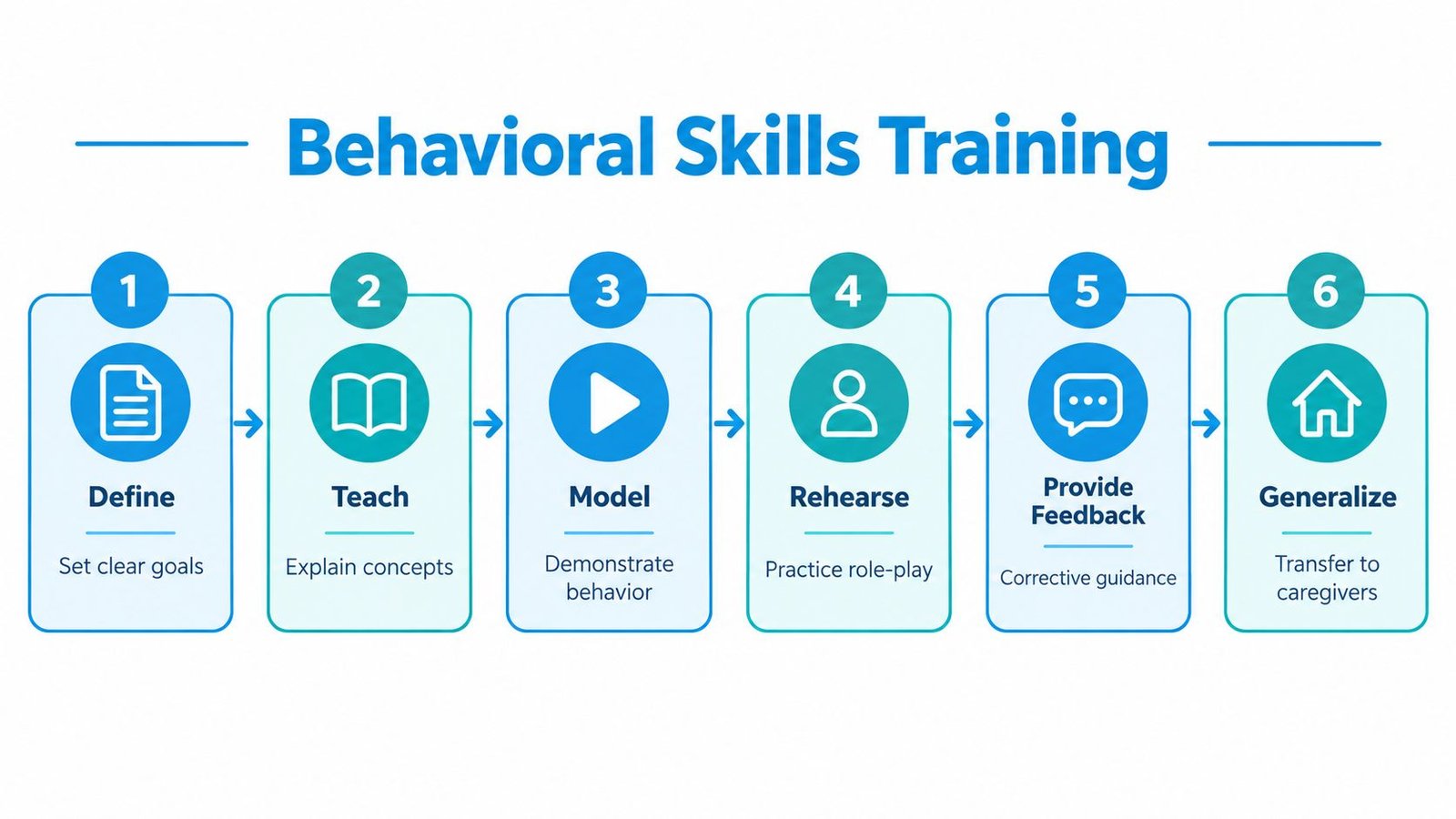
A definition on a page doesn't create competence. Caregivers need to practice the exact recording procedure, receive correction, and demonstrate accuracy under conditions that resemble daily life. Behavioral skills training provides a reliable cycle: define, teach, model, rehearse, provide feedback, and generalize.
The six-part cycle
Define the target and the mastery standard. For example, the caregiver must identify every instance of “shouts no” in a short video and leave unrelated speech unscored.
Teach the recording system. Explain whether the caregiver should count events, start a timer, mark intervals, or record an antecedent-behavior-consequence sequence. Show the agreement formula before practice begins so the observer understands what accuracy means.
Model correct and incorrect scoring. A supervisor might score a clip, pause, and explain why a quiet request is not counted as shouting. Demonstrate how to record a missed observation instead of filling the gap from memory.
Rehearse with role-play or standardized video. Include clear examples, borderline examples, and nonexamples. Short drills are easier to complete than a long lecture, and they reveal confusion while correction is still simple.
Provide feedback immediately. State what was correct, identify the exact scoring error, and have the caregiver score the same segment again. Feedback should address the component, not the person.
Generalize across people and settings. A caregiver who scores accurately at the kitchen table still needs checks during homework, transitions, and community routines. Add new observers only after they review the current definition and practice record.
A defensible mastery rule is 100% correct implementation across two consecutive mock sessions, followed by periodic direct checks. Applied training studies have used this standard. One study reported 97% overall agreement, with agreement ranging from 85% to 100%, after observers met the two-session accuracy requirement (applied observer-training study). These figures describe specific studies, not a guarantee for every team.
Keep a competency record for each RBT, parent, teacher, or relative:
- Definition check: quiz results and reviewed examples
- Practice observations: dates, scenarios, and scored opportunities
- Mastery date: when the observer met the agreed criterion
- Retraining date: the most recent corrective practice
- Independent checks: percentage of real sessions reviewed by another observer
A lecture or app tutorial can introduce a procedure. It cannot prove that a tired caregiver will apply it correctly three weeks later. That's why autism training for parents should be treated as an ongoing skill-building process, not a completion certificate.
Running Interobserver Agreement and Procedural Fidelity Checks
Two people using the same form can still produce the same wrong answer. Interobserver agreement, or IOA, asks whether two observers recorded behavior similarly. Procedural fidelity asks whether the observer followed the recording or intervention procedure as written. They measure different risks and should not be substituted for each other.
For interval data, the basic calculation is:
Matching intervals ÷ total intervals × 100
If two observers score the same interval alike, it counts as a match. For frequency, duration, or latency, use a calculation suited to that measurement rather than relying only on total-count agreement. A total-count comparison may conceal timing differences, missed events, or inconsistent onset and offset decisions.
The shared-error problem
High agreement doesn't prove validity. If both observers fail to notice a quiet hand raise, they may agree perfectly while missing the target. Train on the exact measurement dimension and review disagreements by behavior component and time segment. IOA is strongest when observers independently score the same event rather than discussing it while recording.
Procedural fidelity might ask whether the observer started the timer at the defined onset, marked every interval, recorded the correct setting, and entered the observer identity. It may also assess whether an intervention was delivered as specified. The BACB ethics and documentation code emphasizes records that support continuity, accountability, confidentiality, and lawful professional practice.
A controlled observation study found trained participants reached a 97% mean final accuracy, required an average of 8.6 training sessions, and spent about 83.8 minutes in training, with final accuracy ranging from 94% to 99% (controlled observation study). Those results help illustrate why practice and feedback matter, but each team should set its own preset retraining threshold with the supervising clinician.

A workable check routine looks like this:
- Sample across conditions: Include home, school, clinic, different observers, and relevant routines.
- Review the disagreement: Find the exact interval or event where scores diverged.
- Separate errors: Decide whether the problem was definition, timing, entry, or procedure.
- Retrain below threshold: Use the preset criterion rather than waiting for a visibly poor graph.
- Assign the second observer carefully: A trained parent, teacher, RBT, or supervisor may support a spot check, but the BCBA remains responsible for clinical interpretation and should define the role.
A shared record can support special education progress monitoring when the team preserves the distinction between caregiver observations and professionally verified measurement.
Building a Weekly System That Keeps Data Reliable
A reliable system still works when the lead therapist is sick, childcare shifts between households, or a new RBT joins. The maintenance loop should be small enough to complete and specific enough to reveal drift.
A practical weekly rhythm
At the start of the week, review each operational definition and one example and nonexample. If the routine changed, update the training record before asking everyone to collect data.
During the week, run a short refresher drill. Have a caregiver score a brief scenario independently, then compare the result with the reference score. One quick check can expose confusion about onset, offset, or what belongs in the context field.
At least once during the week, conduct an IOA spot check and a procedural-fidelity check. Don't wait until a monthly meeting if the team is already making decisions from the data.
On Friday, review the graph with the raw entries. Look for missing dates, unexplained gaps, inconsistent observers, sudden level changes, and differences between settings. A graph is only as useful as the records behind it.
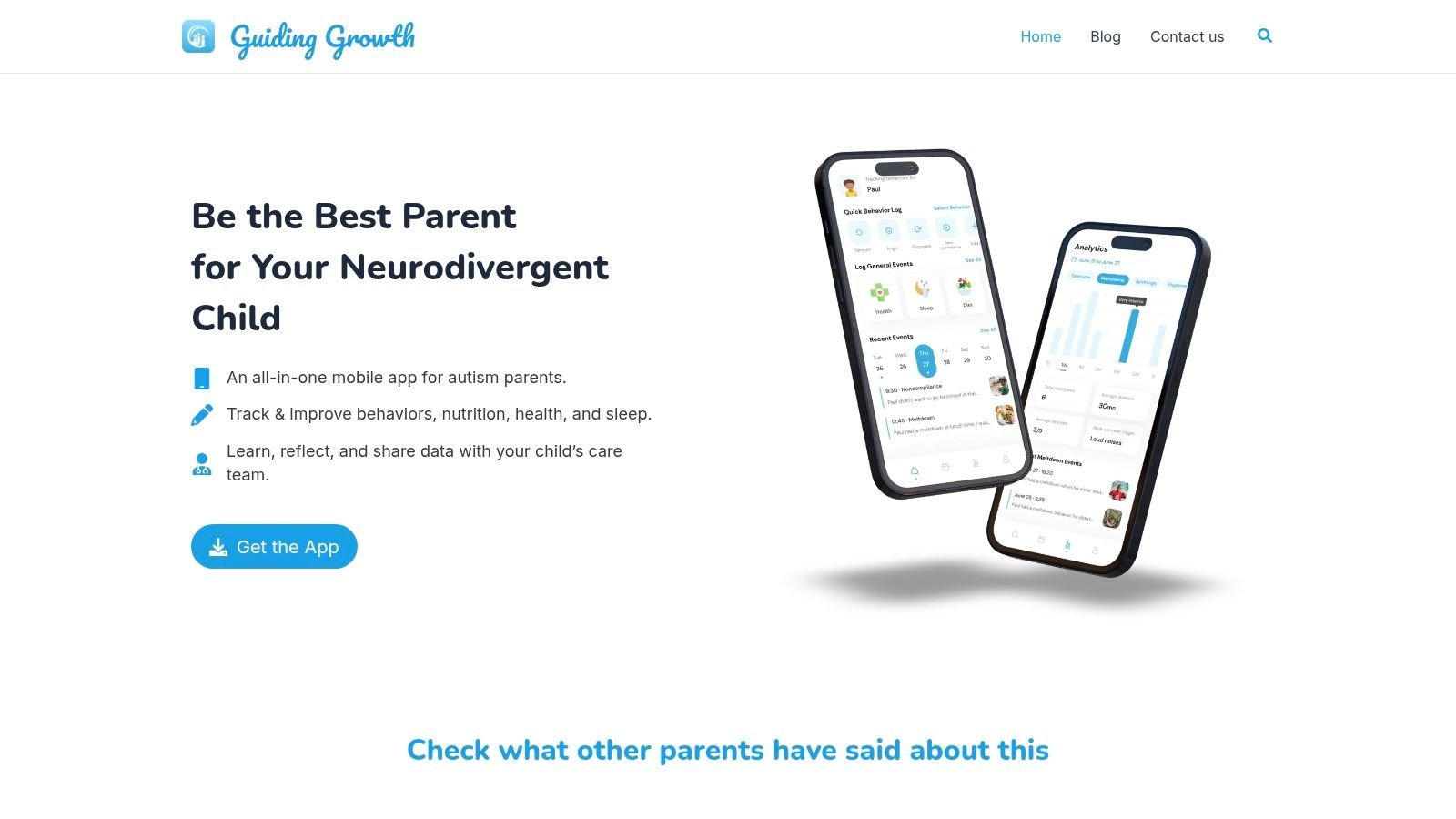
A structured tool such as Guiding Growth can keep operational definitions, observer IDs, timestamps, and context notes together. Families can use the app to organize entries, attach notes or media, view patterns, and prepare a PDF or summary for a therapist or IEP meeting. Permissions still matter. Invite co-parents, babysitters, grandparents, educators, or therapists according to what each person needs to view or add.
Documentation remains the family's responsibility even when an app stores the record. The BACB materials identify raw data, graphs, assessments, progress summaries, and reports as possible parts of a service record, and they emphasize confidentiality during creation, storage, access, transfer, and disposal. Use accurate dates, identify observers, confirm sharing permissions, and follow the provider's privacy and retention requirements.
Knowing When Less Logging Is the Better Answer
More entries don't automatically create better decisions. A family can be highly committed and still produce unreliable data if the system demands constant timing, duplicate scoring, and detailed notes during every routine. A burdened system encourages late entries, copied estimates, and eventual abandonment.
A tiered plan is usually more durable:
- Routine logging: Record a small set of high-value fields on ordinary days, such as behavior, time, setting, observer, and immediate context.
- Targeted measurement: Increase detail during assessment, treatment changes, safety concerns, or periods when the team needs to distinguish frequency from duration.
- Periodic reliability checks: Use planned IOA and fidelity checks instead of asking two people to score everything continuously.
The 2024 survey of behavior analysts found that fidelity data were most often collected with checklists during direct observation, while limited resources, absent employer requirements, and limited supervision time were leading barriers (survey of fidelity-data practices). Those constraints affect families too. Shift work, shared custody, interpreters, siblings, and several care settings can make intensive forms unrealistic even when everyone wants to participate.
A minimum viable dataset should answer the decision at hand. Step logging up when the team needs onset and offset detail, when two observers disagree, or when an intervention has changed. Step it down when the same fields aren't being completed, the observation itself disrupts care, or the clinician only needs a broad routine pattern.
Voice or photo-assisted quick logs can reduce entry friction, but the caregiver should review extracted information for accuracy before saving it. Ask these questions this week:
- Which behavior or skill requires a decision?
- What is the smallest measurement that can inform that decision?
- Who will record it, and when?
- How will another person check accuracy?
- When will the team review the graph and raw entries?
For teams comparing ways to organize progress records across coaching and care contexts, Coachful progress tracking for coaches offers another perspective on keeping updates structured without making documentation the entire service.
Guiding Growth gives families one place to capture structured behavior observations, context, timing, and patterns across caregivers, with voice-based Quick Log entries that can be reviewed before saving and meeting-ready summaries that can be exported. Use it to build a lighter, more consistent ABA data collection routine, then visit Guiding Growth to see how it can fit into your home, school, and therapy coordination.