You're standing by the front door with a backpack in one hand, repeating that it's time to leave, while your child is still absorbed in the last activity and showing no sign of shifting. You gave a warning. You gave another one. Nothing moved until voices rose and everyone left upset. That pattern doesn't mean your child didn't care or that you planned badly. It usually means the support didn't match the specific time skill that was straining in that moment.
Table of Contents
- Why Time Feels Different for Many Autistic Kids
- What Research Says About Time Perception and Memory
- Build a Visual Schedule That Gets Used
- Smooth Transitions With Warnings, Timers, and Bridges
- Track the Situation Around a Missed Transition
- Reduce the Caregiver's Hidden Coordination Load
- Turn Daily Routines Into Meeting-Ready Data
Why Time Feels Different for Many Autistic Kids
Most mornings don't fall apart at the shoe rack. They fall apart earlier, when five more minutes means something clear to you and something vague, urgent, or endless to your child. You're watching the clock because the bus won't wait. Your child may be trying to finish a thought, tolerate a noisy kitchen, and figure out what happens after shoes, all at once.
That's why autism and time management works best when you treat it as an executive function support need, not a motivation problem. Estimating duration, sequencing steps, remembering to start something later, and switching activities are separate skills. A child can manage one and struggle badly with another.
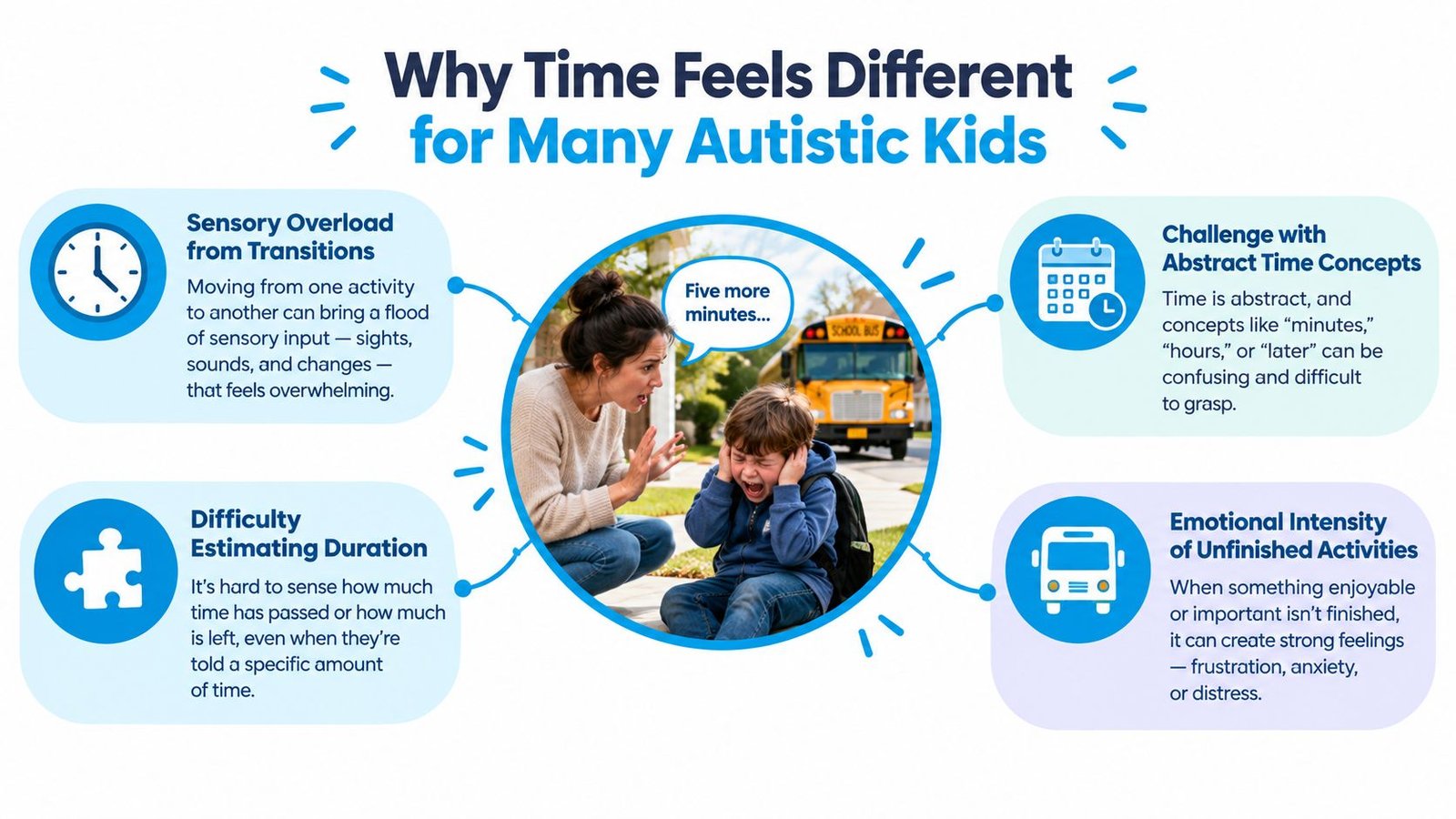
What this looks like at home
- Estimating duration: Brushing teeth feels instant one day and endless the next, so pacing falls apart.
- Sequencing: Your child knows the morning routine but loses the order when a step changes.
- Remembering later actions: Packing a library book after breakfast disappears unless something external holds that intention.
- Switching: Leaving a preferred activity carries an emotional and sensory cost, not just a clock cost.
In a study of 64 adults, 35.4% of autistic participants reported clinically significant time-management deficits compared with 3.1% of controls, with average time-management scores of 49.0 versus 33.0, according to executive-function findings on the Barkley Deficits in Executive Functioning Scale. That study involved adults described as high-functioning, so it doesn't describe every autistic child. It does show why external structure is a legitimate accommodation rather than a crutch.
For a seven-year-old, that translates into something practical. Don't ask which reward will make mornings work. Ask which skill is breaking down. Is it knowing what comes next, judging how long breakfast takes, starting after a cue, or tolerating the switch itself?
When time is hard, the routine is the support. Build the routine around the specific skill that's straining.
Once you name the strain, you can stop repeating the same verbal countdown louder and start changing the conditions around it.
What Research Says About Time Perception and Memory
Parents often hear that autistic kids don't understand time. That statement is too broad to be useful. Perceiving how long something lasts and remembering to act at a future moment are different jobs, and they need different tools.
In a study of 12 autistic children and 12 matched typically developing children, the autistic group showed strong duration discrimination with no greater variability on intervals below 2 seconds and from 2 to 17 seconds, as reported in temporal-bisection research with autistic children. Your child may judge short intervals accurately in a quiet task and still fall apart during a noisy transition.
Other findings point in a different direction for brief waits. On intervals from 400 to 1,600 milliseconds, people with higher autistic traits tended to judge short durations as longer and showed reduced temporal sensitivity in research on brief duration judgments and autistic traits. That helps explain why a short warning, a pause between instructions, or waiting by the door can feel much longer than you intend.
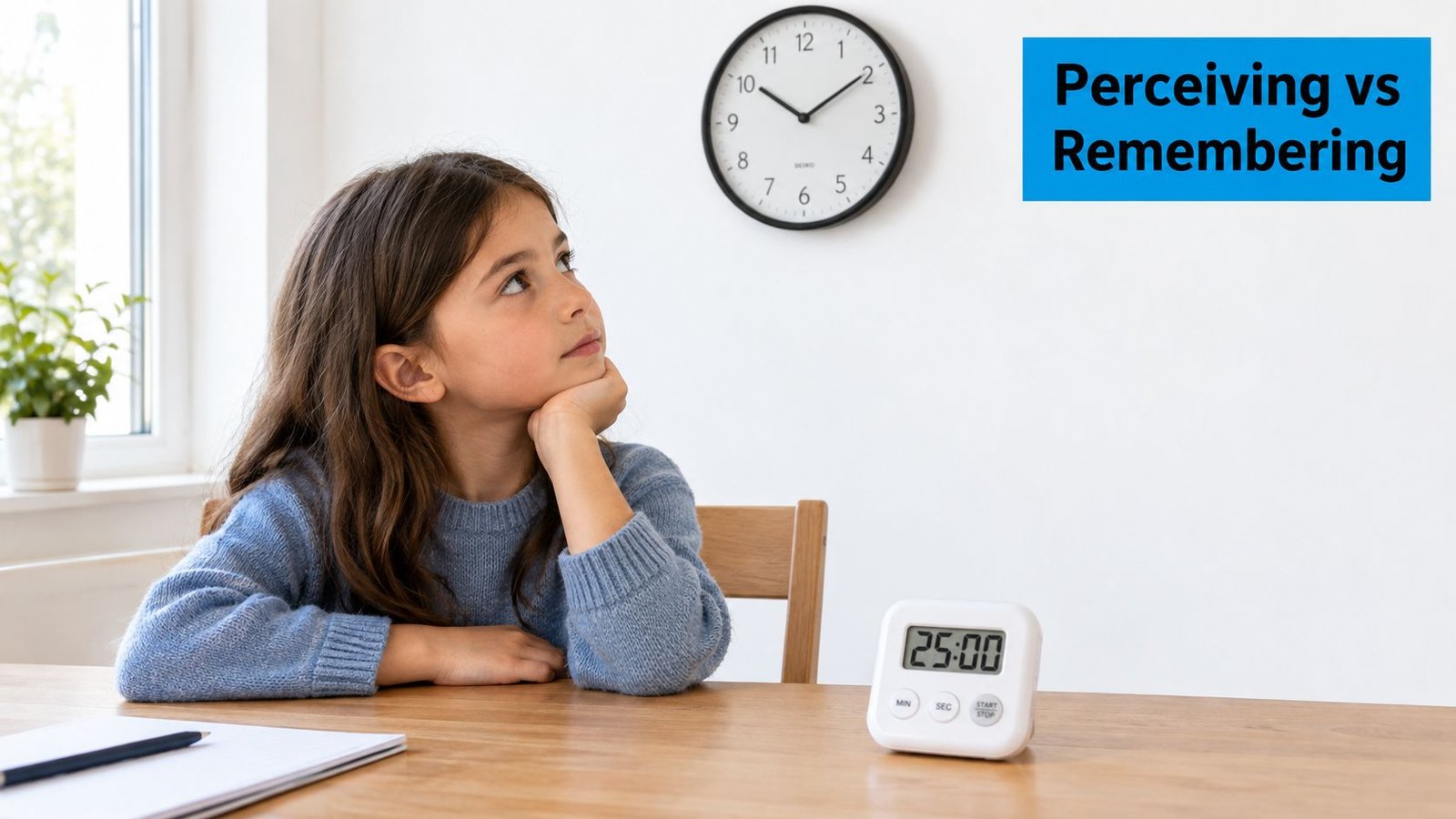
This photo captures the other half of the problem, where a child has to connect a timer on the table with time passing somewhere else in the room.
The prospective memory bottleneck
Time-based prospective memory means remembering to initiate an action at a specified time. Autistic participants performed worse than comparison groups on both time-based and event-based prospective-memory tasks in a systematic review of prospective memory in autism. Leaving for school at a set time, starting medication, or beginning homework after a break all depend on this skill.
Match the tool to the bottleneck. Use a visual clock or countdown to make duration visible. Use a vibrating alarm or routine timer to trigger initiation. Don't expect one tool to solve both a duration problem and a starting problem.
The most evidence-backed place to put this into practice is a visual schedule that your child checks, not a poster nobody touches.
Build a Visual Schedule That Gets Used
A morning can unravel between brushing teeth and finding shoes. Start with one target routine, such as arriving home after school or getting ready for bed. A schedule for the whole day may look complete, but it is harder to teach, update, and keep in use. Begin with the steps that regularly cause a pause or prompt, then adjust the sequence to fit what happens in your home.
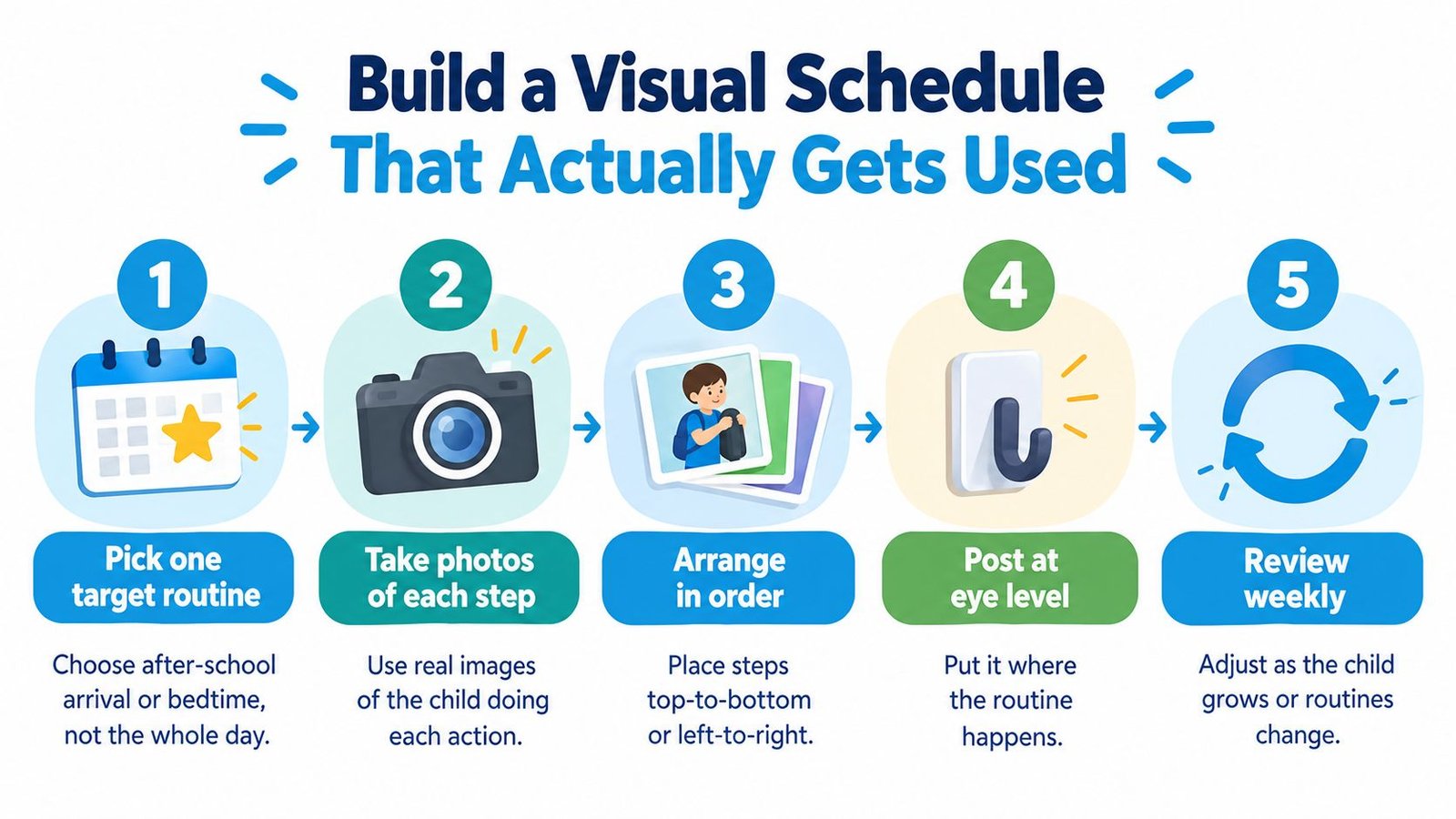
Choose a format your child can scan and you can maintain. Photos can help children who do not read yet; icons suit quick scanning, while older children may prefer a text checklist. A digital display is easier to edit, but a paper strip may be quicker to check in the bathroom or hallway. The right choice depends on the child, the location, and who will update it.
Build the checking habit
- Define one observable target: Choose a sequence you can see, such as completing the morning bathroom routine or moving through after-school steps.
- Choose the format: Match photos, icons, text, or a digital display to your child's reading and scanning preferences.
- Teach the checking habit: Look at the next step together, do it, then cross it off, flip it over, or mark it complete.
- Prompt least to most: Begin with a gesture, add a verbal cue if needed, and reinforce the check. Reduce help as your child becomes more independent.
For a morning strip, use brush teeth, pack snack, shoes, bus. Photograph your child doing each step in your own bathroom and hallway, then place the strip at eye level by the mirror. Familiar images in the actual setting reduce the work of connecting a symbol to the next action.
Evidence supports trying schedules, while also pointing to a maintenance challenge. A review reported positive outcomes in each of seven studies, including improved independent transitions in three studies and increased on-task behavior in four studies. Only four studies assessed maintenance, so plan early for the schedule to work with other adults and in other settings, and for prompts to fade. A schedule that depends on an adult standing beside it still needs adjustment. See a review of visual activity schedule outcomes.
A broader summary covering 23 peer-reviewed studies reported that visual activity schedules had been used to teach skills including on-task behavior. The Association for Science in Autism Treatment review of activity schedules offers further background.
Watch the video before teaching the checking routine. The teaching is part of the tool.
If you coordinate routines on a family calendar, SyncThemCalendars time blocking tips can help adults mark recurring routines and appointment buffers. Keep a brief record of the prompt used and whether the transition worked. Those patterns can show which steps need a different cue and where support can be reduced.
Smooth Transitions With Warnings, Timers, and Bridges
The hardest transition may be leaving the playground, not getting dressed at home. That difference matters: autism and time management work better when cues fit the situation, rather than relying on one schedule for every switch. A child is stopping a predictable activity, processing what comes next, and starting a new set of demands.
Try this sequence on a therapy afternoon. Say, “Building stops when the timer ends. First shoes and car, then your music on the drive.” Put pictures of the shoes and car on a first-then card. When the timer ends, point to the card, offer a familiar object to carry, and begin. If every cue leads to another negotiation, the child may learn to wait for bargaining before moving.
A few tools can work together:
- Advance notice: Give a clear warning and name the next activity in concrete words.
- Visible countdown: Let a timer show time passing instead of asking your child to estimate it.
- Transition bridge: Bring a familiar object, song, snack, or sensory item into the next setting.
- First-then card: Show the less-preferred step and what follows it.
For actions tied to a clock time, try an external cue. A vibrating alarm for departure or medication can prompt the action without relying on your voice. Ask your child to acknowledge it by tapping it off or giving a thumbs up, then start.
Measure the gap: Note how long passes between the cue and your child starting the action, not just whether the task eventually happened.
A transition can finish while still requiring repeated prompts. For a few difficult switches each week, record the cue, prompt level, time to start, and whether the action was completed. These measures show whether the tool is helping your child begin with less support.
Keep the record brief, and include conditions that might change how a cue works: who was present, noise, hunger, warning length, and whether the next activity was familiar. Look for patterns across settings before changing the whole routine. This tracks the child's transition and the caregiver's prompting, so the family can see where support is still needed.
If a countdown raises anxiety, try a shorter warning or a silent visual timer. If your child needs more processing time, lengthen the bridge instead of adding verbal reminders. Change one variable at a time, then note what changed.
Track the Situation Around a Missed Transition
Stop asking why your child was late again. Ask what was different this time. The same child can sail through leaving Grandma's house and melt down leaving the playground, and that contrast contains useful information.
Executive-function performance varies substantially by context, and parents described creating external structure because children might otherwise waste available time, in qualitative research on everyday executive function in autism. Treat a missed transition as pattern detection, not a character verdict.
What to Log Around a Difficult Transition
| Field | Why it matters | Example |
|---|---|---|
| Sleep and energy | Fatigue changes flexibility and initiation | Short night, woke twice |
| Warning time | Too short or too long can both backfire | Two-minute visual countdown |
| Sensory load | Noise, light, and crowding raise switching costs | Loud cafeteria before pickup |
| People and place | Familiar adults and settings change demands | Substitute teacher, new waiting room |
| Next activity clarity | Uncertainty makes leaving harder | Knew therapy room, not the activity |
| Prompt and outcome | Shows whether support reduced dependence | Gesture only, started after timer |
Log right after the event while details are fresh, even if the entry takes under a minute. Note what your child understood about the next activity, not just what you said. Those are often different.
After two weeks, read across entries instead of reliving each day separately. You may notice difficult transitions cluster after poor sleep, on high-noise days, or when warnings came from across the room. Another family might find the pattern is uncertainty, because transitions improve whenever the next adult and room are known.
If you want a structured way to connect those observations, guidance on tracking and understanding behavioral triggers can help you organize antecedents and outcomes consistently. Consistency matters more than perfect detail.
Don't log every transition forever. Sample the hard ones, review for clustering, change one condition, then keep logging long enough to see whether that change helped. That turns scattered memory into a decision you can explain to a teacher or therapist.
Reduce the Caregiver's Hidden Coordination Load
The morning appointment may take thirty minutes, but the work around it can start days earlier: finding a provider, completing forms, arranging transport, sharing records, and checking what happens next. Your child's routines are only one part of family time management. When one caregiver holds every detail in memory, that person becomes the human calendar, and the coordination load can keep growing.
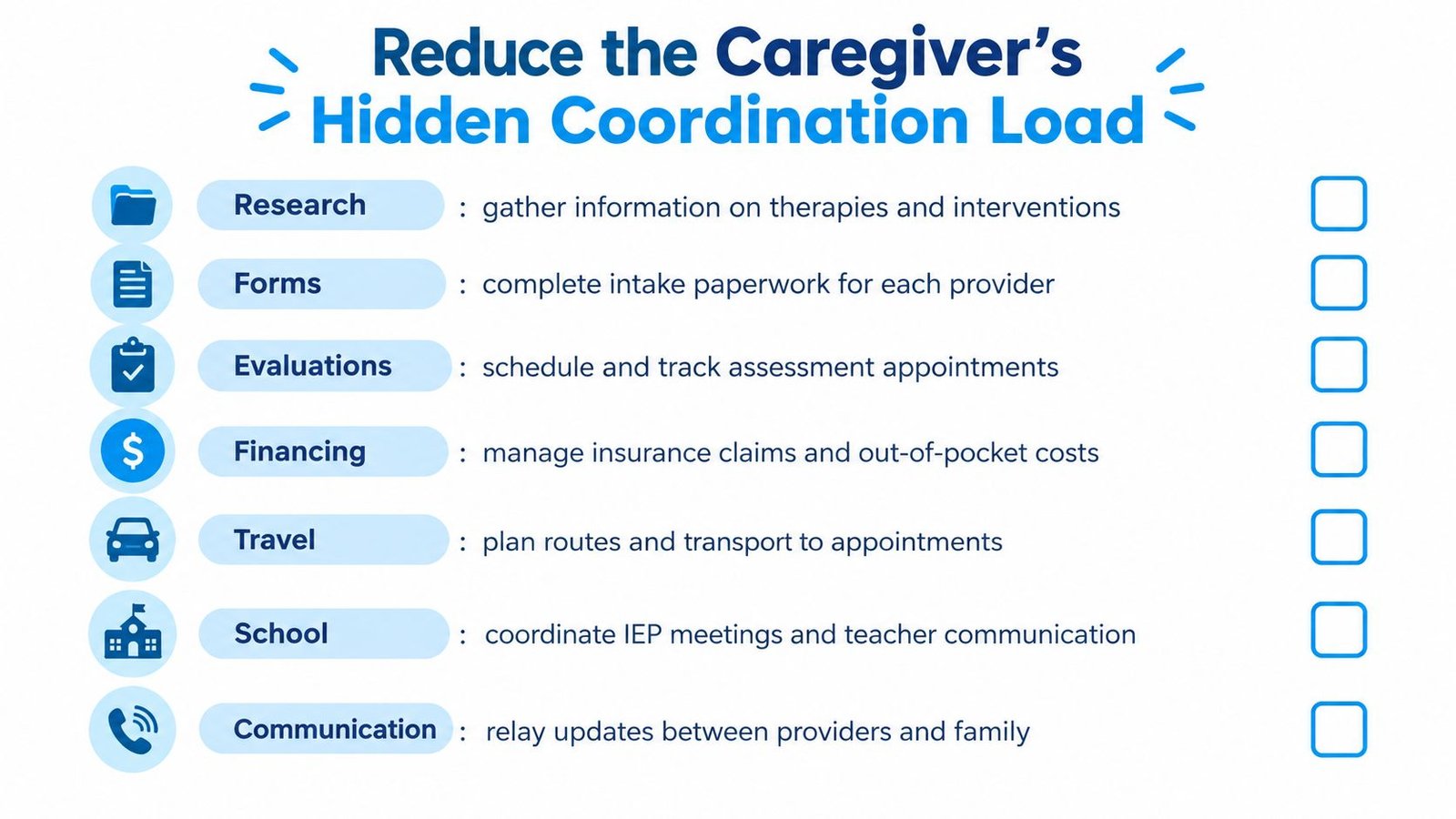
This work takes time. Parents of autistic children reported approximately 370 minutes of informal care per day, including 204 minutes for supervision and emotional support, in time-use evidence on parents of children with complex needs. Another diary study in that review found mothers spent 312 minutes on weekdays and 384 minutes on weekend days, and 92% reported insufficient time to complete activities. These historical figures will not describe every household, but they show why improving a child's schedule may leave caregiver overload untouched.
The coordination itself is often fragmented. Families share information across home, school, transportation, and providers, while each professional may see only part of the picture, as described in research on caregiver coordination and everyday executive function. A reliable system makes ownership visible instead of relying on one person to remember every handoff.
Make ownership visible
Start this week with one shared place to record who is responsible for the next task and when it is due. That could be a shared document, a binder, or a care app. Choose the least complicated option your family will update.
For example, after an appointment, record who will request the notes, who will send them to school, and when that should happen. Let co-parents or grandparents add updates directly rather than sending them to one person to file. Give educators and therapists access only to the routines relevant to their work, and keep family-only details private. Before an IEP or 504 review, gather the records needed for that meeting instead of rebuilding the timeline from memory.
A mobile option such as Guiding Growth lets a parent use a voice recording to create structured entries for behavior, sleep, meals, mood, and medications, then invite collaborators with per-person permissions. The tool matters less than having one current record that the people involved can use.
A care coordination system for families can help you set up shared records and clear handoffs. Track the time you spend coordinating, too. If a strategy saves your child ten minutes but adds an hour of nightly preparation, it may need a simpler version or a different owner.
Turn Daily Routines Into Meeting-Ready Data
A log only helps if it changes a decision. After several weeks, your entries should show behavior frequency over time, common triggers, time-of-day clustering, and whether difficult transitions gather around particular people, places, or warning styles. That's the point where autism and time management stops being a daily scramble and becomes a system you can adjust.
Planning support shouldn't depend on hoping skills will catch up. A longitudinal meta-analysis covering up to 518 autistic children and adolescents and 3,558 typically developing participants found poorer executive functioning at both baseline and follow-up, with no significant group difference in age-related change, in longitudinal executive-function research in autism. Keep supports that work, fade them deliberately, and use your records to decide.
Build a summary a professional can use
Pick a date range tied to the meeting purpose. For an IEP review focused on morning arrival, filter for behavior, sleep, and transition entries rather than handing over every meal and note. For a new specialist intake, include a broader range so the clinician sees context.
A practical summary request looks like this. Choose the last month, select behavior and sleep entries, mark the meeting type as an IEP review, and export the result as a PDF. Bring two or three specific examples that illustrate the pattern, including the warning given, prompt level, latency to start, and outcome.
If you're preparing for school, steps for preparing for an IEP meeting can help you turn those records into goals and questions. Walk in with patterns instead of panic. You're not trying to prove your child is difficult or that you're doing enough. You're showing which conditions make time skills easier or harder.
Bring the conditions, not just the incidents. Professionals can adjust conditions. They can't do much with a general report that mornings are rough.
A rhythm you can sustain
- Tomorrow: Pick one routine, photograph its steps, post the schedule where the routine happens, and teach your child to check and mark each step.
- This week: Log three difficult transitions with sleep, sensory load, warning time, prompt level, latency, and outcome.
- Next two weeks: Change one condition only, such as a visual countdown, a vibrating alarm, or a clearer first-then card.
- This month: Invite one collaborator into the record, review clustering by time and setting, and generate one summary for the next appointment.
Keep the bar deliberately low on busy days. A short voice note that captures the cue, context, and outcome is more useful than a perfect form you abandon. Review weekly at the same time, perhaps while Sunday laundry runs, and ask one question. What pattern repeated, and what's the smallest change worth testing next?
Some routines will improve quickly. Others will work at home and fail at school, or work with you and fail with a substitute. That isn't a reason to scrap the system. It's data about generalization, and it tells the team exactly where to teach next.
Start with one routine tomorrow morning. Your future self, sitting in a meeting three months from now, will be glad you wrote down what happened.
Guiding Growth helps you log routines, transitions, sleep, behavior, and appointments in one shared place, then turns those entries into patterns and meeting-ready summaries for your child's care team. If you're ready to replace scattered notes and memory with a record you can use, visit Guiding Growth and start with tomorrow's first routine.