You hear your child say a line from a favorite movie with perfect expression, at the exact moment they want a snack, leave the room, or calm themselves down. Or maybe their words are advanced, but the rhythm sounds a little unusual. Maybe they use “you” when they mean “I,” or they answer questions in a way that feels very literal. Many parents notice these things long before they have language for them.
That noticing matters.
Speech differences in autistic children can feel confusing at first, especially when your child is clearly trying to communicate. What helps most is shifting from “How do I stop this?” to “What might my child be telling me through this pattern?” That mindset changes everything. It makes room for understanding, support, and more useful conversations with your child's care team.
Table of Contents
- Your Child's Unique Voice and What It Might Mean
- Common Autism Speech Patterns Explained
- Why These Speech Differences Occur
- Signs to Notice and When to Seek Evaluation
- Supportive Strategies for Parents and Caregivers
- How Structured Tracking Reveals Deeper Insights
- Partnering for Your Child's Communication Success
Your Child's Unique Voice and What It Might Mean
A parent once told me, “My son doesn't always answer questions directly, but he can repeat whole scenes from a cartoon with exactly the right feeling in his voice.” That observation was not small. It told us he was hearing language closely, storing it, and using it for a reason.
Many autistic children communicate in ways that don't look typical at first glance. A phrase repeated from a show might mean “I'm overwhelmed.” A sing-song tone might show excitement, regulation, or a natural speech style. A child who seems fluent may still have differences in pitch, stress, or pacing that shape how other people understand them.

Speech differences can be broad and varied
Autism speech patterns are not one single thing. A major NIH-hosted review notes that roughly 3 out of 4 autistic children show some impaired language abilities by kindergarten, while the language profile is highly varied. Some children have broad challenges, others show exceptional linguistic creativity, and many autistic individuals, including fluent speakers, have noticeable differences in stress, tone, and pitch (NIH-hosted review on language and speech in autism).
That wide range is often what confuses parents. People expect one clear sign. Instead, they see a child who might have a large vocabulary but struggles with back-and-forth conversation, or a child who uses repeated phrases very effectively but not always in expected ways.
Speech patterns don't only tell you how a child talks. They often tell you how a child processes, organizes, and expresses experience.
Curiosity helps more than correction
When you listen for meaning instead of only form, your child's communication starts to make more sense. If your child repeats, scripts, hums, pauses, or uses unusual intonation, those patterns may be serving a real purpose. They may help with connection, regulation, memory, or getting a need met.
That's also why it helps to look beyond spoken words alone. Facial expression, body movement, timing, and context often add important information. If you want to build that wider lens, this guide to nonverbal social cues for autism parents can help you notice what speech is doing alongside gestures and expression.
Common Autism Speech Patterns Explained
Some autism speech patterns are easy to notice. Others are subtle and get mistaken for attitude, inattention, or stubbornness. Clear definitions help.
A quick guide you can return to
| Speech Pattern | What It Is | Example |
|---|---|---|
| Echolalia | Repeating words or phrases heard before | Child says “Time to clean up” when they want to leave the room |
| Immediate echolalia | Repeating something right after hearing it | Adult says “Do you want juice?” Child says “Want juice?” |
| Delayed echolalia | Repeating stored phrases later | Child uses a line from a show during a stressful transition |
| Atypical prosody | Differences in pitch, stress, rhythm, loudness, or tone | Speech sounds flat, overly dramatic, sing-song, or unusually loud/quiet |
| Pronoun reversal | Mixing up “I,” “you,” “me,” or using own name instead | Child says “You want help” when they mean “I want help” |
| Literal interpretation | Understanding words exactly as spoken | Child gets confused by “hold your horses” or sarcasm |
Echolalia is often communication
Echolalia means repeating language that was heard before. Parents are often told it's meaningless. In practice, that's often not true.
A child might repeat your question because they need processing time. They might use a familiar script because it's the fastest available way to express a feeling. They might repeat a line because it carries a memory, a routine, or a whole social situation in one chunk.
Examples help:
- Immediate repetition: You say, “Shoes on.” Your child says, “Shoes on,” while moving toward the door.
- Stored script: Your child says, “All done, see you next time,” in the middle of a hard task because that phrase means escape or closure to them.
If you only hear repetition, you miss the message. If you ask, “What was happening right before they said that?” you often find the function.
Prosody affects how speech sounds
Prosody refers to the music of speech. It includes pitch, timing, stress, loudness, and phrasing. This is the area many people notice first, even when a child has strong vocabulary.
A child's speech may sound:
- Flat or emotionless even when they care very much
- Sing-song or exaggerated in a way that stands out
- Too loud or too quiet for the setting
- Unusually paced, with long pauses or bursts of fast speech
Listeners often judge intent by sound, not just words. When a child attempts to join in, an unusual speech melody can lead others to misunderstand them.
Practical rule: If the words seem fine but conversations still feel “off,” listen to rhythm, pauses, volume, and pitch.
Pronoun mix-ups and literal language have patterns too
Pronoun reversal can sound odd if you're not expecting it. A child may say, “You want a cookie,” meaning “I want a cookie,” because they first heard that phrase said to them. They may be recalling the whole phrase exactly as stored.
Literal interpretation can also trip families up. If you say, “Hop in,” your child may pause because they're picturing hopping. If you joke, “That bag weighs a ton,” they may correct you because it doesn't.
These patterns don't mean your child isn't listening. Often, they're listening very precisely.
Why These Speech Differences Occur
When parents ask why autism speech patterns happen, they usually want one answer. There isn't one. Several developmental pathways can shape how a child learns and uses spoken language.
Some children learn language in chunks
One common reason behind repeated phrases is gestalt language processing. This means a child may learn language in larger pieces instead of one word at a time. A full phrase can act like one meaningful unit.
For example, “Let's go bye-bye” may not start as four separate words. It may start as one stored package linked to leaving. Over time, some children begin breaking those chunks apart and recombining them more flexibly.
This is why a repeated phrase can be purposeful even if it seems out of context to someone else. The child may be selecting the closest available language chunk for the moment.
Speech can also reflect sensory and motor differences
Prosody often reflects more than personality. Sensory processing differences can influence how loudly a child speaks, how they monitor their own volume, and how they respond to the rhythm of other people's speech. Motor planning can also shape how smoothly sounds, pauses, and stress patterns come out.
A child whose speech sounds robotic may not be choosing that style. A child whose voice rises and falls dramatically may not hear it as unusual. In both cases, the pattern can be a natural outcome of how they process and produce speech.
Here's the part many families find reassuring. These patterns are not random. They often make sense when you look at regulation, timing, memory, and the child's communication load in that moment.
Function matters more than appearance
Speech differences become less confusing when you ask function-based questions:
- Is this helping my child request something?
- Is this a way to regulate stress or excitement?
- Is my child recalling a familiar script because spontaneous language is harder right now?
- Is the sound pattern affecting daily communication, or just sounding different?
A speech pattern can be unusual and still be useful.
That shift keeps the focus where it belongs. Not on making a child sound typical at all costs, but on helping them communicate comfortably and effectively.
Signs to Notice and When to Seek Evaluation
Some speech differences are part of typical development. Toddlers experiment. They echo. They mix up pronouns. They use phrases in funny ways. The question is not whether a child ever does these things. The question is whether the pattern is persistent, whether it affects communication, and whether your child seems frustrated or hard to understand across settings.
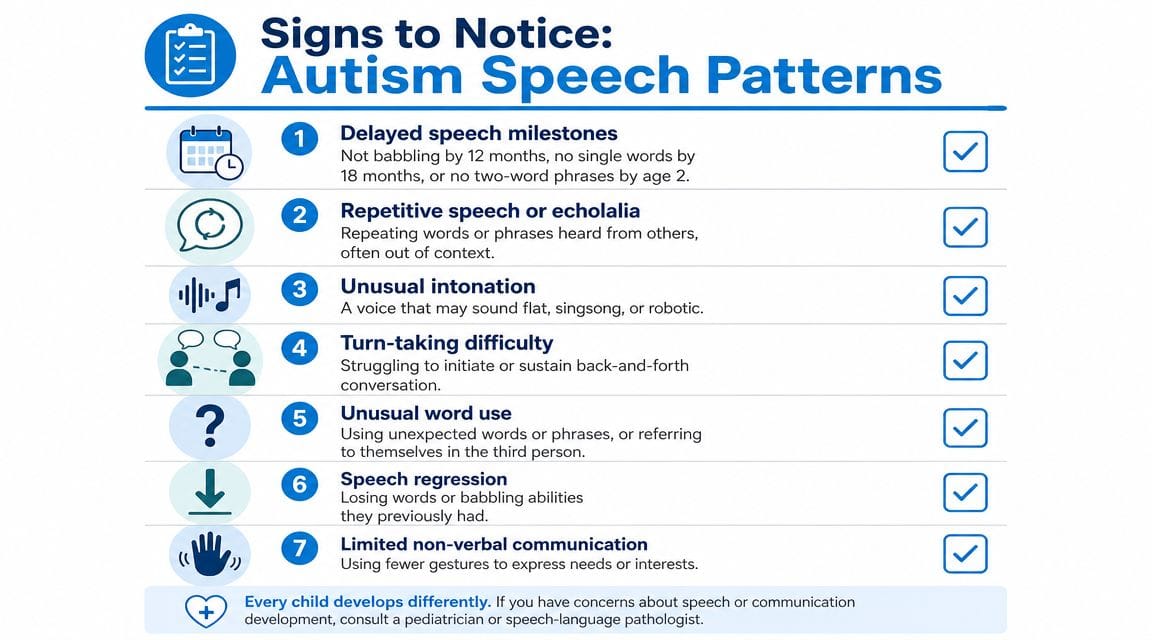
What deserves a closer look
Consider getting a speech-language evaluation if you notice patterns like these over time:
- Repeated scripts that replace flexible language: Your child relies heavily on memorized phrases and struggles to adapt language for new situations.
- Unusual prosody that affects understanding: Other people often misread your child's tone, pacing, or volume.
- Difficulty with back-and-forth conversation: Your child talks, but conversation doesn't flow easily.
- Persistent pronoun confusion: The mix-up isn't occasional. It shows up often and creates confusion.
- Highly literal responses: Figurative language, indirect requests, or jokes regularly cause breakdowns.
- Regression or loss of skills: Words, babbling, or social use of speech decrease after being present before.
- Limited coordination of speech with gestures or facial expression: Your child may use words, but not many other communication tools alongside them.
A pattern matters more when it shows up in daily routines, not just once in a while.
Typical variation versus persistent impact
A brief pronoun mix-up in a toddler usually isn't alarming by itself. A child quoting favorite media sometimes also isn't automatically concerning. What tends to prompt evaluation is consistency, intensity, and impact.
Ask yourself:
- Does this happen across home, school, and community settings?
- Does my child get frustrated when trying to express needs?
- Do familiar adults understand them better than everyone else?
- Are social interactions harder because of how speech sounds or is organized?
If your answer is often yes, it's worth getting skilled input.
A short video can help you compare what you're noticing with common communication signs in real life:
Evaluation is becoming more precise
Speech assessment still relies heavily on clinical listening, parent report, and direct interaction. But the field is also getting better at measuring speech objectively. One study of prosodic and rhythmic speech features reported 85.77% accuracy in classifying autism-related speech abnormalities, showing that measurable speech biomarkers can support clinical observation, especially in verbally fluent individuals where differences may be subtle (study on prosodic and rhythmic speech features).
That doesn't mean a computer replaces a clinician. It means your observations about pitch, pauses, rate, and rhythm are valid things to bring up. They are not “too subjective” to matter.
Supportive Strategies for Parents and Caregivers
Parents often ask what to do in the moment. The most helpful response is usually not correction. It's connection plus modeling.
Respond to the message first
If your child uses echolalia, start by assuming there's meaning there. If they repeat “Do you want outside?” you might respond, “Yes, you want to go outside. Let's go outside.” You're acknowledging the message and offering a slightly more usable model.
That approach lowers pressure. It also gives your child language they can borrow later.
Try responses like these:
- When a script appears during stress: “You're telling me this is hard. Let's take a break.”
- When a repeated phrase seems to be a request: “You want more crackers. I can help.”
- When the phrase is unclear: “I heard that line. Show me what you need.”
Support prosody without demanding a new personality
If your child has unusual rhythm, pitch, or pacing, focus on function. Can people understand them? Can they be heard comfortably? Can they pause enough to get thoughts out?
Play can help:
- Music and rhythm games: Clapping, singing, and chanting can support timing and stress patterns.
- Modeling with warmth: Repeat a phrase naturally without asking your child to “say it right.”
- Visual supports for pacing: Some children benefit from hand cues, dots on a page, or breath cues to slow rate.
The broader field is moving toward individualized support. Current discussion in the literature emphasizes goals like rate regulation or word-finding, rather than trying to eliminate a speech style entirely, and it recognizes that some differences can be adaptive (discussion of individualized speech phenotyping and functional goals).
If a speech difference doesn't block connection, safety, or daily participation, it may not need “fixing.”
Build a communication-friendly home
A supportive communication environment often looks simple, but it takes intention.
- Slow your language a little: Shorter sentences are easier to process during stress.
- Leave space after speaking: Some children need extra time before they answer.
- Use routines as teaching moments: Snack, bath, and bedtime create repeated opportunities for meaningful phrases.
- Accept multiple ways to communicate: Spoken words, gestures, AAC, scripts, pictures, and movement can all count.
- Notice sensory load: Noise, hunger, fatigue, and transitions can all change how speech comes out.
Families sometimes find it helpful to read broadly about child-centered support, and That's Okay's autism guide offers a practical, compassionate overview that fits well with this kind of responsive approach.
If sensory needs seem tied to how speech shows up, this resource on adapting speech therapy for sensory sensitivities may help you think through daily supports.
How Structured Tracking Reveals Deeper Insights
Most parents already track in their heads. The problem is that memory is uneven, especially when days are busy and communication changes fast. You remember the big moment at dinner, then forget the quieter pattern that happened every morning for a week.
What mental notes often miss
A phrase like “Let's go!” might sound random until you log when it happens. Then a pattern appears. It happens before the school bus, during grocery stores, and right before bath. Suddenly the phrase looks less random and more like a transition marker.
Useful tracking usually includes:
- The exact words or script used
- How it sounded, such as flat, loud, whispered, fast, or sing-song
- What happened right before
- Where your child was
- Who was present
- What happened after
That kind of observation helps uncover function. It tells you whether a pattern is linked to stress, excitement, requests, sensory overload, or routine.
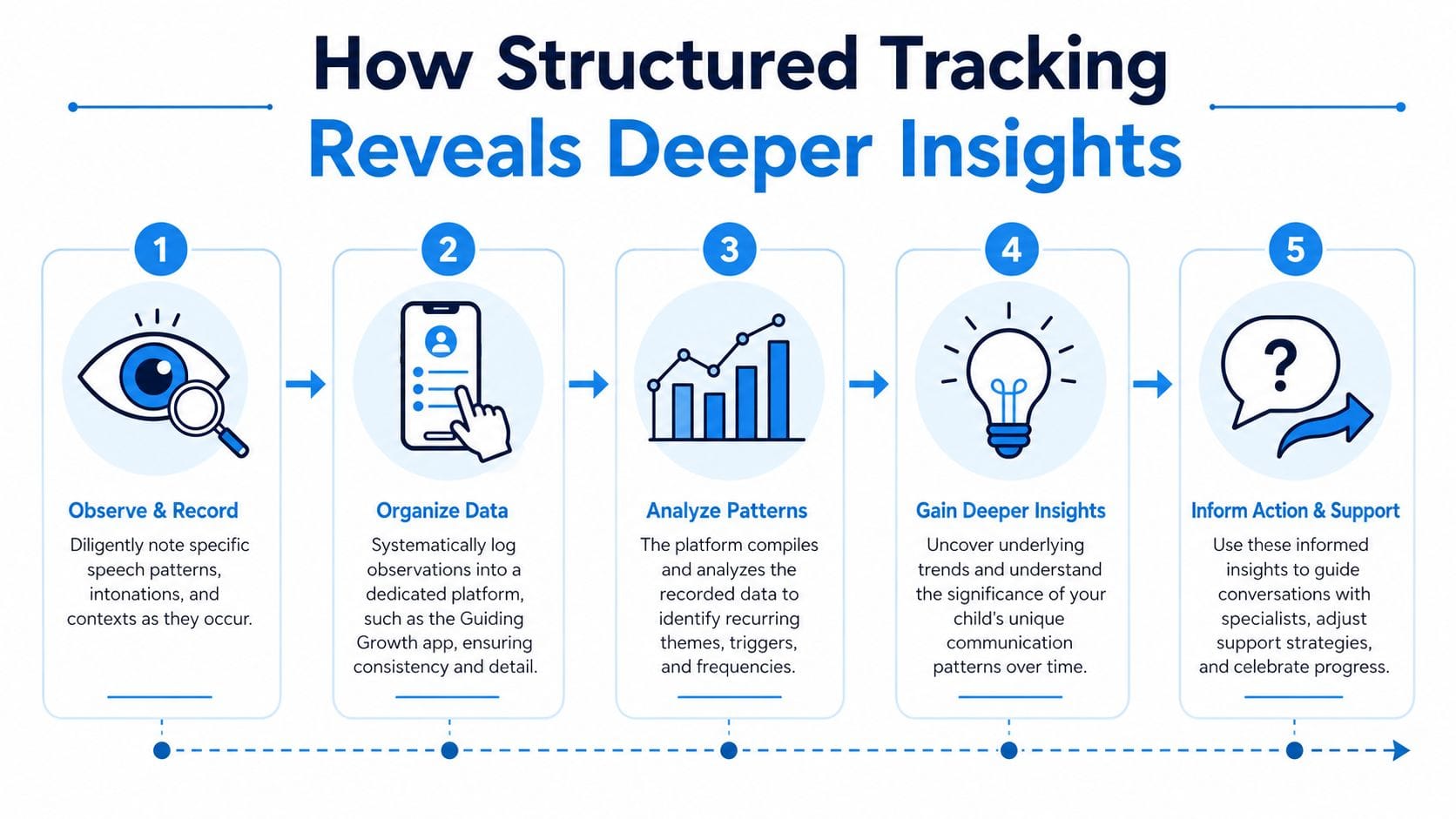
Organized records help your care team faster
A therapist can do more with “He said, ‘No more monkeys jumping on the bed' before every difficult cleanup this week” than with “He scripts a lot.” Specific examples create better clinical conversations.
This is also where speech technology becomes easier to understand in everyday terms. If you're curious about the basics behind voice-to-text tools and how spoken language gets turned into usable data, this explainer on understanding speech recognition for content gives a simple overview.
For families who want one place to log patterns, triggers, and outcomes, Guiding Growth is a mobile app built for that kind of structured tracking. Parents can record communication-related events such as echolalia, note the surrounding context, use voice logging when typing isn't practical, and share organized summaries with therapists or other caregivers. That doesn't replace professional assessment. It gives that assessment better day-to-day information.
Good tracking doesn't just collect events. It reveals patterns you can act on.
Partnering for Your Child's Communication Success
Your child's speech is not just a list of symptoms. It's part of how they connect, regulate, remember, and participate. Some patterns may need support because they create frustration or misunderstanding. Others may be part of your child's natural communication style.
You do not need to decode everything perfectly on your own. But your observations matter more than you may realize. You hear the repeated phrase that always comes before a hard transition. You notice the change in tone when your child is tired. You know when a script means joy, not distress.
That makes you an essential part of the care team.
If you want a broader roadmap for working with therapists and understanding communication support over time, this ultimate guide to speech therapy for autism parents is a helpful next step.
Keep the goal simple. Help your child be understood, help them express what matters, and make sure the adults around them are listening for meaning, not just difference.
If you want a simpler way to turn daily observations into useful information, Guiding Growth helps you log communication patterns, context, and outcomes in one place so you can spot trends and share clearer information with your child's support team.