Supporting a child with autism can feel overwhelming, but free training programs make it easier to learn effective strategies without the financial burden. These resources provide parents with tools to manage behaviors, improve communication, and address sensory challenges at home. Programs like Autism Internet Modules (AIM) and Porchlight Autism Education Series offer self-paced courses, while organizations like Autism Speaks provide downloadable guides like the "100 Day Kit" for newly diagnosed families.
Key Takeaways:
- Why Free Training Matters: Long therapy waitlists and insurance delays make free training crucial for immediate support.
- What You’ll Learn: Topics include understanding autism, behavior management, communication strategies, and sensory processing tips.
- Top Resources: AIM offers 50+ evidence-based modules, Porchlight provides short video lessons, and the CDC’s "Learn the Signs. Act Early." app tracks developmental progress.
- How to Use These Tools: Start small, integrate strategies into daily routines, and track progress using tools like ABC data sheets or apps like Guiding Growth.
These free tools empower parents to confidently support their child’s development while bridging the gap between diagnosis and professional therapy.
Autism Distance Education Parent Training (ADEPT)
Why Parents Need Free Autism Training
The time between receiving an autism diagnosis and accessing professional support can feel overwhelming for families. Insurance approvals and long therapy waitlists often mean delays in getting help. During this gap, free autism training becomes a lifeline, offering immediate, research-based strategies without the hurdles of cost or red tape. These resources not only educate parents but also empower them to handle daily challenges with greater confidence.
Closing the Knowledge Gap
Free training programs help parents understand the reasons behind their child’s behaviors – whether it’s attention-seeking, avoiding a difficult task, or responding to sensory overload. For example, resources like the Autism Internet Modules (AIM) simplify complex topics into digestible lessons. These include communication strategies such as Augmentative and Alternative Communication (AAC) and behavior techniques like reinforcement and prompting [1].
Parents also learn how to create structured routines using tools like visual schedules and ABC (Antecedent-Behavior-Consequence) data sheets, which help track behavior patterns and progress. Concepts like the "80/20 rule" in Applied Behavior Analysis (ABA) – where 80% of tasks focus on mastered skills and 20% introduce new challenges – are practical frameworks that can be applied at home. This knowledge equips parents to better understand their child’s needs and take proactive steps in their development.
Building Parent Confidence
Understanding leads to empowerment. When parents learn autism-related terms and legal rights under the Individuals with Disabilities Education Act (IDEA), they can confidently participate in IEP meetings and advocate for their child’s needs [6]. Free training shifts parents from feeling like bystanders to becoming active contributors to their child’s progress.
The skills gained – like creating visual supports, using reinforcement techniques, or identifying sensory triggers – can be woven into everyday activities such as meals, bedtime, and playtime. These strategies extend the benefits of therapy into daily life. Resources such as the "100 Day Kit" provide families with actionable guidance during the early stages of a diagnosis, offering much-needed structure during an uncertain time [6].
What to Learn in Autism Training
To help you apply effective techniques at home, this section highlights the essential topics every free autism training program should include. The best resources focus on three key areas: understanding autism, managing behavior and communication, and addressing sensory challenges. These core topics provide parents with a solid foundation to support their child’s growth and development.
Autism Basics and Diagnosis
Start with the fundamentals of autism, including diagnostic methods and your child’s legal rights. Training should explain the primary traits of Autism Spectrum Disorder, highlighting both strengths and challenges your child may face [2][8]. Programs like AIM and Porchlight offer expert-designed modules that cover these foundational aspects [2][3].
Recognizing developmental milestones – such as speech, social play, and movement from birth to age five – can help you identify differences early [6]. The CDC’s "Learn the Signs. Act Early." initiative provides checklists and a mobile app to track your child’s progress, giving you concrete data to share with healthcare providers [6]. Familiarizing yourself with terms like ABA, BCBA, and neurodiversity ensures you can collaborate effectively with therapists and educators [4][3]. Additionally, understanding your rights under the Individuals with Disabilities Education Act (IDEA) equips you to navigate special education services and Individualized Education Programs (IEPs) [6][3]. Resources like Wrightslaw are particularly helpful for preparing for school meetings and advocacy efforts [6].
"The AIM modules are written for parents and professionals who need a foundation for understanding autism and implementing evidence-based interventions." – Autism Internet Modules [2]
Once you’ve grasped the basics, the next step is learning strategies to manage behavior and communication effectively.
Behavior and Communication Strategies
Applied Behavior Analysis (ABA) strategies form the backbone of many training programs. Techniques like reinforcement, prompting, shaping, and fading are commonly used [1]. Reinforcement involves rewarding positive behavior immediately to encourage its repetition. Prompting provides assistance when your child needs help completing a task, and shaping rewards small steps toward achieving a larger goal [1].
Visual supports, such as schedules and "First-Then" boards, reduce anxiety and create predictability during transitions [7][4]. For children with limited verbal abilities, Augmentative and Alternative Communication (AAC) tools – ranging from picture boards to sign language – offer alternative ways to communicate needs [2][6][7].
Functional Communication Training (FCT) is another valuable technique, teaching children to express their needs through strategies like "manding" (requesting) or labeling [3]. Many programs also emphasize the "80/20 rule", which balances mastered skills with new challenges [1]. Using ABC (Antecedent-Behavior-Consequence) data sheets allows you to track triggers and patterns in your child’s behavior over time [5].
Sensory Processing and Self-Regulation
Sensory challenges can be overwhelming for many autistic children. Training programs should guide you in identifying sensory triggers through observation and tracking [6]. For example, the Porchlight Autism Education Series includes a module titled "Understanding Sensory Responses", created by occupational therapists and BCBAs to help parents manage these challenges [3].
Making adjustments to your child’s environment can significantly reduce sensory stress. Create a calming space with sensory tools where your child can retreat when feeling overwhelmed [4]. Items like noise-canceling headphones, weighted blankets, and fidget toys can help manage sensory overload in various situations [4]. Visual calm-down cards offer options for self-regulation, such as deep breathing exercises or using a sensory toy [7].
Tools like the Incredible 5-Point Scale help children identify and communicate the intensity of sensory experiences [2]. Social stories – short, simple narratives – prepare children for new sensory situations, such as visiting a doctor or attending a loud event, reducing anxiety and preventing meltdowns [6][3]. For families concerned about wandering, the National Autism Association’s "Big Red Safety Box" includes free door alarms and ID cards to enhance home safety [6].
Learning these core topics equips you to assess the quality of available resources and apply effective strategies in your daily life.
sbb-itb-d549f5b
Best Free Autism Training Resources
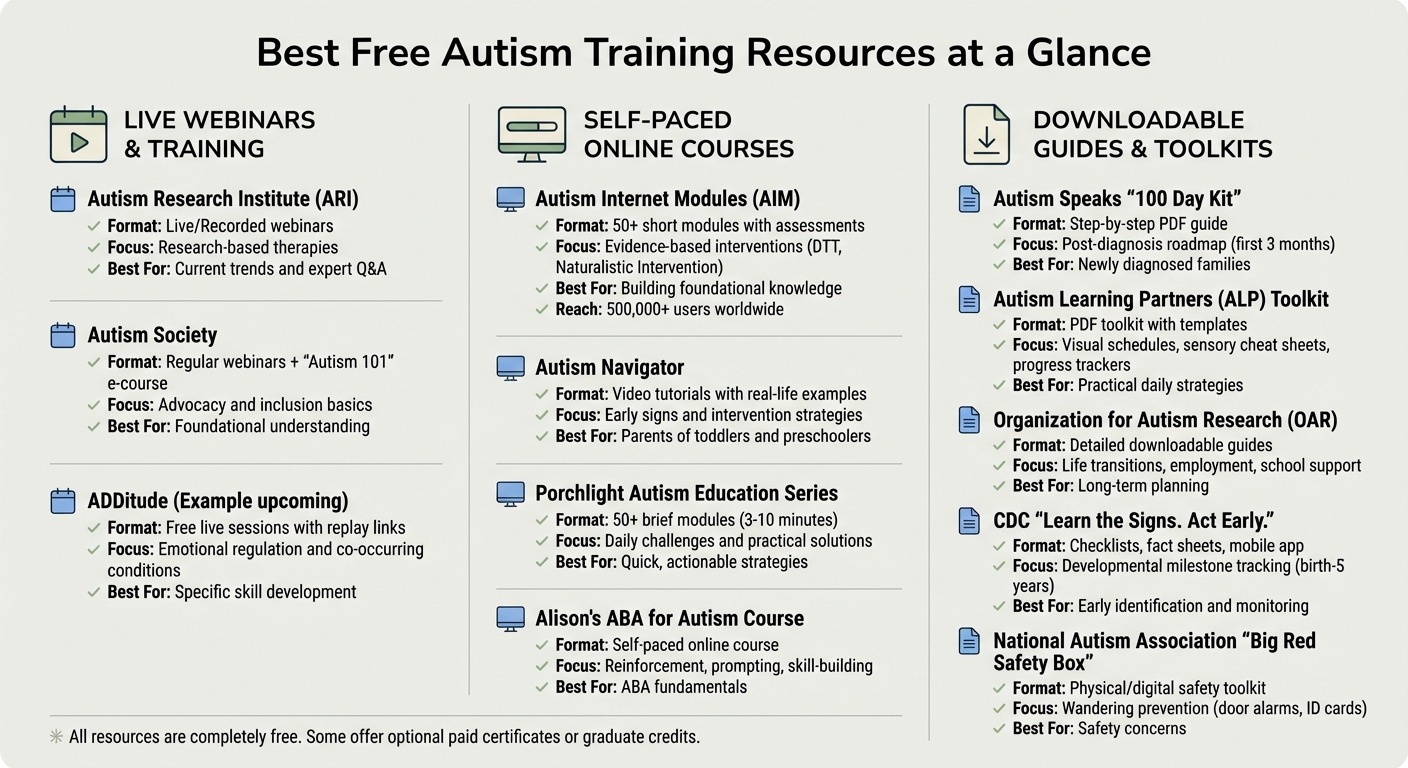
Best Free Autism Training Resources Comparison Guide
With the key topics outlined earlier, let’s dive into some excellent training platforms that translate theory into actionable steps. These resources are designed to help you apply evidence-based strategies in practical ways.
Webinars and Live Training Sessions
Live webinars are a fantastic way to engage with experts and get your questions answered in real time. The Autism Research Institute (ARI) offers webinars led by specialists, focusing on therapies, health, and family well-being. You can join live or access recorded sessions later [6]. Similarly, the Autism Society hosts regular webinars on topics like advocacy and inclusion. They also provide a concise "Autism 101" e-course, covering the basics, signs, and available treatments [6][7].
Mark your calendar for April 2, 2026, at 1:00 PM ET, when ADDitude will host a free live webinar with Doug Mennin, Ph.D., a Clinical Psychology Professor at Columbia University. His session, "Underpinnings of Emotional Dysregulation in Adults: Managing Triggers & Co-Occurring Conditions," will teach mindful awareness techniques and strategies to manage intense emotions [9]. Registrants will also receive replay links at no cost [9].
"Rather than trying to erase difficult emotions, this approach focuses on changing how we relate to them so that we can move forward with greater clarity, flexibility, and purpose." – Doug Mennin, Ph.D., Professor of Clinical Psychology, Columbia University [9]
One of the perks of live webinars is the Q&A segment, where you can interact directly with presenters. Some even offer certificates of attendance for a small fee (around $10), while the sessions themselves remain free [9]. These live events are a great complement to the flexibility of self-paced learning.
Self-Paced Online Courses
For those who prefer flexibility, self-paced courses allow you to learn at your own speed. AIM provides 50 short modules on evidence-based interventions like Discrete Trial Training and Naturalistic Intervention. These modules include pre- and post-assessments to help track your progress [2]. Meanwhile, Autism Navigator offers video tutorials with real-life examples of early signs and intervention strategies, tailored for parents of toddlers and preschoolers [6].
The Porchlight Autism Education Series features over 50 brief modules (3–10 minutes each), created by professionals like occupational therapists and speech-language pathologists. These modules focus on solving daily challenges, such as establishing mealtime routines and teaching social skills [3]. Another option is Alison’s free "ABA for Autism" course, which introduces reinforcement techniques, prompting, and skill-building strategies [1].
AIM has recently updated its modules on Pivotal Response Training and Structured Teaching. While graduate credits are available for a fee through university partnerships, the modules themselves are completely free [2][8]. To make learning even more hands-on, AIM provides printable guides and toolkits that you can use in everyday situations.
Downloadable Guides and Toolkits
If you’re looking for practical tools you can use immediately, downloadable resources are a great choice. Autism Speaks offers the "100 Day Kit", a step-by-step guide for families navigating the first three months after a diagnosis [6]. The Autism Learning Partners (ALP) toolkit includes visual schedules, sensory regulation cheat sheets, and ABA progress trackers to help with home routines [4].
The Organization for Autism Research (OAR) provides detailed guides on topics like daily routines, transitioning to adulthood, and employment planning [6]. For developmental tracking, the CDC’s "Learn the Signs. Act Early." program offers milestone checklists, fact sheets, and even a mobile app for monitoring speech and movement from birth to age five [6]. Additionally, the National Autism Association offers the "Big Red Safety Box", which includes tools like door alarms and ID cards for children at risk of wandering [6].
Sharing completed progress trackers or data sheets with your child’s therapy team can help ensure consistency between home and clinical practices. These tools can be introduced gradually, allowing you to build confidence as you go [4].
| Platform | Format | Primary Focus | Best For |
|---|---|---|---|
| Autism Internet Modules (AIM) | Self-paced modules | Evidence-based interventions | Building foundational knowledge |
| Autism Navigator | Video tutorials | Early signs and intervention | Parents of toddlers and preschoolers |
| Autism Research Institute (ARI) | Live/recorded webinars | Research-based therapies | Current trends and expert Q&A |
| Autism Speaks | Downloadable guide | Post-diagnosis roadmap | Newly diagnosed families |
| Autism Learning Partners (ALP) | PDF toolkit | Home implementation tools | Practical daily strategies |
| Organization for Autism Research (OAR) | Downloadable guides | Life transitions | Long-term planning and school support |
How to Choose and Use Training Materials
Checking Resource Quality
Not all free training materials are created equal, so choosing high-quality resources can save you a lot of time and effort. Start by considering the source of the content. Materials developed by Board Certified Behavior Analysts (BCBAs), university researchers, or certified professionals like occupational therapists and speech-language pathologists are often reliable. Government agencies, such as the CDC, and respected nonprofits like Autism Speaks or the National Autism Association, also produce trustworthy resources.
Pay close attention to whether the materials mention evidence-based methods. Specific terms such as ABA (Applied Behavior Analysis), Naturalistic Intervention, or PRT (Pivotal Response Treatment) are good indicators of research-backed approaches. High-quality modules often include pre- and post-assessments to measure your understanding. For example, the Autism Internet Modules (AIM) have been accessed by over 500,000 people worldwide and are praised by educators for being both cost-effective and impactful in changing practices at the student level [2].
Additionally, choose resources written in straightforward language and offering practical tools, such as ABC data sheets, visual schedules, and behavior tracking templates. These tools are more actionable than materials that focus solely on theory.
Applying Training at Home
Once you’ve identified quality resources, the challenge lies in applying what you’ve learned to your daily routines. Start small – introduce one tool or strategy at a time and use it consistently. Reinforce successes right away to encourage progress. For instance, incorporating a "First-Then" board during breakfast can make transitions smoother.
A helpful approach is the 80/20 rule: ensure 80% of tasks involve skills your child has already mastered, while the remaining 20% focus on new challenges. This balance helps maintain motivation and minimizes frustration. Use tools like ABC data sheets to track behaviors and identify patterns or triggers.
Sharing your progress with your child’s therapy team, including BCBAs or speech therapists, is crucial. By providing them with your data, you can ensure that strategies at home complement clinical practices. Regularly monitor the effectiveness of these approaches using a tracking tool to fine-tune your methods.
Tracking Progress with Guiding Growth
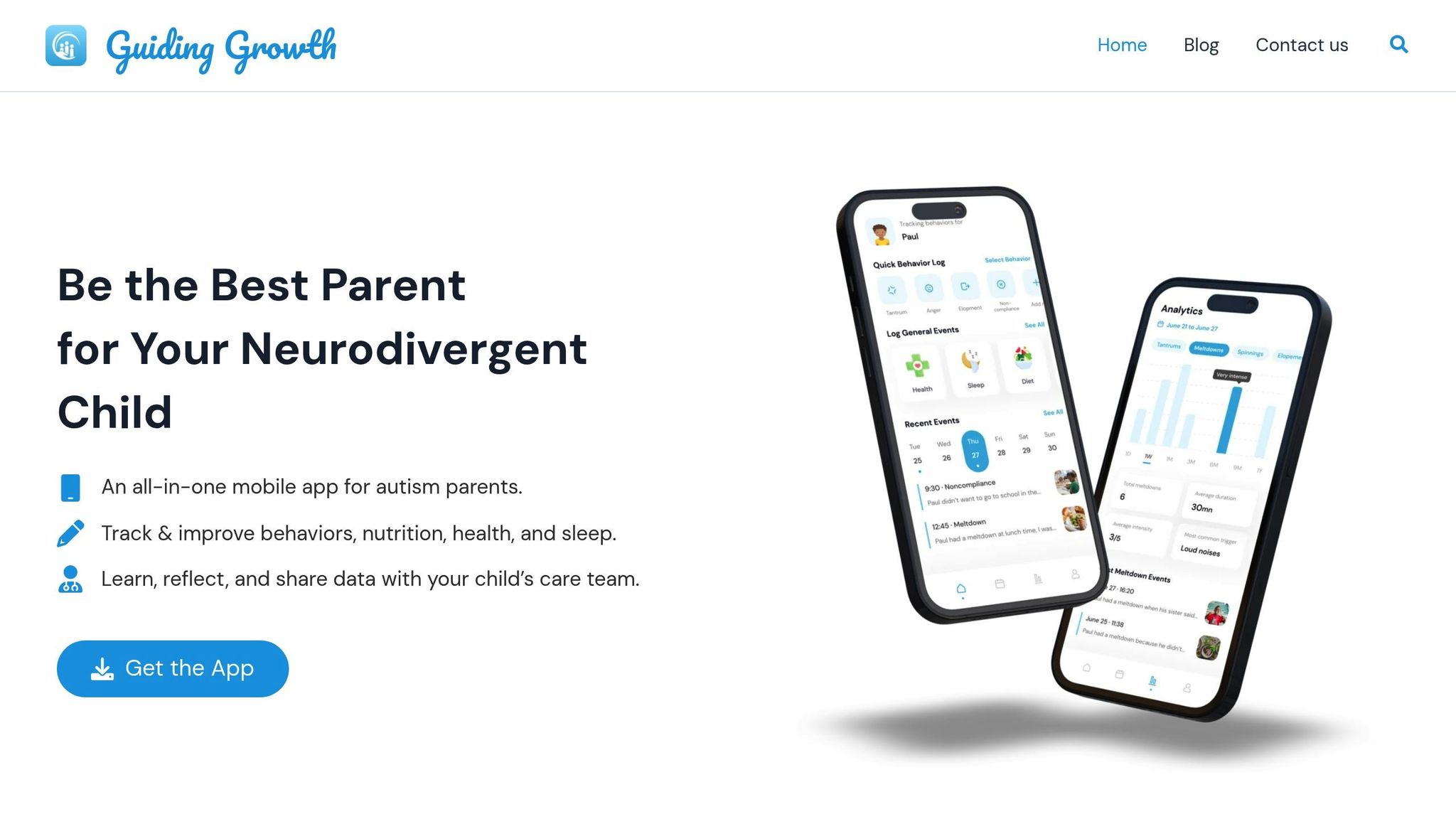
After implementing strategies at home, tracking progress becomes essential for improving your approach. Guiding Growth is a tool designed to turn your daily observations into actionable insights, helping you make better decisions for your child’s care. This app allows you to log various aspects of your child’s life – such as behaviors, sleep, nutrition, health, and activities – all in one place, making it easier to identify trends over time.
For example, if you’re working on reducing meltdowns during transitions, you can log each instance along with the antecedents and consequences. Over time, the app can reveal patterns, helping you determine whether strategies like visual schedules are working. These insights allow you to adjust your methods and celebrate small victories along the way.
The app also makes communication with healthcare professionals more effective. Instead of relying on memory during appointments, you can generate detailed reports from your logged data to share with your child’s BCBA, pediatrician, or therapist. This ensures that everyone involved in your child’s care has accurate, up-to-date information, enabling data-driven adjustments to the care plan.
Guiding Growth is designed with parents in mind, offering not just a way to manage daily observations but also access to knowledge, guidance, and emotional support. By combining free training materials with structured tracking, you create a strong feedback loop that helps you feel more confident and in control of your caregiving journey.
Conclusion
Free autism training resources remove financial barriers, making essential support more accessible. Platforms like the Autism Internet Modules have already reached over 500,000 people globally [8], demonstrating that impactful education doesn’t have to come with a high price tag. Whether you’re facing long waits for formal therapy or seeking ways to enhance professional strategies at home, these free tools offer practical solutions that can make an immediate difference.
Arming yourself with this knowledge allows you to take an active role in your child’s development. By weaving proven techniques into everyday routines, you can create consistency that helps your child thrive. For example, many parents have successfully used ABA strategies to reduce tantrums and bring a sense of calm to their homes.
Start small – try incorporating one or two strategies that fit naturally into your daily life. Use tools like ABC data sheets to monitor progress and share your observations with your child’s therapy team. Apps like Guiding Growth can also simplify tracking patterns and behaviors, helping you stay organized and proactive.
These free resources offer more than just strategies – they empower you to approach parenting with confidence. While autism parenting can be challenging, you don’t have to face it alone. Free training materials provide a strong starting point to improve communication, manage behaviors, and create a more predictable home environment. By tapping into these resources, you’re not just gaining knowledge – you’re building a brighter future for your family.
FAQs
How do I know if a free autism course is evidence-based?
To determine whether a free autism course is backed by solid evidence, start by checking if it’s rooted in scientific research and supported by respected organizations. Look for content that focuses on well-established methods, such as Applied Behavior Analysis (ABA) or Naturalistic Intervention, and ensure it’s developed or reviewed by qualified professionals. Be cautious of courses that make unverified claims or offer promises of cures, as these are red flags. Trusted resources like the Centers for Disease Control and Prevention (CDC) or well-known autism training providers can help you verify a course’s reliability.
Which autism training should I start with after a new diagnosis?
After receiving an autism diagnosis, it’s helpful to start with free webinars or courses that provide basic knowledge and practical strategies. Programs like The Autism Project, Autism Internet Modules, and the Autism Speaks Caregiver Skills Training Program offer research-backed guidance on tools, communication techniques, and daily life skills. These resources serve as an excellent introduction to understanding autism and supporting your child’s growth effectively.
How can I track if home strategies are actually working?
To determine whether home strategies are working, try using tools like visual schedules or behavior tracking sheets. These can help you document routines, behaviors, and any changes over time. Resources, such as autism training modules, highlight how crucial it is to consistently collect and analyze this data. By keeping track of triggers, responses, and progress, you can spot patterns and make adjustments to improve your strategies and reach your goals.