You're in an appointment, and someone asks a simple question that suddenly feels impossible.
“When did the behavior start getting worse?”
“Was it before or after the sleep problems?”
“Did school notice the same pattern?”
You know your child. You've lived every hard moment. But in that chair, with a tired brain and a full week behind you, the details blur. A sticky note is in your bag. A text thread has part of the story. A teacher emailed one example. You meant to write down the rest.
That's where a behavior tracking app can change daily life. Not because parents need more work, and not because children should be reduced to data points. It helps because families deserve a clearer way to notice patterns, share information, and make decisions without relying on memory alone.
Used well, a behavior tracking app becomes less about “tracking behavior” and more about understanding needs. It can help you see what happened, what came before it, what helped afterward, and whether the same pattern is showing up across home, school, and therapy. For many families, that kind of clarity lowers stress right away.
Table of Contents
- From Scattered Notes to Clear Patterns
- Understanding the Purpose of a Behavior Tracking App
- The Real-World Benefits for Neurodivergent Children
- Essential App Features and What Data to Collect
- An Evaluation Checklist for Choosing the Right App
- Integrating Tracking into Family and Clinical Care
- Frequently Asked Questions About Behavior Tracking
- Conclusion From Tracking to Thriving
From Scattered Notes to Clear Patterns
A parent once described the week before a therapy visit like “trying to reconstruct a storm from wet papers.” That's how it feels for many families. You remember the meltdown in the grocery store, the rough bedtime, the morning your child covered their ears and refused the car, but the order gets fuzzy and the context goes missing.
That missing context matters. If a clinician hears “there were three hard days,” that tells one story. If they hear “all three happened after poor sleep and during transitions,” that tells a different one. The same is true for teachers, co-parents, and in-home caregivers.
A behavior tracking app helps turn fragments into a record. Instead of scribbling notes in different places, you log events in one place while they're still fresh. You can add what happened before, how intense it felt, what support was offered, and what happened next.
When families stop trying to remember everything, they can start noticing what keeps repeating.
That shift is bigger than it sounds. Parents often worry that tracking will feel cold or clinical. In practice, many families find the opposite. A clear record can reduce blame, lower arguments about “what really happened,” and support calmer conversations.
You're no longer saying, “I think this has been happening more.” You're saying, “I'm noticing it shows up after late afternoons, loud environments, and missed snacks.” That kind of pattern is actionable.
And once patterns are visible, support gets more humane. You can prepare earlier, adjust routines, and advocate with more confidence.
Understanding the Purpose of a Behavior Tracking App
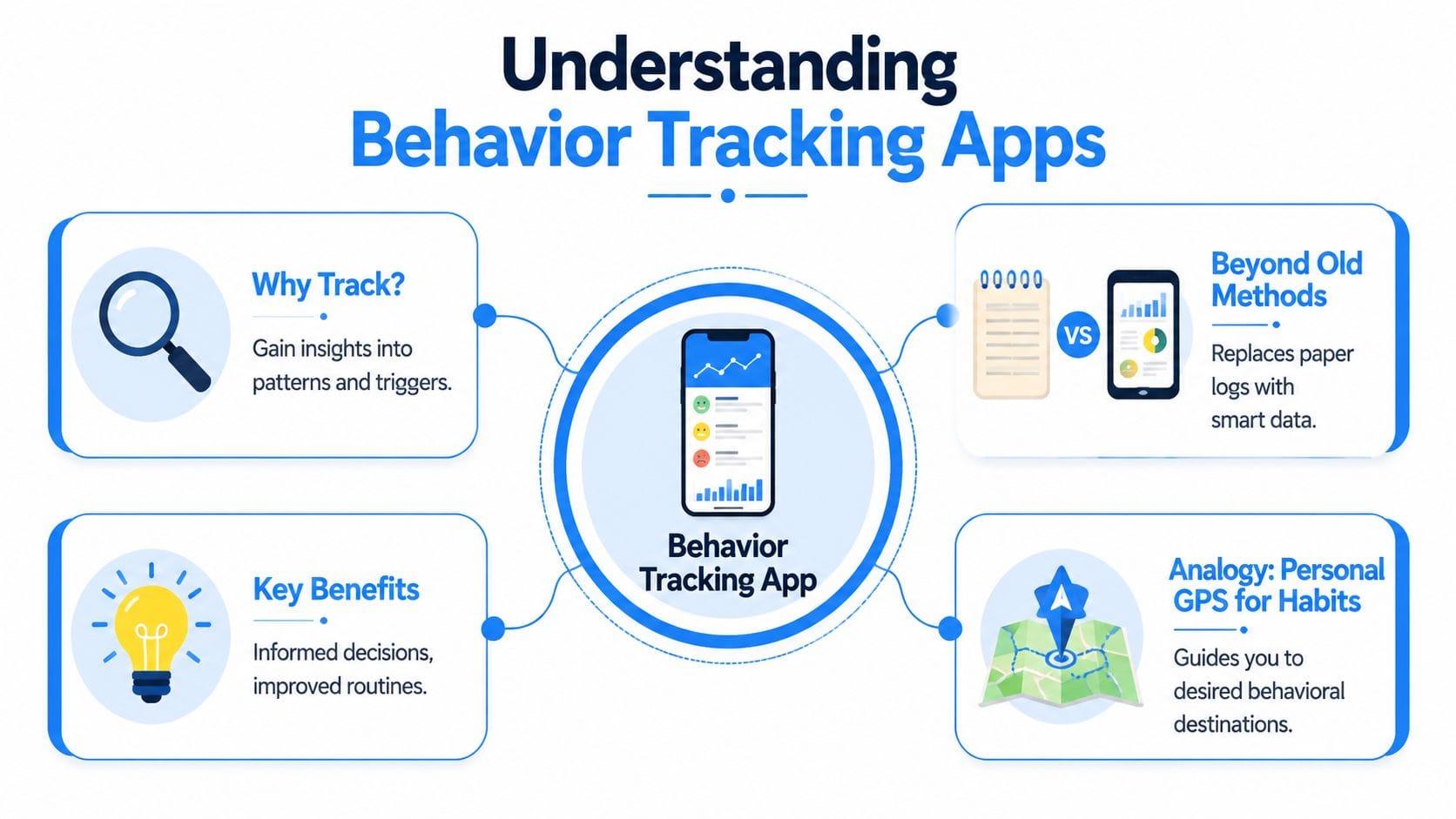
A good behavior tracking app isn't just a place to count incidents. It's more like a detective's notebook that keeps the clues attached to the event.
If your child hits, shuts down, paces, scripts, avoids a task, or suddenly becomes tearful, the event alone rarely tells the full story. The useful questions are often nearby. What was happening before it? Who was there? Was the room noisy? Had your child slept poorly? Did the behavior lead to escape, comfort, sensory relief, or connection?
More than a tally counter
Older methods often focused on frequency alone. A paper chart might tell you a behavior happened five times. That's not useless, but it's incomplete.
Modern apps are better when they help families capture context, such as:
- Timing: Was it early morning, after school, or close to bedtime?
- Setting: Did it happen at home, in class, in the car, or in a crowded store?
- Antecedents: What happened right before the behavior?
- Outcome: What helped, and what didn't?
- Related factors: Was your child hungry, tired, sick, or overloaded?
Those details help adults avoid guessing. They also help separate very different situations that might look similar on the surface.
Why modern apps changed the experience
Behavior tracking has moved from desktop reporting to mobile, real-time, multi-user collaboration. Some current apps emphasize logging events with a few taps, viewing patterns quickly, and letting a whole team contribute to one centralized record, as shown in the Behavior Tracker app listing on Google Play.
That matters because life doesn't happen at a desk. It happens in the hallway before school, in the parking lot after OT, and at the kitchen table during homework. If logging is awkward, families stop doing it.
A strong behavior tracking app should make things easier in the moment, not add friction. That's why newer features matter. Voice logging can help when your hands are full. Smarter summaries can help busy caregivers scan patterns instead of reading dozens of entries one by one. The point isn't high-tech for its own sake. The point is to preserve useful information while family life is moving fast.
Here's the simplest way to think about it:
| Approach | What it captures | What you can learn |
|---|---|---|
| Memory only | Big moments you still remember | Partial story |
| Paper notes | Events, sometimes context | Harder to share and compare |
| Modern behavior tracking app | Events, context, trends, team input | Patterns you can act on |
The Real-World Benefits for Neurodivergent Children
For neurodivergent children, behavior often carries information that other people miss. A child may not be “acting out.” They may be overwhelmed, dysregulated, confused, trying to communicate, or protecting themselves from sensory overload.
That's why tracking can be so valuable. It helps adults move away from judgment and closer to interpretation.
Patterns help you respond earlier
When families log behavior consistently, they often start to notice that hard moments don't come out of nowhere. A meltdown may cluster around transitions, noise, hunger, unpredictability, or social strain. Repetitive speech might rise during anxiety. Task refusal may show up when instructions are too open-ended or when the demand arrives after an already draining day.
Once you can see those patterns, support becomes proactive. You can change the timing, lower sensory load, preview transitions, adjust expectations, or build in recovery time.
This matters across settings too. In a peer-reviewed mHealth study focused on youth mental health services, both clients and providers found behavior tracking generally acceptable because it increased shared information, and the authors concluded that mobile health has the potential to improve daily behavior tracking for youth receiving services, as described in the study on behavior tracking in youth mental health care.
That shared information is often what families have been missing.
Shared language reduces confusion
Parents, teachers, therapists, and relatives may all describe the same child in different ways. One person says “noncompliant.” Another says “frozen.” Another says “avoiding.” Without a shared record, those descriptions can create tension.
A behavior tracking app gives everyone one place to look. That doesn't mean everyone will agree on every interpretation. It does mean they can start with the same events, timing, and notes.
Practical rule: Track to understand needs, not to prove a point.
That shift can soften family stress. It also aligns with a more respectful view of neurodivergence. If you want a broader lens on how emotional support and school relationships fit into neurodiverse development, Soul Shoppe's insights on neurodiversity and SEL is a useful companion read.
A final point often gets overlooked. Tracking isn't only for hard behaviors. It can help you notice what supports regulation too. Maybe your child does better after movement, with a visual schedule, with extra time to process, or after a predictable snack. Those positive patterns deserve just as much attention.
Essential App Features and What Data to Collect
Some apps look impressive but don't help families make better decisions. The right one should make it easier to capture meaningful information, not just store disconnected notes.
What to look for in the app itself
Start with the basics. If logging takes too many steps, you won't keep up with it during real life.
Look for these features:
- Fast entry options: A few taps should be enough for a basic log.
- Custom categories: Families need flexibility because one child's key patterns may involve shutdowns, another's may involve eloping, and another's may involve sleep disruption.
- Context fields: You should be able to add triggers, setting, intensity, and outcome.
- Clear visuals: Trends should be easy to scan without exporting everything to a spreadsheet.
- Multi-person access: Parents, caregivers, and professionals often need different levels of visibility.
- Low-friction capture: Voice logging can be especially helpful when you're busy, driving home, or managing another child.
Some tools now also add AI-based support. Used carefully, that can help summarize logs, surface repeating themes, or prompt you to notice links you might otherwise miss. The best use of AI here isn't replacing human judgment. It's reducing the cognitive load on exhausted caregivers.
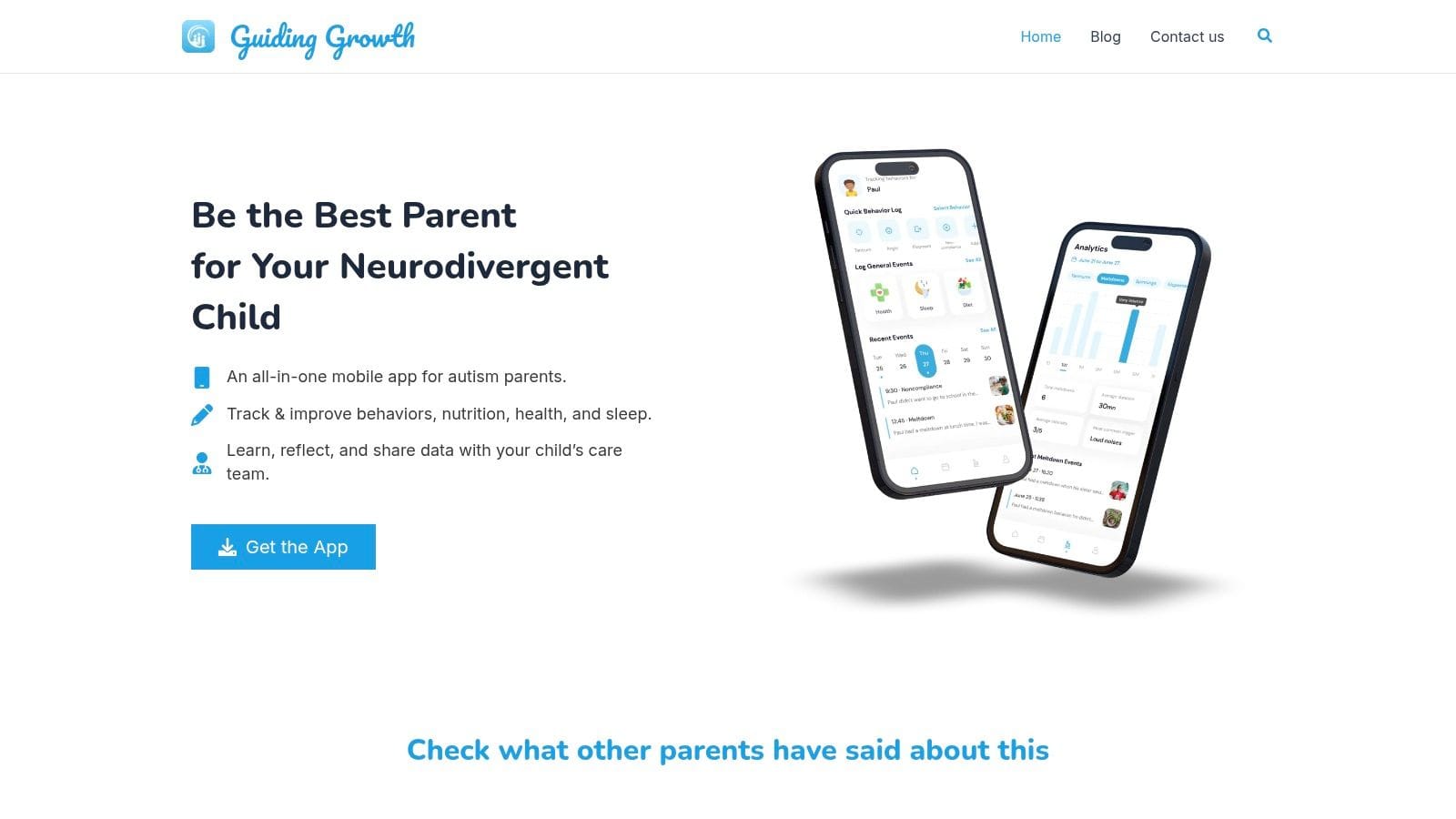
For example, Guiding Growth combines behavior logging with sleep, food, medication, appointments, and shared tracking, and it also includes voice logging and AI support. That kind of all-in-one structure can be useful when a child's hard moments are connected to more than one part of daily life.
What to log so the record is actually useful
A behavior log becomes more clinically useful when it includes more than the behavior itself. One app listing notes that behavior tracking can include context such as sleep, appetite, irritability, and attendance, while also raising the important point that families need structure if they want logs to support real decisions rather than become a pile of entries, as discussed in the Behavior Tracker App Store listing.
That gives families a practical roadmap. Try to collect information in layers.
First layer: what happened
- The behavior or response you observed
- The time
- The location
- Who was present
Second layer: what came before
- Transition
- Demand or request
- Sensory input
- Change in routine
- Social challenge
Third layer: what may have shaped the day
- Sleep quality
- Meals and hydration
- Illness or discomfort
- Medication timing
- School demands or missed breaks
Fourth layer: what happened after
- What support you gave
- Whether the child recovered quickly or slowly
- What seemed to help regulate them
Here's a simple example:
| Log field | Example entry |
|---|---|
| Behavior | Covered ears and dropped to floor |
| Before | Loud school pickup area, long wait |
| Related factors | Short sleep, late snack |
| Support tried | Headphones, moved to quieter spot |
| Outcome | Calmed after several minutes |
Families of teens may also find it helpful to read outside their immediate age group. Some of the self-management ideas in Insight Diagnostics' guide for neurodivergent adults can spark useful thinking about routines, environment, and regulation supports at home.
An Evaluation Checklist for Choosing the Right App
Parents often download an app in a stressed moment, try it for a day, and abandon it because it adds one more task to an already overloaded system. A better approach is to evaluate the app like a care tool, not like a casual download.
The non-negotiables
Some criteria matter before anything else.
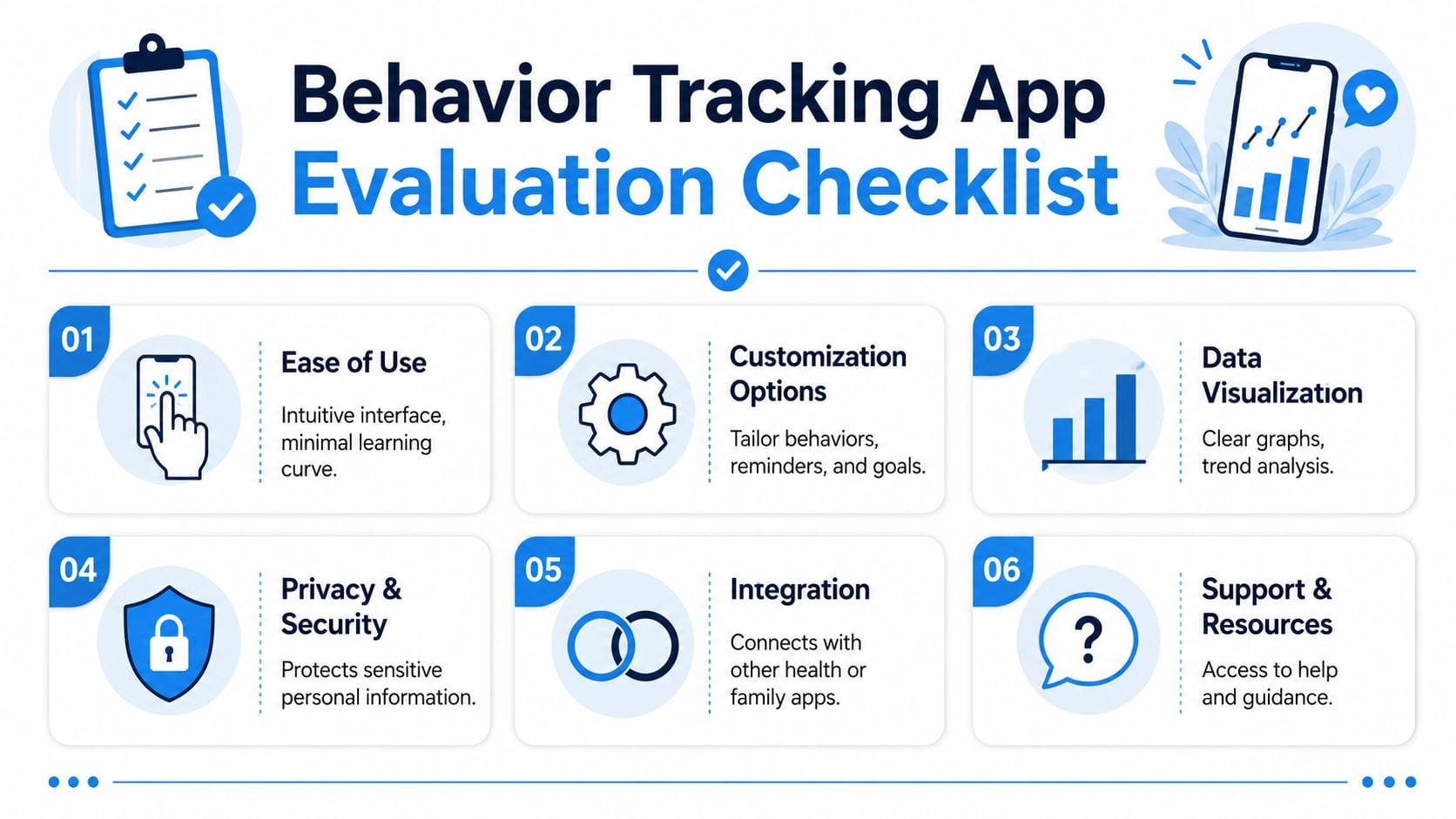
- Privacy and boundaries: The app should be clear about who can see what. Sensitive family information shouldn't be casually exposed to every collaborator.
- Ease of use: If you need a tutorial every time you open it, it won't survive real family life.
- Useful summaries: Graphs and trends should clarify the picture, not bury you in charts.
- Flexible setup: Your child is an individual. The app should adapt to your priorities.
Collaboration is especially important. Shared logging works best when there's one central record and different people can have role-based visibility. One ABA-focused platform overview notes this kind of setup reduces handoff loss and speeds up pattern detection, and it also reports a platform serving over 180,000 users across more than 1,000 organizations in this space, which points to the value of shared longitudinal records over isolated notes in practice, according to Links ABA's overview of ABA data collection tools.
The features that save time
Once the basics are covered, the next question is simple. Does the app save energy, or consume it?
The strongest time-saving features often include:
- Voice logging: You speak the entry instead of typing while juggling bags, siblings, and transitions.
- Smart reminders: Helpful prompts can nudge consistency without becoming noise.
- Pattern support: AI-assisted summaries can help identify repeated combinations like poor sleep plus transitions plus afternoon demands.
- Cross-category tracking: The ability to connect behavior with routines, appointments, meals, and supports matters because families don't live in separate tabs.
A good app should reduce the number of times you have to tell the same story to different people.
Many families discover that “simple” apps aren't always simple in practice. A bare-bones tracker may look clean, but if it can't support collaboration or context, parents end up doing extra work elsewhere.
If you want to compare behavior tools through a special education lens, this special education data collection guide can help you think through what teachers, therapists, and families often need from the same record.
A simple comparison lens
Use this short checklist before you commit:
| Question | Why it matters |
|---|---|
| Can I log an event in seconds? | Fast capture improves consistency |
| Can I add context, not just counts? | Context reveals triggers and supports |
| Can multiple adults contribute safely? | Shared records reduce information gaps |
| Can I review patterns easily? | Trends guide decisions |
| Can the app fit my child's profile? | Customization prevents irrelevant clutter |
| Does it support modern input methods? | Voice and smart summaries lower effort |
If an app fails on several of those questions, it may still work as a temporary notebook. It probably won't work as a long-term support tool.
Integrating Tracking into Family and Clinical Care
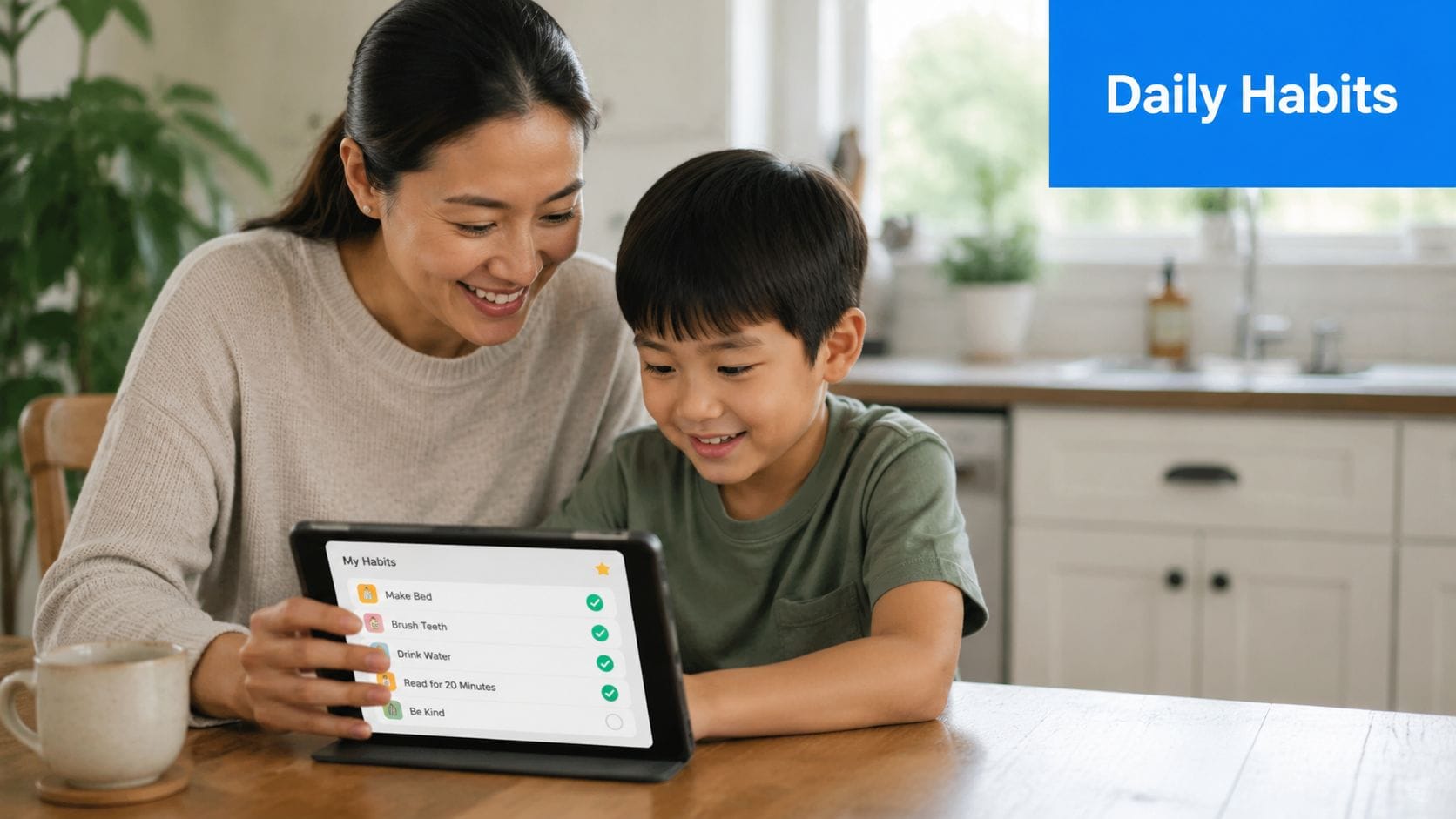
Even a thoughtful app won't help much if it lives unused on your phone. Families do better when tracking becomes a light routine tied to moments that already exist.
How to make logging sustainable
You don't need to record every tiny event. Start with the moments that matter most to your family.
A workable routine often looks like this:
- Choose a narrow focus first. Track one or two priority patterns, such as difficult transitions or bedtime dysregulation.
- Log close to the moment. Short entries made quickly are usually better than detailed entries you never get around to writing.
- Review on a schedule. A quick look every few days is often enough to notice repeats.
- Bring summaries to appointments. Clinicians and educators can respond better when they can see patterns instead of hearing scattered examples.
If your family uses mental health supports alongside behavior tracking, you may also find tools outside this category helpful. For parents exploring broader emotional support options, this in-depth CBT app review offers another angle on digital supports.
How to involve your child and your team
Tracking works best when it supports partnership. That can include your child, depending on age and readiness.
A University of Missouri project on the I-Connect app found that students with special needs used prompts to self-evaluate goal behaviors, and the app graphed progress for students, teachers, and staff to review together, as described in the University of Missouri article on student self-monitoring. That's an important reminder that tracking can be done with a child, not only to a child.
For older children and teens, self-monitoring may include:
- Mood check-ins: “How regulated do you feel right now?”
- Goal reflections: “Did I ask for a break before things got too big?”
- Strategy tracking: “Did headphones help today?”
- Pattern review: Looking at graphs together and talking about what they notice
You can also introduce tracking to professionals in a simple way. Tell them you're trying to create a shared picture, not evaluate their performance. Ask if they'd be willing to log a few key details rather than full narratives. Specific fields usually work best.
“We're trying to notice patterns across settings, so even brief entries are useful if they're consistent.”
If you want examples of how families use logs to support treatment planning, this guide to tracking autism therapy progress offers a practical framework for conversations with providers.
Frequently Asked Questions About Behavior Tracking
Is using a behavior tracking app like spying on my child
It doesn't have to be. The difference is your purpose and your language. If tracking is used to catch, control, or shame, children will feel that. If it's used to understand stress, communication, and support needs, it becomes a care tool.
Try saying, “We're noticing what helps your days feel easier,” instead of, “We're keeping track of your behavior.”
How long does it take to see meaningful patterns
It depends on what you're tracking and how often it happens. Some families notice themes quickly, especially when the same trigger repeats. Other patterns take longer because they involve several factors at once, such as sleep, transitions, and environment.
What matters most is consistency. A few simple entries made regularly are more useful than occasional detailed notes.
What if my co-parent or another caregiver isn't on board
Start small. Ask them to help with one category only, such as bedtime or school pickup. Keep the purpose practical. You're not asking them to adopt a whole new system overnight. You're asking for clearer shared information.
A short script can help: “I'm trying to reduce guesswork and make appointments easier. Could we both log just the tough transitions this week?”
Should I only track challenging behaviors
No. Track strengths, successful supports, and calm moments too. If you only record distress, you'll miss the conditions that help your child feel safe, organized, and connected.
What if tracking starts to feel overwhelming
Simplify the system. Reduce categories. Use quicker entries. Focus on one priority question at a time. A behavior tracking app should lighten your mental load, not become another source of pressure.
Conclusion From Tracking to Thriving
Families rarely need more judgment. They need clearer information, shared understanding, and tools that fit real life. A behavior tracking app can help turn confusing days into visible patterns, and visible patterns into better support.
For neurodivergent children, that matters deeply. When adults can connect behavior with context, they respond with more empathy and less guesswork. The goal isn't perfect data. It's a more connected care routine, a calmer family system, and decisions grounded in what your child is showing you.
If you want one place to log behavior, routines, sleep, food, appointments, and shared notes with less typing and more day-to-day clarity, Guiding Growth is built for that kind of family support.