Preparing for an IEP (Individualized Education Program) meeting can feel overwhelming, but with the right approach, you can actively advocate for your child and ensure their needs are met. Here’s how to get started:
- Organize Documents: Collect past IEPs, evaluation reports, report cards, and work samples. Create a binder or digital file system for easy access.
- Understand Strengths and Needs: Observe your child at home, noting strengths, challenges, and effective strategies. A detailed log can provide valuable insights.
- Prepare Questions: Focus on measurable goals, services, and placement. Ask for data to support claims and clarity on accommodations.
- Coordinate with the Team: Confirm participants, request a draft IEP, and suggest an agenda to ensure your concerns are addressed.
- Bring Evidence: Use work samples, progress logs, and medical or developmental records to back up your points.
Being prepared transforms the meeting into an opportunity to advocate effectively for your child’s education. Remember, your voice matters – be clear, organized, and proactive in addressing your child’s needs.
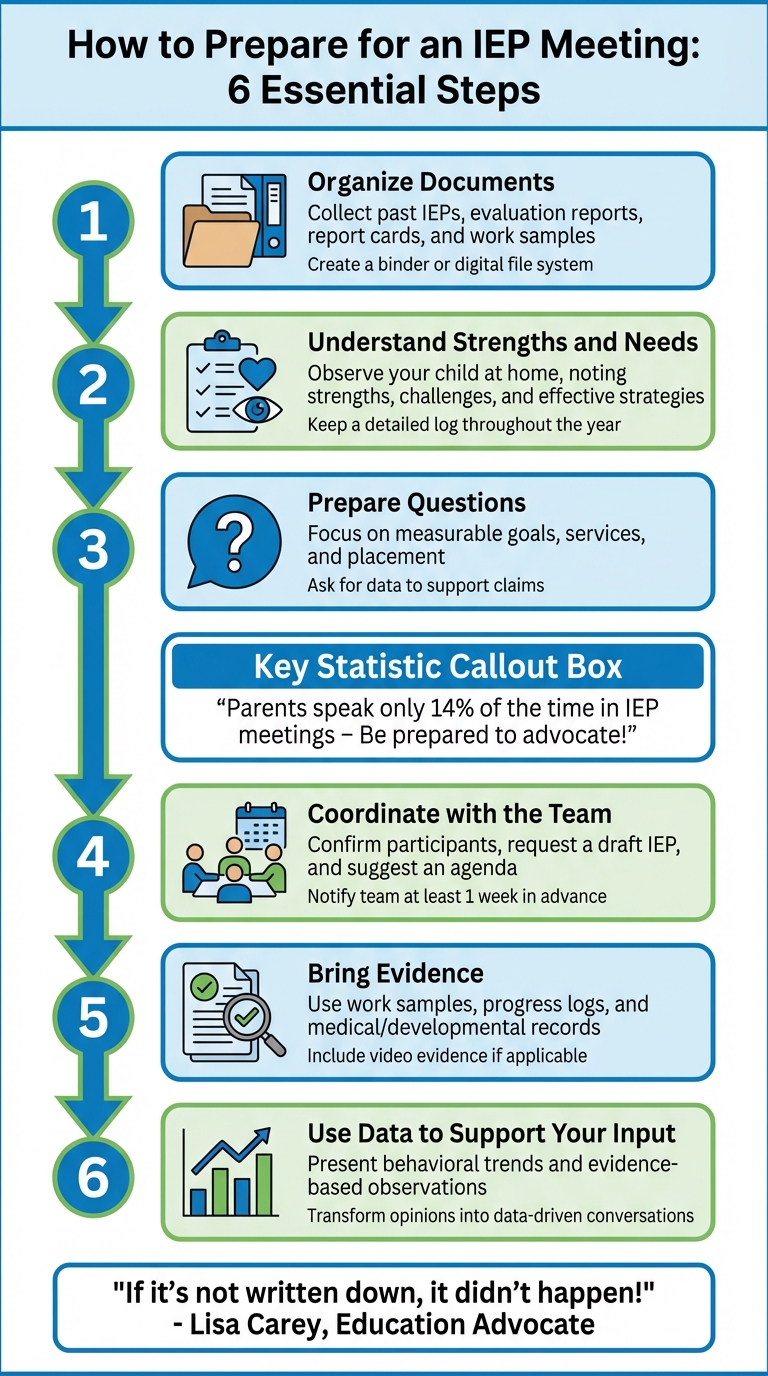
6 Essential Steps to Prepare for an IEP Meeting
How to prepare for an IEP meeting | Experts Answer
sbb-itb-d549f5b
Gather and Organize Your Documents
The first step in preparing for an IEP meeting is collecting all the essential documents. These include previous IEPs, school evaluation reports, report cards, samples of schoolwork, medical or developmental evaluations, and any correspondence with the school. Together, these materials create a comprehensive view of your child’s educational history, helping you spot trends in progress and areas that may need adjustment. Once you’ve gathered everything, take the time to review these documents carefully to uncover patterns and insights.
Review Previous IEPs and Reports
Dive into past IEPs to evaluate whether your child achieved their goals and which strategies were most effective. Compare the goals and services outlined in the IEP with what was actually implemented. Make note of any unmet goals or missed services. Pay special attention to the comments in progress reports, as they often provide more detailed context than standard grades or checkboxes. Additionally, include evaluations from both the school and independent professionals, such as speech or occupational therapists, to get a well-rounded understanding of your child’s needs.
Create a Binder or Digital File System
Organizing your documents is just as important as collecting them. Set up a system – either a physical binder or a digital file – that divides materials into sections like evaluations, report cards, correspondence, medical records, and work samples. Summarize all discussions with the school in brief follow-up emails to ensure there’s a written record. As Lisa Carey, Undivided Non-Attorney Education Advocate, emphasizes:
"Remember: if it’s not written down, it didn’t happen!"
When reviewing assessment reports or draft IEPs, jot down your questions or notes directly on the documents for easy reference during the meeting. Be proactive by requesting a draft IEP and any written assessment reports from the special education coordinator at least a week before the meeting. If you’re signing an assessment plan, note on the form that you want copies of the results before the IEP meeting. This level of preparation transforms your paperwork into a powerful tool for advocacy.
With your documents well-organized, you’ll be better equipped to clearly define your child’s strengths, needs, and goals as you move forward.
Identify Your Child’s Strengths, Needs, and Goals
Turn your observations into actionable insights for the IEP team. Pay close attention to your child’s behavior at home – whether during homework, playtime, or challenging moments. This perspective can provide crucial details that help shape an effective IEP.
Keep a detailed log throughout the year. Record both positive experiences and difficult days, noting triggers for anxiety, assignments that lead to frustration, or new behaviors that surface. If your child shows skills at home that aren’t visible in the classroom, consider recording short video clips as evidence. For instance, a video of your child successfully sharing during a game can challenge assumptions about social difficulties. Also, document strategies that work at home – like visual schedules, calming techniques, or specific cues. These can be proposed as accommodations to support your child in the classroom. By staying organized and thorough, you can provide a well-rounded view of your child’s abilities and needs.
List Strengths and Challenges
Use the information you’ve gathered to create a clear list of your child’s strengths and challenges. Include their talents, interests, and what motivates them, alongside the specific areas where they struggle. This balanced approach not only gives the IEP team a full picture but also highlights opportunities to build on your child’s existing strengths. Research shows that focusing on strengths can boost engagement and success in school.
Don’t forget to include your child’s perspective. Ask them what helps or hinders them at school and share their input. Interestingly, about 90% of secondary students reportedly don’t know what an IEP is or why they have one [4]. Involving your child in the process helps develop their self-advocacy skills, which are crucial for their growth.
Draft a Parent Vision Statement
Your observations and documentation can help you outline long-term goals for your child. Write a brief statement summarizing these goals and present it at the start of the IEP meeting. This sets the tone and keeps the team focused on your priorities, like specific supports or placements. For example, if you’re advocating for an inclusive classroom, explain how it would benefit your child – such as providing neurotypical peer models for behavior.
As Lisa Carey, Undivided Non-Attorney Education Advocate, advises:
"finding the ‘why’ will help center your priorities in the IEP meeting."
This clarity ensures your voice is heard and keeps the meeting aligned with your child’s best interests.
Prepare Your Questions and Concerns
Using your organized records as a foundation, craft questions that focus on clear, measurable outcomes. Studies reveal that parents typically speak during only 14% of IEP meeting intervals, while professionals dominate 86% of the discussion [2]. By preparing targeted questions, you can actively advocate for your child’s needs and ensure your voice is heard.
The trick is transforming vague statements into specific, data-driven inquiries. For example, if a team member mentions your child is "making progress" or "struggling", ask, "Can you show me the data?" This encourages the team to explain how progress is being measured and whether decisions are based on evidence or assumptions [2]. Similarly, when accommodations are suggested, you might ask, "How will this be communicated to every adult who works with my child?" to ensure consistent implementation [2].
Once your questions are ready, review the IEP form to identify where your input will have the most impact.
Request a Blank IEP Form in Advance
Ask for a blank IEP form at least a week before the meeting. Familiarizing yourself with the form’s structure will help you understand what information will be covered and where your contributions will be most valuable. While not all districts are legally required to provide this, you should also request a draft of the proposed goals or the full IEP document ahead of time [1]. Lisa Carey, an Undivided Non-Attorney Education Advocate, explains:
"One of the main points of IDEA… is facilitating meaningful parental participation. How can you meaningfully participate when you are just being presented with something?" [1]
Receiving these documents early allows you to prepare thoughtful, specific questions rather than reacting in the moment. If the school declines to provide drafts, you can request "Prior Written Notice", which requires them to document their decision in writing [2].
Once you understand the form’s layout, focus your questions on key areas that directly influence your child’s education.
Focus on Goals, Services, and Placement
Your questions should center on three critical areas: the appropriateness of goals, the services provided, and your child’s placement.
For goals, ask if they are designed to remain challenging over time and how unmet goals will be adjusted. Clarify how progress will be monitored and how often you’ll receive data-based updates [3][1].
For services and accommodations, it’s important to distinguish between accommodations (how your child learns) and modifications (what your child is expected to learn). Modifications can impact your child’s ability to earn a high school diploma. Lisa Carey cautions:
"A lot of parents don’t realize that modifications mean your child will be doing something that does not meet the standard for meeting diploma requirements. That may be okay for your child and your situation, but it can be awful when a parent doesn’t realize what that means." [1]
Ask which strategies have been effective recently and, if possible, request a demonstration or detailed explanation of how accommodations will be applied in the classroom [3][1].
For placement, focus on ensuring your child is in the "Least Restrictive Environment." Ask how much time will be spent in general education and why a particular placement is best suited to your child’s needs [3][1]. During the 2022-2023 school year, about 7.5 million students – 15% of all public school students – received special education services under IDEA [3]. If you’re advocating for an inclusive setting, consider asking, "What specific skills can my child develop more effectively in an inclusive setting with neurotypical peers?" or "Can we create goals that involve interaction with typically developing peers during recess or extracurriculars?" [1].
Use Data to Support Your Input
Walking into an IEP meeting armed with concrete data can transform the conversation. Instead of getting caught up in subjective opinions, the focus shifts to objective facts. As the VizyPlan Blog puts it, "Data-driven conversations are productive. Opinion-based conversations go in circles." [2] You have a unique perspective – unlike the school, you observe your child in settings they never see, from weekend routines to bedtime struggles and even how they handle transitions at the grocery store. These home-based insights are crucial for providing a complete picture of your child’s needs. The challenge is capturing and presenting this data effectively.
Use Behavioral and Developmental Tracking Tools
Keeping an ongoing log of your child’s behaviors, skills, and challenges outside of school is a powerful way to advocate for them. A continuous record of both good days and tough ones can help reveal patterns and provide solid evidence for your observations. [2] Organizing these notes into clear trends makes them even more impactful.
Digital tools can simplify this process. Apps like Guiding Growth let you document behavioral events with precision – what triggered the behavior, its intensity, duration, and who was present. You can also track sleep patterns, diet, health events, and daily routines all in one place. Over time, this data can uncover connections you might not have noticed: for instance, a sugary breakfast might lead to afternoon meltdowns, or poor sleep could affect emotional regulation the next day. The app’s Smart Summaries feature can even generate professional reports that are easy to share with therapists, doctors, or the IEP team. Once you’ve organized your data, the next step is using it to identify trends and strategies.
Present Evidence-Based Trends
With your data in hand, focus on highlighting clear patterns. Pay attention to differences between home and school performance. For instance, if the school notes your child "sometimes struggles" with transitions, but you’ve logged meltdowns during every transition at home over the past month, that discrepancy should be addressed in the Present Levels section of the IEP. Similarly, if your child has mastered a skill at home or in private therapy but struggles to demonstrate it at school, document that lack of generalization. [2]
When presenting your data, specificity is key. Show what works and what doesn’t. For example, if visual schedules consistently prevent morning meltdowns at home, share that trend and advocate for the same accommodation at school. If an IEP goal from last year hasn’t been met, your data might suggest the current approach isn’t effective and needs adjustment. [1] Sometimes, video evidence can be particularly compelling. If the team doubts your child can perform a specific skill, a short video of them successfully completing the task at home can be more persuasive than words alone. [1]
Coordinate with the IEP Team in Advance
Once you’ve organized your documents and prepared your questions, the next step is reaching out to the IEP team ahead of time. Doing this helps ensure the meeting feels like a true collaboration rather than a one-sided presentation. When everyone knows who’s attending, what will be discussed, and which materials need review, the meeting becomes smoother and more productive.
Confirm the Participant List
Start by emailing the special education coordinator or case manager at least a week before the meeting to confirm who will be attending. A standard IEP team usually includes you, a general education teacher, a special education teacher, a district representative responsible for committing resources, and someone to interpret evaluations, like a school psychologist. If related services – like speech or occupational therapy – are on the agenda, those providers should also be present.
You’re also allowed to bring anyone who has insight or expertise about your child, such as advocates, attorneys, family members, or private therapists. Be sure to notify the IEP team leader in advance about any guests you’ll bring, including their names and roles. If you’ll need a translator or plan to attend virtually, mention this when you respond to the initial meeting notice. Additionally, if you intend to record the meeting, check your state’s laws. For example, California requires you to notify the team at least 24 hours in advance if you plan to audio record [1].
One key detail to confirm is whether a district administrator with the authority to approve funding – often called a "resource committer" – will be present. If this person isn’t there, it could delay the implementation of services. Should the school deny your request for a specific staff member to attend, ask for "Prior Written Notice", which is a formal explanation for the refusal.
Once you’ve confirmed the participant list, the next priority is ensuring everyone is on the same page about the meeting’s agenda.
Request an Agenda
Having a clear agenda can make a big difference. Without one, you may find yourself at a disadvantage during the meeting. To avoid this, contact the special education coordinator at least a week before the meeting and ask for an agenda and any draft documents. When you reply to the official meeting notice, you can include your request directly, such as: "Please provide an agenda and any assessments prior to the IEP meeting."
An agenda ensures that time is set aside for the topics you want to address. It also helps prevent discussions from being cut short before your concerns are fully heard. Research shows that parents typically speak during only 14% of the time in IEP meetings, while professionals dominate the remaining 86%. Additionally, about 33% of parents report feeling confused during these meetings [2].
As education advocate Lisa Carey explains:
"One of the main points of IDEA (Individuals with Disabilities Education Act)… is facilitating meaningful parental participation. How can you meaningfully participate when you are just being presented with something?" [1]
If the school doesn’t provide an agenda, you can send a simple list of items you’d like to discuss. If a full draft isn’t available, ask for the "proposed goals" so you can better understand the focus of the meeting. While an agenda is helpful, some advocates suggest not sharing too many specifics about your concerns in advance, as it might give the district time to prepare counterarguments before you’ve had the chance to present your points.
Bring Supporting Materials and Evidence
Once you’ve worked with your IEP team, it’s time to pull together evidence that backs up your observations. Having concrete materials helps ensure your concerns are understood. Use examples that combine data from school, home, and outside providers to give a complete picture of your child’s needs.
Work Samples and Progress Logs
Gather items like recent homework, tests, and teacher notes to spot patterns. Keep records of emails, calls, and meetings with school staff. If you have important verbal discussions, follow up with a brief email to create a written record.
You can also include progress reports from private therapists. These can showcase skills or challenges that the school might not fully observe. For instance, a speech therapist’s report might reveal improvements in communication that aren’t obvious in the classroom.
Your own observations at home are equally valuable. Track behaviors, skill development, or how well strategies (like visual schedules or routines) are working. Tools like Guiding Growth can help you organize daily observations and create reports that highlight trends over time.
Sometimes, video evidence can make a strong case. For example, if the school says your child can’t perform a particular skill but you’ve seen them do it at home, a short video clip can provide clear proof. As Undivided Resources suggests:
"If certain skills are being pushed but you know that your child can already do those skills, make a video and show the team!"
Relevant Medical or Developmental Records
Medical and developmental records can strengthen your case beyond academic data. Bring up-to-date vision and hearing screening results, as these are required for the IEP team to review. If it’s been over a year since the last screenings, consider scheduling new evaluations to ensure the data is current.
Doctor recommendations detailing necessary accommodations – like adjustments for physical education – are also important. These documents carry weight because they come from licensed professionals.
If you have independent evaluations from private psychologists or developmental specialists, bring those as well. These can provide a comparison point to the school’s assessments. If there are differences between the evaluations, ask the team to explain why. Additionally, reports from insurance-based therapies often include measurable progress on specific goals, which can further demonstrate your child’s potential when they receive the right support.
To stay organized, gather all your documents in a binder or digital file. Being prepared with clear, detailed evidence will help you advocate more effectively for the services your child needs.
Conclusion
Preparing for an IEP meeting can turn what might feel overwhelming into a chance to advocate effectively for your child. By gathering documents, understanding your child’s strengths and needs, crafting specific questions, and organizing your evidence, you step into the role of an active participant rather than a passive observer.
Preparation also helps ground the discussion in facts rather than opinions. Bringing along records like behavior logs, work samples, medical reports, and notes from home allows you to ask for objective proof when progress claims are made. This data-driven approach strengthens your advocacy and aligns well with tools designed for tracking and analysis.
For example, Guiding Growth simplifies the process of monitoring behaviors, sleep patterns, nutrition, and daily activities. It generates detailed reports that highlight trends over time, giving you solid evidence to back up your observations and requests during the meeting.
Remember, you don’t have to sign the IEP during the meeting itself. Take the time to review it at home, and always insist on written documentation for every promise made. Education advocate Lisa Carey wisely reminds us:
"If it’s not written down, it didn’t happen!" [1]
With careful preparation and a clear strategy, you can ensure your child gets the services and support they need to thrive. Your effort and organization lay the foundation for a productive and successful IEP meeting.
FAQs
What should I do if the school won’t share a draft IEP before the meeting?
If the school doesn’t share a draft IEP before the meeting, make a formal request in writing. Clearly state that reviewing the draft ahead of time is crucial for meaningful participation. Emphasize your right to actively contribute and to review necessary documents beforehand. If the school continues to deny your request, it might be helpful to consult a special education advocate or attorney to protect your rights.
How can I prove my child’s needs with data from home?
Consistently keeping track of your child’s behaviors, health, and other observations can be a powerful way to demonstrate their needs. By documenting these details over time, you can identify patterns and show progress, which can be incredibly helpful during IEP meetings. Maintaining detailed records of daily activities, challenges, and responses ensures that your child’s specific needs are clearly understood and supported with tailored services.
Do I have to sign the IEP at the meeting?
You don’t have to sign the IEP during the meeting. Instead, it’s a good idea to take the document home and review it carefully before deciding whether to agree to its terms. While you can sign the attendance page to confirm you were present at the meeting, only sign the IEP itself once you’re sure you’re comfortable with the plan.