If your child has ever reacted strongly to certain sounds, textures, or lights, you may be dealing with sensory triggers. These are stimuli that can overwhelm autistic children, causing distress or heightened responses. Recognizing and addressing these triggers can help create a more comfortable and supportive environment for your child. Here’s a quick summary:
- What are sensory triggers? Specific stimuli (like bright lights, loud noises, or certain fabrics) that can overwhelm autistic children.
- Why does it matter? Understanding triggers can reduce anxiety, prevent autism meltdowns, and improve daily routines.
- How to identify them? Observe your child closely, track their reactions systematically, and focus on patterns across sensory domains (e.g., sound, touch, smell).
What Sensory Overload Feels Like for Autistic Kids- and How to Help
sbb-itb-d549f5b
Why Identifying Sensory Triggers Matters
Recognizing sensory triggers can help prevent crises and improve the overall well-being of your family. By understanding your child’s specific sensory profile, you can make targeted adjustments that ease their discomfort and reduce anxiety throughout the day. These small, immediate changes not only create a more comfortable environment but also pave the way for long-term improvements in behavior and emotional regulation [1][2].
Addressing sensory challenges goes beyond avoiding meltdowns – it supports your child’s ability to regulate emotions, participate socially, and build independence [2]. Samantha Duff, OTD, OTR/L, Senior Director & Occupational Therapist at CST Academy, highlights the importance of this:
"Addressing sensory challenges enables children to engage in learning, play, and social interactions more comfortably" [2].
These changes can have a ripple effect, improving focus during homework, encouraging participation in playground activities, and boosting confidence in new or unfamiliar settings.
Creating a supportive environment also strengthens family relationships. When your home is tailored to your child’s sensory needs, it fosters positive interactions and allows for meaningful bonding moments. Instead of constantly managing crises, you’ll find more opportunities to enjoy quality time together [2].
How Sensory Triggers Affect Behavior
Children react to sensory input in different ways, and understanding these responses is crucial. Some may experience sensory overload, leading to intense emotional reactions like crying, screaming, or visible agitation. Others may have the opposite reaction, withdrawing or becoming unresponsive in what’s known as a sensory shutdown [2]. Avoidance behaviors are also common – your child might hesitate to visit a playground or avoid entering certain stores, anticipating overwhelming sensations.
These behaviors aren’t acts of defiance; they’re natural responses to feeling overwhelmed. For instance, something as minor as a flickering fluorescent light – something you might barely notice – could feel excruciating to your child. Everyday environments can sometimes become sources of distress [1][2].
The Parent’s Role in Identifying Triggers
Parents are in a unique position to identify sensory triggers because you see your child in a variety of real-life situations – at home, in stores, at the park, or during family events. These everyday settings often reveal patterns that teachers or therapists might not observe [1][2]. For example, you might notice your child reacts differently to certain types of lighting or struggles more with background noise in specific environments.
Your daily observations are incredibly valuable. Pay attention to physical cues like changes in posture, breathing, or facial expressions when your child encounters new stimuli [1]. If your child is verbal, asking them directly about what feels overwhelming can provide clear insights. For non-verbal children, tracking patterns in their avoidance behaviors or physical reactions is key. Sharing these observations with occupational therapists or other professionals helps create a personalized sensory integration plan tailored to your child’s needs [2]. These efforts lay the foundation for the systematic tracking methods discussed in the next section.
Preparing to Track Sensory Triggers
After understanding the importance of identifying sensory triggers, the next step is setting up a system to track them. The aim here isn’t perfection – it’s about creating a consistent record that helps uncover patterns you might otherwise overlook. This record will serve as the foundation for taking actionable steps later.
Focus on tracking key details, such as the behavior or reaction, time and date, environment, and environmental factors (e.g., sounds, lights, textures, or smells). Include the intensity and duration of each reaction to transform scattered observations into meaningful insights.
Setting Up Your Tracking System
Organizing observations by sensory domain – like auditory (sounds), visual (lights and patterns), tactile (touch and textures), olfactory (smells), gustatory (taste), and vestibular (balance and movement) – is a practical way to structure your tracking system [2]. This method helps pinpoint which senses are most affected and reveals patterns over time.
You can use a notebook, spreadsheet, or digital tool – whatever aligns best with your daily routine. If you opt for a notebook, try dividing pages by sensory type or create a simple template for quick entries. Be sure to log physical cues such as ear-covering, withdrawing from touch, or tugging at clothing, as these behaviors often indicate sensory discomfort [1].
Using Tools to Make Tracking Easier
Digital tools can simplify the tracking process and help you stay consistent. Apps like Guiding Growth are designed specifically for parents to log behaviors, triggers, intensity, and duration within seconds. Instead of writing detailed descriptions each time, you can select from pre-set triggers and behaviors, add a few notes, and save the entry – whether you’re at the grocery store or the playground.
One of the biggest advantages of digital tracking is its ability to capture context automatically. For instance, Guiding Growth timestamps entries, allows you to note who was present, and even lets you attach photos or videos if needed. Over time, this structured data makes it much easier to identify patterns compared to flipping through handwritten notes.
If your child is verbal, involve them by asking what feels overwhelming and log their responses [1]. For non-verbal children, your observations of their physical reactions become even more critical. By consistently tracking these details, you’ll consolidate scattered observations into a clear sensory profile. This profile will empower you to make more informed adjustments to your child’s environment.
Step-by-Step Guide to Identifying Sensory Triggers
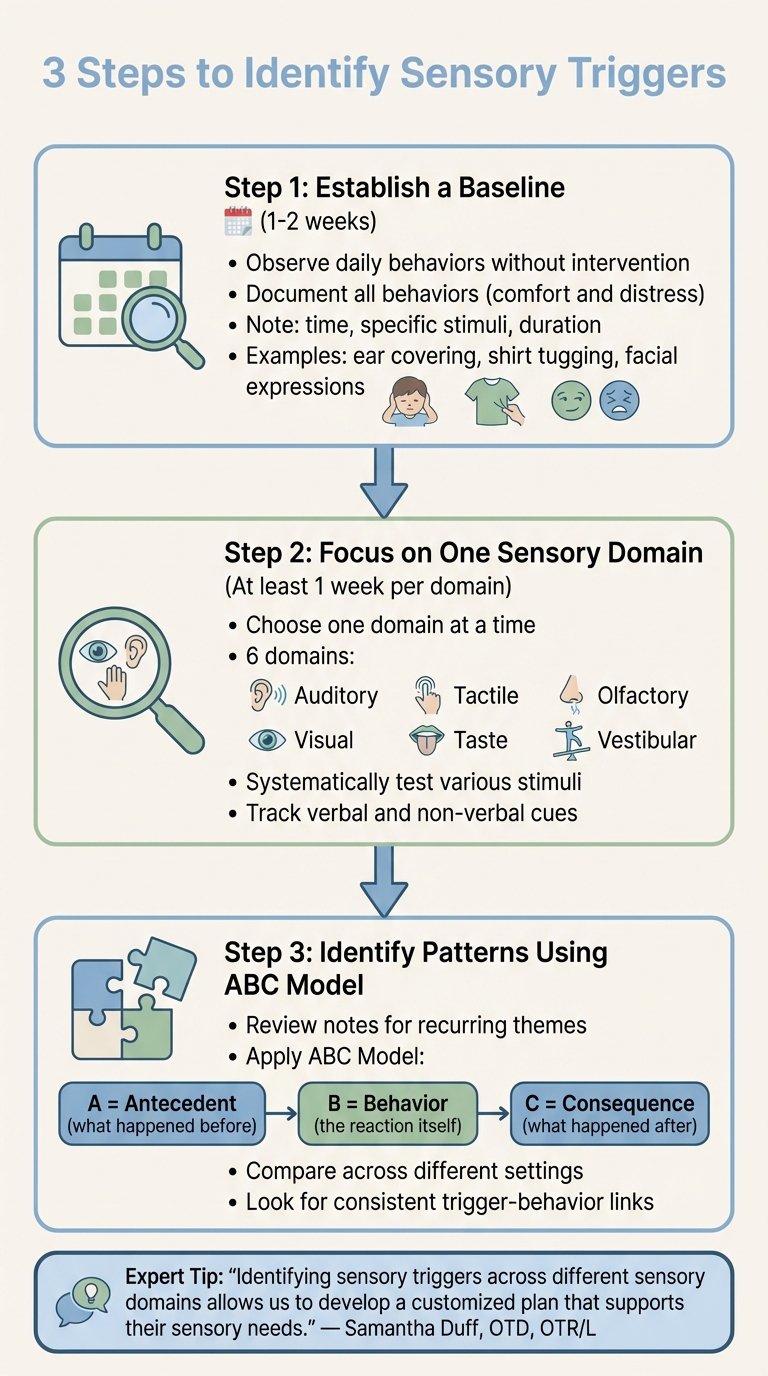
3-Step Process to Identify Sensory Triggers in Autistic Children
With a tracking system in place, you can begin to decode your child’s sensory responses systematically. This process helps transform scattered observations into a clear sensory profile. By following these steps, you’ll gain a structured understanding of what triggers your child’s reactions and how to address them effectively.
Step 1: Establish a Baseline
Before diving into specific triggers, it’s crucial to understand what "normal" looks like for your child. Spend 1–2 weeks observing and recording your child’s daily behaviors without making any changes or interventions. This baseline period serves as a reference point for future insights.
Document all noticeable behaviors, whether they indicate comfort or distress. For instance, if your child covers their ears during dinner prep, jot down details like the time, the specific sounds present, and how long the behavior lasts. Similarly, if they tug at their shirt collar, note aspects like the fabric type, whether the shirt is new, and what activities preceded the behavior.
This detailed documentation provides a snapshot of your child’s sensory world, giving you a foundation to build on as you continue tracking.
Step 2: Focus on One Sensory Domain at a Time
Trying to track every sensory input at once can quickly become overwhelming. Instead, focus on one sensory domain – such as auditory, tactile, visual, olfactory, taste, or vestibular – at a time. Start with the area where you’ve observed the most frequent reactions. For example, if your child often reacts to loud noises, begin with auditory triggers. If they seem sensitive to certain fabrics, start with tactile triggers.
"Identifying sensory triggers across different sensory domains (e.g., auditory, tactile, visual)… allows us to develop a customized plan that supports their sensory needs." – Samantha Duff, OTD, OTR/L, CST Academy
Once you’ve chosen a domain, systematically test various stimuli. For tactile triggers, compare different fabrics or note how your child reacts to tags on clothing. For auditory triggers, observe their responses to sounds like a vacuum cleaner, a doorbell, or a phone ringtone. Pay attention to both verbal feedback (if your child is verbal) and non-verbal cues, such as squinting, pulling away, or covering their ears.
Dedicate at least a week to each sensory domain. This focused approach helps you uncover patterns that might otherwise go unnoticed.
Step 3: Identify Patterns and Connections
After tracking one domain at a time, review your notes to identify recurring themes. Look for consistent patterns that link specific triggers to your child’s behaviors. For example, does your child consistently have meltdowns in brightly lit stores but stay calm in dimmer environments? Do certain textures or sounds seem to provoke similar reactions?
To analyze these patterns, apply the ABC model:
- Antecedent: What happened immediately before the behavior?
- Behavior: What was the behavior itself?
- Consequence: What occurred right after the behavior?
For instance, if your child becomes overwhelmed in a noisy, crowded space but calms down when moved to a quieter area, you’ve likely identified a sensory trigger. Compare observations across different settings, such as home, school, or the playground, to confirm whether the same triggers produce consistent reactions. Recognizing these patterns equips you with the knowledge to make informed adjustments that support your child’s comfort and development.
Using What You’ve Learned to Support Your Child
Once you’ve identified your child’s sensory triggers, the next step is to make adjustments that reduce exposure and create a more comfortable environment. The patterns you’ve observed and documented can act as a guide for making meaningful changes at home, in school, and within the broader community. These observations help shape specific modifications to better support your child.
Adjusting the Environment to Reduce Triggers
Start by addressing the triggers that occur most often. For instance, if your child frequently reacts to the brightness of overhead fluorescent lights, consider swapping them out for lamps with softer bulbs or installing dimmers to control the intensity. If loud noises are an issue, keep noise-canceling headphones or earplugs handy, especially in places where unexpected loud sounds are common.
For tactile sensitivities, choose soft, tag-free clothing and explore options like weighted blankets or compression garments, which can provide a calming sense of deep pressure. If certain smells cause discomfort, switch to unscented cleaning products and avoid strong fragrances in shared spaces.
"Understanding and addressing these triggers is key to creating a supportive environment where children with autism can thrive." – Samantha Duff, OTD, OTR/L, Senior Director & Occupational Therapist
Create a designated "quiet zone" at home filled with calming items like soft blankets, fidget toys, or even a favorite book. This space can serve as a retreat when your child feels overwhelmed. When heading out, consider assembling a portable sensory kit with essentials like sunglasses, earplugs, fidget toys, and preferred snacks. This kit can help manage triggers in public settings and make outings more manageable.
Keep track of these adjustments and share them with professionals to ensure consistency across all environments.
Sharing Insights with Healthcare and Educational Professionals
Your detailed tracking can also be a valuable tool when working with healthcare providers and educators. Share your observations, highlighting the most frequent triggers, the times of day when behaviors are more likely to occur, and the interventions that have worked at home.
Tools like Guiding Growth can help you turn weeks of observations into concise, easy-to-read reports for healthcare providers. These summaries offer a comprehensive view of your child’s sensory profile, covering areas like auditory, visual, tactile, olfactory, taste, and vestibular sensitivities. This approach ensures that professionals don’t have to rely solely on verbal descriptions during appointments, which can sometimes miss key details.
Advocate for successful strategies to be incorporated into your child’s Individualized Education Program (IEP) or therapy plan. For example, if noise-canceling headphones help at home during vacuuming, request that they also be available during fire drills at school. Sharing these insights helps educators and therapists maintain consistency, which can strengthen your child’s ability to self-regulate across different settings.
"We partner with parents to ensure that strategies and progress extend beyond the therapy setting." – CST Academy
Additionally, share any visual supports you use at home, like schedules or autism social skills activities, with teachers. This ensures your child experiences consistent preparation techniques, no matter the location. When everyone on your child’s care team is aligned, interventions are more effective at reducing sensory-related challenges.
Conclusion
Taking your observations and adjustments a step further, it’s time to weave those insights into everyday strategies. Recognizing sensory triggers is a game-changer when it comes to supporting your autistic child’s well-being. Whether it’s the buzz of fluorescent lights, the feel of certain fabrics, or sudden loud noises, understanding what overwhelms your child allows you to make specific changes. These changes can help help autism meltdowns, ease anxiety, and encourage more participation in daily activities. The patterns you notice through observation don’t just explain tough moments – they pave the way for better emotional regulation, growing confidence, and stronger family bonds.
"With the right support, children with autism can learn to manage sensory triggers effectively, leading to meaningful improvements in their quality of life." – CST Academy
As mentioned earlier, consistent documentation turns scattered notes into clear, actionable patterns. This detailed record-keeping becomes essential when collaborating with therapists, teachers, or doctors who depend on your insights to create effective strategies.
Tools like Guiding Growth make this process much easier by transforming daily observations into structured, usable data. Instead of juggling notebooks or trying to recall details from weeks ago, you can quickly log events, identify trends using visual analytics, and produce clear reports to share with your child’s care team. These shared insights and tailored adjustments help build on the progress made through consistent tracking.
"Identifying and managing sensory triggers is a continuous journey that requires patience and keen observation." – ParkerandTalia [1]
Each observation you make contributes to refining the personalized environment we’ve explored throughout this guide. Stay patient – every insight brings you closer to creating a space where your child can truly thrive. Your dedication and ongoing efforts will lead to meaningful, lasting improvements in their comfort and development.
FAQs
How do I tell a sensory trigger from “bad behavior”?
To understand the difference between sensory triggers and "bad behavior", pay attention to the context of your child’s actions. Sensory triggers are often responses to environmental factors – like loud noises, bright lights, or certain textures – that overwhelm their senses. If you notice a specific behavior repeatedly happening after certain sensory experiences, it’s likely tied to a trigger rather than intentional misbehavior. Using tools like the ABC method (Antecedent-Behavior-Consequence) can help you track patterns and pinpoint these triggers, allowing you to better address and support your child’s needs.
What should I write down when a meltdown or shutdown happens?
When a meltdown or shutdown happens, it’s important to record the details to figure out what might have caused it. Take note of what occurred leading up to the event – things like sensory overload (e.g., loud noises, bright lights, or uncomfortable textures), emotional stress, disruptions to routine, or unmet needs like hunger or tiredness. Be sure to include specifics such as the time, location, and any environmental factors. Tracking this information over time can help uncover patterns, allowing you to make changes to the environment, teach coping strategies, and potentially prevent similar episodes in the future.
When should I share my trigger notes with my child’s school or therapist?
Once you’ve consistently observed and documented patterns that reveal your child’s sensory triggers, it’s time to share those notes. This step is especially important when working with professionals to develop strategies or make adjustments to your child’s environment. By sharing these insights, you help create interventions, routines, or accommodations that are more personalized and effective. It also ensures everyone involved is on the same page, leading to a more coordinated approach to managing your child’s triggers.