When your child has autism, understanding the support options available in schools is critical. Two common plans – IEPs (Individualized Education Programs) and 504 Plans – offer distinct ways to ensure your child gets the help they need. Here’s the key difference:
- IEP: A legally binding plan under the Individuals with Disabilities Education Act (IDEA), designed for students requiring specialized instruction and services like speech or occupational therapy. It includes measurable goals and progress tracking.
- 504 Plan: A plan under Section 504 of the Rehabilitation Act of 1973, focused on classroom accommodations (e.g., extended test time, sensory breaks) to ensure access to education without altering the curriculum.
Choosing the right plan depends on your child’s needs:
- If they need specialized instruction or services, an IEP is the better fit.
- If they only require accommodations to access the general curriculum, a 504 Plan may suffice.
Both plans aim to provide a free appropriate public education (FAPE) and are legally binding. Advocacy, documentation, and regular reviews are essential to ensure your child receives the right support.
Quick Comparison:
| Feature | IEP | 504 Plan |
|---|---|---|
| Purpose | Specialized instruction | Accommodations |
| Eligibility | 1 of 13 IDEA disabilities | Any disability affecting life activities |
| Services | Includes therapies and goals | Focuses on removing barriers |
| Progress Tracking | Detailed goals and reviews | No formal goals or tracking |
| Legal Framework | IDEA | Section 504 |
Start by requesting an evaluation in writing and documenting your child’s challenges. Schools must evaluate within 60 days, and your input as a parent is vital during the process.
504 Plan vs. IEP: What’s the Real Difference? (And Which Does Your Child Need?)
sbb-itb-d549f5b
What Are IEPs and 504 Plans?
Understanding the purpose and framework of these plans can help you better advocate for your child. An Individualized Education Program (IEP) is a legally binding document under the Individuals with Disabilities Education Act (IDEA). It is designed to provide specialized instruction, therapies, and services tailored to a child’s specific needs. For autistic children, this might include customized teaching strategies, speech or occupational therapy, and defined academic, social, or behavioral goals. While IEPs focus on delivering specialized support, 504 Plans are about ensuring equal access to education by adapting the learning environment.
A 504 Plan, created under Section 504 of the Rehabilitation Act of 1973, lists accommodations like extended test times, sensory breaks, preferential seating, or the use of tools such as fidget devices. These accommodations help students access the curriculum without altering its content. As the American Speech-Language-Hearing Association explains:
"A 504 plan is not special education. It is designed to outline accommodations that a student needs to access the educational curriculum."
The key difference lies in eligibility and scope. IEPs are available to students who qualify under one of IDEA’s 13 disability categories and demonstrate a need for specialized instruction. On the other hand, 504 Plans support students with any physical or mental impairment that significantly limits major life activities. For instance, an autistic child who doesn’t require specialized teaching but needs specific accommodations to participate in the general curriculum might qualify for a 504 Plan.
IEPs include detailed elements such as current performance levels, measurable annual goals, and the services provided. They also incorporate transition planning starting in the early teen years. These plans are reviewed annually and reevaluated every three years to ensure they remain effective.
"The IEP is a legal and binding document and must be followed as written."
In contrast, 504 Plans focus on removing learning barriers by specifying accommodations related to how information is presented, how the student responds, the setting, and the timing of activities. Unlike IEPs, they don’t include formal goals or track progress. Both plans, however, aim to provide a free appropriate public education (FAPE) in the least restrictive environment, ensuring students can learn alongside their non-disabled peers. Understanding these distinctions is crucial when deciding which plan is the right fit for your child.
How IEPs and 504 Plans Differ
Both IEPs and 504 Plans aim to support autistic students, but they operate under different legal frameworks. IEPs are governed by the Individuals with Disabilities Education Act (IDEA), which focuses on providing specialized instruction tailored to a child’s specific needs. On the other hand, 504 Plans fall under Section 504 of the Rehabilitation Act of 1973, a civil rights law aimed at preventing discrimination and ensuring equal access to education. These legal distinctions shape the services and accountability measures for each plan.
The primary difference between the two lies in what they offer. IEPs are designed to provide specialized instruction and related services, such as a modified curriculum, speech therapy, or occupational therapy, to help students make educational progress. In contrast, 504 Plans focus on accommodations – adjustments like extra test time, sensory breaks, or preferential seating – that remove barriers without altering the curriculum. As the Congressional Research Service puts it:
"The IDEA ‘guarantees individually tailored educational services,’ while the ADA and Section 504 are focused on eliminating discrimination in public life." [1]
Eligibility criteria also set the two apart. IEPs are limited to students with one of 13 disabilities defined under IDEA, including autism, and require that the disability adversely affects educational performance. A 504 Plan, however, has broader criteria, covering any disability that substantially limits a major life activity. For instance, a child who doesn’t need specialized instruction but requires accommodations to access the general curriculum may qualify for a 504 Plan even if they don’t meet the requirements for an IEP. These distinctions are key to advocating for the plan that best fits your child’s needs.
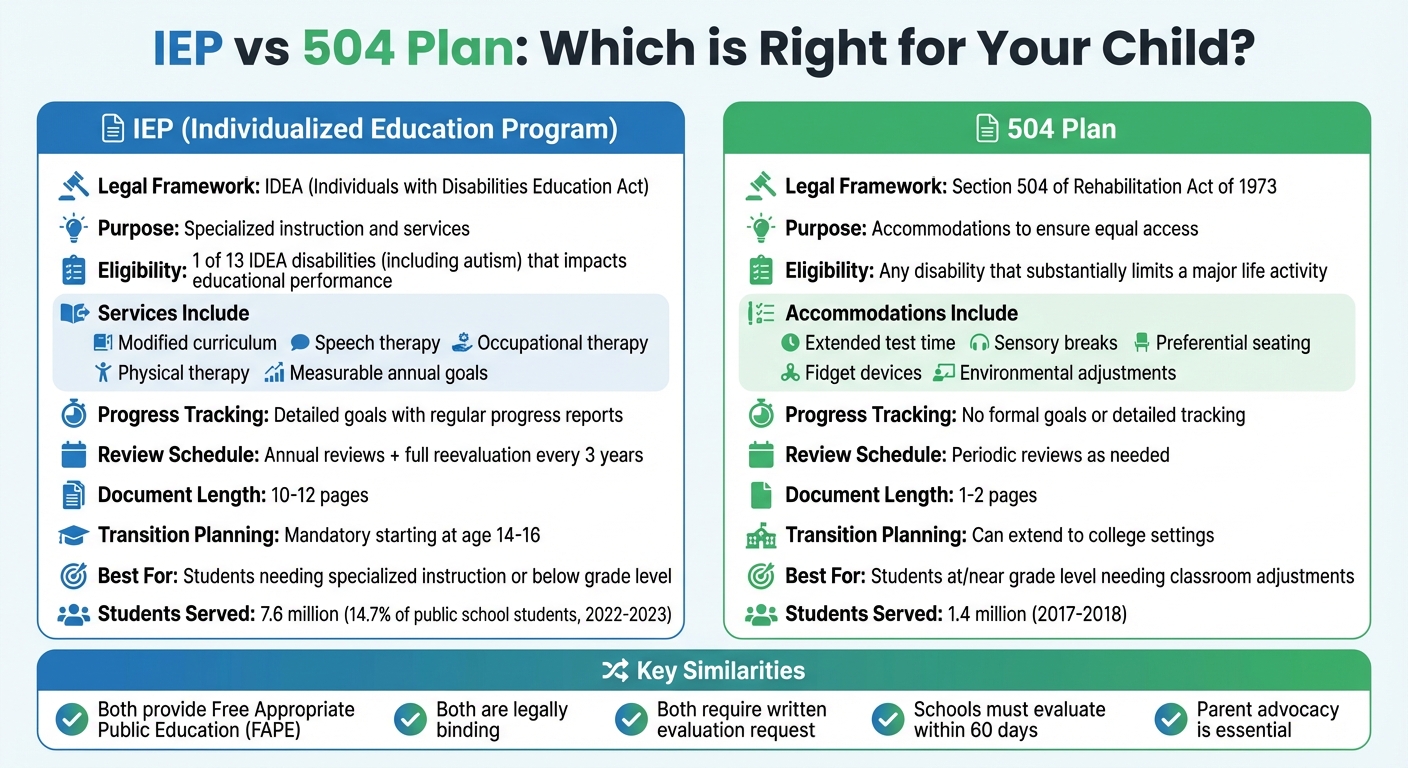
Here’s a side-by-side comparison of the main features of both plans:
| Feature | IEP (Individualized Education Program) | 504 Plan |
|---|---|---|
| Purpose | Provides specialized instruction and related services tailored to the child’s unique needs. | Ensures equal access by removing barriers through accommodations. |
| Eligibility | Requires one of 13 specific disabilities (e.g., autism) that impacts educational performance. | Covers any disability that substantially limits a major life activity. |
| Supports | Includes services like a modified curriculum, speech therapy, and occupational or physical therapy. | Offers accommodations without altering the curriculum. |
| Monitoring & Review | Includes measurable annual goals; reviewed annually with a full reevaluation every three years. | Reviewed periodically and updated as needed; no formal annual goals. |
Another key difference lies in progress tracking. IEPs include measurable annual goals and regular progress reports to monitor a child’s development. They are formal legal documents, meaning schools are required to follow them exactly. In contrast, 504 Plans don’t typically include formal goals or detailed progress tracking, though they are periodically reviewed to ensure accommodations remain effective. For example, during the 2022–2023 school year, roughly 7.6 million children (14.7% of public school students) received IDEA services, while nearly 1.4 million students relied solely on 504 accommodations in 2017–2018.
Selecting the Right Plan for Your Child
Does your child need adjustments within the classroom or a completely customized approach to learning? If your child requires a modified curriculum or specialized services like speech or occupational therapy, an Individualized Education Program (IEP) might be the better choice.
Start by assessing your child’s current performance and challenges. For example, a child who is at or near grade level but struggles with test anxiety or sensory overload may do well with a 504 Plan. On the other hand, a child performing below grade level and needing significant support is likely to benefit more from an IEP. The key question is whether your child needs help accessing lessons as they are or if the lessons themselves need to be adapted.
Next, take the time to document your observations. Before requesting an evaluation, keep a detailed record of your child’s difficulties in areas like academics, social interactions, behavior, and sensory responses. Tools like Guiding Growth can help you organize this information systematically. This documentation will be crucial when submitting a written request for evaluation to the school principal or special education coordinator.
Finally, think about your child’s future needs. Long-term planning is an important aspect of this decision. For instance, if your autistic child will require transition planning for life after high school (something IEPs include starting at age 14 or 16) an IEP provides a more structured framework. Additionally, if measurable goals with regular progress tracking are important to you, the formal monitoring built into an IEP (such as annual reviews and reevaluations every three years) ensures consistent accountability. These considerations can help you determine which plan aligns best with your child’s needs and goals.
Advantages and Disadvantages
Each plan comes with its own set of benefits and limitations, and understanding these trade-offs can help you make a more informed decision.
| Feature | IEP Advantages | IEP Disadvantages | 504 Plan Advantages | 504 Plan Disadvantages |
|---|---|---|---|---|
| Eligibility | Provides comprehensive support for students who qualify under one of 13 disability categories | Has a higher qualification threshold – students must meet specific criteria and demonstrate that their disability negatively impacts their educational performance | Easier and quicker to qualify due to a broader definition of disability (any impairment that "substantially limits" a major life activity) | May not offer enough support for students requiring specialized instruction |
| Services | Includes specialized academic instruction along with related services like speech, occupational, and physical therapy | Involves more paperwork and formal meetings; IEP documents are typically 10–12 pages long | Focuses on essential accommodations without labeling the child as needing "special education"; documentation is often only 1–2 pages | Does not include specialized instruction or related services |
| Accountability | Features measurable annual goals with progress tracking; goals are often written to specific mastery levels (e.g., 90% accuracy) | Comes with stricter requirements and more administrative processes | Easier to implement with less bureaucracy | Lacks formal annual goals, detailed progress monitoring, and transition planning |
| Long-term Planning | Requires mandatory transition planning for post-high school life starting at age 14 or 16 | Legal timelines demand evaluations within 60 days of parental consent | Can extend accommodations to college settings | Receives no federal funding under Section 504, which may limit available resources |
When weighing these options, it often boils down to whether your child needs to learn new skills or simply requires adjustments to their learning environment.
For children who need direct instruction in areas like social skills or self-regulation, an IEP’s structured, goal-oriented framework is ideal. On the other hand, if your child benefits more from environmental changes – like extra time on tests or sensory breaks – a 504 Plan can be a simpler and more efficient solution. This comparison offers a clearer path as you continue advocating for the right support for your child.
Conclusion
If your child requires specialized instruction with measurable goals and transition planning, an IEP may be the best choice. On the other hand, if they primarily need classroom accommodations, a 504 Plan could be more suitable. Both serve distinct purposes in providing tailored support and ensuring access to education.
To get started, submit a written request for an evaluation. Schools are required to complete evaluations within 60 days, and if your child qualifies, an IEP must be developed within 30 days.
As part of the IEP team, take an active role by sharing your child’s perspectives, participating in discussions, and inviting trusted professionals to meetings. Advocacy doesn’t end once the plan is in place. Regular reviews ensure the plan adapts to your child’s changing needs. Annual reviews and progress reports are essential tools to track their development and ensure their supports remain effective.
Stay in close communication with your child’s teachers to confirm they understand and implement the accommodations outlined in the plan. If the school fails to follow the plan, remember that both IEPs and 504 Plans are legally binding. You have the right to file a complaint or request mediation if necessary.
To strengthen your advocacy efforts, document your child’s behaviors, challenges, and progress. This record can provide valuable data for team discussions, ensuring decisions are based on facts rather than assumptions. With a well-constructed plan and your ongoing support, you can help create an educational environment where your autistic child has the tools to succeed.
FAQs
What’s the difference between an IEP and a 504 Plan, and how do I choose the best option for my child with autism?
An IEP (Individualized Education Program) and a 504 Plan both aim to support children with autism, but they cater to different levels of need and types of assistance.
An IEP is tailored for children who face significant challenges that affect their ability to learn or behave in a typical classroom setting. This plan, created under the Individuals with Disabilities Education Act (IDEA), outlines specific goals, services, and modifications to address your child’s unique requirements. It’s designed for students who need specialized instruction and more comprehensive support to thrive academically and socially.
A 504 Plan, however, is geared toward children who don’t qualify for an IEP but still need accommodations to fully participate in the general education curriculum. This might include adjustments such as extended time on tests, sensory breaks, or modified seating arrangements. Governed by Section 504 of the Rehabilitation Act, this plan is ideal for children who have milder needs and don’t require specialized instruction.
Choosing between the two depends on your child’s specific challenges and the level of support they need. Working closely with school professionals, educators, and specialists through evaluations and discussions can help determine the best path for your child’s success.
How can I request an evaluation for an IEP or 504 Plan for my child?
To begin the process of requesting an evaluation for an IEP or 504 Plan, start by pinpointing the specific challenges your child faces in learning or navigating daily school activities. These might include difficulties with communication, behavior, or academic tasks that suggest they need extra support.
The next step is to submit a written request to the school. Address this to your child’s teacher, counselor, or principal, and clearly outline your concerns. Explain why you think an evaluation is important, and consider attaching any relevant documents, like medical records or personal observations, to strengthen your request.
After submitting your request, the school will guide you through the evaluation process. Be ready to work closely with teachers and specialists to ensure the assessment accurately reflects your child’s needs. If they qualify, the school will create a personalized IEP or 504 Plan to provide the support they require.
How do IEPs and 504 Plans differ in terms of accountability and progress tracking?
IEPs (Individualized Education Programs) and 504 Plans take very different approaches when it comes to accountability and tracking progress.
IEPs, which are governed by the Individuals with Disabilities Education Act (IDEA), are legally binding and packed with specific, measurable goals tailored to a child’s unique needs. These programs require consistent progress monitoring and rely on a collaborative team of educators, specialists, and parents to ensure the child is on track to meet their goals.
504 Plans, on the other hand, fall under Section 504 of the Rehabilitation Act. They focus on accommodations that help remove barriers to learning, ensuring equal access to education. However, they typically don’t include measurable goals or require regular progress tracking. This difference makes IEPs more structured and goal-oriented, while 504 Plans emphasize accessibility and support without the added layer of formal progress evaluation.