The Modified Checklist for Autism in Toddlers (M-CHAT) is a quick, free screening tool for identifying autism risks in children aged 16 to 30 months. It involves a 20-question yes/no form completed by parents during routine checkups, typically at 18- and 24-month visits. Early detection is key, as the M-CHAT can identify autism two years earlier than average, allowing for earlier intervention, which improves developmental outcomes.
- How it works:
- Stage 1: Parents answer questions about behaviors like responding to their name or pretend play.
- Stage 2: A follow-up interview for medium-risk scores ensures accuracy and reduces false positives.
- Risk Levels:
- Low (0–2): No action required, but repeat screening at 24 months if under 2.
- Medium (3–7): Follow-up interview; scores of 2+ require further evaluation.
- High (8–20): Immediate referral for diagnostic evaluation and early intervention.
Key Stats:
- 98% of toddlers with positive screens show developmental concerns.
- 54% of those screening positive on both stages are diagnosed with autism.
- Early intervention services are available under U.S. law for children under 3.
If your child screens positive, act immediately by contacting early intervention services or scheduling a diagnostic evaluation. Early action makes a meaningful difference in your child’s development.
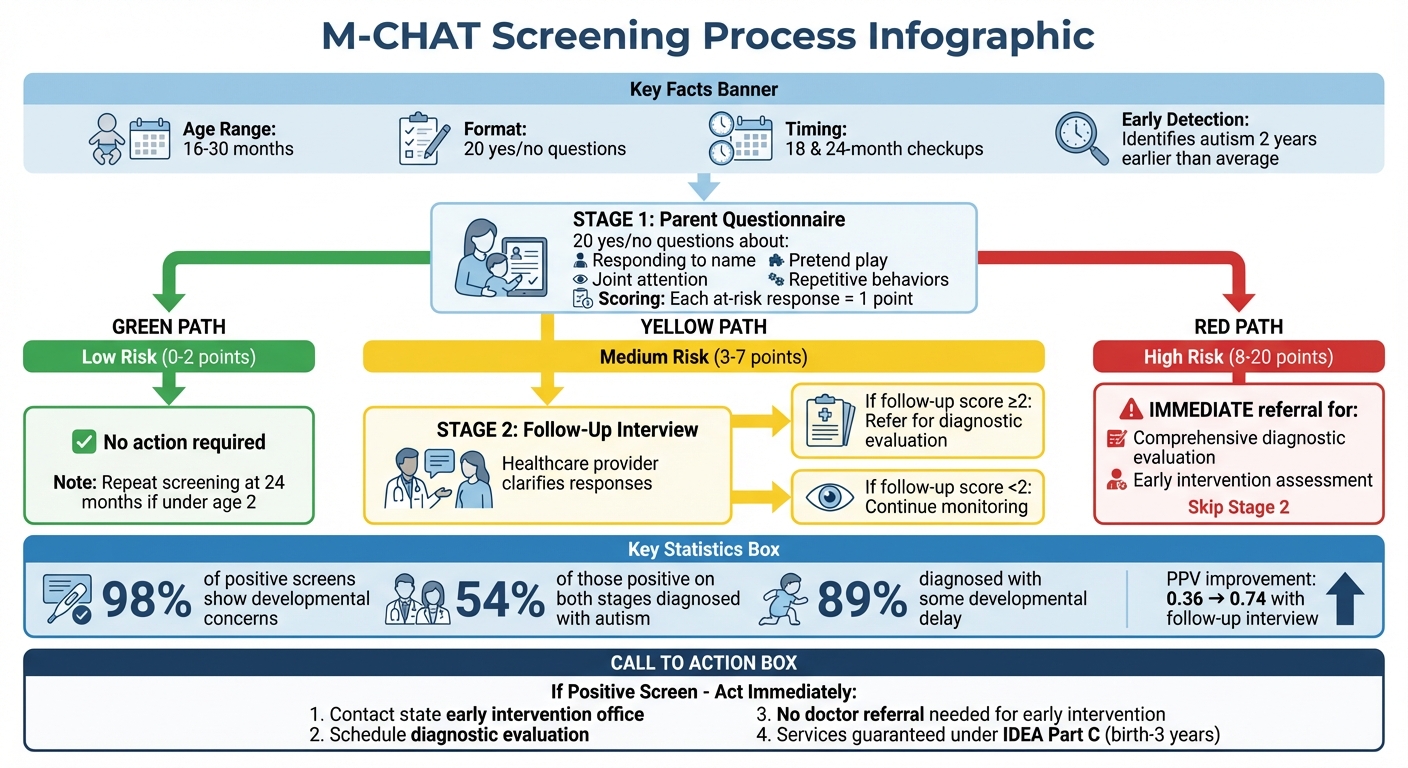
M-CHAT Screening Process: Two-Stage Risk Assessment and Next Steps
Developmental Screening – The Basics: M-CHAT-R/F

How the M-CHAT Screening Works
The M-CHAT-R/F uses a two-step process to identify toddlers who might need further evaluation for autism. This approach combines broad initial detection with a more detailed follow-up, reducing unnecessary referrals while improving accuracy.
Stage 1: The Parent Questionnaire
Parents start by answering 20 yes/no questions about their child’s everyday behaviors. These questions focus on areas like how the child responds to their name, engages in joint attention, participates in pretend play, and displays repetitive behaviors. It’s important to answer based on typical behavior rather than occasional incidents.
The risk levels based on the questionnaire are:
- 0–2: Low risk
- 3–7: Medium risk
- 8–20: High risk
Children scoring in the high-risk category may skip the second stage and go straight to a diagnostic evaluation.
Stage 2: The Follow-Up Interview
For children in the medium-risk range, healthcare providers conduct a follow-up interview with parents. This step helps clarify the initial responses, distinguishing normal variations in behavior from potential concerns.
This follow-up significantly improves the test’s accuracy, raising the positive predictive value (PPV) from 0.36 to 0.74 overall, and from 0.11 to 0.65 in low-risk groups [1]. Any child scoring 3 or higher after this step is referred for a comprehensive clinical evaluation [2]. This process ensures that children who need further assessment are identified early and accurately.
Understanding Your Child’s M-CHAT Score
When using the M-CHAT, each "at-risk" response (typically marked as "No") is given 1 point. The total score provides insight into your child’s risk level for Autism Spectrum Disorder (ASD) and helps determine the next steps.
"The M-CHAT TOTAL SCORE is the recommended score for assessing ASD risk in toddlers,"
states the M-CHAT Official Website [2]. This approach ensures a high level of sensitivity, aiming to identify as many potential cases as possible. The scoring system is used across both stages of the M-CHAT process to provide a thorough evaluation.
The total score places toddlers into specific risk categories, each with recommended actions.
Score Categories and What They Mean
Low-Risk (0–2 points):
No additional action is required at this time. However, for children under 24 months, it’s a good idea to repeat the screening after they turn 2. This score typically indicates development within the expected range unless clinical observations suggest otherwise.
Medium-Risk (3–7 points):
A Stage 2 Follow-Up Interview is conducted to address any concerns. If the follow-up score reaches 2 or higher, a detailed diagnostic evaluation is recommended.
High-Risk (8–20 points):
An immediate referral for a comprehensive diagnostic evaluation and early intervention assessment is advised.
Research shows that about 54% of children who screen positive on both stages of the M-CHAT-R/F are ultimately diagnosed with Autism Spectrum Disorder. Additionally, approximately 89% are diagnosed with some type of developmental delay, and nearly 98% exhibit developmental concerns that require further evaluation [2]. While a positive result doesn’t confirm an autism diagnosis, it strongly suggests the need for professional assessment.
sbb-itb-d549f5b
What to Do After a Positive M-CHAT Screen
If your child receives a positive result on the M-CHAT, it’s important to take immediate steps. A positive screen doesn’t confirm an autism diagnosis, but it does indicate the need for further evaluation. According to the M-CHAT™ Parent FAQ:
"We recommend that if your child screens positive, you should act immediately."
Delaying action can have serious consequences. The same resource highlights that "Waiting a year means that valuable intervention time is lost, and might mean that your child is at increased likelihood of falling farther behind his or her peers" [4]. Early intervention is most effective when started by ages 2 or 3.
Your next steps should include contacting your state’s early intervention office to request an evaluation and scheduling a formal diagnostic assessment with a specialist. Developmental-behavioral pediatricians, psychologists, or other qualified professionals can provide this evaluation [4]. Parents don’t need a referral from a doctor to access early intervention services. To find specialists, you can:
- Ask your child’s pediatrician for recommendations.
- Check with your health insurance provider for in-network options.
- Reach out to local hospitals or clinics.
If your child’s healthcare provider doesn’t express concern despite a positive screen, it’s essential to advocate for further evaluation. Research shows that many developmental concerns are not flagged until after screening. You can still move forward independently by contacting early intervention services or seeking an expert evaluation [4].
In the United States, early intervention services are guaranteed under Part C of the Individuals with Disabilities Education Act (IDEA) for children from birth to age 3 [5]. These programs often include therapies like speech and physical therapy, family training, and Applied Behavioral Analysis (ABA). A positive M-CHAT result strongly suggests developmental concerns that require follow-up, ensuring your child gets the support they need.
Taking these steps promptly can make a significant difference in your child’s development.
Using Guiding Growth to Support the M-CHAT Process
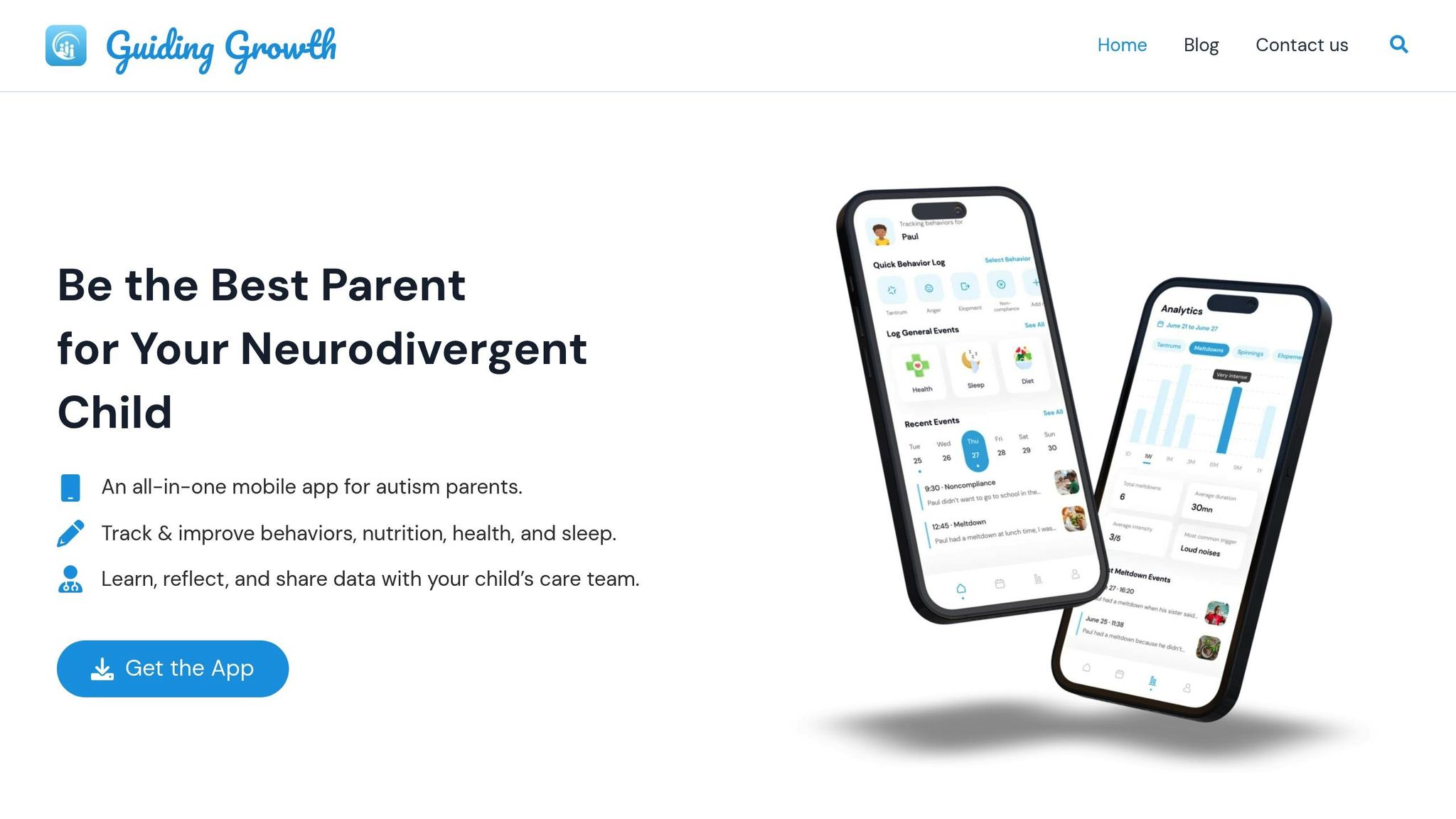
Answering the M-CHAT accurately depends on observing your child’s daily behaviors consistently. This screening tool asks parents to focus on typical behaviors rather than occasional ones, which can be tricky to recall. By using Guiding Growth to track your child’s daily patterns, you can provide more precise answers to the 20 screening questions. This approach helps bridge the gap between subjective memory and objective, detailed observations.
Documenting Behaviors and Development
Guiding Growth allows you to monitor key areas of your child’s development, including social engagement, communication, and joint attention. For example, you can track how your child interacts with peers, responds to their name, or uses gestures like pointing. It also helps you note milestones like imaginative play – such as pretending to cook or feeding a doll – and identify unusual patterns like repetitive motions or sensory sensitivities [3].
By keeping daily records, you can clearly differentiate between behaviors your child shows regularly and those that occur less often, providing a more accurate picture of their development.
Sharing Information with Your Child’s Doctor
Accurate documentation becomes especially valuable if your child scores in the medium-risk range on the M-CHAT and requires a Follow-Up Interview with a pediatrician or healthcare provider. Guiding Growth transforms your observations into detailed reports that include specific examples of your child’s behaviors, sleep habits, and developmental milestones. These reports can lead to more meaningful discussions with your doctor.
Additionally, if further evaluation using tools like the ADOS-2 is recommended, the tracking data you’ve gathered offers specialists context about your child’s typical behaviors and overall development [3]. This level of detail supports a more thorough and informed diagnostic process.
Conclusion
The M-CHAT-R/F plays a key role in identifying autism early, paving the way for timely diagnostic evaluations and interventions. Catching signs early allows access to intervention services that can make a meaningful difference in developmental outcomes.
To make the most of this tool, consistent documentation is crucial. Since the M-CHAT relies on observing everyday behaviors, keeping detailed and regular records can enhance the quality of clinical discussions.
Accurate and ongoing documentation ensures you’re well-prepared to collaborate with your pediatrician, no matter your child’s risk score. Together, the M-CHAT and thorough behavioral tracking equip you to advocate for timely evaluations and the support your child may need.
FAQs
What are the advantages of using the M-CHAT for early autism detection?
Detecting autism early using the M-CHAT (Modified Checklist for Autism in Toddlers) gives parents and caregivers the chance to take action at the right time. Early intervention can make a big difference, helping children on the autism spectrum develop better communication and social skills while improving their overall quality of life.
The M-CHAT is a straightforward tool aimed at spotting early signs of autism in children aged 16 to 30 months. By identifying potential concerns during these early years, families can collaborate with healthcare professionals to develop personalized plans that address the child’s specific needs during these crucial developmental stages.
How can parents accurately answer M-CHAT questions?
When answering M-CHAT questions, focus on your child’s usual behaviors rather than occasional or recent actions. Think about how they typically respond in everyday situations and provide honest answers. The screening aims to identify consistent patterns, not one-off incidents.
Take your time with the questions – careful observation over time can lead to more accurate results. If you’re uncertain about a particular behavior, consider consulting a healthcare professional for guidance to ensure your responses reflect your child’s behavior as accurately as possible.
What should parents do if their child gets a high-risk score on the M-CHAT?
If your child scores in the high-risk range on the M-CHAT, the next step is to arrange a follow-up appointment with their healthcare provider. This follow-up may include a more in-depth assessment to gain a clearer understanding of your child’s developmental progress and needs.
Depending on the findings, the provider might suggest a diagnostic evaluation or recommend beginning early intervention services. Acting promptly can play a key role in supporting your child’s growth and development, making it essential to address any concerns without delay.