Understanding nonverbal social cues – like facial expressions, gestures, and tone of voice – can be challenging for autistic children. These cues make up over 90% of communication, yet they often need to be explicitly taught. Here’s what parents need to know:
- Nonverbal cues include body language, eye contact, tone, and personal space.
- Many autistic children struggle with interpreting these signals, which impacts social interactions.
- Tools like visual aids, social stories, and role-playing can help teach these skills.
- Progress tracking and adjusting strategies are key for long-term learning.
Common Nonverbal Cues and Teaching Strategies
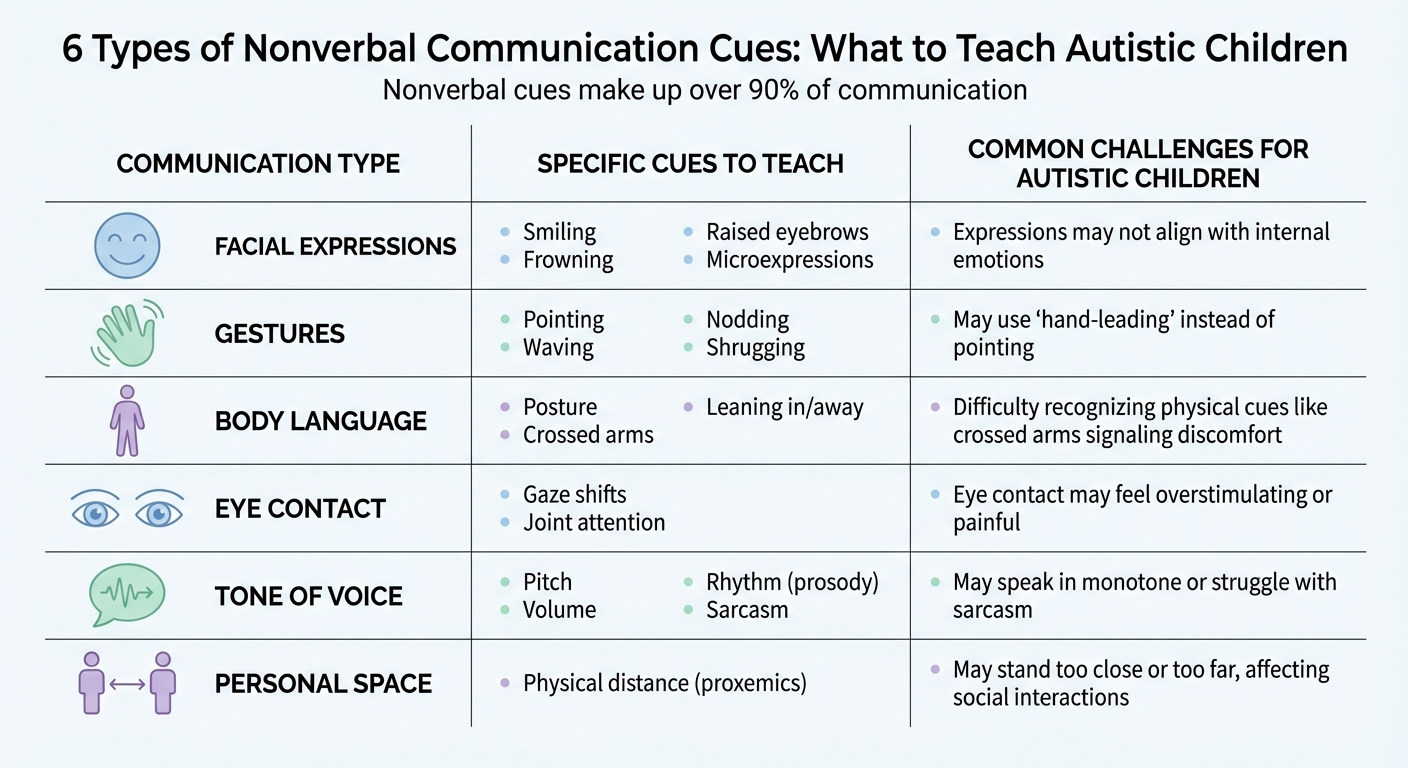
6 Types of Nonverbal Communication Cues and Challenges for Autistic Children
Identifying Common Nonverbal Cues
Every day, your child encounters a variety of nonverbal cues, but prioritizing which ones to address first can make a big difference. Start with facial expressions – smiling, frowning, or raised eyebrows. These are fundamental, yet autistic children may struggle to align their facial expressions with their emotions [1][3]. Gestures like pointing, waving, or nodding are also key, though some children may rely on "hand-leading" (using an adult’s hand as a tool) instead of pointing [3].
Body language speaks volumes through posture and movement. Crossed arms might indicate discomfort or defensiveness, while leaning in can show interest [4][7]. Eye contact and gaze shifts are essential for joint attention – where focus is shared on an object – but direct eye contact can feel overstimulating or even physically painful for many autistic children [1][3]. Tone of voice (prosody) adds emotional depth to words, yet some children might use a monotone voice or interpret sarcasm literally [1][4]. Lastly, understanding personal space (proxemics) is crucial – standing too close can feel intrusive, while standing too far may seem aloof [1][4].
| Communication Type | Specific Cues to Teach | Common Challenges for Autistic Children |
|---|---|---|
| Facial Expressions | Smiling, frowning, raised eyebrows, microexpressions | Expressions may not align with internal emotions [1][3]. |
| Gestures | Pointing, waving, nodding, shrugging | May use "hand-leading" instead of pointing [3]. |
| Body Language | Posture, crossed arms, leaning in/away | Difficulty recognizing physical cues like crossed arms signaling discomfort [4][7]. |
| Eye Contact | Gaze shifts, joint attention | Eye contact may feel overstimulating or painful [1][3]. |
| Tone of Voice | Pitch, volume, rhythm (prosody), sarcasm | May speak in monotone or struggle with sarcasm [1][4]. |
| Personal Space | Physical distance (proxemics) | May stand too close or too far, affecting social interactions [1][4]. |
It’s important to teach your child not only how to use these cues but also how to interpret them in others. This dual focus helps them navigate social settings with more ease, even though it can be mentally draining for them [1][2].
Using Visual Supports and Social Stories
Many autistic children learn best through visual aids, making tools like picture cards, emotion charts, and visual schedules incredibly effective [9][8]. These tools simplify abstract nonverbal signals into clear, visual representations. For instance, an emotion chart featuring photos of joy, sadness, or anger can help your child identify emotions in themselves and others [9].
Social stories take this a step further by using illustrations and simple language to explain social situations and their "hidden rules" [4][8]. For example, a social story might explain what crossed arms mean or how to take turns during play. Research from the National Autism Center highlights the effectiveness of visual supports in improving social understanding for autistic children [8].
To maximize the impact of these tools, use them consistently across settings – home, school, and therapy – so your child can apply their skills in different environments. First/Then boards are another helpful strategy for transitions, pairing a less preferred activity with a motivating reward, like "First clean up toys, then watch TV" [9]. To make these tools more durable and engaging, laminate the visuals and involve your child in choosing the images [9].
Practicing Through Role-Playing and Modeling
Role-playing offers a safe environment for your child to practice social interactions. Start with simple, scripted scenarios like greetings, asking for help, or ordering at a restaurant [8][4]. Break these interactions into smaller steps, focusing on one cue at a time – like facial expressions first, followed by gestures, and then tone of voice – before combining them [4].
Video modeling and live demonstrations are also powerful teaching methods. Play recordings of social interactions and pause to discuss specific gestures or tones [4]. You can even record your child successfully using a social cue (video self-modeling) to build their confidence [4]. Another fun activity is a "cue hunt" during movies or cartoons, where you pause to identify a character’s facial expression or tone of voice [4]. When modeling in person, pair spoken words with clear, exaggerated gestures – like waving when saying "bye" or nodding when saying "yes" [3].
After social interactions, reflect with your child by asking which cues they noticed and praising their efforts [4]. Use a "pause and wait" approach, giving them extra time to process nonverbal cues before responding [3]. These strategies create a strong foundation for improving nonverbal communication skills in a structured and engaging way.
sbb-itb-d549f5b
Activities for Teaching Nonverbal Communication
Observation and Imitation Games
Making nonverbal learning fun at home is easier than you might think. Start with "cue hunts" – pick a specific gesture or expression, like a shrug or a smile, and look for it together while watching cartoons or running errands [4]. Another idea is "sound-off movie clips": mute short video scenes and focus on facial expressions and body language to guess a character’s emotions [5].
Try gesture guessing, where you perform gestures like crossing your arms or leaning forward, and your child guesses their meaning [5]. For tone of voice practice, tone matching works well – play recordings of the same phrase spoken in different tones (excited, serious, sad) and ask your child to identify the emotion behind each one [5]. These activities allow kids to sharpen their observation skills without the stress of live interactions.
Next, let’s look at how to use everyday moments to build on these skills.
Using Media and Everyday Scenarios
Everyday routines are full of chances to practice nonverbal cues naturally. For example, family meals are great for teaching conversational turn-taking. Encourage your child to notice pauses, tone changes, or excited voices when someone shares news. At the park or a restaurant, practice joint attention by pointing out interesting things together, like a passing airplane or a playful dog [3].
After these interactions, take a moment to reflect. Ask your child which cues they noticed and if anything stood out. This kind of debriefing helps reinforce what they’ve learned in a low-pressure way.
Now, let’s see how peer interactions can take these skills to the next level.
Encouraging Peer Interaction
Once your child has practiced at home, applying these skills with peers is the next step. Peer modeling is a natural way for children to learn by observing and imitating others during structured playgroups or classroom activities [8]. Research published in the Journal of Autism and Developmental Disorders highlights how peer modeling supports social engagement [8].
"Peer models can create more natural settings… Practice real conversations, not just drills." – Bright Life ABA [4]
Focus on shared interests to make social interactions more enjoyable. Enroll your child in clubs or activities they love, like drama classes, LEGO building, or art workshops [6][1]. Structured games, such as board games, provide clear rules that ease social anxiety while teaching turn-taking and cooperation [8]. For playdates, choose quieter settings and allow sensory breaks if needed [8]. You can also train siblings or friends to offer quick, helpful feedback, like saying, "They seem bored – try asking them a question" [4].
These real-world experiences help reinforce nonverbal communication skills in a variety of social settings.
Tracking and Adjusting Your Child’s Progress
Using Tools to Measure Progress
Start by creating a baseline of your child’s missed social cues, such as facial expressions, tone of voice, or gestures [4]. From there, maintain a progress log to document both missed cues and areas of improvement [3][4]. For instance, you might note when your child successfully identifies frustration from crossed arms or when they miss the sarcasm in a friend’s comment.
Another key element to track is the level of prompting your child requires. Begin with full prompts, like physically guiding them, and gradually move to partial prompts, such as verbal reminders, until they can recognize cues on their own [4]. You can also make it fun by focusing on specific gestures – like a thumbs-up or a shrug – and tracking how often your child spots them in movies or during everyday activities [4].
For a more structured approach, tools like Guiding Growth (https://guidinggrowth.app) can help you log your child’s behaviors, social interactions, and responses to various cues. This app turns daily observations into actionable insights, making it easier to spot patterns and communicate progress with therapists or teachers. By analyzing this data, you can identify what’s working and make informed decisions about when to tweak your methods.
When to Change Your Approach
Keep an eye out for signs that suggest it’s time to adjust your strategy. If your child begins to regress, losing gestures or expressions they previously mastered, it’s a clear signal to re-evaluate your approach [3]. Similarly, if they can use social cues but seem overly tired, anxious, or withdrawn, they might be experiencing masking burnout – a state where they’re consciously imitating behaviors at a high mental cost [1][2].
Other warning signs include overteaching fatigue, where practicing cues feels robotic rather than meaningful [4], or a lack of generalization, where your child can perform skills in therapy but struggles in real-world settings like the playground or cafeteria [4]. If something like eye contact causes sensory discomfort, consider alternatives, such as teaching them to focus on someone’s forehead instead [3][8]. It’s a good idea to review your teaching plan every few months to ensure it remains effective [4].
Creating a Supportive Learning Environment
Celebrating Small Wins
Learning nonverbal cues takes time, and every small step forward is worth celebrating. If your child recognizes a frown or notices crossed arms, respond with enthusiastic praise – something as simple as a cheerful "Wow!" or a clap can go a long way [10].
"Progress isn’t about rushing. It’s about celebrating every small step – a smile understood, a gesture recognized, or a tone of voice correctly read. These wins build confidence over time." – The Treetop [5]
Focus on the effort rather than perfection. If your child tries to interpret an expression, even if they don’t get it quite right, acknowledge their attempt. For example, if they point to an object instead of just reaching for it, celebrate that new behavior. Recognizing and rewarding these efforts fosters confidence and reinforces their engagement in activities they enjoy [10]. By shifting the focus from "fixing deficits" to supporting their unique communication style, you help them feel understood and valued.
While celebrating these small victories, it’s equally important to create an environment that reduces stress and sensory challenges.
Reducing Pressure and Sensory Overload
A supportive environment isn’t just about encouragement – it’s also about minimizing stress and managing sensory input. For instance, if maintaining eye contact feels uncomfortable or overwhelming for your child, don’t force it. For some autistic individuals, direct eye contact can even be physically painful [1][8]. Instead, praise them for engaging in ways that feel manageable, like looking at someone’s forehead or focusing nearby.
"What appears as a lack of engagement may actually be an attempt to manage overwhelming sensory input or avoid the discomfort of forced eye contact." – Sachs Center [1]
A calm and familiar setting can also make a big difference. Use tools like visual schedules or "First/Then" boards to help ease transitions and create predictability [9][6]. Pay attention to signs of fatigue or overstimulation, and avoid pushing too hard. Reducing performance pressure helps prevent mental exhaustion and creates a more positive learning experience for your child.
Conclusion
Teaching nonverbal social cues to your autistic child is a journey that grows and changes over time. What may seem like a communication gap is more accurately a different way of interacting with the world – your child isn’t broken or incomplete; they’re simply navigating a system of unspoken rules that feels unfamiliar to them [1]. The goal isn’t about molding them into neurotypical behavior but about fostering connection and confidence, ensuring they feel understood and valued [4][5].
As we’ve covered, nonverbal signals lay the foundation for meaningful social interactions. Start with the basics: tools like emotion charts and social stories can help clarify these cues. Every step forward, no matter how small, is progress. Whether it’s identifying a smile or using a gesture instead of grabbing, each milestone adds to their understanding of social dynamics.
Tracking progress consistently is key to refining your approach. By keeping a record of the cues your child picks up on and the ones they find challenging, you can adapt your strategies as they grow [3][4]. Apps like Guiding Growth (https://guidinggrowth.app) can make this easier by turning daily observations into actionable insights. These tools help you spot patterns, track behaviors, and even create reports that make discussions with healthcare providers more effective. Understanding your child’s development in this way can boost your confidence as a caregiver.
With the right tools and support, autistic children can not only learn to interpret nonverbal signals but also flourish in their social interactions.
Most importantly, be patient with yourself and your child. Learning to interpret social cues can feel like trying to read an unfamiliar language or sight-read a piece of music – it requires focus and time [1]. Allow your child the space to process, minimize sensory distractions when possible, and always assume they are capable. Your child has a rich inner world and often understands far more than they can express [1]. With patience, structured support, and thoughtful adjustments, you’re creating the foundation for stronger connections and lasting confidence.
FAQs
Which nonverbal cues should we teach first?
Teaching facial expressions and body language is a great starting point for understanding emotions and intentions. These nonverbal cues are universal and often the easiest to recognize, making them an ideal foundation for developing broader nonverbal communication skills. By focusing on these basics, learners can quickly grasp how people convey feelings without words, setting the stage for mastering more complex interactions.
How can I teach social cues without forcing eye contact?
Teaching social cues doesn’t have to revolve around eye contact. Instead, you can shift the focus to other nonverbal signals like facial expressions, body language, gestures, and tone of voice. Strategies such as visual supports, role-playing, and video modeling can be incredibly effective in helping children pick up on these cues. Tools like social stories and regular, structured practice also play a key role in building their understanding, all while respecting their personal comfort levels and sensory preferences.
How do I know if my child is burning out from masking?
Signs of burnout from masking can show up as heightened stress, constant fatigue, and pulling away from social interactions. You might notice your child becoming irritable, having trouble focusing, or losing interest in activities they once enjoyed. They may also retreat into solitude as a way to recharge. Spotting these signs early gives you the chance to ease their stress, offer support, and encourage them to express themselves genuinely – helping to avoid emotional exhaustion.