The Social Communication Questionnaire (SCQ) is a quick, parent-completed screening tool designed to identify traits linked to autism spectrum disorder (ASD) in children aged 4 and older. It takes about 10–15 minutes to complete and focuses on three areas: social interaction, communication, and repetitive behaviors. The SCQ comes in two versions:
- Lifetime Form: Reviews developmental history, especially behaviors around ages 4–5.
- Current Form: Focuses on behaviors from the past three months, useful for tracking progress.
A score of 15 or higher indicates the need for further evaluation, though the cutoff may vary by age. The SCQ is not a diagnostic tool but a starting point for discussions with healthcare providers. It helps determine whether more in-depth assessments, like the Autism Diagnostic Observation Schedule (ADOS), are necessary.
Key Takeaways:
- Purpose: Screen for autism traits, not diagnose.
- Scoring: 0–39 points; 15+ suggests further evaluation.
- Use Cases: Lifetime Form for initial screenings, Current Form for monitoring progress.
- Limitations: Results can be influenced by age, developmental delays, and co-occurring conditions.
The SCQ is a helpful tool for identifying areas of concern and guiding conversations with professionals about next steps in understanding your child’s needs.
Improving Assessment of Autism Across a Lifespan: Best Practices
sbb-itb-d549f5b
The 2 Versions of the SCQ: Lifetime and Current
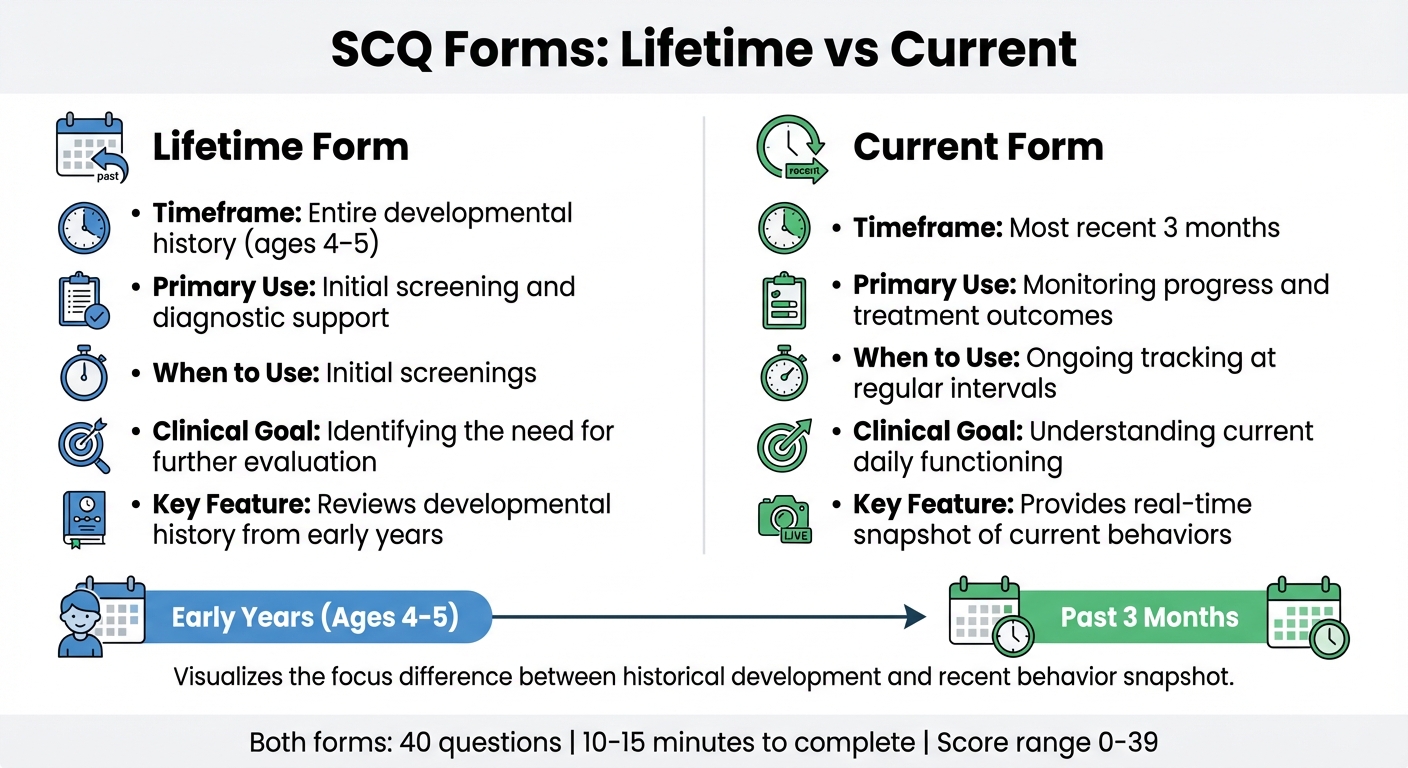
SCQ Lifetime vs Current Form Comparison Chart
This section dives into the specific purposes and applications of the two SCQ forms: Lifetime and Current. Knowing when to use each can provide a clearer understanding of your child’s development and progress.
Lifetime Form
The Lifetime Form focuses on your child’s developmental history, particularly between the ages of 4 and 5 [3]. When completing this form, it’s essential to reflect on behaviors from those early years rather than recent ones.
"The Lifetime version addresses a child’s entire developmental history, while the Current version looks at the child’s behavior over the last 3 months." – Kennedy Krieger Institute [4]
To ensure accuracy, consider revisiting old videos, journals, or medical records. These resources can help you recall details about your child’s early developmental milestones [3].
Current Form
The Current Form, on the other hand, evaluates your child’s behavior and social communication skills from the past three months [3]. This provides a real-time snapshot of their current functioning, making it especially useful for tracking changes over time.
"Current scores (last 3 months) help the clinician understand the individual’s current daily experiences and evaluate treatment and educational plans." – CHOP Research Institute [1]
Healthcare providers often rely on the Current Form during regular check-ins, such as every few months, to assess how therapies or interventions are influencing your child’s development [4].
When to Use Each Form
The Lifetime Form is ideal for first-time evaluations or initial screenings, as it captures a comprehensive historical perspective. In contrast, the Current Form is better suited for monitoring progress or assessing the effectiveness of treatments over time [1][4]. Comparing scores from multiple Current Forms can help you and your healthcare team determine whether interventions are having a meaningful impact on your child’s daily life.
| Feature | Lifetime Form | Current Form |
|---|---|---|
| Timeframe | Entire developmental history (ages 4–5) | Most recent 3 months |
| Primary Use | Initial screening and diagnostic support | Monitoring progress and treatment outcomes |
| When to Use | Initial screenings | Ongoing tracking at regular intervals |
| Clinical Goal | Identifying the need for further evaluation | Understanding current daily functioning |
The main difference between the two forms lies in the timeframe they cover. Next, we’ll take a closer look at how SCQ scores are calculated and what they reveal in practical terms.
How SCQ Scores Are Calculated and What They Mean
SCQ Scoring Basics
The SCQ is a 40-item yes/no questionnaire designed to be completed in just 10–15 minutes. It produces a final score ranging from 0 to 39 (the first question is excluded), with each autism-related response earning 1 point. Scoring takes about 5 minutes, and higher scores suggest a stronger likelihood that your child may exhibit characteristics associated with autism spectrum disorder (ASD) [1]. The questionnaire focuses on three main areas: Reciprocal Social Interaction, Communication, and Restricted/Repetitive/Stereotyped Patterns of Behavior [2]. While clinicians may sometimes examine scores within these individual domains, the total score is the primary measure used for screening. This scoring system lays the groundwork for interpreting the significance of the cutoff score.
Understanding the Cutoff Score
The standard cutoff score for the SCQ is 15 [1]. If your child scores at or above this number, it indicates they may exhibit social communication traits consistent with ASD, warranting a more comprehensive diagnostic evaluation. For school-age children, the SCQ has demonstrated a sensitivity of 0.88 and a specificity of 0.72 when this cutoff is applied [2].
However, the cutoff can vary depending on age. For children aged 17–45 months, a cutoff of 15 provides a sensitivity of 0.47, but lowering it to 11 improves sensitivity to 0.89. For adults with intellectual disabilities, a cutoff of 12 is recommended [2]. Healthcare providers may adjust the threshold based on your child’s age and developmental profile to balance identifying potential cases with minimizing false positives.
SCQ as a Screening Tool, Not a Diagnosis
While understanding how SCQ scores are calculated is important, it’s equally crucial to recognize that the SCQ is not a diagnostic tool. Its purpose is to flag potential concerns rather than provide a definitive diagnosis [5]. A score above 15 serves as an indicator for further evaluation.
"As a screening measure, the SCQ is not suitable for individual diagnosis; responses should be considered alongside clinical observations." – CHOP Research Institute [1]
If your child’s score exceeds the cutoff, your healthcare provider will likely recommend additional assessments, such as the Autism Diagnostic Observation Schedule (ADOS) or the Autism Diagnostic Interview-Revised (ADI-R). These in-depth evaluations, considered the gold standard for diagnosing ASD, involve either direct observation or detailed clinical interviews that may take several hours to complete [5]. The SCQ’s role is simply to highlight the need for further investigation, helping guide discussions with healthcare professionals and determining the next steps in the process.
Factors That May Affect SCQ Scores
Demographic and Developmental Factors
Demographic factors can significantly influence SCQ scores. Studies indicate that variables like sex, household income, race, and maternal education levels play a role. Families with lower household incomes or lower maternal education levels often experience reduced specificity, which can lead to more false positives – this is particularly common among minority families [2].
"Lower maternal education and minority status may be more prone to inaccurate screenings (i.e., false positive results)." – TSLAT (Texas Statewide Leadership for Autism Training) [2]
Age is another critical factor. For the SCQ to provide valid results, a mental age of at least 2.0 years is required, regardless of chronological age [1][2]. This distinction becomes especially important for children with developmental delays, as their results may need careful interpretation. Beyond demographics, a child’s unique behavioral and functional profile also plays a role in shaping SCQ outcomes.
Behavioral and Functional Considerations
A child’s overall level of functioning has a direct impact on SCQ scores. Research shows a negative correlation between functional ability and total SCQ scores – children with lower functioning levels often score higher, which can inflate results [2].
Communication skills are another key factor. For adults with intellectual disabilities, the communication subscale has been found to have poor internal consistency (alpha 0.48), making it less reliable for this group [2]. Additionally, behaviors linked to co-occurring conditions such as ADHD, OCD, or Attachment Disorder may overlap with autism traits, further inflating scores [1][6]. If your child has other diagnoses, it’s essential to discuss these with your healthcare provider when reviewing SCQ results.
"Level of functioning should be considered in interpretation of screening scores." – Snow & Lecavalier [2]
The reliability of the SCQ also varies with age, which is explored in the next section.
Consistency Across Age Groups
The SCQ’s accuracy is not uniform across all age groups. In fact, it performs differently depending on the age of the individual being assessed [2]. A study analyzing 344 participants aged 1.58 to 25.92 years found that the tool’s reliability improved significantly for individuals 7.5 years or older [2]. For younger children (17–45 months), the standard cutoff score of 15 yielded a sensitivity of only 0.47. However, lowering the cutoff to 11 increased sensitivity to 0.89 [2]. Similarly, for toddlers aged 20–40 months, the tool demonstrated a sensitivity of 0.76 and a specificity of 0.58 – levels often deemed insufficient for precise identification [2].
The SCQ also behaves differently in clinical settings compared to the general population. For example, specificity drops from 0.95 in the general population to 0.74 when used with children already presenting developmental concerns [2]. This means false positives are more likely in clinical environments. Taking these factors into account can help you and your healthcare provider interpret SCQ results with greater accuracy.
Using SCQ Results With Healthcare Professionals
Communicating With Healthcare Providers
The SCQ is a helpful starting point for conversations with your child’s healthcare team. When you bring the results to an appointment, present them as an indicator that further evaluation might be needed. Remember, the SCQ isn’t meant to provide a diagnosis – it’s a tool to highlight whether additional assessment should be considered [1].
Before your appointment, complete the questionnaire to give your provider a clear measure to discuss. It’s also a good idea to prepare specific questions, such as:
- "Which domain most influenced the score, and what does that mean for my child’s support needs?"
- "Could factors like anxiety, ADHD, or sensory processing differences affect these responses?"
These types of questions can guide your provider in interpreting the results within the broader context of your child’s development. Additionally, combining SCQ results with other diagnostic tools can provide a more complete picture.
Combining SCQ With Other Assessment Tools
The SCQ works best when paired with other evaluation methods. While the SCQ is based on your observations, tools like the ADOS involve direct observation by trained professionals. Combining these approaches helps balance parental insights with professional expertise [1].
For example, using the SCQ alongside the ADOS is often more time-efficient and cost-effective compared to pairing the ADOS with the ADI-R. The SCQ takes only 10–15 minutes to complete, while the ADI-R can take 1.5–3 hours [1]. This makes the SCQ a practical option for many families.
It’s worth noting that research indicates only 14–50% of children who screen positive on initial autism screeners are ultimately diagnosed with ASD after a full evaluation [5].
"A positive result on a screener is just a signal for more information, not a final answer. It’s an essential first step that says, ‘Hey, let’s look into this,’ not ‘This is a definite yes.’" – Sachs Center [5]
Healthcare providers should integrate SCQ results with clinical observations, developmental history, and interviews to create a comprehensive assessment. It’s important to ask how your child’s SCQ scores align with what the provider observes during the visit. Additionally, tracking SCQ scores over time can offer valuable insights into your child’s progress.
Tracking Progress With SCQ Over Time
The Current SCQ, which focuses on the past three months, provides valuable insights into your child’s daily functioning and the impact of treatments [1]. Requesting the Current SCQ every three months can help you and your provider monitor the effectiveness of interventions and make adjustments as needed.
"Current scores (last 3 months) help the clinician understand the individual’s current daily experiences and evaluate treatment and educational plans." – CHOP Research Institute [1]
For instance, consistently low scores in social communication might indicate a need for speech therapy, while higher sensory-related scores could suggest that occupational therapy might be beneficial. You can also use these results to advocate for specific supports in your child’s IEP or 504 plan, such as extra time on tests, preferential seating, or participation in social skills groups.
To make tracking even easier, tools like Guiding Growth (https://guidinggrowth.app) can help you document daily behaviors, health patterns, and activities. These detailed reports can enhance communication with your healthcare team and strengthen your collaborative approach to supporting your child.
Conclusion: Using SCQ Insights to Support Your Child
The SCQ helps measure autism-related traits in three main areas: reciprocal social interaction, communication skills, and restricted or repetitive behaviors [2][3]. By understanding your child’s scores, you can identify areas where they may need extra support and use this as a foundation for meaningful conversations with healthcare providers.
It’s important to remember that the SCQ is a screening tool, not a diagnostic test. Scoring above the threshold indicates the need for further evaluation rather than providing a definitive answer. The real benefit of the SCQ lies in how it sparks deeper discussions with your child’s care team. These conversations should combine clinical observations, developmental history, and your day-to-day experiences as a parent. Together, they create a roadmap for ongoing monitoring and support.
The Current form of the SCQ is particularly useful for tracking your child’s progress over time. According to the Kennedy Krieger Institute:
"This will permit us to see if children’s scores are getting better, getting worse, or staying the same, and to correlate this with other factors, like the treatments or interventions they are receiving" [4].
This long-term perspective provides valuable insights into how therapies and educational strategies are working.
To build on these insights, consider documenting your child’s daily behaviors, sleep habits, and activities alongside SCQ assessments. Tools like Guiding Growth make it easier to track these patterns and create detailed reports. These reports can enhance discussions with healthcare providers, offering a clearer and more complete picture of your child’s development.
FAQs
What is the SCQ, and how does it help identify autism traits in my child?
The Social Communication Questionnaire (SCQ) is a straightforward screening tool aimed at identifying traits linked to autism spectrum disorder (ASD). It consists of a parent-completed questionnaire with 40 simple yes/no questions designed to evaluate your child’s social communication skills and behavioral patterns.
The SCQ focuses on essential areas like social interactions, communication abilities, and repetitive behaviors, offering valuable insights into your child’s development. While it’s not meant to provide a diagnosis, the results can serve as a helpful starting point for conversations with professionals. If concerns arise, it can guide decisions about whether further evaluation is necessary. Collaborating with your child’s healthcare provider ensures a clearer understanding of the results and helps you plan the next steps to address your child’s specific needs.
What does it mean if my child’s SCQ score is above the cutoff?
If your child’s SCQ score exceeds the cutoff of 15, it suggests the need for a more thorough evaluation for autism spectrum disorder (ASD). While this score doesn’t provide a definitive diagnosis, it signals the importance of consulting with a qualified specialist, such as a developmental pediatrician or psychologist, to determine the appropriate next steps.
A detailed assessment can clarify whether your child meets the criteria for ASD and help identify the most effective strategies to support their growth. Acting early with proper evaluation and intervention can make a significant difference in addressing your child’s specific needs and ensuring they have access to the right care and resources.
How often should I use the SCQ Current Form to monitor my child’s progress?
The SCQ Current Form is generally completed every three months. This schedule helps track recent behaviors and monitor your child’s progress consistently. By reviewing the form at these intervals, parents and professionals can spot changes over time and tweak strategies as necessary.
That said, the timing isn’t set in stone. It can be adjusted based on your child’s unique needs and advice from your healthcare provider. Regularly using the form keeps you informed and fosters better collaboration with professionals to support your child’s growth.