When evaluating autism, medical and school assessments serve distinct purposes and follow different legal frameworks. A medical evaluation diagnoses Autism Spectrum Disorder (ASD) using DSM-5 criteria, focusing on clinical symptoms like social challenges and repetitive behaviors. It often leads to access to therapies such as speech or occupational therapy, covered by health insurance. A school-based evaluation, however, determines if autism impacts a child’s ability to learn and qualifies them for educational services under the Individuals with Disabilities Education Act (IDEA). Importantly, a medical diagnosis doesn’t guarantee special education services – schools must show that autism directly affects academic performance.
Key points to understand:
- Medical evaluations focus on clinical diagnosis and treatment eligibility.
- School evaluations assess educational impact and determine eligibility for IEPs or 504 Plans.
- Both evaluations operate under different legal standards and involve unique processes.
Quick Comparison:
| Feature | Medical Evaluation | School-Based Evaluation |
|---|---|---|
| Conducted By | Doctors/clinicians | School professionals and parents |
| Criteria Used | DSM-5 | IDEA |
| Purpose | Diagnose ASD, guide treatment | Assess impact on learning |
| Outcome | Access to therapies, insurance | Eligibility for IEP or 504 Plan |
Understanding these differences helps parents secure the right support for their child across both medical and educational systems.
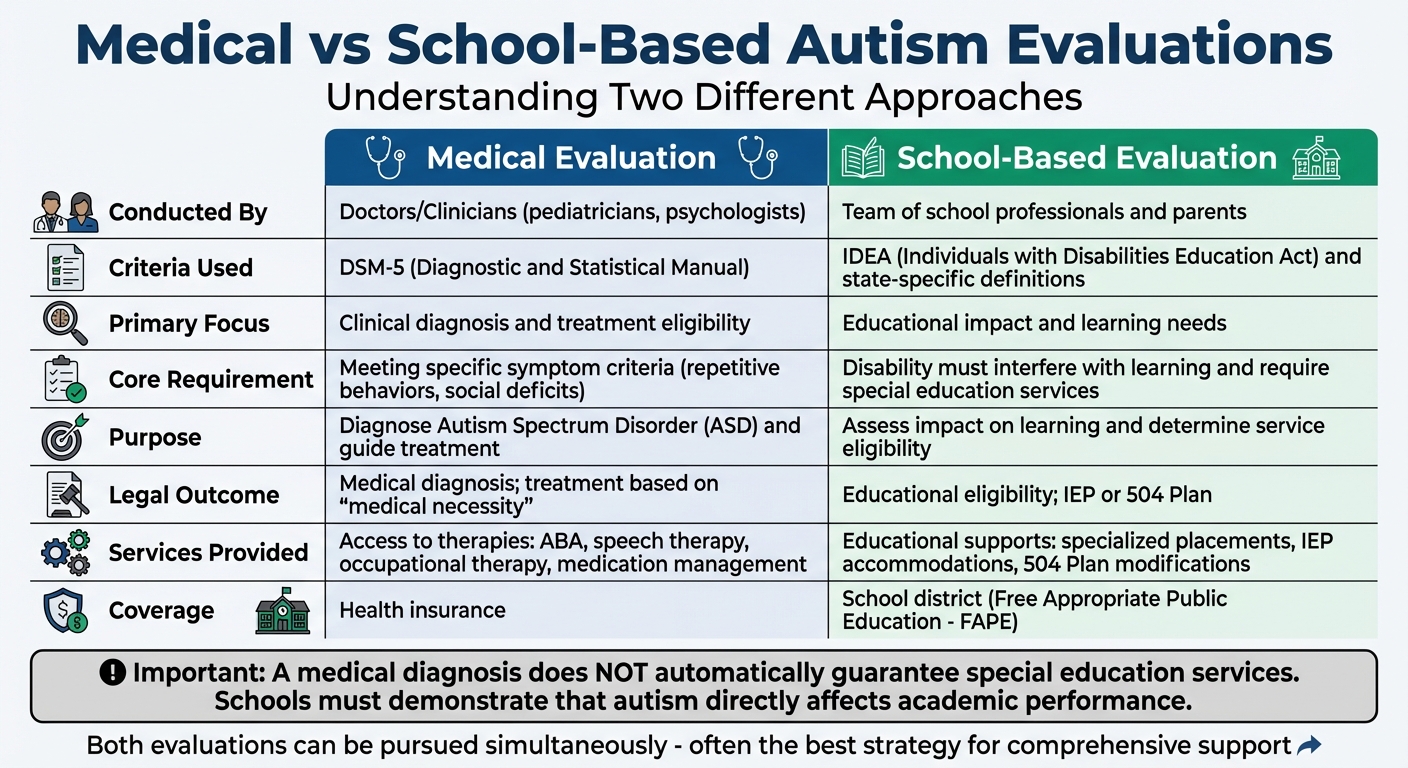
Medical vs School Autism Evaluations: Key Differences Comparison Chart
Medical Autism Evaluations: Process and Legal Uses
How Medical Evaluations Are Conducted
Medical evaluations for autism are carried out by licensed professionals, such as pediatricians or psychologists, using the guidelines outlined in the DSM-5. The American Psychiatric Association describes the DSM-5 as:
The authoritative resource for assessment and characterization of mental disorders, for use by clinicians, researchers, policy makers, insurance agencies, and legal systems. [2]
The evaluation process typically begins with gathering a detailed developmental history, conducting a physical examination, and administering standardized tests. These may include tools like the ASRS (Autism Spectrum Rating Scales), intelligence tests, and executive functioning assessments to better understand the child’s abilities and challenges.
To meet the criteria for an autism diagnosis under the DSM-5, a child must show specific symptoms in two key areas: persistent difficulties with social communication and interaction, and restricted, repetitive patterns of behavior. These symptoms need to significantly impact daily functioning, though clinicians often interpret this requirement broadly. Since May 2013, the DSM-5 has combined several previously separate diagnoses – Autistic Disorder, Asperger’s Disorder, and Pervasive Developmental Disorder Not Otherwise Specified (PDD-NOS) – under the single category of Autism Spectrum Disorder (ASD) [1].
This diagnostic process not only shapes clinical treatment plans but also serves as a basis for accessing legally supported services.
Legal Uses of Medical Evaluations
A medical autism diagnosis opens the door to healthcare-funded treatments. As explained by the CAR Autism Roadmap:
In the medical model, a diagnosis alone is usually sufficient to warrant treatment. [1]
Once diagnosed, children can access a range of clinical interventions, such as Applied Behavior Analysis (ABA), speech therapy, occupational therapy, and medication management. Insurers and clinicians rely on the diagnosis to determine the necessity of these treatments and to approve coverage.
In addition to medical care, the diagnosis can have implications in educational settings. For children who do not qualify for an Individualized Education Program (IEP) under the Individuals with Disabilities Education Act (IDEA), the diagnosis can still support the case for a 504 Plan. This plan might include accommodations like extended time on tests, preferential seating, or adjusted assignments to help the child succeed in school.
It’s important to note, however, that a medical diagnosis alone does not guarantee access to special education services. While medical evaluations focus on identifying symptoms for clinical care, school-based evaluations are required to determine how autism impacts a child’s academic performance. To qualify for an IEP, the evaluation must demonstrate that the child’s autism directly hinders their educational progress [1].
sbb-itb-d549f5b
School-Based Autism Evaluations: Process and Educational Impact
How School Evaluations Work Under IDEA
School evaluations under the Individuals with Disabilities Education Act (IDEA) are different from medical evaluations because they focus specifically on how a child’s condition affects their education. According to IDEA, the goal is to determine if a child qualifies as a "child with a disability" who requires special education and related services. As stated in the law:
"Child with a disability means a child evaluated in accordance with §§300.304 through 300.311 as having [a disability] and who, by reason thereof, needs special education and related services." [4]
Before conducting an evaluation, schools must provide written notice explaining the reasons for the assessment (or why they might refuse it) and obtain your written consent. Once consent is given, the evaluation must be completed within 60 days, unless a state-specific timeline applies. [4]
The evaluation process is thorough, addressing areas like health, vision, hearing, social and emotional development, cognitive abilities, academic skills, communication, and motor abilities. To make eligibility decisions, schools rely on multiple assessment tools rather than a single test. [4]
For children with autism, schools often include a Functional Behavioral Assessment (FBA) as part of the evaluation. This helps identify triggers for challenging behaviors and assists in creating strategies to support the child. These evaluations are critical in shaping decisions about your child’s educational needs and services. [3]
Legal Outcomes of School Evaluations
The results of these evaluations determine whether a child qualifies for educational supports under IDEA. If eligible, the child receives a Free Appropriate Public Education (FAPE) through an Individualized Education Program (IEP). The legal benchmark for FAPE is whether the school provides "personal instruction with sufficient support services to permit the child to benefit educationally from that instruction." [5]
Even if your child has a medical autism diagnosis, the school evaluation must demonstrate that autism affects their ability to make academic progress. The IEP team assesses whether the child’s symptoms interfere with learning and whether specialized services – such as a smaller classroom setting – are necessary. [5]
If your child does not qualify for an IEP under IDEA, they might still be eligible for support under Section 504 of the Rehabilitation Act. This can include accommodations like extra time on tests or modified assignments. Additionally, if you disagree with the school’s evaluation, you have the right to request an Independent Educational Evaluation (IEE) at the school’s expense. When this happens, the school must either fund the IEE or initiate a due process hearing to defend its evaluation. Disputes like these are common, with over 3,000 IDEA-related administrative hearings occurring each year. [5]
The outcomes of these evaluations play a direct role in determining the educational services and accommodations your child can access.
Educational vs. Medical Criteria for Autism: Why The Difference Matters | SPED 101
Comparing Medical and School Autism Evaluations
Medical and school evaluations approach autism from two very different angles, each guided by specific legal frameworks. These differences not only influence how autism is assessed but also determine the kinds of support and services available to your child.
Medical evaluations focus on diagnosing Autism Spectrum Disorder (ASD) using the DSM-5 criteria. This process looks for specific diagnostic markers like repetitive behaviors and challenges with social communication. A diagnosis through this route often opens the door to therapies and treatments, such as behavioral therapy, occupational therapy, speech therapy, or medication, based on medical necessity.
School evaluations, on the other hand, are governed by the Individuals with Disabilities Education Act (IDEA). These assessments aim to determine if a child’s disability significantly impacts their ability to learn, thus requiring special education services. As the CHOP Research Institute explains:
The primary difference between a medical diagnosis and an educational eligibility determination is the impact the condition has on student learning. [1]
This distinction is vital. A medical diagnosis of autism doesn’t automatically mean a child qualifies for special education services. The school’s evaluation must show that the condition directly affects academic performance. This difference in focus shapes both the evaluation process and the type of support your child may receive.
Medical evaluations typically result in treatment plans tailored to the child’s medical needs, while school evaluations lead to educational supports like an Individualized Education Program (IEP) or accommodations through a 504 Plan.
Medical vs. School Evaluations: Side-by-Side Comparison
Here’s a breakdown of how these two evaluation types differ:
| Feature | Medical Evaluation | School-Based Evaluation |
|---|---|---|
| Conducted By | Doctor or specialized clinician | Team of school professionals and parents |
| Primary Criteria | DSM-5 (Diagnostic and Statistical Manual) | IDEA and state-specific definitions |
| Core Requirement | Meeting specific symptom criteria (e.g., repetitive behaviors, social deficits) | Disability must interfere with learning and require special education services |
| Legal Outcome | Medical diagnosis; treatment based on "medical necessity" | Educational eligibility; IEP or 504 Plan |
| Scope of Services | Therapy (speech, OT, behavior therapy, medication) | Educational supports, specialized placements, and skill-building programs |
This table highlights the distinct roles these evaluations play in addressing your child’s needs.
It’s also worth noting that some states use stricter definitions of autism for educational purposes than those found in the DSM-5. In such cases, a child might receive a medical diagnosis of autism but not qualify under the school’s "autism" category. However, they may still be eligible for services under a different disability classification. [1]
Using Both Evaluations to Support Your Child
Getting both medical and school evaluations at the same time can help you build a strong foundation of support for your child – whether at home, in therapy, or at school. This dual approach not only ensures broader assistance but also strengthens your position if you need to challenge decisions about your child’s eligibility for services.
"Educational and medical services can be pursued simultaneously, which is often the best strategy for children on the autism spectrum." – CHOP Research Institute
Each type of evaluation offers unique advantages. A medical evaluation can lead to therapies like speech therapy, occupational therapy, or behavioral interventions based on medical needs. On the other hand, school evaluations focus on educational supports, such as specialized classroom placements, accommodations, or learning programs tailored to your child’s needs. Together, these evaluations create a well-rounded support system.
Using Medical Evaluations in School Settings
Sharing the results of your child’s medical evaluation with the school can help highlight how specific challenges – like social communication difficulties or sensory sensitivities – affect their ability to succeed in the classroom.
However, schools are required to confirm that a diagnosis impacts academic performance before they can provide special education services. This means the school must conduct its own evaluation to determine if your child’s condition affects learning and requires specialized instruction.
If the school decides your child doesn’t qualify for an Individualized Education Program (IEP), you can still request accommodations under Section 504 of the Rehabilitation Act of 1973. A 504 Plan can provide helpful classroom supports, such as extra time on tests, sensory breaks, or preferential seating, even if specialized instruction isn’t deemed necessary.
Taking these steps can help bridge gaps when medical and school evaluations don’t align.
What to Do When Evaluations Disagree
Conflicting results between medical and school evaluations can happen because each system has a different focus. Medical evaluations use DSM-5 criteria to assess overall symptoms and functioning, while school evaluations focus on whether those symptoms directly impact learning.
When evaluations disagree, pinpoint the specific areas where challenges arise. For issues at home, consider seeking additional input from a medical or psychological professional. For school-related concerns, request further assessments or supports from the school team. These steps can help clarify the areas of need and guide next steps.
If you believe the school’s evaluation is incomplete or inaccurate, you can request an Independent Educational Evaluation (IEE) at the school district’s expense. This additional professional opinion may influence the school’s decisions about eligibility and services.
It’s also important to note that some states define autism differently for educational purposes than the DSM-5 does. This means your child could receive a medical diagnosis of autism but not qualify under the school’s "autism" category. In such cases, your child might still be eligible for services under a different classification. Work closely with your school team to explore all possible options.
Supporting Your Advocacy with Data Tracking
Keeping accurate data is a game-changer when it comes to advocating for your child. Whether you’re dealing with medical evaluations or school assessments, well-organized records can make a huge difference. When medical and school teams present conflicting viewpoints, having clear, objective data can help bridge the gap [6].
Both systems rely heavily on input from parents. Medical evaluations focus on developmental milestones and behavioral history, while school assessments require proof of how challenges affect classroom performance [6] [1]. Bringing detailed, data-driven information to these discussions ensures you’re prepared to answer questions confidently and advocate effectively for your child. But how do you track and organize this data? Let’s explore some practical strategies.
Organizing Data to Strengthen Your Case
Tracking patterns in your child’s daily life can provide the evidence you need to make a compelling case. For medical evaluations, focus on documenting behaviors tied to social interaction challenges or repetitive actions, as outlined in the DSM-5 [1]. Record details like how often behaviors occur, how long they last, and what seems to trigger them. This kind of detailed log helps medical professionals get a clearer picture of your child’s needs.
For school evaluations, it’s important to know that a medical diagnosis alone doesn’t automatically qualify a child for services under the Individuals with Disabilities Education Act (IDEA). You’ll need to show how autism-related behaviors impact learning and require additional support [1]. Keep track of incidents where behaviors disrupt classroom activities – like struggling with multi-step instructions, difficulty transitioning between tasks, or sensory sensitivities that affect focus.
An app like Guiding Growth can simplify this process by centralizing all your records. With it, you can log behavioral events, noting triggers, intensity, duration, and context. It also lets you track other factors like sleep patterns, diet, health changes, and daily routines. Over time, this data can reveal patterns you might not have noticed – like how poor sleep might lead to tough mornings or how certain foods might improve focus.
Sharing Information with Your Child’s Team
Once you’ve organized your data, it becomes a powerful tool for collaborating with your child’s support team. Clear, shareable reports can make evaluation meetings and IEP discussions far more productive.
Guiding Growth’s Smart Summaries feature takes your logged data and turns it into professional, easy-to-read reports. By selecting a specific date range, you can generate summaries that highlight patterns in behavior, sleep, health, and nutrition. Instead of relying on memory, you’ll walk into meetings armed with precise, data-backed insights.
These reports don’t just help you communicate – they can also influence important decisions. Presenting evidence-based summaries ensures that both medical providers and school teams are working from the same set of facts. This unified approach strengthens the support your child receives in both educational and medical settings [6].
Conclusion
Grasping the difference between medical and school-based autism evaluations goes beyond managing paperwork – it’s about ensuring your child gets the right support. Medical evaluations provide a DSM-5 diagnosis, which can unlock access to therapies covered by health insurance, federal disability benefits, and protections under the ADA. On the other hand, school evaluations under IDEA focus on how autism impacts a child’s education, determining eligibility for IEPs and 504 Plans without requiring a medical diagnosis. Each serves a specific purpose, and using both together strengthens your ability to advocate effectively.
When evaluations from medical professionals and schools don’t align, objective data becomes a critical tool. In such cases, you have the right to request an Independent Educational Evaluation (IEE) at public expense. Presenting evidence like behavioral patterns, sleep disruptions, or dietary impacts can help bridge the gap between clinical observations and a school’s findings.
Effective advocacy starts with preparation. Families who secure comprehensive services are often those who document consistently, communicate clearly, and understand their rights across both medical and educational systems. By maintaining organized records that show how autism affects your child in different settings, you create a foundation of evidence that’s difficult to ignore.
To make this process easier, tools like Guiding Growth can help parents stay organized without becoming overwhelmed. This app consolidates behavioral logs, health records, sleep patterns, and nutritional data into one place, transforming your observations into professional reports that medical providers and school teams can easily understand. It’s not about replacing professional evaluations – it’s about equipping you to actively participate in decisions that shape your child’s future.
Navigating the legal framework around autism evaluations can feel overwhelming, but understanding these systems empowers you. When you know how medical and school evaluations work, what rights they provide, and how to use data to support your case, you move from reacting to shaping the conversation. Armed with facts and a clear vision, you can advocate for what your child needs to thrive.
FAQs
Does a medical autism diagnosis guarantee an IEP at school?
An autism diagnosis from a medical professional doesn’t automatically guarantee a child will receive an Individualized Education Program (IEP) at school. The decision depends on a school-based team’s evaluation of whether the child’s condition affects their ability to learn and engage with the general education curriculum. While the medical diagnosis is taken into account, it’s just one piece of the puzzle in determining eligibility.
What should I do if the school’s evaluation disagrees with my child’s doctor?
If the school’s evaluation doesn’t align with your child’s doctor’s findings, it’s important to remember that these assessments have different objectives. A medical evaluation focuses on diagnosing autism and understanding developmental needs, while a school evaluation is designed to assess eligibility for special education services.
Work with both teams to bridge any gaps in understanding. Share your perspective, listen to theirs, and advocate for what your child needs. If necessary, you can request a meeting, ask for a reevaluation, or seek an independent evaluation to ensure your child’s needs are properly addressed.
When should I request an Independent Educational Evaluation (IEE)?
If you feel that the school’s evaluation of your child’s educational needs doesn’t fully address their challenges or seems inaccurate, you might want to request an Independent Educational Evaluation (IEE). An IEE offers a second opinion, providing a more comprehensive look at your child’s learning needs. Since the school team determines eligibility for special education services using various data sources, an IEE can help ensure no important details are overlooked.