Understanding sensory milestones in autism can help you better support your child’s development. Sensory processing differences, like overreacting or underreacting to stimuli, affect daily activities such as eating, sleeping, and social interactions. Tracking these responses across sensory domains – touch, sound, taste, smell, and movement – provides insights that can guide interventions and improve routines.
Key Steps to Track Sensory Milestones:
- Observe Baseline Behaviors: Spend 1–2 weeks noting natural responses to sensory input without making changes.
- Use a Tracking System: Record triggers, responses, and times consistently using tools like notebooks, spreadsheets, or apps.
- Rate Frequency and Intensity: Categorize behaviors (e.g., avoiding or seeking stimuli) and track how often and how strongly they occur.
- Identify Patterns: Look for recurring triggers or calming inputs to adjust routines and environments.
- Collaborate with Professionals: Share detailed logs with therapists or pediatricians to create tailored strategies.
Apps like Guiding Growth simplify tracking by organizing observations, identifying patterns, and generating reports for therapy sessions. This structured approach helps you make informed decisions and create a supportive environment for your child’s growth.
How to Track my Child with Autism’s Progress – Preparing Teaching Materials (5/5) | Autism at Home
sbb-itb-d549f5b
Key Sensory Domains to Track
Sensory challenges can differ greatly from one individual to another. Understanding these differences begins with tracking each sensory domain to identify specific areas where support might be needed. Occupational therapist and researcher A. Jean Ayres, PhD, OTR/L, described this process as:
"Sensory integration is the process through which humans register, modulate, and discriminate input from the environment (sounds, sights, tastes, balance and movement, joint position in space, and smells)." [5]
Below, you’ll find an overview of observable behaviors in key sensory domains.
Touch and Proprioception
Touch (tactile processing) involves how a child reacts to physical sensations like fabrics, grooming activities, or engaging in messy play (think finger painting or playing with sand). Pay attention to whether a child avoids light touches but seeks firmer pressure, as this can reveal specific tactile preferences or sensitivities.
Proprioception, on the other hand, refers to the body’s internal sense of position and force. Watch for signs like using excessive or insufficient force when handling objects, bumping into furniture, or seeking out tight spaces or heavy pressure. These behaviors can provide clues about their spatial awareness and body control, which are crucial for daily tasks. Documenting these patterns will be an essential step in creating a sensory tracking system.
Sound and Auditory Processing
Auditory processing isn’t just about hearing; it’s about how the brain interprets sounds. Everyday noises like a blender, vacuum, or crowded spaces can feel overwhelming for some children, while others may seem unresponsive.
A practical tip: when giving verbal instructions, wait at least six seconds before repeating yourself. As Inclusive ABA explains:
"The 6 second rule for autism is a communication strategy that involves giving a verbal cue or instruction once, then waiting about six seconds before prompting again or expecting a response. This pause allows autistic individuals extra time to process the information." [4]
Track how your child responds to their name, how well they follow spoken instructions in quiet versus noisy environments, and whether certain sounds trigger distress. Consistent observation in this area can shed light on how auditory processing impacts their ability to function day-to-day.
Taste, Smell, and Feeding
This domain is closely tied to nutrition and the dynamics of mealtime. Food selectivity is common among autistic children [3], but it often stems from factors like texture, temperature, or smell rather than taste alone. If a particular food is rejected, consider experimenting with its texture before assuming the issue lies with flavor.
Keep a log of which textures and smells lead to avoidance, which foods are consistently accepted, and how these preferences evolve. This information can be especially helpful when collaborating with feeding or occupational therapists to address challenges at mealtimes.
| Sensory Domain | What to Observe | Daily Life Impact |
|---|---|---|
| Touch (Tactile) | Tolerance for clothing, grooming, skin contact, messy play | Dressing, bathing, exploring new environments |
| Proprioception | Force used with objects, body awareness, deep pressure seeking | Motor control, physical safety, ability to sit still |
| Auditory | Response to name, distress from sounds, filtering background noise | Following directions, social interaction, communication |
| Taste & Smell | Food texture/temperature selectivity, reactions to odors | Nutrition, mealtime behavior, social dining |
How to Track Sensory Milestones Step by Step
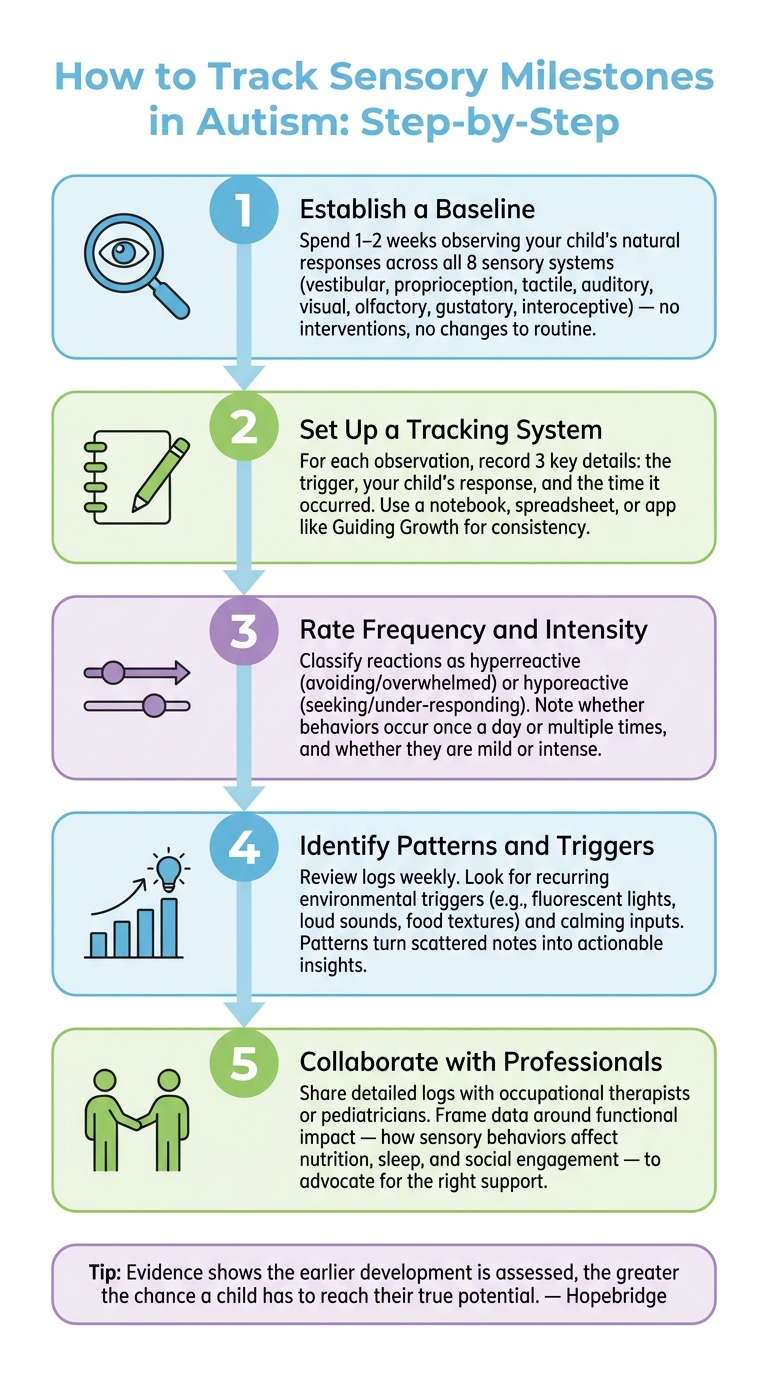
How to Track Sensory Milestones in Autism: Step-by-Step Guide
Knowing what to track is just the beginning. Having a clear process turns scattered notes into actionable insights that can genuinely support your child.
Establishing a Baseline
Start by spending 1–2 weeks simply observing your child – no interventions, no changes to their routine. The idea is to capture their natural responses across different settings and times of day. Watch for patterns: Are certain behaviors more common in the morning or evening? Do they ease up after activities like swinging or heavy play?
Make sure to observe all eight sensory systems: vestibular (balance and movement), proprioception (body position), tactile, auditory, visual, olfactory, gustatory, and interoceptive (internal states like hunger or pain) [1]. Everyday tasks – like bath time, getting dressed, or eating – can reveal a lot because they involve predictable sensory input. Don’t just focus on what upsets your child; note what calms them too. Self-regulation cues, like rocking or seeking tight spaces, are an important part of their baseline [1].
Setting Up a Tracking System
Once you’ve identified baseline patterns, organize your observations in a way that makes sense and is easy to refer back to. AIDE Canada explains this method well:
"By observing and taking careful notes, patterns can be unveiled which can give us information as to when it is best to intervene." [7]
For each observation, jot down three key details: the trigger, your child’s response, and the time it occurred [7]. This context transforms raw notes into meaningful data. Whether you prefer a notebook, a spreadsheet, or an app like Guiding Growth, the key is consistency. Tools like Guiding Growth allow you to log daily behaviors and activities in one place, helping you identify patterns that might otherwise go unnoticed.
Using Consistent Rating Scales
To make your observations useful over time, adopt a consistent scoring system. Random notes can be hard to compare week to week, but a structured scale simplifies things. One effective method is to classify reactions as either hyperreactive (overwhelmed, avoiding) or hyporeactive (under-responding, seeking) [7]. For instance, shielding eyes from bright lights suggests hyperreactivity to visual input, while staring directly into lights or flicking fingers in front of the face indicates hyporeactivity [7].
In addition to categorizing, track frequency and intensity. Note whether a behavior happens once a day or multiple times, and whether it’s mild (brief and manageable) or intense (a full meltdown or refusal to continue an activity). This layered approach provides occupational therapists and pediatricians with objective, detailed information to work with. As Hopebridge emphasizes, "evidence shows the earlier development is assessed, the greater the chance a child has to reach their true potential." [8]
Tools and Methods for Sensory Tracking
Once you’ve set up your tracking system, the next step is choosing tools that help you effectively record and analyze sensory observations.
Checklists and Sensory Diaries
Keeping a sensory diary – even something as simple as a notepad – can be a powerful way to track calming versus overwhelming sensory inputs, reactions to clothing textures, or responses to specific foods [9]. Over time, these notes often reveal patterns that might otherwise go unnoticed.
For a more structured approach, tools like the Pathways.org Ability Checklist are incredibly helpful. This checklist covers developmental milestones from 1 month to age 6+, giving parents a clearer way to identify potential gaps they might miss on their own [2]. As Pathways.org highlights, "the behaviors of a child with sensory issues are extremely varied, making them hard to detect" [2]. A checklist provides a concrete starting point for understanding these behaviors.
Another useful technique is the "Sensory Detective" method. Each time a specific behavior occurs, jot down the time of day, what was happening right before, and what followed [7]. For example, was your child calm before the behavior? Did the behavior leave them feeling more settled or more agitated? This method helps you link behaviors to potential triggers and outcomes.
These tools make it easier to weave sensory tracking into your daily life without feeling overwhelming.
Routine-Based Tracking
Once you’ve started observing, incorporate tracking into daily routines like dressing, mealtimes, and bedtime [1]. For instance, if your child resists putting on a shirt every morning or seeks tight hugs after school, these consistent behaviors provide repeatable data points.
For children who can participate, visual aids like laminated picture cards showing a beaker – from empty to full – can help them express their sensory state. This simple tool allows kids to communicate feelings they might struggle to verbalize, giving parents instant feedback [7].
Using Guiding Growth for Sensory Tracking
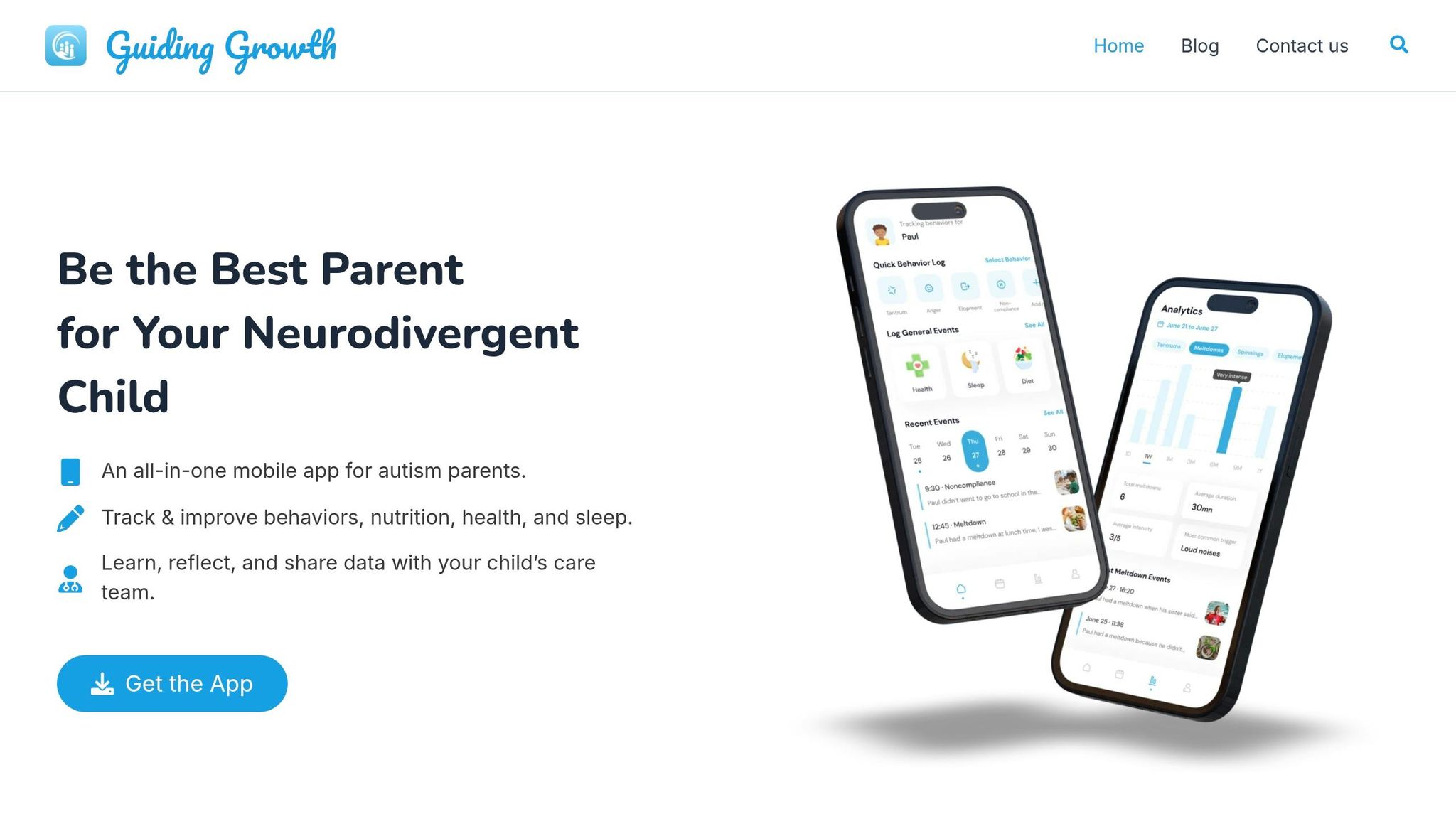
While manual tools like diaries and checklists are helpful, digital solutions can simplify the process and offer deeper insights. Paper notes have their drawbacks – they can get lost, it’s hard to spot patterns over time, and summarizing everything for a therapy session can feel overwhelming. That’s where Guiding Growth comes in.
This app is designed to log behavioral events with detailed context: what triggered the behavior, its intensity, how long it lasted, who was present, and where it occurred. During setup, you’ll create your child’s sensory profile, which includes their known triggers and preferences. From there, every log connects back to this profile, making the data more meaningful.
Guiding Growth also features an AI coach, Alma, who uses your child’s history to provide tailored guidance instead of generic recommendations. Before therapy or pediatric appointments, the app’s Smart Summaries generate structured reports. These summaries cover behavioral patterns, sleep trends, and nutrition across any chosen time frame, saving you time and helping you focus on meaningful conversations with your child’s care team.
Using Sensory Data to Support Your Child
Your logs provide a clear guide for making changes that help your child thrive.
Identifying Patterns and Triggers
After logging data for several days, look for patterns. Tracking responses across sensory areas – like vestibular, tactile, auditory, and interoceptive – can reveal what overstimulates your child [1]. Review your logs weekly to spot environmental triggers that might be easy to miss in the moment. For example, harsh fluorescent lights, the noise of a hand dryer, or the texture of a scratchy collar might appear repeatedly in your notes over a two-week period. These recurring patterns give you the insights needed to make focused adjustments.
Adjusting Home Strategies
Once you’ve identified a trigger, you can move beyond guesswork and start making specific changes. For instance, if your logs show that your child struggles to settle at night, altering the lighting – keeping it bright and natural during the day and dimming it in the evening – can help regulate their sleep-wake cycle [1]. Similarly, if your feeding logs show food aversions, consider tweaking the texture of the food instead of removing it entirely. Document their reactions, whether it’s gagging, pushing the food away, or showing curiosity. This helps you pinpoint whether the issue lies in the food’s texture, smell, or temperature [1].
You can also try strategies like pausing for 6 seconds after giving verbal instructions to allow more processing time. Track whether this improves their response rates over time.
Once you refine your home strategies using your logs, professionals can build on this foundation to create tailored interventions.
Working with Professionals
Sensory challenges impact up to 90% of individuals with autism [10], but short clinical appointments often leave parents struggling to explain the full picture. Detailed logs can change that. These records not only guide your home strategies but also provide professionals with a clear, data-driven understanding of your child’s needs. Bringing in specific observations – like triggers, their frequency, intensity, and how they affect daily life – helps developmental pediatricians or occupational therapists (OTs) craft precise intervention plans.
The key is to frame your data around functional impact. For example, there’s a big difference between a child who dislikes mushrooms and one who gags on most solid foods and has a severely limited diet [10]. Showing how sensory behaviors affect critical areas like nutrition, sleep, or social engagement – backed by weeks of logged data – makes it easier to advocate for the right level of support. If your child is under 3, this data can also help you request a free evaluation through your state’s Early Intervention program via the Early Childhood Technical Assistance Center (ECTA) [6].
Guiding Growth’s Smart Summaries can be especially helpful – they compile patterns in behavior, sleep, and other logged data into a structured report. This allows you to walk into appointments prepared, spending less time explaining and more time collaborating on solutions with your child’s care team.
Conclusion: Staying Consistent with Sensory Tracking
Sensory behaviors in autistic children can differ greatly, making them challenging to identify without a reliable system in place [2]. By consistently tracking these behaviors, scattered observations become cohesive patterns. These patterns guide practical decisions, whether it’s tweaking a morning routine or preparing for an occupational therapy session. A structured approach not only clarifies behaviors but also supports steady progress both at home and in professional environments.
Incorporating tracking into daily life ensures consistency [11]. Tools like standardized checklists, setting short-term goals, or recording a quick voice note at the end of the day can make the process easier and less overwhelming [11]. This practice highlights progress – whether it’s trying a new food or preventing meltdowns – providing encouragement and a sense of achievement for the entire family.
"Tracking progress helps identify areas of improvement, track the mastery of skills, and determine the need for additional support or modifications to the treatment plan." – Ralph Moller [11]
The Guiding Growth app streamlines this process, bringing all your observations together in one place. From logging sensory behaviors and meals to creating Smart Summaries for your child’s care team, it transforms everyday notes into a clear, actionable view of your child’s progress. No more juggling spreadsheets or scattered notebooks – this tool helps you make well-informed decisions that truly support your child’s development.
FAQs
How do I tell if a reaction is sensory or behavior?
To tell the difference between sensory reactions and behavioral reactions, pay close attention to the context and the type of response. Sensory reactions happen automatically in response to sensory input – like feeling soothed by a gentle touch or rhythmic movement. On the other hand, behavioral reactions are deliberate actions taken to achieve a specific goal, such as avoiding something unpleasant. The key is to ask: Is the response an automatic reaction to sensory input, or is it a purposeful action? This distinction can help clarify the difference.
What should I track during my child’s meltdown?
When your child experiences a meltdown, it’s important to track specific details to better understand their sensory and emotional needs. Pay attention to their level of distress, any potential sensory triggers, and physical responses like crying, yelling, or withdrawing. Notice how they communicate during these moments or attempt to self-regulate. Equally important is observing how they eventually calm down and which strategies seem most effective. Using structured tools for this process can reveal patterns and make it easier to share insights with healthcare providers.
When should I share my sensory logs with an OT or doctor?
If you’re concerned about your child’s sensory development or notice that their milestones seem different from typical patterns, consider sharing your sensory logs with an occupational therapist or doctor. Delays or unusual sensory responses can be a sign that an evaluation might be helpful. Consulting a healthcare professional can offer insight and guidance tailored to your child’s needs.