You've probably seen this happen. Your child is pacing, flopping onto the couch, leaning over the armrest, or rocking on the floor because their body is asking for movement, and nothing in the room seems to meet that need in a safe, organized way. A sensory rocking chair often enters the conversation at exactly this point, when families want something calming but don't want to guess.
As both a pediatric OT and a parent, I think a sensory rocking chair can be a useful tool, but only when we treat it like a tool. It isn't magic. It isn't right for every child. And it works best when we choose it carefully, introduce it thoughtfully, and pay attention to what changes in daily life.
Table of Contents
- Understanding Sensory Rocking Chairs and Vestibular Input
- The Therapeutic Benefits for Neurodivergent Children
- Important Safety Considerations and When to Be Cautious
- How to Choose the Right Sensory Rocking Chair
- Introducing and Integrating the Chair into Daily Life
- Tracking Effectiveness with the Guiding Growth App
- Alternatives and Complementary Sensory Tools
Understanding Sensory Rocking Chairs and Vestibular Input
A sensory rocking chair isn't just a child-sized version of living room furniture. It's designed to give a child controlled movement in a way that supports regulation, posture, and attention. Commercial therapy models are often contoured, foam-filled, covered in vinyl for easy cleaning, and may include safety restraints. Typical benchmarks also show adult capacities around 250 to 275 lb, with junior options around 140 lb and one model sized for users up to 50 inches tall, which matters because fit changes both safety and how predictable the movement feels, as described by therapy chair product guidance from Rehabmart.
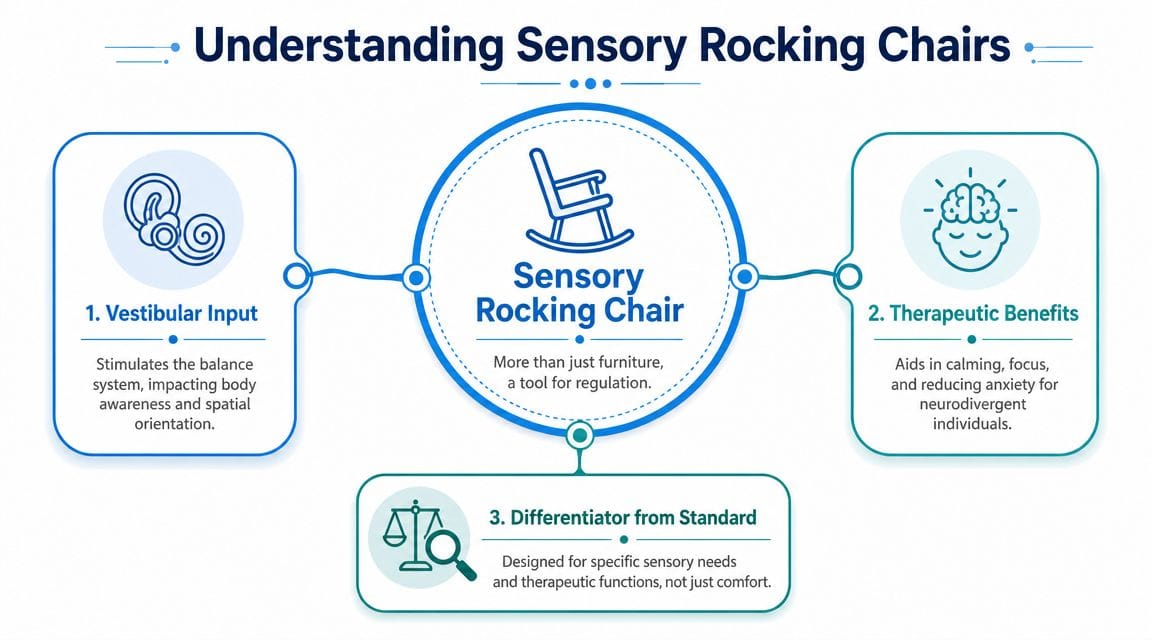
Why this chair is different
Regular rocking chairs are built for general comfort. Sensory rockers are usually shaped to hold the body more securely and keep the movement gentle and predictable. That difference is important for kids who get overwhelmed by too much motion or who need support staying seated without using extra effort just to keep their balance.
Many parents find it helpful to first learn the broader idea of sensory integration before picking equipment. This practical guidance for parents gives a helpful overview of how sensory input affects behavior and regulation in everyday life.
How vestibular input works
The vestibular system is the body's internal balance system. I often explain it to families as an inner gyroscope. It helps the brain answer basic questions like: Am I moving? How fast? Which direction? Am I steady?
A sensory rocking chair delivers rhythmic forward-and-back movement, sometimes described technically as low-amplitude anterior-posterior motion. When that movement is smooth and repeated, some children feel more organized and less “buzzing” inside. Their bodies don't have to work as hard to search for movement, and that can free up energy for listening, reading, or recovering from overload.
Practical rule: The chair should help the child look more settled, not more wound up.
That's also why size matters more than many parents expect. A chair that's too big can make the child slide, brace, or work too hard to stay positioned. A chair that fits well supports the body so the sensory input stays consistent. If you're still trying to sort out whether movement is helping or if something else is driving dysregulation, it can help to use a structured process for identifying sensory triggers in autism.
The Therapeutic Benefits for Neurodivergent Children
The biggest reason families try a sensory rocking chair is simple. They want a safer, more organized way for their child to get movement without bouncing off the walls, tipping a kitchen chair, or crashing into furniture.
In practice, that can be a very reasonable goal. An autism-focused summary of dynamic seating reports an 86% improvement in “in-seat” behavior and more than a 50% increase in on-task participation for rocking chairs and related seating supports, and it also notes that children often use them in short supervised bursts of 5 to 10 minutes rather than for long stretches, according to this overview of sensory rocking chairs in autism practice.
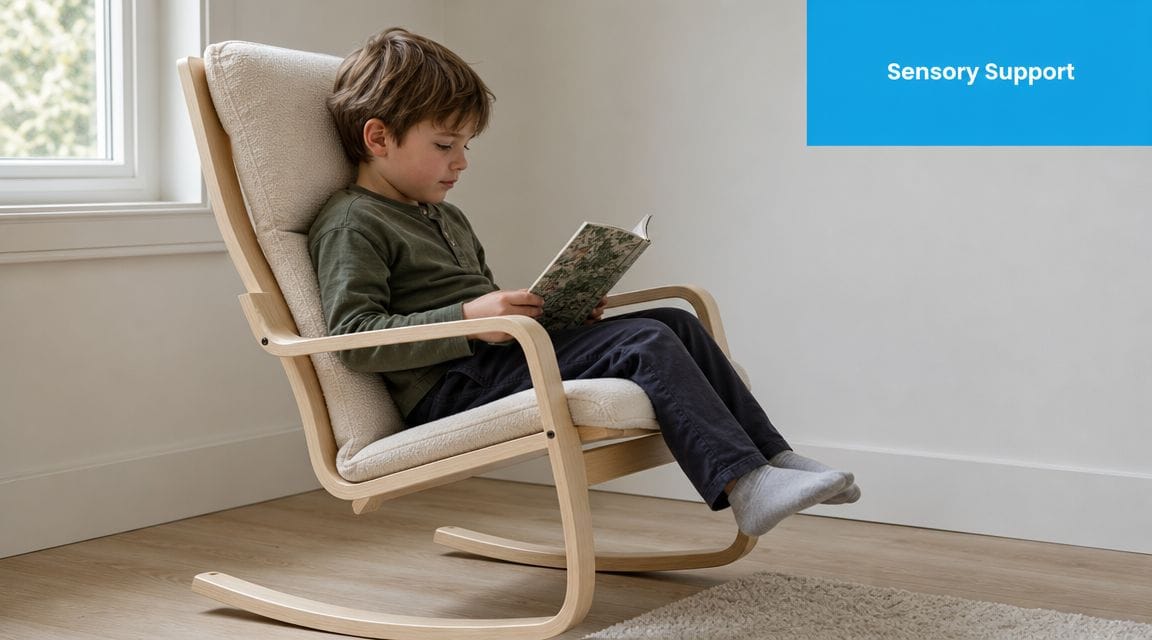
What families often notice first
The first change usually isn't dramatic. It's often more subtle and more meaningful. A child gets through a worksheet with fewer stand-ups. Bedtime de-escalation goes a little smoother. Transitioning in from school takes less time.
Those changes matter because they reflect better self-regulation, not forced stillness. We're not trying to make kids stop moving. We're trying to give their nervous system movement that helps rather than movement that spirals.
A sensory rocking chair may help when a child:
- Needs movement to focus: Some kids listen better when their body has a steady job.
- Gets restless during seated tasks: Homework, reading, crafts, and table meals can go more smoothly with controlled motion.
- Needs a predictable reset after stress: After school, after noise, or before a difficult transition, rocking can provide a familiar rhythm.
Where the benefits show up
The chair tends to work best when we match it to a clear purpose. One child may use it before homework. Another may use it after a noisy outing. A third may use it as part of a calm corner routine before their body reaches a breaking point.
Controlled movement can support participation when it gives the child enough input to stay organized without taking them away from the task.
What doesn't work as well is using the chair as a vague cure-all. If the child is hungry, exhausted, in pain, overwhelmed by sound, or avoiding a task for reasons unrelated to sensory need, rocking alone won't solve the problem. The chair is useful when the mismatch is about movement and regulation.
Important Safety Considerations and When to Be Cautious
This is the part many online articles rush past. Rocking is not automatically calming for every child.
Some children seek vestibular input and settle with it. Others become more dysregulated, more excited, or physically uncomfortable. Guidance in autism-focused OT discussions consistently points to individualized assessment and supervised use, especially when a child has balance concerns, seizures, mobility limits, or motion sensitivity, as discussed in this safety-focused review of sensory rocking chair use.
When rocking can backfire
A child may not be a good fit for a sensory rocking chair if you notice:
- Dizziness or nausea: They look pale, uncomfortable, or need time to recover afterward.
- Escalation instead of calming: Their voice gets louder, movement gets bigger, and they become more disorganized.
- Poor body control in the chair: Sliding, tipping, throwing their head back, or using the rocker in unsafe ways.
- Medical red flags: Concerns involving seizures, significant balance issues, inner-ear problems, or mobility limitations need clinical discussion first.
Sometimes parents tell me, “But my child loves spinning and rocking.” Loving movement doesn't always mean the movement is regulating. Some children crave intense input and still become less organized after they get it.
Questions to ask before use
Before buying or introducing a chair, ask yourself:
- What problem am I trying to solve? Is it transition stress, difficulty staying seated, post-school decompression, or something else?
- What happens after movement now? Does your child look calmer, or do they get more revved up?
- Can my child get in and out safely? Consider transfers, trunk control, and supervision needs.
- Will this be used as support, not restraint? The chair should never become a place where a child is forced to stay.
- Who will monitor response? Someone needs to watch early use closely enough to notice patterns.
Safety comes before sensory goals. If the movement isn't clearly helping, pause and reassess.
If you're unsure, bring the question to your OT, pediatrician, or therapy team with specific observations. “He gets calmer after swinging but nauseous after rocking” is much more useful than “He likes sensory stuff.”
How to Choose the Right Sensory Rocking Chair
Choosing a sensory rocking chair gets easier when we stop looking for the “best” one and start looking for the best match. The right choice depends on your child's body, their movement profile, the setting, and how you expect the chair to be used.
A helpful benchmark comes from school and therapy supply products. The Rocking Soft Sensory Chair from EAI Education measures 27" x 21" x 27" and supports up to 250 lbs, and its product description positions it as a foam-cushioned seat meant to “improve focus” rather than just provide comfort, according to the EAI Education product listing.
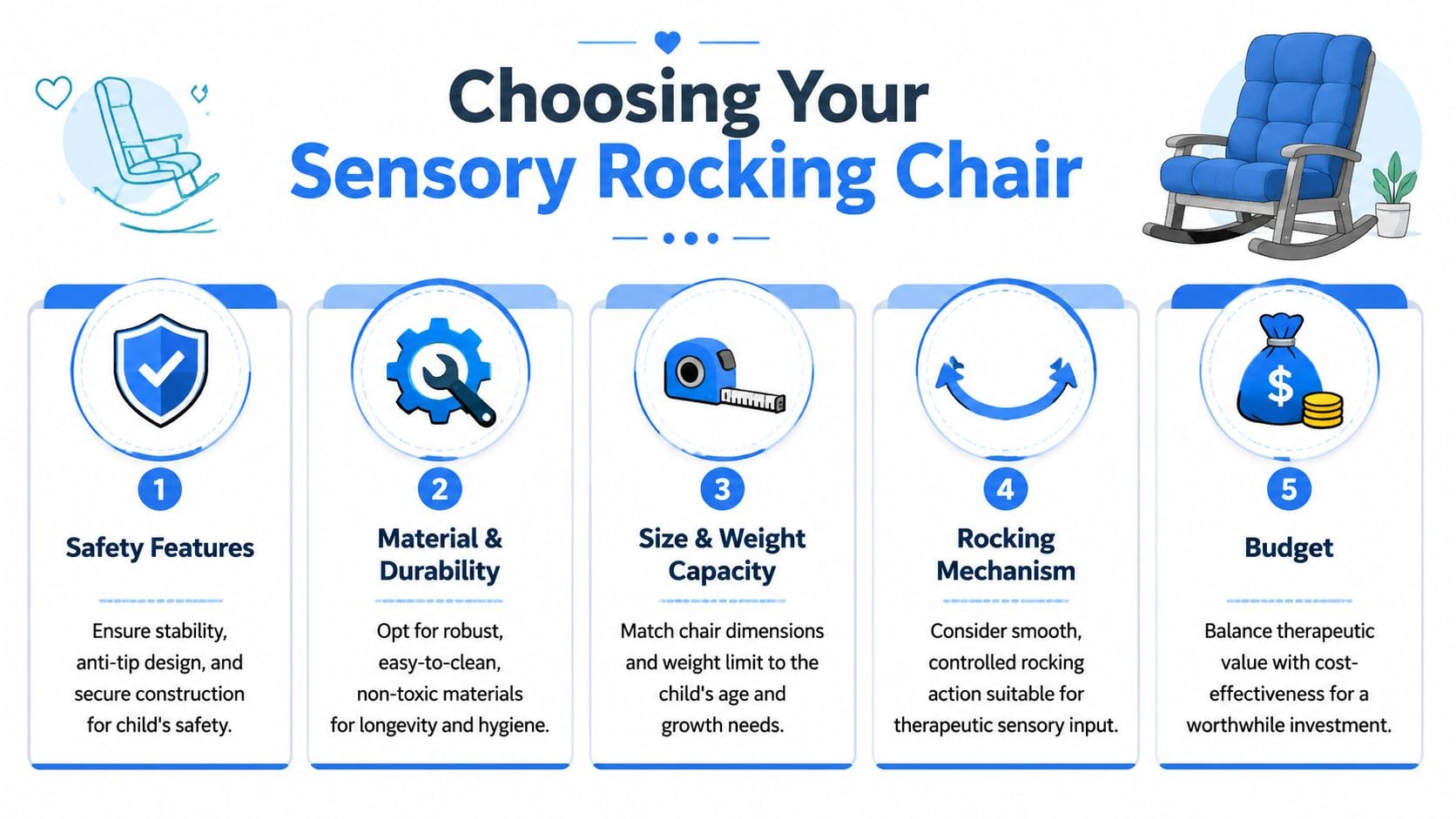
What to compare before you buy
Start with fit. A child who's swallowed by the chair often has to fight the equipment. A child who's cramped may avoid it or use it in awkward positions.
Then look at materials and shape.
- Contoured foam seating: Often gives more body feedback and feels more containing for kids who like deep boundaries around the hips and trunk.
- Vinyl or wipe-clean covers: These are practical for homes, clinics, and classrooms where spills, sweat, or frequent use are part of daily life.
- Gentle rocker base: You want smooth motion, not dramatic tipping or fast rebound.
- Optional straps or restraints: These may exist on some therapeutic models, but they should only be considered in the context of professional guidance and never as a shortcut for regulation.
A related sensory tool can sometimes help with body awareness too, especially for kids who need more whole-body input. This overview of autism and weighted vests is useful when you're comparing movement-based tools with pressure-based supports.
Later in the decision process, it helps to see the chair in action:
A quick decision table
| Consideration | Better choice | Trade-off |
|---|---|---|
| Child needs body boundaries | Deeper, scoop-like seating | May feel restrictive to children who prefer freedom of movement |
| Chair will be used often | Wipe-clean, durable finish | May feel less cozy than soft fabric |
| Child is easily overstimulated | Low, predictable rocking motion | Less exciting for movement seekers |
| Shared home or school use | Higher weight capacity and sturdy build | Usually bulkier to move |
| Small space | Compact footprint | Less room for larger children to reposition |
The best sensory rocking chair is the one your child can use safely, predictably, and willingly.
What usually doesn't work is buying based on looks alone. A stylish rocker can still be the wrong sensory experience. I'd choose stable function over attractive design every time.
Introducing and Integrating the Chair into Daily Life
A good chair can still fail if it's introduced poorly. If the child experiences it as a demand, a reward they have to “earn,” or a place adults send them only when they're already overwhelmed, they may reject it or associate it with distress.
Educational and therapy suppliers often place these chairs in calm-down corners, libraries, classrooms, and therapy rooms because the combination of movement and a stable seated base supports self-regulation. They're also described as helpful for students who need to fidget while maintaining focus, and practical guidance emphasizes gentle, predictable rocking, low-distraction placement, and pairing use with behavior tracking to see whether it reduces escalation or supports recovery after overload, as outlined by school-use sensory soft rocker guidance.
Start with routine, not pressure
Introduce the chair during a neutral or calm moment. Don't wait for a meltdown and then suddenly present it as the solution.
A better sequence looks like this:
- Show it during regulation time: Let your child explore it when they aren't already overloaded.
- Model the rhythm: Some children need to see what “gentle” looks like.
- Keep the first use short: Stop while it's still working.
- Pair it with something calming: A book, soft lighting, a familiar stuffed animal, or quiet music can help.
I usually recommend placing the chair in a defined sensory space rather than floating it in the busiest room of the house. Corners work well because they reduce visual input and make the routine feel intentional.
What effective use usually looks like
A sensory rocking chair tends to become most useful when it's tied to repeated moments in the day.
Consider options like:
- After school decompression: Before conversation, homework, or demands.
- Before seated work: A brief rocking period can help some kids arrive in their bodies.
- During a calm corner routine: Alongside other predictable regulation tools.
- After a hard transition: Not as punishment, but as support.
What doesn't work well is unlimited, chaotic use. If the rocking becomes forceful, silly, or dysregulating, the chair has stopped doing its job.
Keep the motion small enough that the child can still breathe, look around, and stay connected to the room.
If the chair is helping, you'll often see one of three outcomes. Recovery is faster. Task participation is smoother. Escalation is less intense. If none of those are happening, it may be the wrong tool, the wrong timing, or the wrong type of movement.
Tracking Effectiveness with the Guiding Growth App
Parents are often asked whether a sensory rocking chair is helping, and most of us answer from memory. The problem is that memory is biased toward the hardest days. If you want to know whether the chair is effective, you need a simple way to track what happened before, during, and after use.
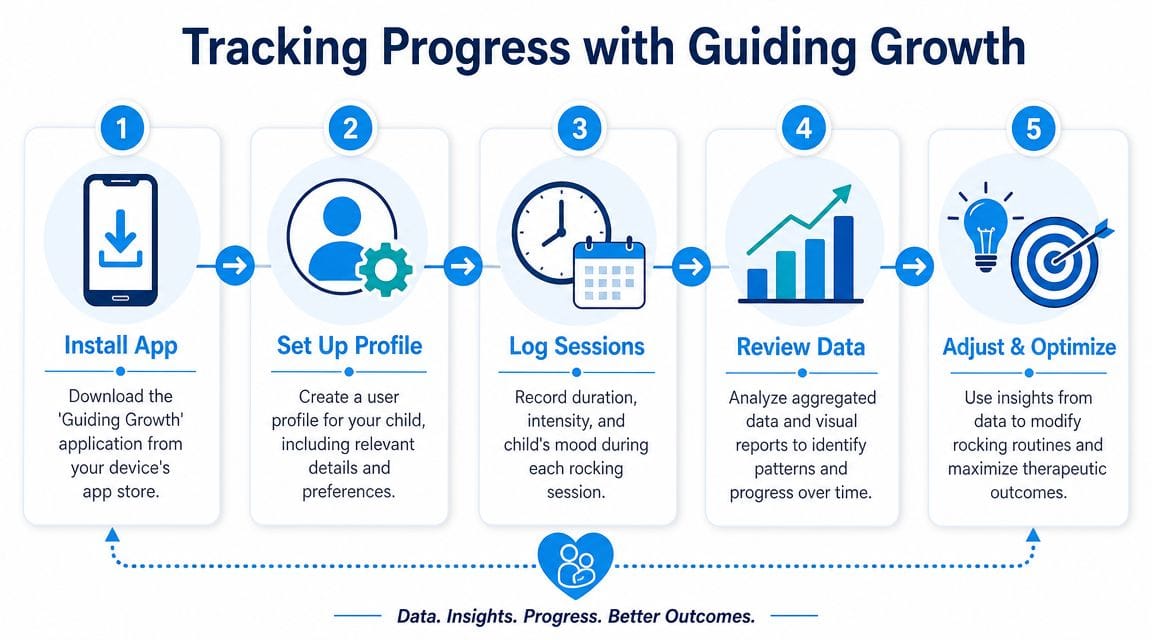
What to track
Keep it practical. You don't need a research study at home.
Log details such as:
- When the chair was used: Before homework, after school, during a transition, or after overload.
- How long the session lasted: Short enough to stay regulating.
- What your child looked like before use: Restless, teary, avoidant, loud, shut down, or dysregulated.
- What happened afterward: More focused, more organized, sleepy, silly, resistant, or no clear change.
You can also note related daily variables that influence regulation, such as sleep, meals, school stress, therapy days, and sensory load. That context often explains why the same tool works beautifully one day and falls flat the next.
How tracking changes decisions
Once you log the chair consistently, patterns become easier to spot. Maybe rocking helps before reading but not before math. Maybe it supports after-school recovery but makes bedtime harder if used too late. Maybe the chair isn't the issue at all, and the actual trigger is hunger or noise.
That kind of tracking helps families talk more clearly with therapists and teachers. Instead of saying, “I think the sensory rocking chair helps,” you can say, “It seems most useful after school, in a quiet room, before demands start.”
A structured app makes that process less burdensome because you're not chasing paper notes, text messages, or memory. The point isn't to track everything forever. The point is to gather enough consistent observation to make better decisions and stop guessing.
Alternatives and Complementary Sensory Tools
A sensory rocking chair is one option in a larger sensory toolbox. If the chair doesn't help, that doesn't mean your child “failed” the strategy. It usually means their nervous system needs a different kind of input, a different dose, or a different setup.
If a rocking chair isn't the right fit
Some children respond better to:
- Therapy swings: These offer movement in a different plane and may suit kids who seek more dynamic vestibular input.
- Balance balls or active seating: Useful for children who need movement during desk work but don't want a more containing chair.
- Floor-based movement options: Rocking on a wedge, lying over a peanut ball, or doing guided movement breaks may feel more natural.
Tools that pair well with rocking input
A chair also doesn't need to stand alone. Many families build a calm space with multiple options.
That might include:
- Proprioceptive supports: Heavy work, body socks, push-pull activities, or other pressure-based tools.
- Auditory supports: Noise-reducing headphones for children who get overloaded by sound.
- Visual calming tools: Some families like SEL tools like glitter bottles for students because they add a quiet visual focus during regulation time.
If you're building out that toolbox, this guide to sensory tools that help calm meltdowns is a useful next step. The most effective sensory plan usually isn't built around one perfect product. It's built around several tools that meet different needs at different times.
If you want a simpler way to track routines, behaviors, sensory triggers, and what helps day to day, Guiding Growth can help you turn scattered observations into clear patterns you can use at home and share with your child's support team.
Made with Outrank