Public meltdowns are involuntary neurological responses caused by sensory, emotional, or cognitive overload. They differ from tantrums in that meltdowns are not goal-driven and involve a complete loss of control. For autistic children, meltdowns are more frequent due to their heightened sensitivity to stimuli.
Key Points:
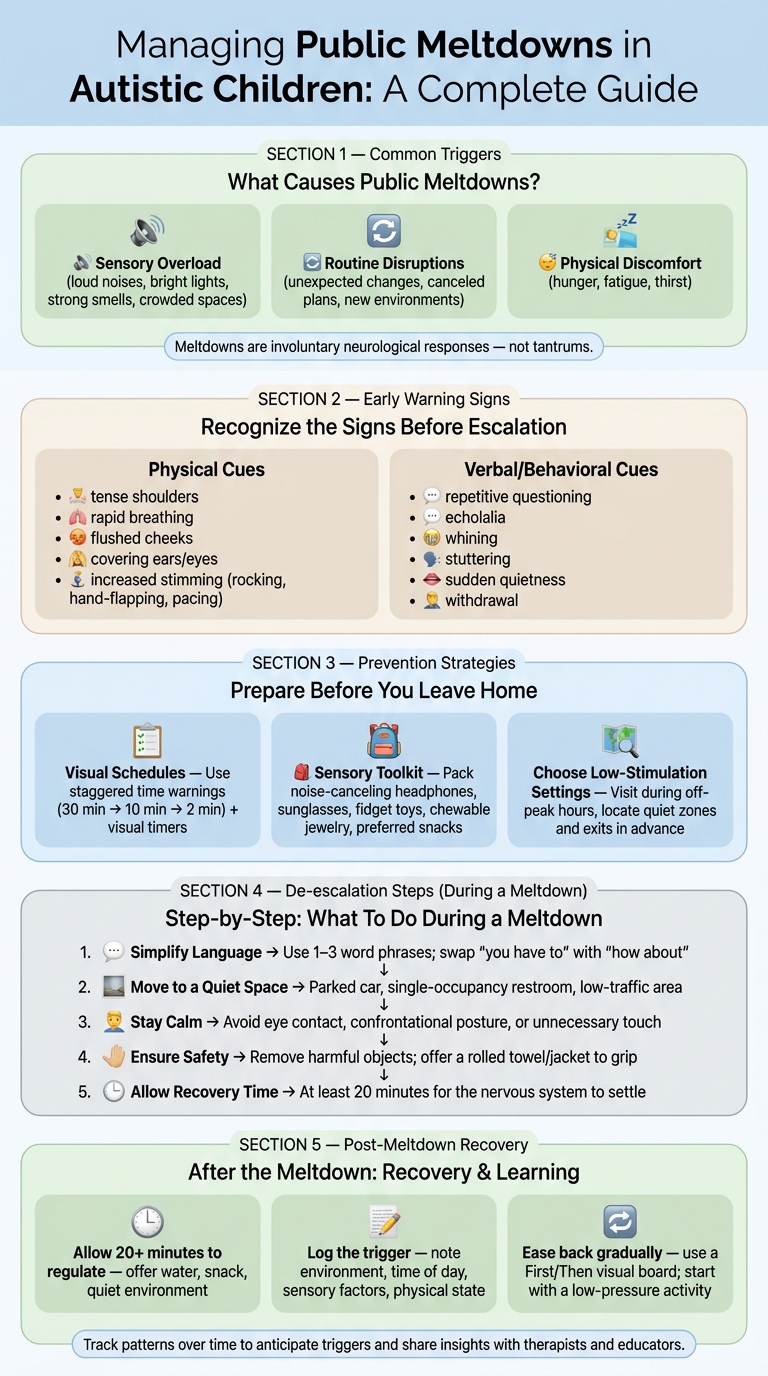
- Triggers: Sensory overload (e.g., loud noises, bright lights), unexpected routine changes, physical discomfort (hunger, fatigue).
- Early Signs: Tense body language, repetitive behaviors, verbal cues like whining or sudden quietness.
- Prevention: Use visual schedules, pack sensory tools (e.g., noise-canceling headphones, snacks), and choose low-stimulation settings.
- De-escalation: Simplify communication, move to a quieter space, and stay calm to help your child recover.
- Recovery: Allow at least 20 minutes, provide comfort, and identify triggers for future planning.
By preparing ahead, recognizing triggers early, and responding calmly, you can better manage public meltdowns and support your child during challenging moments.
How to Manage Autism Meltdowns in Public: Triggers, Warning Signs & De-escalation Steps
What Causes Meltdowns in Autism? Psychotherapist Explains
sbb-itb-d549f5b
Common Triggers for Public Meltdowns
Autistic children can feel overwhelmed by unpredictable stimuli in public settings. Public meltdowns often occur when multiple stressors build up, leaving their nervous system unable to manage the overload[1][2].
Sensory Overload
Public spaces like grocery stores, malls, and restaurants can bombard the senses: harsh fluorescent lighting, loud beeping from checkout scanners, overlapping conversations, strong food smells, and the constant touch of strangers brushing past. While most people filter out background noise, autistic children often process every bit of sensory input at once[2].
"Autistic brains process everything at once, unlike neurotypical brains that filter out background stimuli. The lower brain stem interprets this as a literal threat to survival." – Kids Club ABA[2]
Even small things that seem insignificant to others – like a flickering light or a strong perfume – can feel physically overwhelming to an autistic child[1]. Over time, these sensory inputs stack up, often leading to meltdowns[2]. Here’s a quick look at common sensory triggers and ways to manage them:
| Trigger Type | Common Examples | Quick Management Strategy |
|---|---|---|
| Visual | Fluorescent lights, bright sunlight, busy decor | Use sunglasses or wide-brimmed hats[3] |
| Auditory | Beeping scanners, loud crowds, music, sirens | Noise-canceling headphones or earplugs[2][3] |
| Tactile | Itchy clothing tags, stiff fabrics, accidental bumps | Opt for soft clothing or provide fidget tools[2][3] |
| Olfactory | Strong perfumes, food smells, cleaning products | Avoid areas with strong odors when possible[1] |
Disruptions to routine can further intensify this sensory stress.
Unexpected Changes in Routine
In addition to sensory challenges, sudden changes in routine can significantly increase stress. Predictability helps autistic children feel secure, as it reduces the mental effort required to navigate daily life. When routines are disrupted – whether it’s a canceled plan or an unexpected detour – their brains are forced to adapt quickly, which can be especially draining.
"Autistic people frequently rely on predictability and structure to feel safe and regulated. Disruptions to expected schedules, cancelled plans, or sudden changes in the environment can cause the person significant distress." – Medical News Today[1]
Even small deviations, like taking a different route home or finding a favorite restaurant closed, can trigger a stress response.
Physical Discomfort and Fatigue
Basic physical needs like hunger, thirst, or tiredness can lower a child’s ability to handle stress. For autistic children, these factors can quickly reduce their capacity to manage overwhelming situations[2]. Lack of sleep or missed meals further erodes their ability to cope with sensory or emotional challenges.
"What appears as a minor trigger is typically a build-up of multiple stressors throughout the day." – Kids Club ABA[2]
Signs of physical discomfort – such as impatience, whining, or breaking routine – should be treated as early warnings. Addressing these needs promptly, like offering a snack or a break, can help prevent meltdowns during outings[2].
Recognizing Early Warning Signs
Understanding early warning signs plays a key role in managing public meltdowns. The goal is to act before the nervous system becomes overwhelmed. Most meltdowns don’t come out of nowhere – there’s usually a buildup. Learning to recognize this gives you a chance to step in early.
"Your child often shows distress signals before reaching full meltdown." – Kids Club ABA [2]
Physical and Verbal Cues
Pay attention to physical signs like tense shoulders, rapid breathing, flushed cheeks, or sweating. These indicate the body is already under stress. You might also see behaviors like covering ears or eyes – clear signals that sensory input is becoming overwhelming.
Verbal cues are equally important. Look for signs like repetitive questioning, echolalia (repeating words or phrases), stuttering, or whining. On the flip side, sudden quietness or a complete loss of words can also suggest overload is near.
"For my son, I often see the buildup before the meltdown actually happens. It can look like pacing, covering his ears, repeating the same word or phrase over and over, or his body just becoming tense." – Christina, Autism Advocate [1]
Non-verbal behavior often adds even more insight.
Changes in Body Language
A shift in body language is often the first thing caregivers notice. A child who was engaged might suddenly pull away from the group, avoid eye contact, or physically try to leave the situation. Increased stimming behaviors – like rocking, hand-flapping, or pacing – are reliable indicators that stress is rising [1][2].
Some children might display hyperactivity or inappropriate giddiness instead of withdrawing [2]. If their energy feels out of sync with the environment, it’s worth treating it as a warning sign. Spotting these shifts early allows you to take action – whether that’s reducing demands, moving to a quieter space, or offering a simple choice – before things escalate.
Recognizing these cues early makes intervention much more effective.
Prevention Strategies Before Leaving Home
Getting ahead of potential challenges can make all the difference when heading out with a child on the autism spectrum. A bit of preparation at home can set the stage for a smoother experience in public.
Using Visual Schedules and Social Stories
Uncertainty can be tough for children on the autism spectrum. Tools like visual schedules and social stories help by turning abstract plans into clear, visual steps.
"Visual supports are low-cost and effective tools that make routines tangible and accessible for children on the autism spectrum. They translate spoken instructions into a concrete format that can be revisited as often as needed." – Therapy Partners [6]
One effective strategy is offering staggered time warnings before leaving: "In 30 minutes, we’re going to the store", followed by reminders at the 10-minute and 2-minute marks. Pair these verbal cues with a visual timer, such as a sand timer or a countdown app, to make the concept of time more concrete and manageable.
For unfamiliar destinations, a brief social story or even a video walkthrough can help ease pre-outing jitters [6]. You can also involve your child in planning the outing. This not only prepares them but also gives them a sense of control.
"Involving your child in planning an outing will make them feel included and as though their opinion is valued. They will also know exactly what to expect and feel like they’ve been given some power over what happens to them." – Raising an Extraordinary Person [4]
Once your visual plan is ready, the next step is preparing a sensory toolkit.
Packing the Right Items
Think of your bag as a mobile sensory toolkit, tailored to your child’s specific needs. Whether they’re sensory-seeking or sensory-avoiding, having the right items on hand can help manage their emotions before distress sets in [6].
| Category | What to Pack | Why It Helps |
|---|---|---|
| Auditory | Noise-canceling headphones, earplugs | Blocks overwhelming sounds like scanner beeps or crowd noise [2][3] |
| Visual | Sunglasses | Reduces discomfort from bright fluorescent lighting [2][3] |
| Tactile/Grounding | Fidget toys, stress balls, putty | Provides calming sensory input and supports self-soothing [2] |
| Oral Regulation | Chewable jewelry, crunchy or preferred snacks | Helps with regulation through chewing or taste [2][3] |
| Comfort & Motivation | Favorite stuffed animal, small reward toy | Offers emotional security and builds motivation to follow the plan [4] |
For instance, research highlights how noise-canceling headphones can significantly reduce stress responses in children aged 8 to 16 with ASD [2]. Similarly, a simple snack can do more than just ease hunger – it can provide a calming moment. As Building Blocks Therapy explains, "A small snack can soothe a child not just physically but emotionally, as it provides a moment of calm and focus on a pleasant activity, redirecting their thoughts temporarily." [3]
With your toolkit ready, you can also plan for sensory-friendly environments to further reduce stress.
Choosing Low-Stimulation Settings
Timing and location are just as crucial as preparation. A busy grocery store on a Saturday afternoon is a very different experience from the same store on a quiet Tuesday morning. Whenever possible, opt for off-peak times to avoid large crowds, loud noises, and long lines [3][6].
Before heading out, map out your destination to locate quiet zones and exits [3][6]. This way, you’ll know where to go if your child needs a break. For particularly challenging new environments, consider doing a trial run – a quick, pressure-free visit to help your child get familiar with the space before the main outing [4].
De-escalation Steps During a Meltdown
Even with careful preparation, meltdowns can still happen. When they do, the goal is to reduce the intensity of the situation and ensure your child’s safety. It’s important to understand that a meltdown is an involuntary neurological response, not a deliberate behavior. Because of this, traditional discipline, bargaining, or ignoring the behavior won’t work and could even escalate the situation.
Reducing Language and Demands
During a meltdown, your child’s brain is in crisis mode and unable to process complex instructions. The best approach is to simplify communication. Avoid giving multi-step directions altogether. Instead, use short, clear phrases – stick to one to three words. If you have a visual First/Then board available, this can also be helpful.
Additionally, reframe your language to reduce pressure. For example, swap phrases like “you have to” or “you need to” with gentler alternatives such as “how about” or “would you like.” Simple statements like “The car is right here” can also help reduce the immediate fight-or-flight response. This small adjustment can create a bit of breathing room for your child [2]. Once communication is simplified, focus on moving to a quieter space to lower stimulation levels further.
Moving to a Quieter Space
Use the quiet zones you identified during your preparation. A parked car, a single-occupancy restroom, or a low-traffic area of a building can serve as effective retreat spots [2][3].
"Finding a quiet space is one of the most effective strategies for managing a meltdown. Moving to a less stimulating environment allows the individual to regain their composure without distractions." – Building Blocks Therapy [3]
When transitioning to a quieter space, keep your communication minimal and clear. For instance, you might say, “I’m going to carry you.” If your child is comfortable with it, a light touch on the shoulder can provide reassurance. Use sensory tools from your toolkit as needed to help manage stimulation during the move.
Staying Calm and Keeping the Child Safe
Once in a quieter space, focus on staying calm to support your child’s recovery. Avoid direct eye contact, confrontational body language, or unnecessary physical touch if your child is highly agitated, as these can feel threatening [2]. Instead, remain nearby – close enough to provide comfort without being overwhelming – and practice slow, steady breathing.
"Staying calm not only aids in managing your child’s emotions but also models effective self-regulation." – Building Blocks Therapy [3]
To ensure safety, remove any objects that could cause harm. If your child needs a physical way to release tension, offer something like a rolled-up jacket or towel to grip and twist [5]. Once the environment is calm and free of stressors, allow at least 20 minutes for recovery.
Helping Your Child Recover After a Meltdown
Once a meltdown ends, the recovery phase begins.
"The recovery period is just as important as the moment itself." – Christina, Autism Advocate [1]
Allowing Time to Regulate
Recovery from a meltdown isn’t something a child can control. Even after the trigger is removed, it often takes at least 20 minutes for their nervous system to settle down [2]. During this time, your child might seem drained, quiet, or completely worn out – all typical signs of recovery. Simple comforts like a nap, a glass of water, or a light snack can help ease this process. Keep the surroundings calm, dim, and quiet to support their return to a relaxed state. Once things are calm, reflect on how to help autism meltdowns to better prepare for similar situations in the future.
Identifying the Trigger
Take a moment to consider what caused the meltdown. Was there an unexpected change? Was the environment too noisy or overwhelming? Think about which calming strategies worked and jot these details down. Tracking the specific trigger, the setting, and effective recovery methods can help you spot patterns. This information can also be valuable when sharing insights with your child’s therapist or teacher [3]. Once you’ve gathered your observations, gently guide your child back to their routine.
Gradually Returning to Routine
Avoid jumping straight back into the original plan. Instead, start with a familiar, low-pressure activity [1]. A "First/Then" visual board can be a great tool here, showing your child one simple next step rather than overwhelming them with an entire schedule [2]. Afterward, keep demands light to prevent additional stress as they ease back into their day.
Using Tools to Track Meltdown Patterns
Tracking meltdown patterns builds on earlier strategies, offering deeper insights into triggers and effective interventions. Once you’ve pinpointed your child’s triggers and the recovery methods that work, it’s essential to document this information for future use. Over time, this practice can provide a clearer understanding of recurring challenges. As Christina, an autism advocate, wisely notes:
"When I shifted from trying to ‘stop’ them to trying to ‘understand’ them, it made all the difference for both of us." [1]
Logging Triggers and Behaviors
Documenting each meltdown incident helps uncover patterns that might not be obvious at first. While a single episode can provide some clues, observing multiple events over time paints a much fuller picture. Often, meltdowns result from an accumulation of stressors rather than one isolated event [2]. By keeping a log, you can better understand what conditions consistently lead to escalation.
When recording an event, include details like the environment (e.g., grocery store, park, or school), the time of day, potential sensory triggers (such as loud noises or bright lights), your child’s physical state (tired, hungry, or unwell), and any calming strategies you used. Over time, you’ll start to notice patterns, such as specific locations or times of day that are more challenging.
For this purpose, tools like Guiding Growth can be incredibly helpful. This app allows parents to log detailed behavioral events, including triggers, intensity, duration, location, and the people involved. Its behavioral analytics dashboard highlights patterns – like time-of-day trends or frequent triggers – that might be hard to track through memory or scattered notes.
Creating Reports for Therapists and Educators
Once you’ve identified patterns in your logs, sharing this information with your child’s support network can make a big difference. Therapists and educators often rely on fragmented observations from brief interactions, but structured data can provide a much clearer picture.
Guiding Growth’s AI Smart Summaries feature simplifies this process by generating detailed narrative reports from your logged data. These reports can cover behavioral patterns, sleep trends, and more. Parents can tailor reports for specific purposes – whether for therapy sessions, coaching, or school meetings – and share them as PDFs with the care team. This ensures that everyone involved is working with the same comprehensive information.
"Your child’s unique patterns become clear through observation and help you intervene before complete overwhelm occurs." – Kids Club ABA [2]
Conclusion: Preparing for Public Outings With Confidence
Public outings don’t have to feel overwhelming. By identifying your child’s specific triggers and preparing ahead of time, you can make these experiences more manageable for everyone involved.
The strategies discussed in this article work best when used together. Tools like visual schedules and sensory kits help lower stress in the moment, while recognizing early warning signs allows you to step in before challenges arise. Having a quiet exit plan ensures everyone’s safety. These steps give you a solid foundation to refine your approach for future outings.
"Regularly assess each outing and adjust your approach to prevent recurring triggers." – Hes-Extraordinary [4]
Starting small can be a game-changer. Building confidence through early wins creates a positive cycle of success for both you and your child [4]. Sharon, a Senior Behavior Support Practitioner, highlights the value of incremental changes:
"Small adjustments – a visual prompt, a quiet corner, a predictable routine – can make a big difference over time." [6]
Tracking your observations is another powerful tool. Platforms like Guiding Growth help you log triggers, behaviors, and outcomes, enabling you to shift from reacting to anticipating. This kind of data also provides a clear picture to share with therapists, teachers, and care teams, ensuring everyone is aligned. By combining thoughtful preparation, real-time strategies, and reflective analysis, you can approach each outing with greater confidence and ease.
FAQs
How can I tell a meltdown from a tantrum?
A meltdown happens when someone is overwhelmed by sensory or emotional input, leading to a loss of control over their behavior. Signs often include crying, shouting, or retreating from the situation. On the other hand, a tantrum is more intentional – it’s a way for a child to express frustration or try to get something they want, and they usually have some level of control during the episode. Understanding these differences is key for caregivers to respond appropriately and offer the right kind of support.
What should I do if a meltdown starts in public?
When faced with a meltdown, the key is to stay calm and focus on de-escalating the situation. Start by using calming techniques like speaking in a soft, steady tone, offering a safe and quiet space, or gently redirecting attention to something soothing or familiar.
Preparation can also make a big difference. Identifying potential triggers ahead of time and planning how to respond can help you manage these moments more effectively. It’s all about creating an environment where your child feels safe and supported.
Above all, prioritize their safety and comfort. Stay patient, avoid reacting with frustration, and focus on keeping the situation from escalating further. Your calm presence can make a world of difference.
How can I track triggers to prevent future meltdowns?
To better understand and manage meltdowns, pay close attention to the situations, environments, or stimuli that might set them off. Common triggers often include sensory overload, unexpected changes in routine, or heightened anxiety. Tools like behavior trackers can be incredibly helpful in spotting patterns over time. Apps such as Guiding Growth make it easier to log behaviors and triggers, giving you the insights needed to take proactive steps and put strategies in place to address potential issues before they escalate.