You ask for handwashing, your child runs the water for two seconds, flicks soap on one finger, melts down at the sound of the faucet, or bolts before drying. By the time you've repeated “wash your hands” three times, it no longer feels like a simple routine. It feels like a daily stress point.
That's usually not a motivation problem. It's a task design problem.
Handwashing asks for sequencing, motor planning, timing, sensory tolerance, and follow-through. For many autistic and neurodivergent children, that's too much to hold together as one verbal instruction. A handwashing task analysis turns the routine into a clear set of teachable actions so you can see exactly where things break down, lower stress, and teach the skill in a way your child can use.
Table of Contents
- Why a Simple Task Needs a Structured Plan
- Building Your Child's Handwashing Blueprint
- Choosing the Right Teaching Method
- Mastering Prompts Fading and Reinforcement
- Adapting for Sensory Needs and Common Hurdles
- Tracking Progress and Solving Common Problems
Why a Simple Task Needs a Structured Plan
A lot of parents hear “just teach handwashing” as if it's one skill. It isn't. It's a chain of small actions done in the right order, with the right amount of soap, enough scrubbing, and enough regulation to stay with the task until the end.
That matters because handwashing isn't optional busywork. The CDC reports that handwashing can prevent about 30% of diarrhea-related sicknesses and about 20% of respiratory infections in the U.S. (CDC handwashing facts and stats). If a child only wets their hands and leaves, they haven't really learned the routine.
What a handwashing task analysis actually is
A handwashing task analysis is a map. You take one routine and break it into specific, observable steps. Instead of saying “go wash your hands,” you teach actions like turn on water, wet hands, get soap, scrub, rinse, and dry.
That shift changes everything for a child who struggles with vague directions.
- It reduces language load. One step is easier to understand than a multi-part command.
- It lowers uncertainty. Predictable routines usually get less resistance than changing expectations.
- It helps you teach accurately. You can prompt the exact step that's hard instead of overhelping the whole routine.
- It makes progress visible. “Can now rinse independently” is much more useful than “doing a little better.”
Practical rule: If you can't tell which exact step is failing, the task is still too big.
Why this works especially well for neurodivergent kids
Many neurodivergent children don't resist because they're being difficult. They resist because the task has hidden demands. The water may feel wrong. The soap may be sticky. The dryer may be too loud. The sequence may move too fast. The adult may be talking through three directions at once.
A structured plan turns an abstract expectation into something concrete. It also gives the adults a shared script. Home, school, and therapy can use the same sequence, the same prompts, and the same language.
That consistency is often what finally makes the routine click.
Building Your Child's Handwashing Blueprint
Some families start with a printable list they found online and hope it fits. Sometimes it does. Often it doesn't. The best handwashing task analysis matches the child, the sink, the materials, and the way the routine happens in your home or classroom.
What to watch before you write the steps
Observe the routine first. Don't jump straight into correcting.
Watch one or two attempts and ask:
- Where does the child stop? At the faucet, at the soap, during scrubbing, or at drying?
- What can they already do? If they can turn on the water independently, keep that step independent.
- What part causes stress? Look for covering ears, pulling hands away, stalling, arguing, or leaving.
- What does the setup require? A pump soap bottle, separate hot and cold taps, a step stool, and a paper towel dispenser all change the task.
A strong task analysis should describe what the child has to do, not what an ideal sink setup would require.
If the towel is across the room, “get towel” is part of the routine. If the soap pump is stiff, that motor demand matters too.
A detailed framework helps. In special education and research with autistic children, a 13-step handwashing task analysis is a common format because it reduces ambiguity when prompting and collecting data (13-step handwashing task analysis reference).
For families working on other self-care routines too, this kind of structured teaching fits well with broader daily living practice. If you want ideas for building independence across home routines, this guide to practical life for young children is a useful companion read.
If you need help making hygiene routines more repeatable across days, this article on building consistent hygiene habits adds a practical habit-building lens.
A practical 13-step template
You don't need a fancy form. You need a list that is concrete enough to score.
Here's a simple version you can copy and adapt.
| Step | Mon | Tues | Wed | Thurs | Fri |
|---|---|---|---|---|---|
| 1. Walk to sink | |||||
| 2. Turn on water | |||||
| 3. Adjust water | |||||
| 4. Wet both hands | |||||
| 5. Get soap | |||||
| 6. Rub hands together | |||||
| 7. Scrub fronts of hands | |||||
| 8. Scrub backs of hands | |||||
| 9. Scrub between fingers | |||||
| 10. Rinse soap off | |||||
| 11. Turn off water | |||||
| 12. Get towel | |||||
| 13. Dry hands completely |
You can mark each box with a quick code such as I for independent, V for verbal prompt, G for gesture, P for physical help, or R for refusal.
How to customize the list without making it messy
Don't keep adding steps forever. Add only what changes teaching.
For one child, “get soap” is enough. For another, you may need:
- Reach for soap
- Place hand under pump
- Press pump
That extra detail is useful only if those are the points where support is needed.
A good customized blueprint usually follows three rules:
- Keep steps observable. “Washes well” is vague. “Rinses soap off” is clear.
- Match the actual environment. Include step stool use, faucet style, and towel location if they affect success.
- Write the steps so another adult could score them the same way. If grandparents, school staff, or a therapist can't tell what counts, the list needs editing.
The sweet spot is clarity, not perfection. A handwashing task analysis should make teaching easier, not create paperwork that nobody uses.
Choosing the Right Teaching Method
Once the steps are written, the next decision is how to teach them. Parents often get stuck here because the terms sound clinical. They're simpler than they seem.
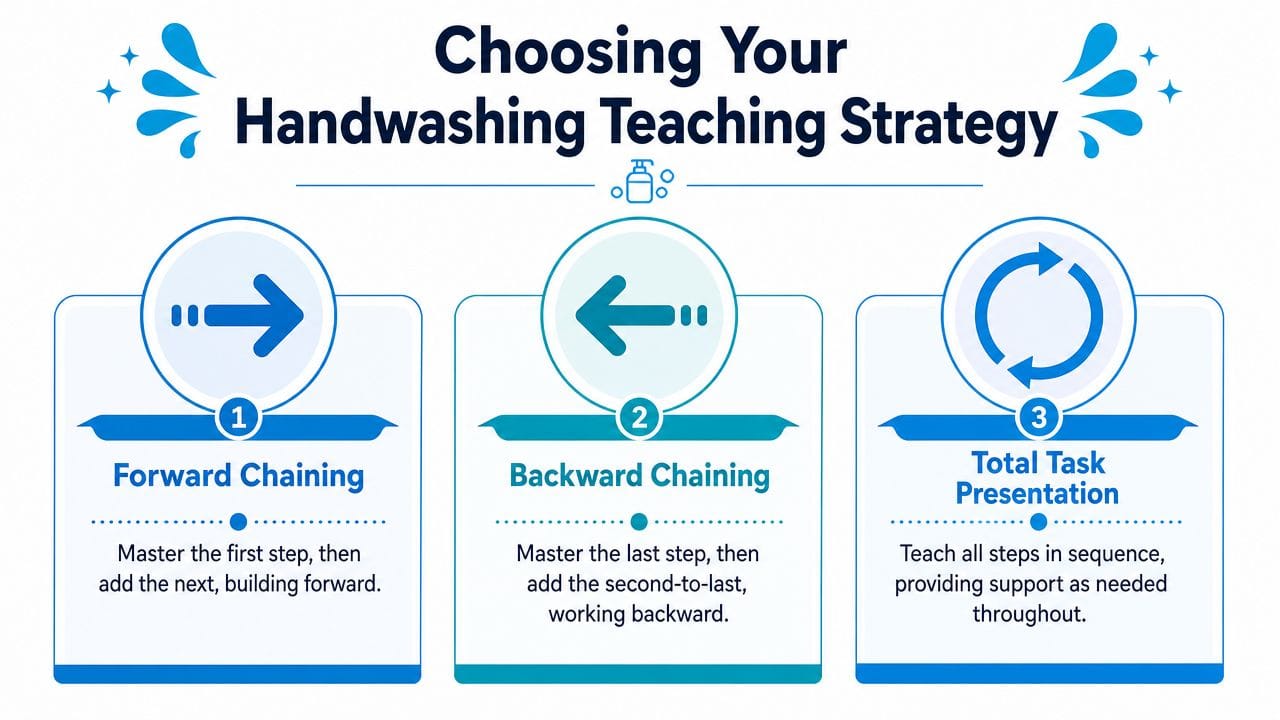
Forward chaining
Forward chaining starts at the beginning. The child learns step 1 first. Once that's solid, you add step 2, then step 3, and keep building.
This works well for children who need a clear starting point and do better when success grows piece by piece. If turning on the water is already motivating, forward chaining can create early momentum.
Backward chaining
Backward chaining means you help with most of the routine and let the child finish the last step independently. Then you gradually move backward through the chain.
This is often a strong choice when the child likes the feeling of completion. Drying hands, throwing away the paper towel, or turning off the faucet can give a clear “I did it” ending. That success can reduce resistance the next time.
Backward chaining is often the best fit when getting started is hard but finishing feels satisfying.
Total task presentation
Total task means the child attempts the whole sequence each time, with support wherever needed. You're not isolating one step. You're teaching the entire routine while adjusting prompts across the chain.
This method fits children who already know parts of the routine but can't yet link them together smoothly. It also works well when the child tolerates guidance across the full activity.
Families who want a broader explanation of how stepwise teaching supports independence can also look at how ABA therapy builds daily living skills.
How to choose without overthinking it
Use the child's response, not theory alone.
- Choose forward chaining when your child needs predictable build-up and gets discouraged by too much at once.
- Choose backward chaining when your child resists the routine but likes finishing and receiving praise right away.
- Choose total task when your child can tolerate the whole routine and mostly needs support connecting the steps.
If your first choice isn't working, switch. The teaching method is a tool, not a rule. If frustration rises, independence drops, or prompts start stretching across every step, the method probably isn't matching the child.
Mastering Prompts Fading and Reinforcement
A task analysis gives you the route. Prompts are how you help the child travel it without getting stuck. The mistake I see most often isn't too little help. It's inconsistent help. One day the adult does everything. The next day they give a vague verbal cue and expect independence.
Children learn faster when support is deliberate.
Use the least help that still works
Think about prompts on a ladder from more intrusive to less intrusive. The exact hierarchy can vary, but the common options are physical guidance, modeling, gesture, visual cue, and verbal cue.
For handwashing, that might look like this:
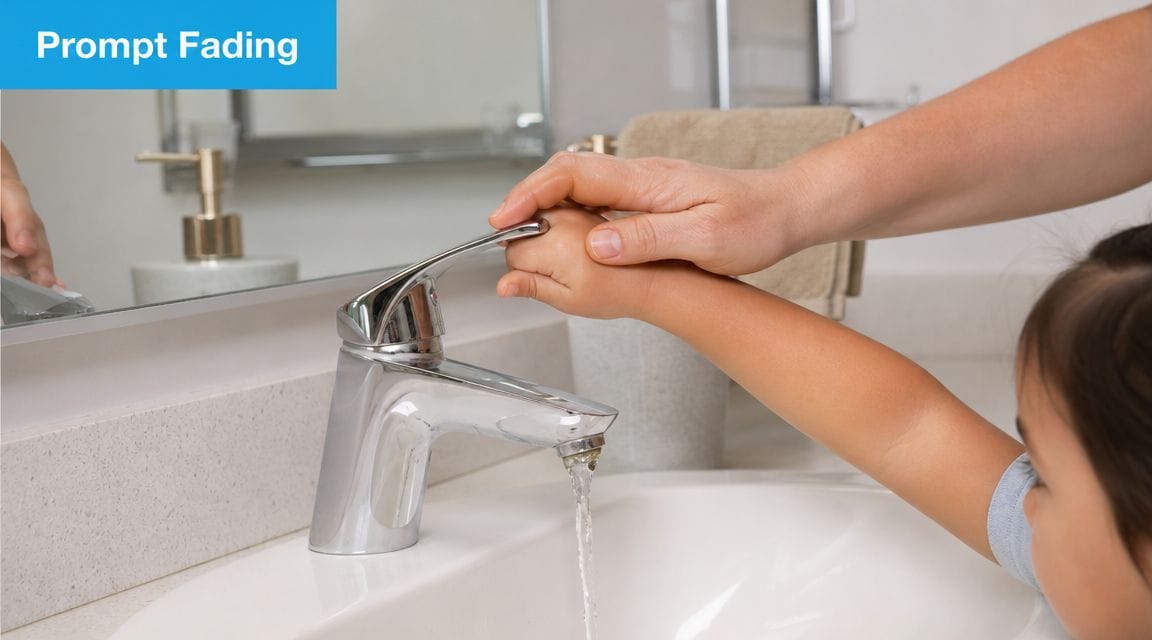
- Physical guidance: Gently guiding the child's hand to the soap pump.
- Modeling: You rub your own hands together to show scrubbing.
- Gesture prompt: You point to the towel dispenser.
- Visual cue: A laminated picture sequence posted near the sink.
- Verbal cue: “Soap next.”
Not every step needs the same prompt. A child might need physical help to press a stiff soap pump but only a gesture to remember drying.
What prompt fading actually looks like
Prompt fading means reducing support on purpose once the child starts succeeding. If you don't fade, the child can become dependent on the prompt instead of learning the step.
A simple way to fade looks like this:
- Start with the lowest prompt that still gets success.
- Keep your wording short and consistent.
- When the child completes that step more smoothly, reduce the prompt.
- Pause before helping, so the child has a chance to respond.
- If errors increase, go back up one level briefly, then try fading again.
For example, if your child only gets soap after hand-over-hand help, you might fade to a light touch at the wrist, then to pointing at the bottle, then to waiting while the visual cue does the work.
Coaching note: Fade one step at a time. Don't reduce support across the entire routine in one day.
Prompt fading works best when adults use the same language and timing. “Wash correctly” is too vague. “Get soap” or “Dry hands” is much easier for a child to act on.
Reinforcement that fits the child
Reinforcement isn't bribing. It's showing the child that effort and success lead to something worthwhile.
The strongest reinforcement is immediate and specific.
- Name the action: “You turned off the water by yourself.”
- Match the child's style: Some children want enthusiastic praise. Others prefer calm acknowledgment, a favorite song clip, or quick access to a preferred activity.
- Reinforce the step you're teaching: If you're building independence at drying, praise drying. Don't give a vague “good job” after the whole chain.
If your family likes visual motivation systems, a simple chore chart reward system can help organize practice, especially for children who respond well to seeing progress build over time.
What usually doesn't work is delayed praise, too much talking during the routine, or rewards that are unrelated to the child's actual preferences. The routine should feel supported, not negotiated step by step.
Adapting for Sensory Needs and Common Hurdles
Some children know the steps and still resist. That's the moment to stop assuming the problem is noncompliance and look at the sensory load.
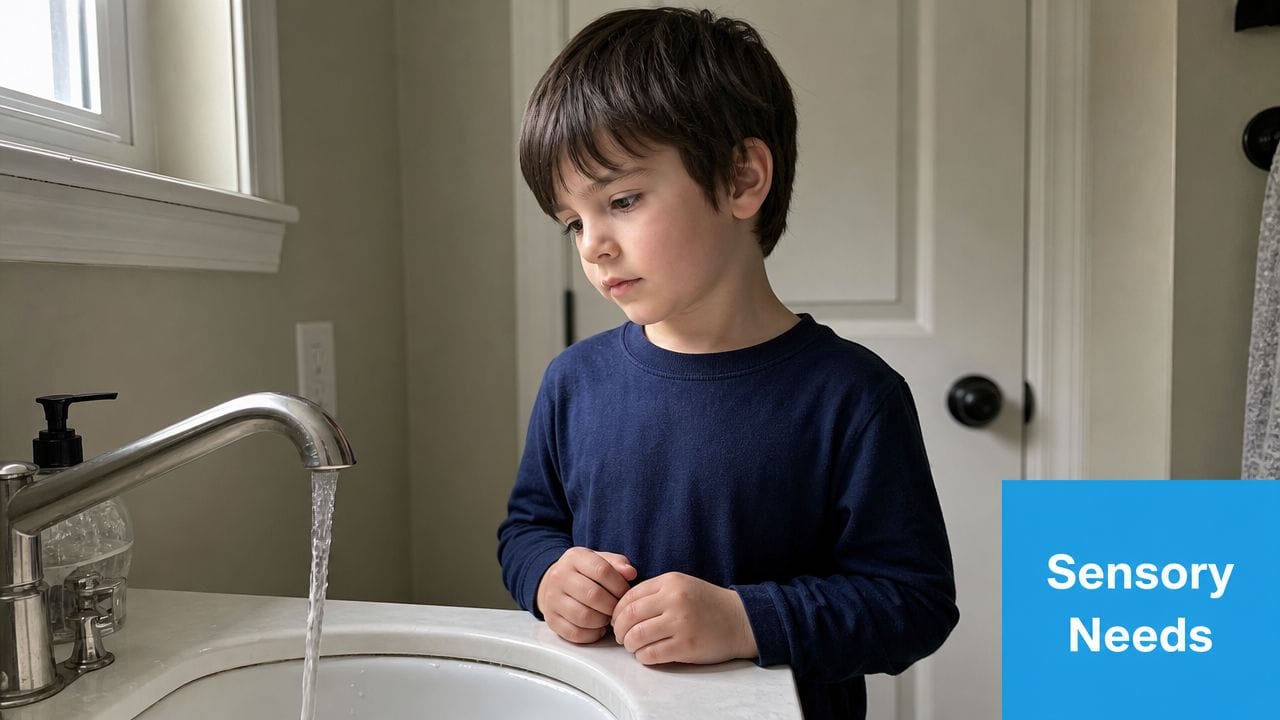
A major gap in many online guides is that they list the standard routine but don't address discomfort. Some children do worse with a long, detailed task analysis because extra steps raise demand and increase prompt dependence. A shorter adapted routine may work better than a technically perfect one when sensory triggers are driving refusal (discussion of sensory discomfort in handwashing task analysis).
When the real barrier is sensory load
Look at what your child is avoiding, not just whether they finished.
Common triggers include:
- Sound: Faucet noise, hand dryer noise, echo in the bathroom
- Touch: Slimy soap, cold water, rough paper towels
- Visual input: Fast-moving water, drain opening, bright lights
- Motor effort: Hard-to-press soap pumps, awkward faucet handles, reaching too high
- Emotional carryover: Being interrupted from a preferred activity, feeling rushed, past struggles at the sink
If you're trying to identify the pattern behind refusals, meltdowns, or task avoidance, this guide on how to identify sensory triggers is worth reading.
Practical adaptations that often help
You don't have to force your way through every barrier. Change the setup first.
- Swap the soap: Try foam soap if liquid soap feels sticky or hard to rinse.
- Adjust the sound: Use noise-dampening headphones if the faucet or dryer is the sticking point.
- Simplify the faucet step: A towel can help with turning handles off if direct contact feels aversive.
- Control temperature: Set the water before inviting the child to the sink when possible.
- Stabilize body position: Use a step stool so the child isn't stretching and balancing at once.
- Change drying tools: Some children strongly prefer a soft towel over paper towels or dryers.
- Reduce visual stress: A drain cover or shifting hand position can help children who fear the drain.
A short demonstration can help adults picture what a calmer teaching approach looks like:
When a shorter routine works better
Not every child needs every micro-step spelled out at first.
If a long checklist increases resistance, strip it down to the essential sequence. For example:
- Wet hands
- Soap
- Scrub
- Rinse
- Dry
Once the child tolerates the routine, you can add precision back in where needed. That's often more effective than demanding full compliance with a detailed chain the child can't yet regulate through.
The best handwashing task analysis is the one your child can complete with growing independence and tolerable stress.
Tracking Progress and Solving Common Problems
Most families can tell when handwashing is going badly. What's harder is seeing why it's inconsistent. That's where tracking helps.
And this isn't just about the child. A study teaching handwashing to children with developmental disabilities found that even trained therapists implemented the steps with 64.5% fidelity on average (implementation fidelity study on handwashing task analysis). That's an important reminder that adults miss steps too, especially when the routine is rushed or stressful.
What to track
Keep the data light enough that you'll use it.
Track things like:
- Step completed or not
- Prompt level used
- Refusal or distress point
- Adaptation used that day
- Setting differences, such as home bathroom versus school sink
A few days of step-by-step notes often reveal patterns quickly. Maybe the child completes everything except drying. Maybe they do well with foam soap but refuse liquid soap. Maybe one caregiver gives long verbal directions and another uses visuals, and the visual approach works better.
How to respond when progress stalls
Plateaus usually come from one of four problems.
- The task is still too hard: Break the difficult step down further.
- The prompts are too heavy: Fade sooner, or switch to a less intrusive prompt.
- The sensory barrier wasn't addressed: Change materials or environment before asking for more compliance.
- The skill doesn't generalize: Practice at a second sink only after the first setup feels solid.
If a child starts resisting again after doing well, don't assume they're backsliding for no reason. Check whether the bathroom changed, the routine got rushed, the soap was replaced, or the adult support became inconsistent.
Good data keeps you from guessing. It also makes collaboration easier because everyone can see the same pattern instead of relying on memory.
If you're tired of juggling paper logs, screenshots, and mental notes, Guiding Growth gives you one place to track routines like handwashing, note prompt levels, record sensory triggers, and share patterns with the other adults supporting your child. It's a practical way to turn “this routine is hard” into clear next steps you can use.