A Gentle Path to Potty Training Success
Toilet training can be one of the hardest daily-life milestones for parents of autistic children. You may already have tried a potty seat, a sticker chart, a timer, a visual schedule, and a dozen well-meaning tips, only to end the day with wet clothes, tears, and the feeling that nothing fits your child. If that's where you are, you're not failing, and your child isn't being difficult.
Autism toilet training tips work best when they match the child in front of you, not an idealized routine from a generic handout. A recent review found toileting resistance in 49.1% of preschool children with autism spectrum disorder, compared with 23.6% of children with developmental delays and 8.0% of children in the general population, which shows how common these struggles are and why a more personalized approach matters. The same review also linked toileting difficulty with constipation, expressive language delays, and low social motivation in autistic children, reinforcing the need to combine medical screening, communication supports, visual structure, and reinforcement rather than relying on one tactic alone (review of toileting resistance in preschool children).
If you need broader support for toilet training in autism, start there, then come back to build a plan you can practically use day to day.
Table of Contents
- 1. Visual Supports and Social Stories
- 2. Sensory-Friendly Environment Modifications
- 3. Structured Routine and Predictable Schedules
- 4. Positive Reinforcement and Preferred Rewards
- 5. Graduated Exposure and Desensitization
- 6. Modeling and Imitation-Based Learning
- 7. Communication Supports and Augmentative/Alternative Communication (AAC)
- 8. Data-Driven Progress Monitoring and Flexible Adjustment
- Autism Toilet Training: 8-Strategy Comparison
- Your Partner in Progress Tracking What Works
1. Visual Supports and Social Stories
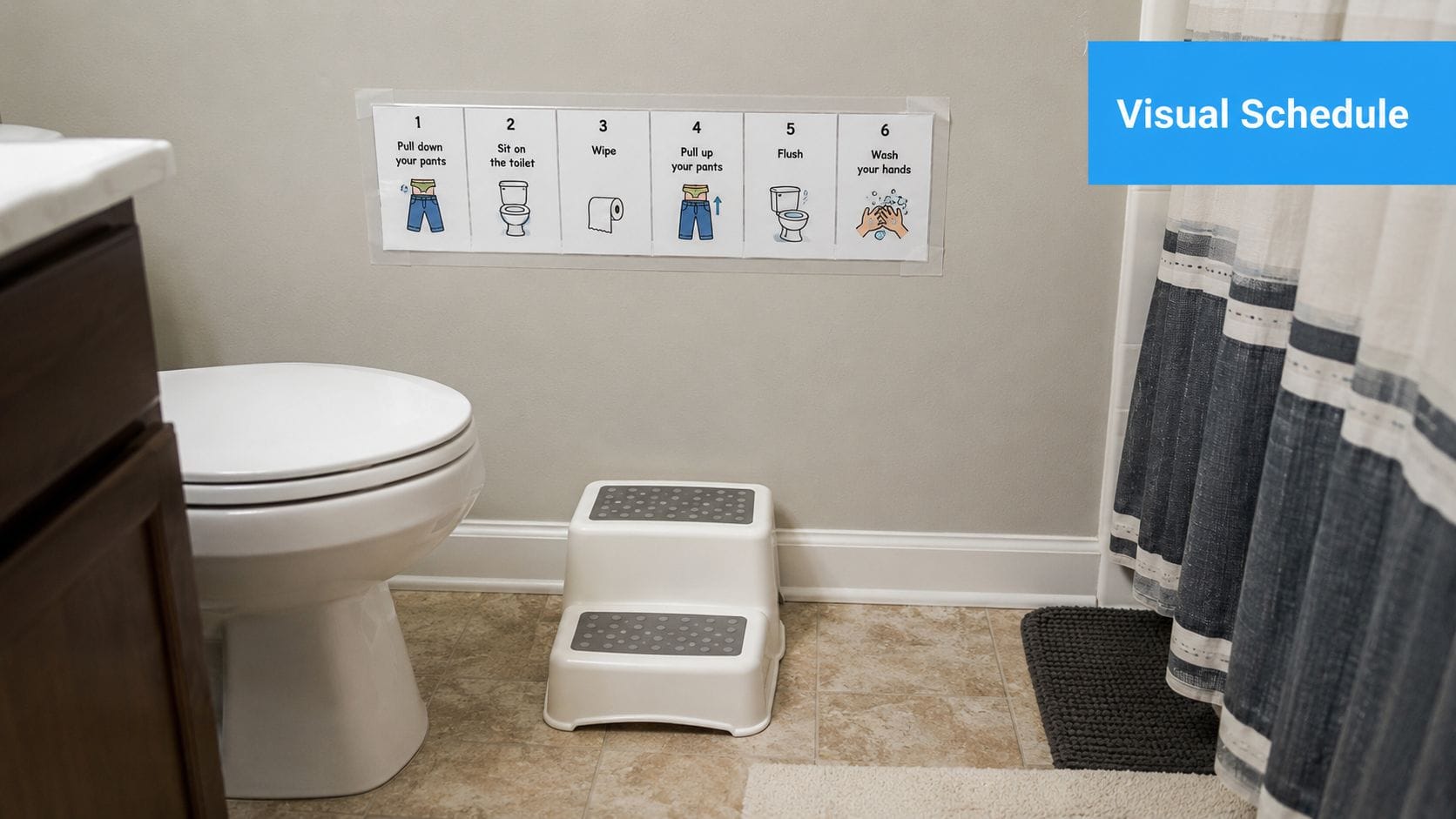
Some children don't resist the toilet itself. They resist uncertainty. A bathroom routine has a lot of moving parts: stop play, walk to bathroom, pull clothes down, sit, wait, wipe, flush, wash hands, return to activity. If those steps live only in adult language, many autistic children miss the sequence.
Visual supports reduce that load. A laminated strip above the toilet, PECS-style cards on a ring, or step-by-step photos of your own bathroom can make the routine feel concrete instead of abstract. Social stories help even more when the child is anxious about one specific part, such as the flush, the smell, or stopping a preferred activity.
Make the routine visible
A good visual sequence is simple and literal. Use your child's real toilet, real underwear, real soap, and real hand towel when possible. Generic cartoon icons are fine, but personalized photos often reduce confusion faster.
You can also build a short social story that names sensory details in a calm way: “The toilet may sound loud. I can cover my ears. Then I wash hands and I'm all done.” If you need help writing one, this guide on how to write social stories for autism is a practical starting point.
Practical rule: If your child can't remember the steps without repeated adult prompting, the visual isn't optional yet.
A few ways to make visuals work better:
- Keep it close: Put the schedule at your child's eye level near the toilet, not across the room.
- Keep it consistent: Use the same images at home, daycare, and grandparents' house when possible.
- Keep it interactive: Let your child remove a card, point to the next step, or mark “done.”
- Keep notes on response: In Guiding Growth, log which visual sequence led to calmer sits, fewer refusals, or easier transitions so everyone uses the same version.
What doesn't work well is changing the script every few days. If Monday uses a sticker chart, Tuesday uses spoken reminders, and Wednesday uses a different picture set, the child has to relearn the process instead of practicing it.
2. Sensory-Friendly Environment Modifications
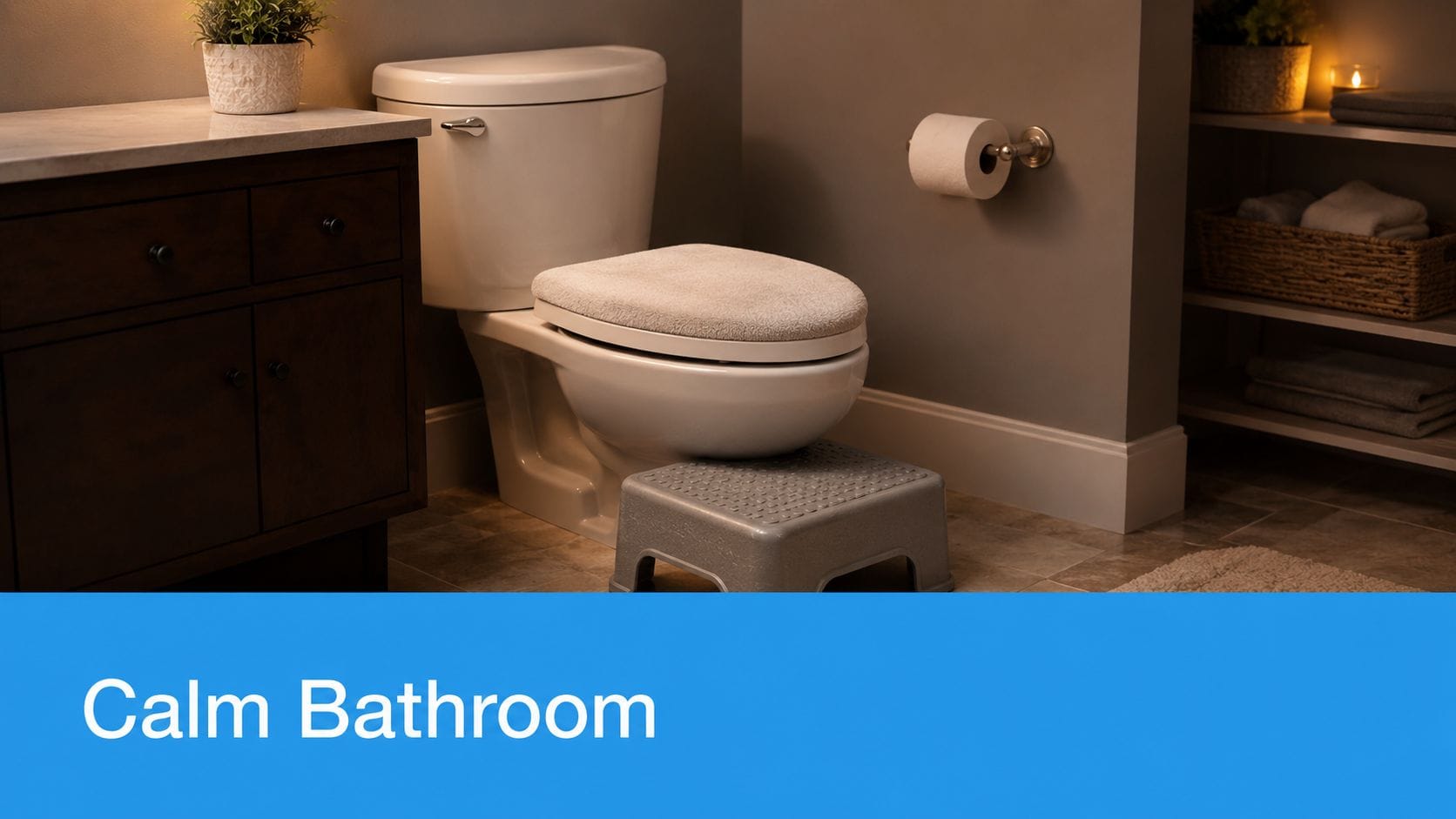
A child can understand toileting and still avoid the bathroom because the room feels bad. Bright light, echoing sound, a cold seat, dangling feet, strong cleaner smell, or the flush can be enough to trigger refusal. Parents often interpret that refusal as noncompliance. In practice, it's often a sensory problem first.
Start by looking at the bathroom as if you had to sit there with your feet unsupported, a fan buzzing overhead, and a toilet that booms when flushed. Then change the environment before you increase demands. A cushioned reducer seat, a stable step stool, softer lighting, and permission to leave before flushing can shift the whole experience.
Change one variable at a time
If you change everything at once, you won't know what helped. Swap one feature, observe for several days, then decide whether to keep it.
Useful examples include:
- Seat comfort: A padded reducer seat can feel more secure than a wide, hard adult seat.
- Foot support: A sturdy stool matters because many children relax their body better when their feet are planted.
- Sound control: Flush after the child leaves if the sound is a trigger. A sound machine outside the bathroom can also reduce contrast.
- Lighting: Softer bulbs or natural light can help if overhead lighting feels harsh.
Sometimes practical bathroom setup details overlap with mobility and positioning issues seen across age groups. This piece on ideal toilet height for seniors isn't about autism, but it highlights why seat height and stability affect comfort and success.
Some children don't need more prompting. They need the room to stop feeling like a threat.
Guiding Growth is useful here because sensory triggers are easy to forget in the moment. Log whether resistance happened with the fan on, with bright lights, after a flush, or when using a different bathroom. Over a week or two, patterns often become much clearer than your memory alone.
3. Structured Routine and Predictable Schedules
A reliable routine often works better than constant reminders. Many autistic children do best when bathroom visits happen at consistent points in the day, such as after waking, after meals, before leaving the house, and before bed. That rhythm lowers negotiation and helps the body connect internal signals with predictable opportunities.
There's also practical support for using a scheduled approach. A clinical-style autism toileting guide recommends beginning with 10-minute intervals, moving to 15 minutes after two consecutive accident-free days, and then increasing by 5-minute steps toward 45 to 60 minute intervals while using dry checks and simple requests (clinical guide to scheduled toileting intervals).
Build the schedule from real patterns
That doesn't mean every child should start on the same timer. Some children get agitated by frequent interruptions. Others need close scheduling at first because they don't notice body signals yet. The schedule should come from observation, not from a rigid rule.
A workable routine often includes:
- Natural anchor points: Upon waking, after meals, before bath, before car rides.
- A warning cue: A visual timer, first-then card, or simple “bathroom, then snack.”
- A short sit: Long sits often create power struggles. Keep the routine calm and finite.
- The same sequence each time: Same bathroom, same words, same order.
Parents usually run into trouble when they overschedule. If the child is asked to stop every few minutes, toilet training can become a chain of interruptions and refusals. A better method is to start with the times your child is already most likely to void, then widen or space visits based on logged results.
If you want the toileting plan to fit into the whole day, this article on building a routine for your autistic child can help you place bathroom trips where they're most sustainable. In Guiding Growth, record time, outcome, and whether the transition was easy or difficult. That's how you figure out whether your current schedule is supportive or just noisy.
4. Positive Reinforcement and Preferred Rewards
Not every reward works, and a weak reward can make parents think reinforcement “doesn't work” when the underlying issue is mismatch. Toileting asks for effort, interruption, body awareness, and often sensory tolerance. The payoff has to matter enough to compete with all of that.
The best reinforcement is specific to the child. For one child, that might be immediate access to a favorite YouTube clip. For another, it's a mini LEGO figure, a swing break, a crunchy snack, or a few minutes with a preferred sensory item. What matters most is timing and clarity.
Reward the right step, not just the final result
Many families wait to reward only urine or stool in the toilet. That's often too late, especially for anxious or minimally verbal children. Reinforce the step your child can do today. Sitting calmly, entering the bathroom without protest, pulling pants down, or using a picture card to request the toilet are all valid targets.
A strong reward plan looks more like skill-building than bribery:
- Match the reward to the step: Bigger challenge, stronger payoff.
- Deliver it fast: The child should connect the action and the reward immediately.
- Name the behavior: “You sat on the toilet.” “You asked for help.” “You peed in the toilet.”
- Fade slowly: As skills become easier, reduce the intensity or frequency without removing all encouragement at once.
What usually fails is using a reward the child only mildly likes, delivering it too late, or changing the rules midstream. Another common problem is asking for too much at once. If the child has never tolerated sitting, don't make flush, wipe, and handwashing the price of earning anything.
Guiding Growth helps because motivation changes. A reward that worked last month may stop working when interests shift. Logging successful attempts alongside the reward used gives you a realistic menu instead of guesswork.
5. Graduated Exposure and Desensitization
Some children panic long before toileting begins. They may refuse to enter the bathroom, scream when the flush starts, hold urine to avoid sitting, or become distressed the moment you mention the toilet. In those cases, standard autism toilet training tips won't land until anxiety comes down.
Graduated exposure works by breaking the task into tolerable pieces. You're not forcing the child through the whole chain. You're helping them learn that each part can be safe.
Go slower than your instinct tells you
A useful starting ladder might look like this: stand near the bathroom door, step inside, sit on the closed lid with clothes on, sit on the open toilet with clothes on, sit with pants lowered, stay while another person flushes, then remain in the room during flushing. The exact order depends on your child's trigger.
Use very short, low-pressure practices paired with comfort. A favorite book on the closed lid may be a better first step than any formal sit. If the child bolts as soon as pants come down, back up and stabilize the previous step before trying again.
If a child can only succeed when the demand is tiny, make the demand tiny. Progress still counts.
One autism resource specifically advises families to rule out biological or medical issues before starting toilet training, which is especially important when a child suddenly resists a step they previously tolerated (guidance on ruling out medical issues before toilet training). Pain changes behavior fast. So do constipation, urinary discomfort, and medication effects.
Guiding Growth can make exposure work more cleanly. Create a simple hierarchy in the app, log which step was attempted, note the child's response, and record what helped them recover. That gives you a plan you can share with school staff instead of asking everyone to improvise.
6. Modeling and Imitation-Based Learning
Some children learn toileting best after they've seen it clearly and repeatedly. Modeling can be live, through a sibling or caregiver, or video-based with a simple step-by-step example. The point isn't to force attention. The point is to make an invisible routine visible.
A parent might briefly narrate: “Pants down, sit, pee goes in the toilet, wipe, flush, wash hands.” A sibling might use the bathroom naturally while the child observes from the doorway without pressure. Dolls and figurines can also help when direct modeling feels too intense.
Here's a simple video example you can preview and decide whether it fits your child's learning style:
Use short, repeatable models
Keep modeling brief. A child doesn't need a lecture. They need a repeatable sequence they can recognize. If you use video, choose one with calm pacing, clear visuals, and no extra sensory clutter.
A few practical uses:
- Before a scheduled sit: Watch the same short clip each time to prime the sequence.
- During play: Show a doll “go potty” and wash hands.
- After success: Replay the model to reinforce what just happened.
- For one hard step: Use a mini-video only for flushing, wiping, or handwashing if that's the sticking point.
Modeling is especially useful when verbal explanations alone aren't sticking. It also reduces the need for repeated adult commands, which some children experience as pressure. In Guiding Growth, note whether a modeled routine before the bathroom leads to calmer entry, more independent steps, or less prompting. If it does, you've found a support worth keeping.
7. Communication Supports and Augmentative/Alternative Communication (AAC)
A child can't become independently toilet trained if they have no reliable way to say “bathroom,” “help,” “all done,” or “it hurts.” This is one of the biggest gaps in many toilet plans. Adults focus on the schedule and the seat, but the child still has no functional message.
That problem is even bigger for minimally verbal children, children who freeze under pressure, or children who toilet in one setting but not another. One autism resource recommends teaching a sign, picture exchange, or simple phrase for bathroom requests, which highlights how often communication is often a primary bottleneck (toilet training tips for nonverbal children with autism).
Teach a bathroom message that travels everywhere
Pick one request form and use it everywhere. That might be a single icon on an AAC device, a laminated bathroom card, the sign for “toilet,” or a simple spoken approximation. Don't build a complicated language lesson in the bathroom. Start with communication that's fast and usable.
A simple communication set might include:
- Toilet: “I need bathroom.”
- Help: For clothing, wiping, or opening the door.
- Done: To end the sit clearly.
- Ouch or pain: So discomfort doesn't get mislabeled as refusal.
What doesn't work well is changing the message by location. If home uses a sign, school uses a spoken script, and daycare waits for a full sentence, the child has to learn three systems under stress.
Keep the communication tool physically available in the bathroom and near transitions. Then log successful requests in Guiding Growth, along with whether the child initiated, responded to a prompt, or used a backup card when speech dropped. Those details help parents, teachers, and speech-language pathologists stay aligned.
8. Data-Driven Progress Monitoring and Flexible Adjustment
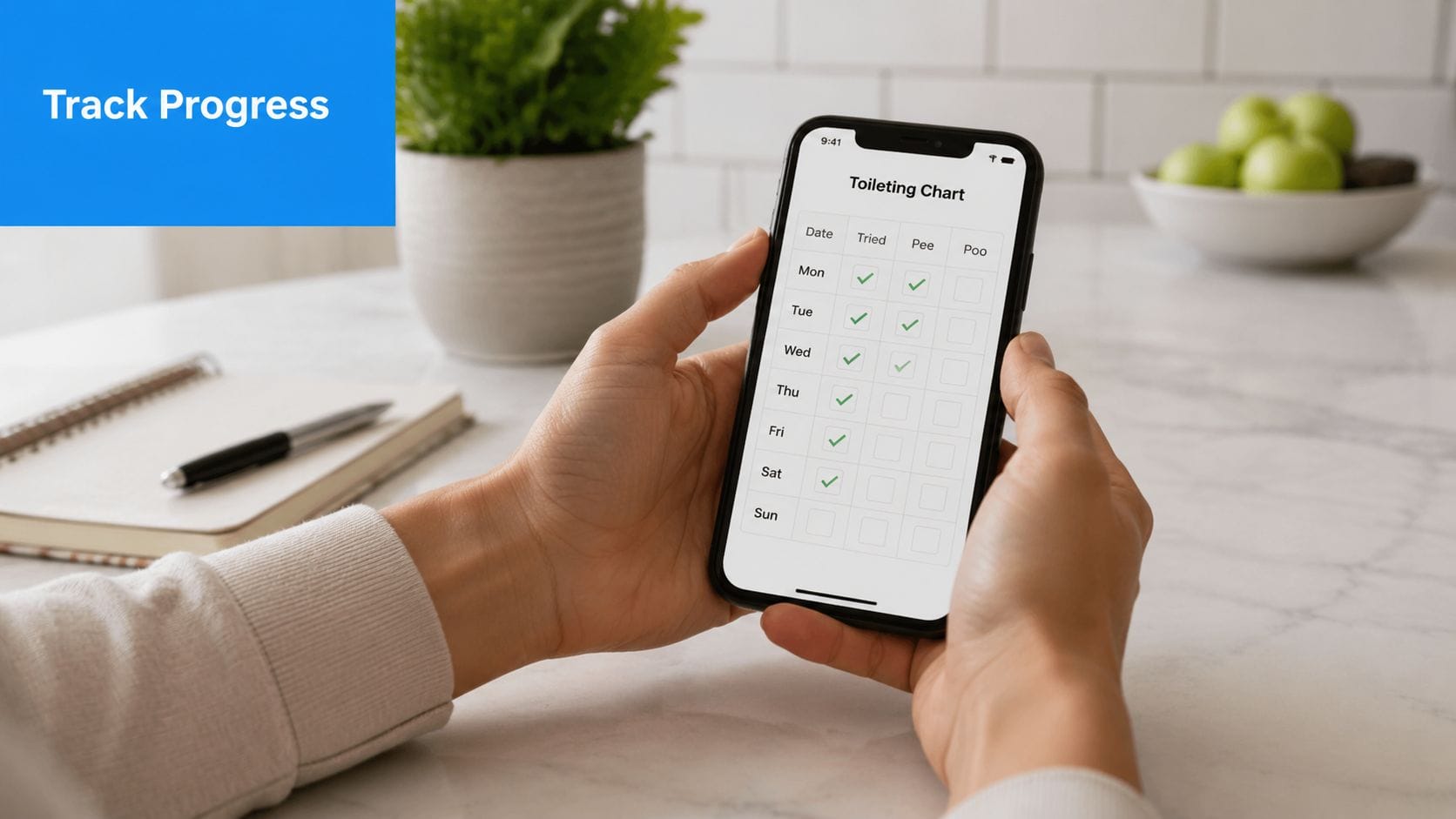
If you're not tracking, it's easy to overestimate what's working and underestimate what's getting in the way. Parents remember the hard days vividly. They often miss that accidents are clustered at one time of day, or that success happens mostly after breakfast, or that refusals spike in one bathroom but not another.
A small school-based study helps show why structured data matters. Researchers trained 5 children with autism or developmental delays using diaper removal, scheduled bathroom visits, sits capped at a maximum of 3 minutes, immediate reinforcement for urination in the toilet, and gradually extended intervals between visits. All 5 of 5 participants achieved the target outcomes, and each retained urine for 2 hours or more and urinated in the toilet after intervention (community-based toilet training study).
Track enough detail to make decisions
The point of data isn't paperwork. It's pattern detection. A useful log captures what happened and what surrounded it.
Track details like these:
- Outcome: Toilet use, accident, refusal, dry sit, bowel movement, request for help.
- Timing: Time of day and time since last void.
- Context: Home or school, bathroom used, lighting, noise, who was present.
- Body factors: Signs of constipation, discomfort, stool withholding, or unusual urgency.
- Support used: Visual schedule, timer, reward, AAC prompt, comfort item.
If you want a practical framework, this guide on how to track autism therapy progress fits toileting work well too. Guiding Growth is especially relevant because it includes potty tracking, voice logging, and shared notes, so caregivers can quickly record meals, bathroom attempts, and context without creating a separate spreadsheet.
Track just enough to answer the next decision. Don't collect data that no one will use.
This is also where flexibility matters. If the data shows that a strategy increases conflict, change it. If one bathroom consistently leads to success, use that information. If accidents rise alongside signs of constipation or pain, pause the behavioral push and involve the child's medical team. Good data helps you persist with the right plan and stop pushing the wrong one.
Autism Toilet Training: 8-Strategy Comparison
| Strategy | Implementation complexity 🔄 | Resource requirements ⚡ | Expected outcomes ⭐ | Results/Impact 📊 | Tips/Insights 💡 |
|---|---|---|---|---|---|
| Visual Supports and Social Stories | Moderate, design and personalization time; regular updates may be needed | Low–Moderate, printing, laminating, image sourcing or templates | High for comprehension and predictability in visually-oriented children | Reduces anxiety, clarifies steps, supports generalization across settings | Involve the child in image choice; keep visuals at eye level and update as progress occurs |
| Sensory-Friendly Environment Modifications | Moderate–High, may require home changes and trial-and-error adjustments | Moderate–High, specialty seats, lighting, sound solutions, possible installations | High for children whose toileting is blocked by sensory triggers | Lowers meltdowns and avoidance; often accelerates toileting when sensory barriers removed | Change one factor at a time; document sensory triggers and successful setups |
| Structured Routine and Predictable Schedules | Moderate, requires strict consistency and caregiver coordination | Low, visual schedules, timers, routine planning tools | High for children who thrive on routine and predictability | Builds biological regularity, reduces negotiation, simplifies caregiver support | Start with natural times (after meals, waking); use visual timers and share schedule with all caregivers |
| Positive Reinforcement and Preferred Rewards | Moderate, must identify reinforcers and maintain consistency | Low–Moderate, small rewards, token systems, tracking tools | High when truly preferred reinforcers are used | Increases motivation and faster skill acquisition; risk of expectation over time | Deliver rewards immediately, pair with specific behaviors, plan a fading strategy |
| Graduated Exposure and Desensitization | High, requires slow, systematic steps and careful monitoring | Low–Moderate, planning time, comfort items, gradual stimulus control | High for anxiety-driven avoidance when paced appropriately | Produces durable reduction in fear but can take months; prevents negative associations | Use small steps, document anxiety levels, allow regression and backtracking as needed |
| Modeling and Imitation-Based Learning | Low–Moderate, prepare brief live or video models; may need privacy considerations | Low, video creation or curated clips, peer modeling arrangements | Moderate–High for children who learn by observation | Often faster acquisition than verbal instruction alone; effectiveness varies by child | Keep models brief and age-matched; allow repeated viewings and personalize when possible |
| Communication Supports and AAC | Moderate–High, customization and caregiver training required | Moderate–High, AAC devices/apps, communication boards, training time | High for non-speaking or minimally verbal children to express needs | Reduces frustration and accidents; increases independence with consistent use | Start with 2–3 core items, practice outside bathroom, keep portable backups and train all caregivers |
| Data-Driven Progress Monitoring and Flexible Adjustment | Moderate, requires regular logging and periodic review | Low–Moderate, app or chart, time commitment for entries | High for optimizing and tailoring strategies based on evidence | Reveals patterns, enables timely pivots, and documents progress for professionals | Log contextual details, review weekly, set measurable goals and share visualizations with the team |
Your Partner in Progress Tracking What Works
Successfully navigating toilet training with an autistic child takes patience, close observation, and a willingness to adapt without blaming the child or yourself. Progress rarely looks like a straight line. A child may tolerate sitting before they ever void on the toilet. They may request the bathroom with a picture card before they can stay dry consistently. Those are still meaningful gains.
One of the most helpful shifts parents can make is moving from “Why isn't this working?” to “What pattern am I missing?” Sometimes the missing piece is sensory. Sometimes it's communication. Sometimes it's timing. Sometimes it's constipation, discomfort, or a schedule that's too demanding. The families who make steadier progress usually aren't the ones who push hardest. They're the ones who observe more clearly and adjust sooner.
That's why data-driven autism toilet training tips matter so much. You don't need a perfect charting system. You need a practical way to record what happened, under what conditions, and whether the current plan is helping or creating more stress. Once you can see those patterns, you stop guessing. You can shorten sits, change rewards, alter the bathroom setup, coordinate with school, or contact your pediatrician with actual observations instead of a vague sense that things are off.
There's also real value in consistency across adults. Toilet training often stalls because one caregiver uses visuals, another relies on verbal reminders, and a third waits for the child to initiate. Shared tracking brings everyone back to the same plan. It also makes it easier to celebrate small wins that get lost in the rush of daily life.
Guiding Growth is one relevant option for families who want that kind of structure in one place. Because it supports behavior logging, routines, shared notes, and potty tracking, it can help parents connect bathroom attempts with meals, sensory triggers, communication, and daily schedule changes. That doesn't replace clinical judgment or medical care. It gives you a clearer record of what your child is showing you.
Toilet training doesn't need to become a battle of wills. It works better as a responsive process built around safety, predictability, communication, and evidence from your child's real day. Track the small things. Respect the setbacks. Keep what helps. Change what doesn't.
If you want a simpler way to log bathroom attempts, track meals and routines, and share patterns with caregivers or therapists, take a look at Guiding Growth. It can help turn scattered notes into a toilet training plan you can effectively use.