You point to a bird outside the window. You smile, waiting for your child to look where you're looking. Instead, they keep spinning a toy wheel, glance at your hand, or move on entirely. That moment can feel small, but for many parents it carries a lot. You may wonder, “Did they miss it?” or “Are we not connecting?”
That kind of moment has a name. It's called shared attention, often referred to as joint attention. It means two people are tuned in to the same thing and, in some way, sharing that experience together.
Shared attention autism is a topic many people seek to understand, and you are not alone. This topic can sound clinical, but in daily life it shows up in ordinary moments: noticing a dog on a walk, looking back and forth during a game, bringing you a toy just to show it. The good news is that shared attention is something you can support gently, at home, in ways that feel natural and respectful.
Table of Contents
- The Silent Language of Shared Moments
- What Is Shared Attention and Why It Matters
- Developmental Signs and Autistic Differences
- Everyday Strategies to Nurture Shared Attention
- How to Track and Understand Your Child's Progress
- Support Resources for Families and Professionals
The Silent Language of Shared Moments
A parent sits on the floor beside their child during play. The child is intently focused on lining up blocks by color. The parent picks up a bright blue block, holds it near their face, and says, “Look what I found.” The child doesn't look up. The parent tries again later with bubbles, then with a funny sound, then with a favorite book.
Many families know this feeling. It can seem like your child is in the room with you, but not quite with you in the moment you hoped to share.
That doesn't mean your child doesn't care, and it doesn't mean connection isn't possible. Often, it means your child is processing attention differently. Some autistic children are intensely focused on objects, movement, sound, or sensory details. Shifting from that focus to another person, then back again, may be hard work.
Shared attention isn't about forcing eye contact or making a child perform social behavior on cue. It's about helping connection feel possible, clear, and safe.
When parents first hear the phrase shared attention autism, it can sound like a checklist item. In real life, it's much more human than that. It's the back-and-forth spark in a game of peekaboo. It's a child handing you a toy. It's a quick look toward you after hearing a strange noise. It's the beginning of “Did you see that too?”
These moments may be brief, subtle, and easy to miss. They also matter. Once you know what to look for, you can start noticing your child's current style of connection and create more chances for it to grow.
What Is Shared Attention and Why It Matters
Shared attention means a child and another person are focused on the same object, event, or activity, while also being aware of each other. It isn't just “looking.” It's coordinating attention.
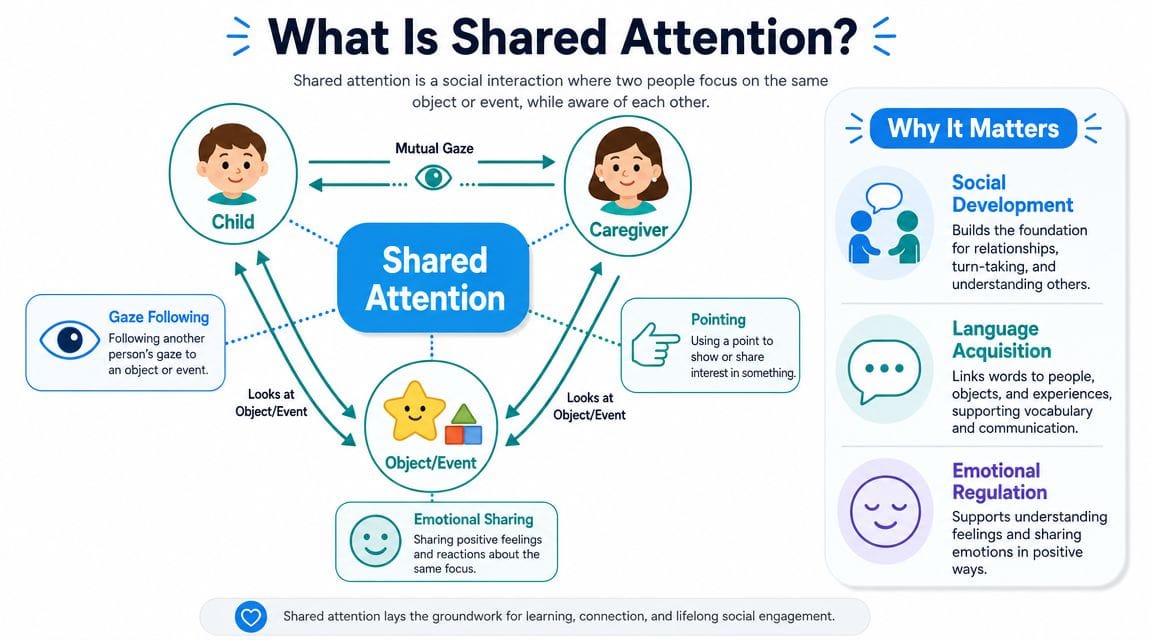
The social triangle
A simple way to picture this is as a social triangle:
- Child
- Caregiver
- Object or event
If your child looks at a toy, then at you, then back to the toy, that triangle is active. If you point to a plane and your child follows your point, the triangle is active. If your child brings you a leaf from outside and waits for your reaction, that's shared attention too.
It can include:
- Gaze shifting between a person and an object
- Pointing to show or request
- Showing an item to someone
- Shared facial expression, such as smiling after something surprising or funny
Parents who want a broader picture of early interaction can also explore insights on child social development, which can help place shared attention within the wider world of early relationships.
Two ways shared attention shows up
Shared attention usually appears in two main forms.
Responding to shared attention
This is when someone else starts the interaction, and the child responds.
Example: You point to a truck, and your child looks toward it.Initiating shared attention
This is when the child starts it.
Example: Your child points to a bubble, looks at you, and smiles as if to say, “Did you see that?”
Both forms matter, and they don't always develop evenly. A child may get better at responding before they begin initiating on their own.
Why this skill matters beyond social moments
In autism research, joint attention is described as a predictor of language function, social skills, communication, adaptive function, and intelligence, and one study found that better joint attention was positively associated with higher scores on the K-ABC Mental Processing Index in children with ASD without severe intellectual disability, as reported in this research on joint attention and later development.
That matters because shared attention helps children connect words to experiences. If a child and caregiver are both focused on the same ball while hearing “ball,” the word has a clear anchor. Shared attention also supports learning from people, not just from objects.
Practical rule: If you want to support language, don't start with more words. Start with more shared moments.
For many children, this skill becomes part of how they build trust, understand turn-taking, and notice that other people have thoughts and feelings connected to what they see. That's why shared attention is often treated as a foundation, not an extra social polish.
Developmental Signs and Autistic Differences
Some parents notice shared attention differences early. Others only recognize them later, once they compare everyday moments with what they expected. A child may enjoy people but rarely point to show interest. Another may love toys and routines but not look when someone gestures across the room.
What matters most is not labeling every variation as a problem. It helps more to ask, “How does my child currently share attention, and what seems hard about it?”
What parents often notice first
Measurable differences in shared-attention behavior can appear within the first year of life. In a longitudinal study of 32 infants, researchers found that initiating joint attention at 8 months and responding to joint attention at 12 months were linked to autism spectrum disorder risk at 18 months. The 12-month responding measure was statistically significant with p = 0.014 and explained 45.2% of the variance by Nagelkerke's criterion, according to this longitudinal study on early joint attention markers.
Parents often describe things like:
- Limited gaze following when they point something out
- Less spontaneous showing of objects just to share interest
- Strong object focus with fewer looks back to another person
- Brief or inconsistent back-and-forth moments during play
If you're also trying to understand body language, facial expressions, and subtle social signals, this guide to nonverbal social cues for autism parents can help connect the pieces.
Shared Attention Milestones
| Age Range | Typical Development | Possible Autistic Variation |
|---|---|---|
| Infancy | Begins noticing faces, voices, and shifts in adult attention | May focus strongly on sensory features, movement, or objects |
| Later infancy | May follow gaze or gestures more consistently | May look at the pointing hand rather than the object being indicated |
| Early toddler period | May point, show, or look back and forth to share interest | May request help or items without clearly sharing attention for enjoyment |
| Toddler years | Shared attention becomes more frequent in play, books, and routines | May participate in the same activity without clearly signaling shared focus |
This table isn't a test. It's a way to organize observation. Some autistic children show strong skills in one area and clear differences in another.
Not always about social interest alone
A major nuance often gets missed. Shared attention challenges may not be only “social.” A 2021 eye-movement study found children with ASD showed reduced gap effects across both social and nonsocial stimuli, and the authors concluded the alteration was not specific to the social domain but associated with cognitive functioning, as described in this study on visual attention and autism.
That means a child may not be ignoring you. They may be having difficulty disengaging from one thing and shifting attention to another. For families exploring overlapping attention and regulation patterns, this article on neurobiological links in ADHD and autism can add useful context.
When a child doesn't share attention, the question isn't always “Won't they?” Sometimes it's “What's making attention shifting hard right now?”
That shift in perspective often changes everything. It makes room for support instead of blame.
Everyday Strategies to Nurture Shared Attention
Helping shared attention grow usually works best when it feels like play, not a lesson. Children are more likely to engage when the interaction starts from their interest, their comfort, and their pace.

Start by joining, not directing
If your child is spinning a car wheel, sit nearby and notice it too. You might spin another wheel, copy the rhythm, or softly comment on what they're doing. This is often more effective than immediately calling their name, asking questions, or trying to redirect them to your idea.
A few helpful starting points:
- Get at eye level. Your face becomes easier to notice when it isn't towering above the activity.
- Follow the child's lead. Enter their focus before asking them to enter yours.
- Use simple language. Short comments often work better than rapid instructions.
- Pause. Leave room for a glance, a gesture, or a small response.
Interventions for joint attention often use prompting, reinforcement, and play-based routines, with caregiver actions such as eye-level positioning and immediate reinforcement used to increase gaze shifts and bids for shared attention, as outlined in these joint attention ABA strategies.
Use scaffolding in small steps
Teaching joint attention is often scaffolded. Caregivers may start with parallel play at eye level, then create a motivating contrast, such as holding a preferred item slightly out of reach so the child looks from the object to the adult before receiving it. This gradual shaping helps build a durable repertoire of behaviors, according to this seminar handout on shaping joint attention.
Scaffolding can look like this in daily life:
Sit beside your child and copy their play
If they're stacking cups, stack your own.Add a playful interruption
Hold the next cup near your face for a second.Wait for any shift toward you
A glance, body turn, reach, or smile counts.Respond right away
Give the cup, continue the game, share the fun.
This is a gentle invitation. It's not about making a child “earn” access to something they love. It's about creating a reason to notice another person within a meaningful activity.
For parents who want more ideas for turning play into growth opportunities, this resource on how structured play supports autism development may be useful.
Here is a short demonstration that shows how shared-attention support can look in practice.
Build shared moments into daily routines
You don't need special materials. Shared attention practice fits into routines you already do.
- During meals: Hold up two choices and wait. If your child looks between the food and you, that's a moment to reinforce.
- During books: Point to one interesting picture and pause instead of naming everything on the page.
- During outdoor walks: Stop when something naturally stands out, like a bus, leaf blower, or dog.
- During songs: Pause before a favorite part and wait to see whether your child looks toward you for the next line.
Small, repeated moments in ordinary routines often build more durable skills than occasional long practice sessions.
Some days your child will engage more. Some days they won't. That's normal. The goal isn't a perfect response every time. The goal is making shared attention easier, warmer, and more predictable over time.
How to Track and Understand Your Child's Progress
One of the hardest parts of supporting shared attention at home is knowing whether anything is changing. Progress often doesn't look dramatic. It may show up as a quicker glance, a longer pause before turning away, or a new habit of bringing you something interesting.
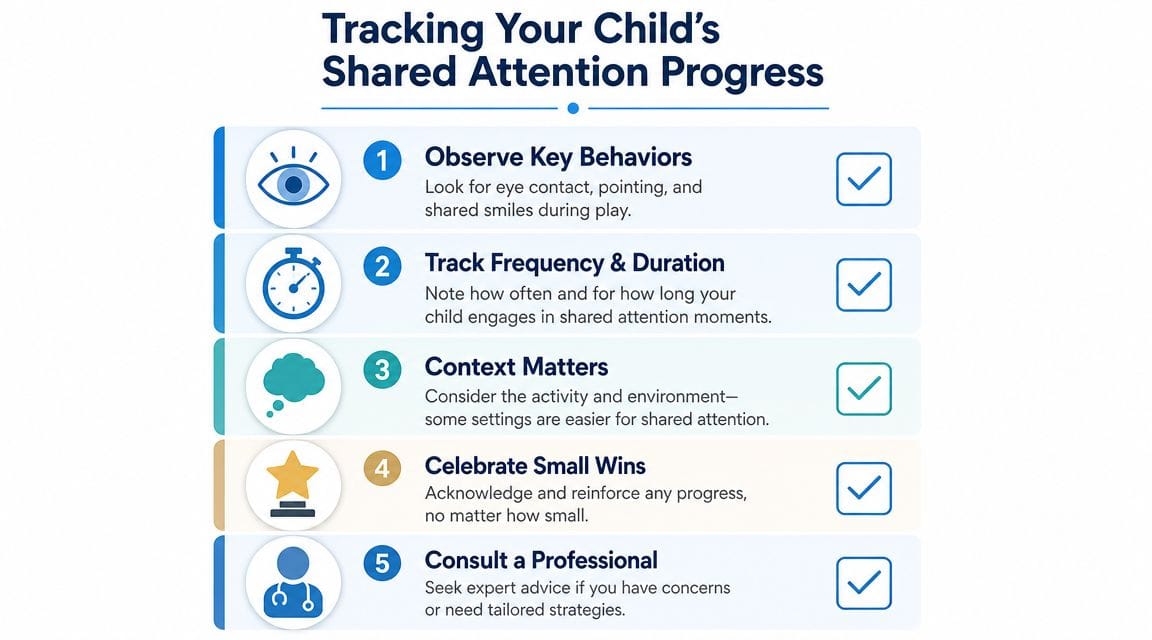
What progress actually looks like at home
A major gap in parent resources is guidance on what “improvement” in joint attention looks like at home and how to track it. Actionable, routine-based indicators, such as frequency of spontaneous pointing or gaze-shift response latency, are needed to connect interventions to real-world measurement and trend monitoring, as noted in this discussion of home-based joint attention tracking.
That idea matters because many parents rely on memory. Memory is messy, especially when you're tired and juggling meals, school communication, therapy notes, and sleep issues.
Progress might look like:
More spontaneous showing
Your child brings you a toy, leaf, snack wrapper, or drawing without needing help.Faster response to your bid
When you point or call attention to something, the delay before they orient gets shorter.More back-and-forth during play
Instead of one brief look, there are several moments of checking in.Shared attention in more places
Not just in therapy, but in the kitchen, car, bath, or playground.
Simple things to log
You don't need a complicated chart. You need a few observations you can record consistently.
Try tracking:
What happened
“Looked from bubbles to me twice before I blew more.”Where it happened
Kitchen, backyard, car ride, bedtime book.What seemed to help
Favorite toy, quiet room, slower pace, sibling nearby.What made it harder
Noise, fatigue, transitions, hunger, crowded setting.
A structured tool can make this easier. How to track autism therapy progress gives a useful framework for observing patterns across home and therapy, and Guiding Growth can help families log these moments, routines, and context in one place, including quick voice logging when typing isn't realistic.
Keep this lens: Don't ask, “Can my child do shared attention?” Ask, “Under what conditions does shared attention happen more easily?”
That question turns observation into action.
How patterns help you make decisions
Once you log a few weeks of moments, patterns often become clearer. You may notice your child shares attention more during movement play than table tasks. Or that they respond better when only one adult is speaking. Or that mornings go better than late afternoons.
Those patterns help with everyday decisions:
| Observation pattern | What it might suggest |
|---|---|
| More shared attention during sensory play | Use water, sand, spinning, or movement as entry points |
| Better responses in quiet settings | Reduce competing sound and visual input |
| More initiating during favorite routines | Build practice into predictable, motivating activities |
| Fewer bids when tired or hungry | Protect regulation before expecting interaction |
This kind of tracking also gives you concrete information to share with therapists, teachers, pediatricians, and caregivers. Instead of saying “sometimes he does it,” you can describe what happens, when it happens, and what supports it.
That doesn't just document progress. It helps people around your child respond more consistently.
Support Resources for Families and Professionals
Families don't need to figure this out alone. Shared attention grows best when the adults around a child use similar expectations, similar pacing, and similar ways of noticing progress.
Support doesn't have to mean doing more. Often it means doing less at once, slowing the interaction, and making room for connection inside play and routines. Caregiver behaviors such as getting on the child's eye level and offering immediate positive reinforcement are commonly used to support gaze shifts and shared-attention bids in play-based work, as described earlier in the article.
A few strong places to continue learning include:
- Autistic Self Advocacy Network for neurodiversity-affirming perspectives
- Child Mind Institute for parent-friendly developmental explanations
- Local early intervention teams, speech-language pathologists, developmental pediatricians, and occupational therapists for individualized support
- Community-based provider directories if you're looking for region-specific services, such as THERAPSY's services for autism
For professionals, the same principle applies. Shared attention is easier to support when home, school, and therapy use shared language and similar observation habits. A teacher who notices a child points during snack, and a parent who notices the same thing during bath toys, are both contributing to a clearer picture.
What matters most is steady, compassionate attention. Your child doesn't need perfect sessions. They need adults who notice the small openings for connection and respond to them with warmth.
If you want a simple way to record shared-attention moments, routines, and patterns without relying on memory alone, Guiding Growth gives parents one place to log daily observations, organize care information, and share useful context with the people supporting their child.