Your child is lining up toys again. Or rocking on the couch. Or flapping their hands when they get excited. Maybe they repeat the same phrase several times in a row. You notice it, then your mind starts racing. Is this typical? Is it stress? Is it sensory? Is something wrong?
That worried pause is very common. Many parents first encounter repetitive behavior not in a clinic, but in the middle of ordinary life. At breakfast. In the car. During homework. What makes it hard is that the behavior can look obvious, while the meaning behind it feels unclear.
A helpful starting point is this. Repetitive behavior is not automatically a problem, and it isn't automatically meaningless. Often, it's a clue. If you're trying to make sense of patterns like rocking, hand flapping, or repeated sounds, learning to identify sensory triggers in autism can make those moments feel less mysterious and more manageable.
Table of Contents
- Understanding Your Child's Repetitive Behaviors
- What Is the Definition of Stereotyped Behavior
- Stereotypy Stimming and Tics Explained
- Common Examples and Their Possible Functions
- How to Respond and When to Seek Help
- Turn Observations into Action with Guiding Growth
Understanding Your Child's Repetitive Behaviors
A parent might see their child pacing in the hallway while humming the same tune, or rocking during quiet time, and feel two things at once. Concern, and confusion. The behavior seems important, but no one has handed them a plain-language guide for what they're seeing.
That uncertainty can make ordinary moments feel heavy. If your child repeats a phrase over and over, you may wonder whether to stop it, ignore it, redirect it, or ask for an evaluation. If they flap when they're excited, you may wonder whether that's joy, overload, habit, or all three.
The first question is usually too big
Many parents start with, “What does this mean?” That question makes sense, but it often needs to be broken into smaller ones first.
- What exactly happened: Was it rocking, repeating words, toe walking, or something else?
- When did it happen: During excitement, boredom, stress, or fatigue?
- What changed before it started: Noise, transition, demand, hunger, lights, or social pressure?
- What happened after: Did your child calm down, get more upset, or stay the same?
Those details matter more than parents are often told.
Practical rule: Before trying to stop a repetitive behavior, try to understand what job it may be doing for your child.
Worry often softens when the pattern gets clearer
A repetitive behavior can look strange from the outside and still make sense from the inside. A child who rocks may be organizing their body. A child who repeats a phrase may be processing language, asking for predictability, or regulating emotion. A child who flaps may be expressing intense excitement.
Seeing behavior this way doesn't mean dismissing concerns. It means replacing panic with observation. That shift helps parents respond with steadier judgment and more compassion.
What Is the Definition of Stereotyped Behavior
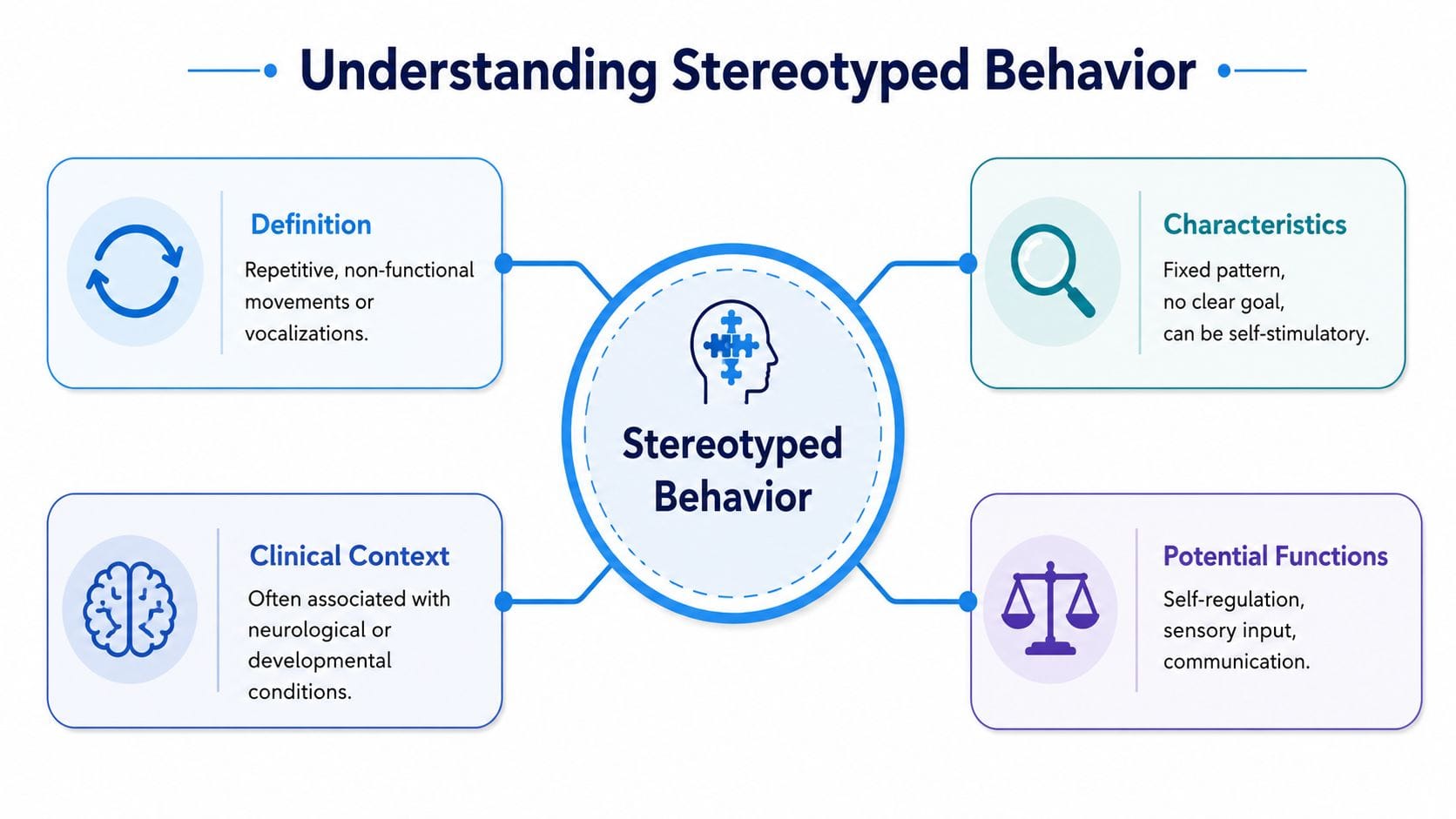
The stereotyped behavior definition used in clinical and research settings is specific. It refers to a repetitive, fixed, and invariant movement, posture, or vocalization that serves no obvious adaptive purpose. In autism, it falls within the DSM-5 category of restricted and repetitive behaviors, and the DSM-5, published in 2013, retained these behaviors as a core diagnostic dimension based on the observable pattern itself, not a single assumed cause, as described in this clinical review of stereotyped movements and DSM framing.
A simple way to think about it
Think of a song stuck on loop. It repeats the same way, with the same rhythm and shape, again and again. That's the part clinicians are noticing. The pattern.
Stereotyped behavior is labeled by how it looks and sounds from the outside:
- Repetitive: It happens again and again.
- Fixed: It tends to follow a familiar form.
- Invariant: It looks very similar each time.
Classic examples include hand flapping, body rocking, toe walking, and echolalia. Those examples are often what bring parents to the term in the first place.
Why the definition matters
This definition can be surprisingly reassuring. It doesn't say your child is choosing a “bad behavior.” It also doesn't say the behavior has one universal meaning. It says clinicians are describing a recognizable pattern.
That distinction matters because the same type of repetitive movement can appear in different contexts. The label stereotypy doesn't belong only to autism. It can also be used across other developmental, neurologic, or psychiatric conditions because the term describes form, not a single cause.
A descriptive label is not a moral judgment. It's a way to describe what is observable so families and professionals can talk about the same thing.
Parents often get stuck on the phrase “no obvious purpose.” That wording can sound cold. In practice, it usually means the purpose isn't immediately visible to an outside observer. A child may still be getting something important from the behavior, such as sensory input, emotional release, or internal regulation.
That's why the stereotyped behavior definition is only the beginning. It names the pattern. It doesn't tell the whole story of the child.
Stereotypy Stimming and Tics Explained
Parents hear these words all the time: stereotypy, stimming, tics. In everyday conversation, people often use them as if they mean the same thing. They don't.
Why these terms get mixed up
All three can involve repeated movements or sounds. That's the overlap. The confusion starts because families are trying to name what they see, while different professionals may focus on different features.
A useful distinction from the clinical literature is this. Stereotyped behavior is a broad descriptive term based on repetitive, fixed form, while a separate diagnosis depends on context, age of onset, and impairment. That distinction is highlighted in this MedLink discussion of stereotypies and related movement disorders.
Comparing repetitive behaviors
The table below won't replace an evaluation, but it can help you describe what you're seeing more accurately.
| Characteristic | Stereotypy | Stimming | Tics |
|---|---|---|---|
| Overall pattern | Fixed and repeated in a similar way | Repetitive, but may vary depending on need or sensory input | Usually brief and less rhythmic |
| Rhythm | Often rhythmic or patterned | Can be rhythmic or non-rhythmic | Often sudden and non-rhythmic |
| Possible purpose | May appear to have no obvious external goal, though it may still regulate internally | Often linked to sensory regulation, excitement, or calming | Often experienced as less voluntary and harder to suppress comfortably |
| Examples | Rocking, hand flapping in a repeated pattern, repeated vocal sounds | Fidgeting, humming, squeezing, pacing, repeating sounds for regulation | Eye blinking, shoulder jerks, throat sounds |
| How parents may notice it | Looks very similar each time | Seems tied to mood, sensory load, or environment | May appear sudden, brief, and hard to predict |
| Clinical note | Descriptive term based on form | Everyday term often used for self-regulation | Different movement category from stereotypy |
A simple way to think about it is this:
- Stereotypy describes the shape of the behavior.
- Stimming often describes the function people see in it.
- Tics are usually discussed as a different movement pattern.
That's why a single behavior might be described in more than one way depending on who is talking. A parent may say, “My child flaps to calm down.” Another professional may say, “That hand movement looks stereotyped.” Those statements can both point to the same event from different angles.
If you're unsure what term fits, describe what you saw instead of forcing a label. “Repeated hand flapping during excitement” is more useful than guessing.
Common Examples and Their Possible Functions
Some behaviors stand out immediately. A child rocks while watching a show. Another walks on their toes across the kitchen. Another repeats the last line of a question before answering. These can feel puzzling at first, but they're easier to understand when you look at both form and context.
Stereotyped behavior is usually identified early in childhood, often by around age 3 to 4 years, and episodes can last from seconds to minutes and happen multiple times per day, especially during excitement, fatigue, stress, or boredom. The same source also notes that these behaviors may provide internal regulation or self-stimulation, which is why context matters so much in understanding them, as summarized in this overview of stereotypy examples and timing.

What parents often notice first
Here are some common examples people ask about:
- Hand flapping: Often noticed during excitement, anticipation, or overload.
- Body rocking: May show up during waiting, fatigue, or attempts to calm.
- Toe walking: Can be part of a broader sensory or movement pattern.
- Echolalia: Repeating words, phrases, or sounds heard from others or media.
Parents also notice when these behaviors seem to cluster around certain moments. A loud store. A long day. A difficult transition. A burst of happiness after seeing a favorite toy.
If your child often covers their ears, winces at noise, and then starts rocking or repeating phrases, it can help to look at the sensory picture too. This guide on whether covering ears can be a sign linked to autism and sensory stress can give that pattern more context.
Looking for function instead of fault
A behavior can have more than one possible function. That's why interpretation should stay flexible.
| Behavior | What it may look like | Possible function |
|---|---|---|
| Rocking | Back-and-forth body movement | Calming, organizing the body, coping with stress |
| Hand flapping | Repeated arm or hand movement | Expressing excitement, releasing energy, sensory regulation |
| Toe walking | Walking on the balls of the feet | Seeking a certain body sensation or motor pattern |
| Echolalia | Repeating words or phrases | Processing language, seeking predictability, communicating indirectly |
A useful shift is to stop asking only, “How do I make this stop?” and start asking, “What might my child be getting from this?”
Many repetitive behaviors make more sense when you treat them as communication from the body, even when the child isn't using them as intentional words.
That doesn't mean every repetitive behavior should always continue without limits. It means support starts with curiosity. If rocking helps your child settle after school, it may be serving an important purpose. If repeating a phrase happens most during stress, the repetition may be showing you where the strain is.
How to Respond and When to Seek Help
The first response doesn't need to be dramatic. It needs to be calm, observant, and practical.
Start with safety and observation
When you see a repetitive behavior, start with two questions. Is my child safe? Is this behavior helping them regulate, or is it getting in the way?
If the behavior is safe and your child seems more settled because of it, you may not need to interrupt right away. A child who rocks gently while winding down may be doing something that works for their nervous system. Stepping in too quickly can increase stress instead of reducing it.
Try this short observation checklist:
- Notice the setting: Was the room loud, bright, crowded, or demanding?
- Watch your child's state: Did they seem excited, tired, frustrated, bored, or overwhelmed?
- Check what came before: Transition, denial of a preferred activity, waiting, hunger, or conflict?
- See what follows: More calm, more agitation, withdrawal, or readiness to rejoin?
When redirection helps
There are times when redirection is appropriate. If a behavior is unsafe, physically harmful, or making it hard for your child to participate in something they want or need to do, gentle support may help.
That might include:
- Offering an alternative: A movement break, a quiet space, or a sensory item.
- Reducing demand: Shortening the task, slowing the pace, or adding predictability.
- Changing the environment: Lower noise, dim lights, fewer people, or more space.
- Supporting communication: Giving simple words or visual supports for what your child may be trying to express.
Redirection works best when it solves the underlying need instead of merely blocking the movement.
If a behavior increases when you interrupt it, that's useful information. Your child may be relying on it more than it appears.
A short video can help many parents think more clearly about behavior as communication and regulation:
What to document
If a repetitive behavior is frequent, changing, disruptive, or confusing, write down what you see. Good notes are often more helpful than a vague memory in a stressed moment.
A simple log might include:
Behavior observed
“Rocking on couch” or “repeating same question.”Time and place
After school, in the grocery store, at bedtime.Possible trigger
Noise, waiting, hunger, transition, fatigue, excitement.Duration and intensity
Brief and mild, or longer and harder to interrupt.What helped
Snack, quiet room, movement break, reduced demands, reassurance.
Seek professional guidance if the behavior is causing injury, is persistent and strongly interfering with daily life, or seems linked to a broader developmental concern. You don't need to arrive with a perfect explanation. Clear observations are enough to start.
Turn Observations into Action with Guiding Growth
Parents often have pieces of the puzzle, but not the whole picture. One day the rocking happens after school. Another day the echolalia shows up before dinner. A week later, toe walking seems stronger after poor sleep. Without a system, those details stay scattered.
Why patterns matter
Patterns change the conversation. Instead of saying, “It seems like this happens a lot,” you can say, “It tends to happen when routines change,” or “I notice more repetition when my child is tired, hungry, or overloaded.” That kind of clarity helps at home and in meetings with teachers, therapists, or doctors.
You can build that clarity by using a consistent method to track and understand behavioral triggers. The key is not collecting perfect data. It's noticing repeatable links between behavior, environment, body state, and response.
What organized tracking changes
A good tracking system helps you move from isolated incidents to useful patterns.
- Behavior logs become clearer: You can record hand flapping, rocking, echolalia, shutdowns, or demand-related stress in one place.
- Context stops getting lost: Sleep, meals, routines, appointments, and environment can be viewed alongside behavior.
- Collaboration gets easier: Family members and professionals can work from the same observations instead of separate memories.
- Support becomes more targeted: You can test what helps, then repeat what works.
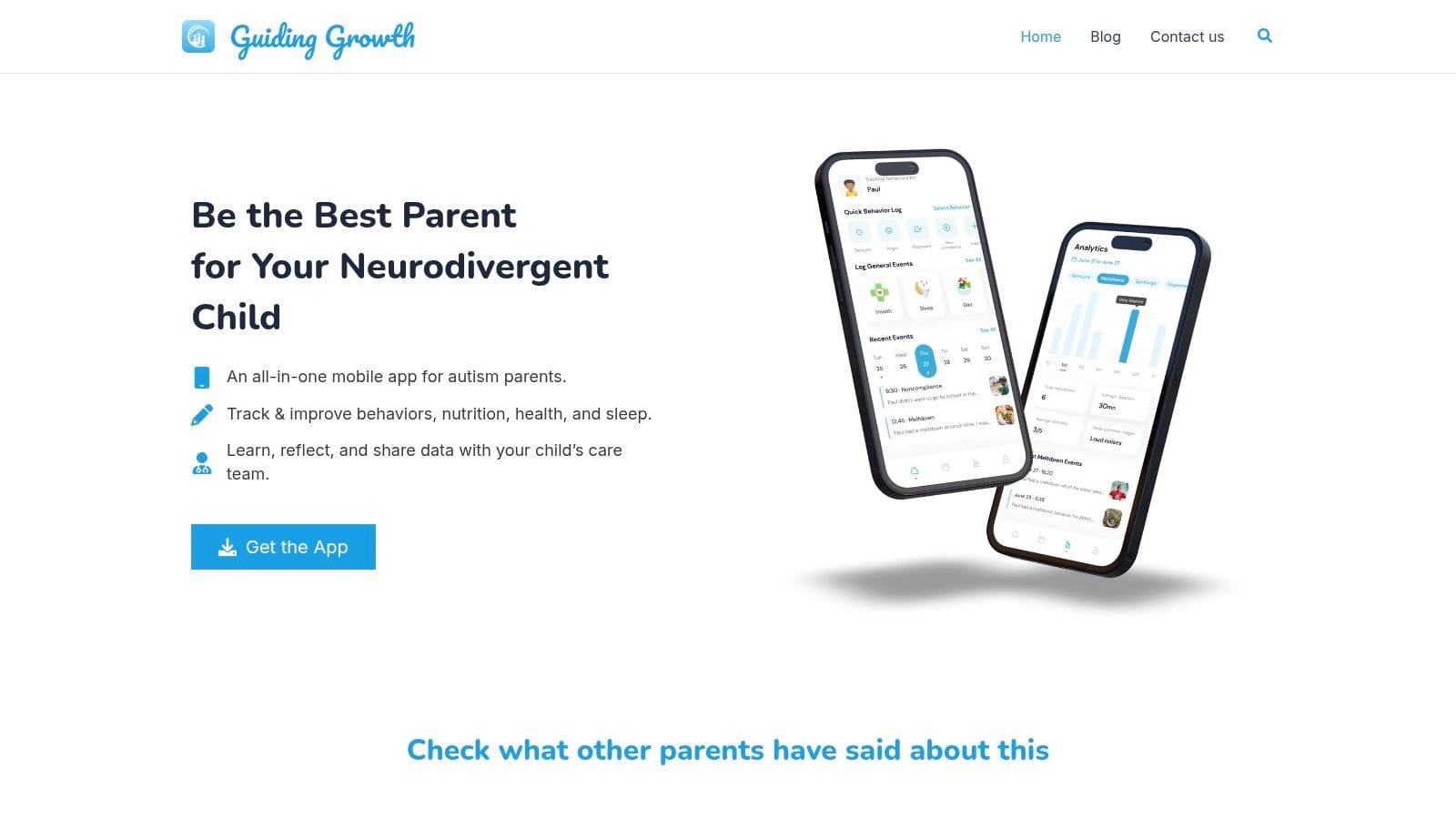
That's where Guiding Growth can make daily care feel more manageable. The app gives parents one place to log behaviors, routines, sleep, food, medications, appointments, and context without relying on scattered notes. It also supports real-time sharing with caregivers and professionals, and includes tools like quick voice logging and Alma AI for day-to-day parenting support.
When behavior feels confusing, structure helps. When structure reveals patterns, decisions get easier. And when decisions get easier, parents usually feel less alone and more confident.
If you're trying to make sense of repetitive behaviors without drowning in notes, Guiding Growth can help you track what's happening, spot patterns, and share clear observations with the people supporting your child. It turns “I'm worried” into “I can see what's going on.”