Some mornings unravel before breakfast. A child freezes when it's time to get dressed. Shoes suddenly feel impossible. Toothbrushing turns into a negotiation. You repeat the same directions, louder each time, and everyone starts the day flooded.
That pattern doesn't usually come from laziness or defiance. It often comes from a mismatch between what the morning demands and how a child processes language, transitions, sensory input, and pressure. A morning routine visual schedule helps because it makes the routine visible, predictable, and easier to follow when spoken reminders aren't landing.
The version that works best usually isn't a cute printable chart pulled from the internet and left unchanged for months. It's a schedule that fits the child in front of you, allows room for anxiety and demand avoidance, and gets adjusted when real life changes.
Table of Contents
- Why Mornings Feel So Hard and How a Visual Schedule Helps
- Choosing the Right Visual Schedule Format
- How to Build an Effective Morning Visual Schedule
- Introducing and Using the Schedule Successfully
- Troubleshooting When Your Child Resists the Schedule
- Evolving Your Routine with Data Driven Insights
Why Mornings Feel So Hard and How a Visual Schedule Helps
A lot of parents wake up already bracing for the first transition. Out of bed. Into the bathroom. Out of pajamas. Away from a preferred toy. Toward breakfast. Toward shoes. Each step looks small to an adult, but for a child who struggles with transitions, language processing, anxiety, or sensory overload, each one can feel like a fresh demand.
Verbal directions often fail because they vanish the second they're spoken. “Go brush your teeth, then get dressed, then come to the kitchen” can sound simple to us and impossible to hold onto for a child who's already dysregulated. When the routine lives only in your voice, you become the reminder, the prompt, and often the target of frustration.
A visual schedule changes that dynamic. The routine sits outside your body. The child can see what's happening, what's next, and what counts as finished.
Practical rule: When the schedule becomes the guide, you can stop sounding like a broken alarm clock.
That shift matters. A 2018 study in the Journal of Autism and Developmental Disorders found that 85% of neurodivergent children showed improved independence in morning routines after just 14 days of using a visual schedule, with 92% of parents reporting reduced morning stress levels.
Why the visual part matters
A morning routine visual schedule works best when it reduces uncertainty. Instead of hearing an abstract sequence, the child sees a concrete path. Wake up. Toilet. Get dressed. Breakfast. Brush teeth. Shoes. Done.
That visibility helps in a few specific ways:
- It lowers memory load so the child doesn't have to keep the whole routine in their head.
- It reduces argument loops because you can point instead of repeating.
- It supports independence because the child can move through the routine with less adult prompting.
- It makes transitions less abrupt because “what's next” is already there.
Parents often notice that the schedule doesn't fix every hard morning. It does something more useful. It gives the morning a shape.
Hope matters too
When a routine has been rough for a long time, families often assume they need stricter follow-through. Usually they need clearer structure and better fit. If your child's morning struggles seem tied to overwhelm, it also helps to look at patterns in the background, like noise, clothing discomfort, hunger, sleep, or rushing. This guide on how to identify sensory triggers in autism is a good starting point for noticing what might be adding pressure before the day even begins.
Choosing the Right Visual Schedule Format
The best schedule format is the one your child will use on a busy Tuesday. Not the prettiest one. Not the one another family loves. Not the one that takes an hour to update every time the routine changes.
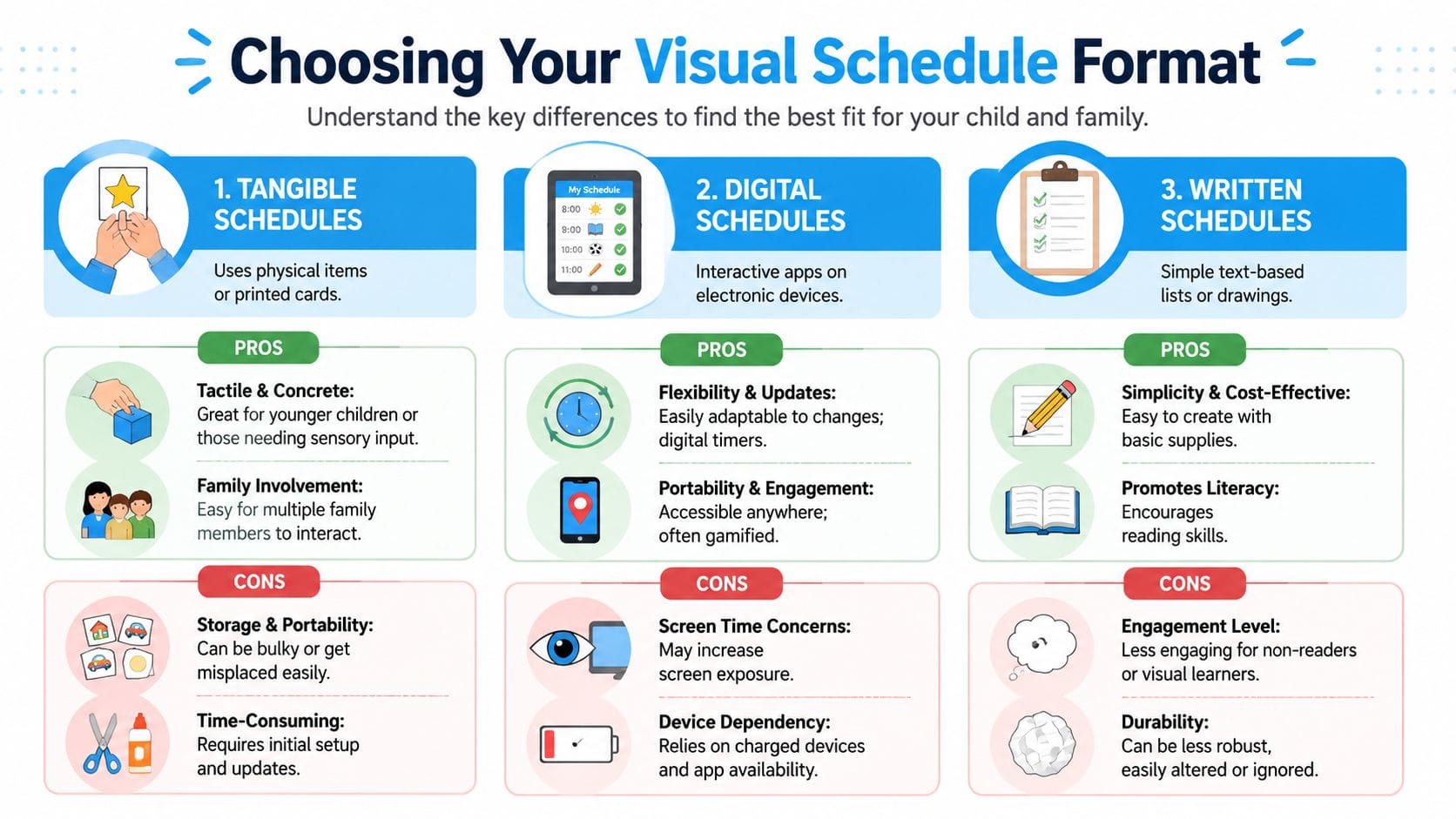
Some children do best with something they can touch and move. Others respond better to a digital routine that can change quickly when the morning goes sideways. A few older kids can manage a written checklist, but for many children, text alone asks too much.
What physical schedules do well
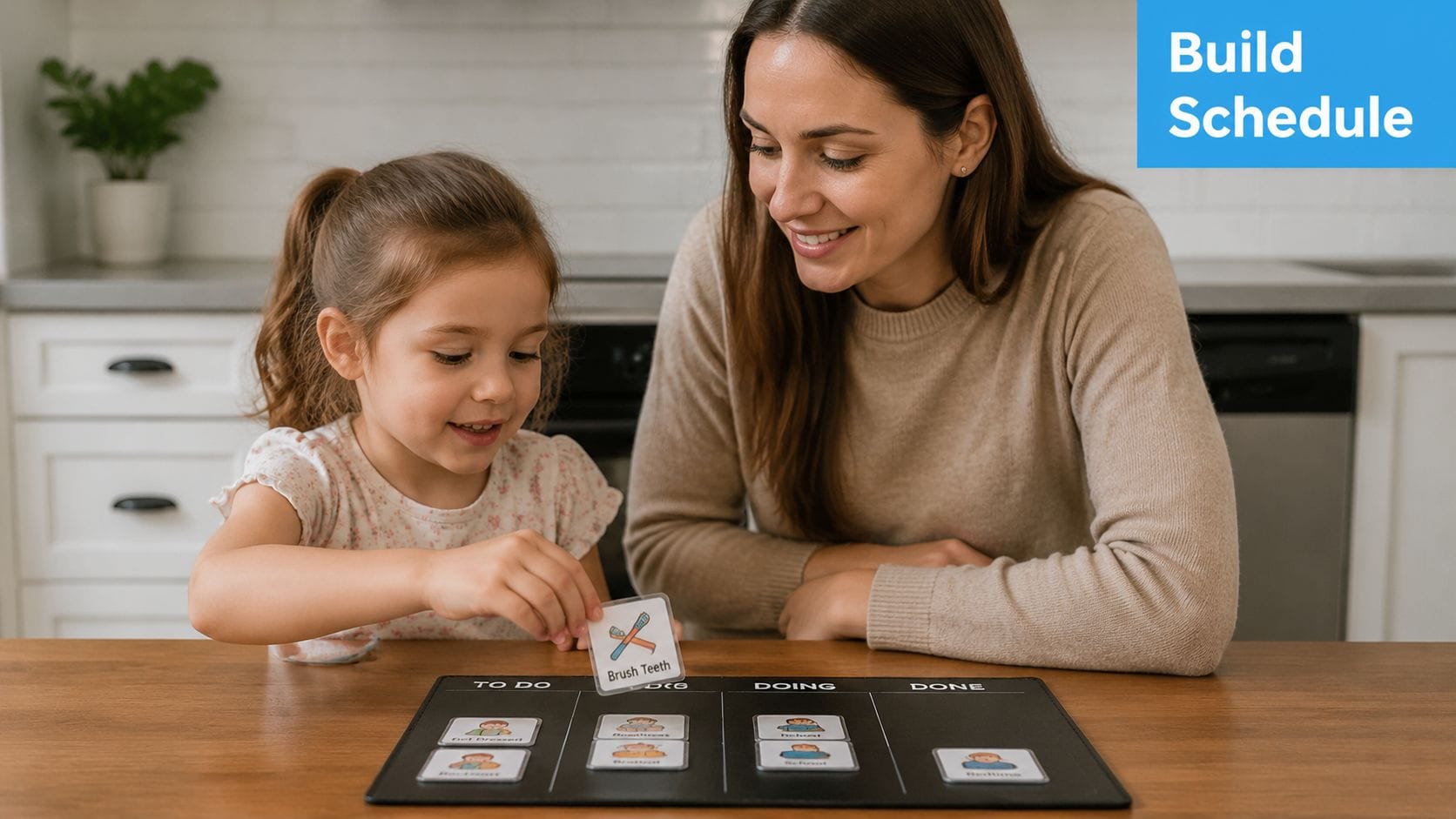
A tangible schedule usually means printed cards, Velcro strips, a binder, or a board on the wall. It's concrete. A child can pull off “get dressed” and move it to “finished.” That action matters, especially for kids who need a physical cue that a step is complete.
Physical schedules are often a strong fit when a child:
- Needs sensory input and benefits from handling pieces
- Gets distracted by screens or becomes stuck on the device itself
- Responds well to routine locations like a board by the bedroom door
- Needs family-wide consistency so every caregiver can use the same visible tool
The trade-off is upkeep. Cards get lost. Boards need updating. If the routine changes often, a physical system can become outdated fast.
When digital works better
A digital schedule lives on a phone or tablet. Its biggest strength is flexibility. If breakfast needs to come before getting dressed because the child woke up hungry and shaky, you can change the order quickly. If you want to add a timer, audio support, or a calming choice, digital tools make that easier.
Digital schedules can work well when a family needs:
- Fast edits for variable mornings
- Portability between home, grandma's house, and school drop-off
- Built-in timers for steps like toothbrushing
- Less physical clutter on counters and walls
The trade-off is real too. Some children find screens overstimulating. Others melt down when the battery dies or the app glitches. If the device becomes more interesting than the routine, the schedule stops being the tool and starts being the problem.
Tangible vs. Digital Visual Schedules
| Format | Pros | Cons | Best For |
|---|---|---|---|
| Tangible | Concrete, tactile, easy for multiple caregivers to use together | Bulkier, easier to lose pieces, slower to update | Younger children, children who need hands-on interaction, homes with stable routines |
| Digital | Easy to edit, portable, can include timers and quick changes | Depends on device access, may raise screen concerns, can become distracting | Families with changing routines, older children, caregivers who want fast customization |
| Written | Simple, low-cost, easy to make | Less accessible for non-readers, easier to ignore, less engaging | Children who already read comfortably and don't need picture support |
A good format reduces friction for the whole family. If it's hard for you to maintain, it won't stay consistent long enough to help.
For many families, the best answer isn't either-or. It's both. A physical board at home for the main routine, plus a digital backup for changes, travel, or therapy collaboration.
How to Build an Effective Morning Visual Schedule
A schedule works when it matches the child's actual bottlenecks. That means you don't start by designing. You start by observing. Which part blows up first. Where does your child stall. Which step seems simple to you but feels huge to them.
Start with the real morning, not the ideal one
Use a top-down task analysis. Pick the exact morning sequence that causes the most stress, then break it into smaller actions. “Get ready” is too vague. “Toilet, underwear, shirt, pants, socks” is much easier to follow.
The most effective schedule usually starts small. Clinical ABA studies show that using high-fidelity, real photographs of the child performing a task increases comprehension by 40% in children with limited verbal processing compared to using abstract icons. Starting with a 3–5 activity cap yields a 75% higher adherence rate in the first two weeks.
That smaller start is one of the most common differences between schedules that stick and schedules that get abandoned. Families often try to map the whole morning at once. It's better to build one successful sequence first.
Try this order:
- Choose one routine chain such as wake up, toilet, dress, breakfast, shoes.
- Break each step down only as much as your child needs.
- Keep the first version short so success comes early.
If you want another practical example of breaking a child's day into manageable chunks, this guide on planning a preschool daily schedule gives useful structure ideas you can adapt for mornings.
Use visuals your child understands quickly
Many printable schedules use generic clip art. Sometimes that's fine. Often it isn't. If a child has limited verbal processing or struggles to generalize from cartoon icons, a real photo works better because it shows the exact sink, the exact toothbrush, the exact coat hook.
That's why I usually recommend:
- Real photos first for younger children or children who need concrete cues
- Simple icons later if the child already understands the sequence
- Consistent orientation so the board feels orderly and easy to scan
If the child has to decode the picture, the picture isn't helping enough.
You can also save yourself trouble by using a ready-made structure instead of building from scratch every time. A simple autism daily schedule template can give you a starting layout, then you can personalize the visuals to match your child's routine.
Keep the design clear and easy to use
The schedule should be calm to look at. Many children do worse with bright, busy designs that adults think are fun. Clear beats cute.
Use these design rules:
- Large visuals with enough space to recognize each item quickly
- Plain backgrounds instead of patterned ones
- Eye-level placement in a spot the child naturally passes
- A visible finish point like an “all done” box or finished column
- Low clutter so the schedule doesn't compete with the room
If a step is time-bound, add a visual timer. “Brush teeth” is clearer when the child can also see how long it lasts. If the schedule is interactive, let the child move the card, flip it, or tap it complete. That physical participation often improves buy-in because the routine feels like something they do, not something done to them.
Introducing and Using the Schedule Successfully
A strong schedule can still fail if it gets introduced as one more demand. The child hears, “Now you have a chart telling you what to do too.” That's why the launch matters almost as much as the design.
Lead with collaboration
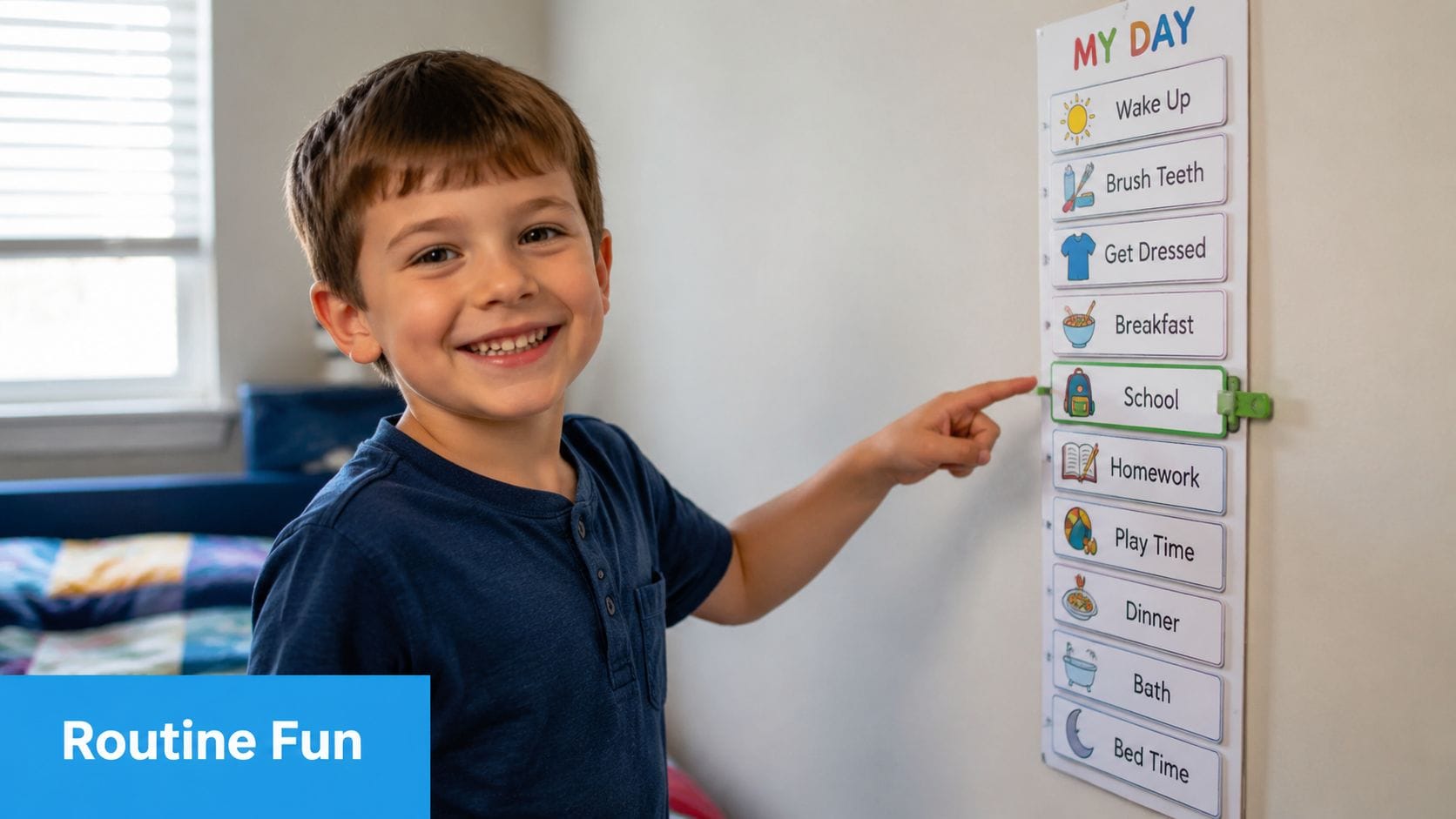
Bring the schedule in during a calm moment, not in the middle of a rushed school morning. Show it. Name the steps. Let your child touch it, move pieces around, or help choose where it hangs.
Use warm, simple language. “This will show us what comes next.” “When you finish one, you move it here.” “We'll do it together.”
That approach feels different from “You need to follow this now.” Children who are sensitive to pressure notice the difference immediately.
A useful launch sequence looks like this:
- Model first by walking through the schedule alongside your child.
- Prompt lightly with pointing more than talking.
- Praise the specific effort such as “You checked the next picture” or “You moved ‘breakfast' all by yourself.”
The goal isn't perfect compliance. The goal is helping the child trust the routine.
Make completion visible
Children often need a clear sense that a step is over. If the schedule stays static, the morning can feel endless. A finished box, flipped card, or moved Velcro strip gives closure.
Specific praise works better than generic praise. “Good job” passes by too fast. “You put your socks on and checked your board” tells the child exactly what worked.
Keep reinforcement immediate and small. Waiting until the entire routine ends is often too late, especially for a child who's still learning the sequence.
Pair the schedule with real world supports
The visual schedule doesn't have to work alone. It usually works better with a few supports around it.
- Visual timers help with tasks that feel open-ended.
- Transition objects can help a child move from one room to the next.
- Predictable sensory supports like a preferred seat at breakfast or a calming song can smooth rough steps.
If toileting is one of the morning sticking points, it can help to pair your routine work with practical sleep and nighttime strategies too. Families dealing with overnight accidents may find these expert tips for nighttime training useful because rough nights often spill directly into rough mornings.
Troubleshooting When Your Child Resists the Schedule
A resisted schedule isn't proof that visual supports don't work. It usually means the current version is too rigid, too long, too unclear, or too demand-heavy for that child on that day.
Resistance is information
When a child rejects the board, look past the behavior and ask what the refusal is protecting them from. Anxiety. Sensory discomfort. Loss of control. A step that feels too hard. A bad night's sleep. A transition that comes too fast.
This matters even more for children with demand avoidance. Recent clinical data shows that 30-40% of autistic children exhibit demand avoidance behaviors. For these children, introducing flexible nodes, where they can choose between two approved steps, can reduce shutdowns by 45% compared to strictly linear schedules.
That means “be consistent” isn't always the best advice if consistency is being delivered as pressure.
Build choice into the schedule
A flexible schedule still has structure. It just has breathing room inside it.
Useful adaptations include:
- Choice nodes such as “teeth first or bathroom first”
- Two approved dressing options like soft pants or joggers
- An escape hatch with a brief calming step before rejoining the routine
- A shortened version for high-stress mornings
Here's what usually doesn't work:
- Insisting on the exact same order every day when the child is already escalating
- Adding more verbal prompting after the child has stopped processing language
- Treating refusal as manipulation instead of communication
A flexible schedule isn't lowering expectations. It's removing the kind of pressure that makes the child unable to meet them.
If the same step fails repeatedly, rewrite that step. Don't just repeat it louder tomorrow.
Evolving Your Routine with Data Driven Insights
The biggest weakness of a laminated morning chart is that it can't learn. Your child changes. Sleep changes. Sensory tolerance changes. School stress changes. The schedule has to change too, or it slowly stops matching the morning you currently live in.
Why static schedules stop working
Some weeks, the same routine that worked beautifully on Monday falls apart by Thursday. That isn't inconsistency on your part. It's often context. Recent studies show that 62% of parents report their child's routine needs change weekly. However, 95% of traditional visual schedule guides offer no method for tracking contextual triggers like diet or sleep against the schedule's success, a gap addressed by AI-assisted parenting apps.
That gap matters because patterns are hard to spot when you're exhausted. You may feel like dressing has become the problem, when the underlying pattern is poor sleep. Or breakfast refusal may only show up after a late therapy day. Without tracking, those links stay hidden.
What to track so the routine improves
You don't need a complicated system. You need a repeatable one. Track what happened before the morning, what step broke down, and what adjustment helped.
A useful log includes:
- Sleep quality and bedtime disruptions
- Morning mood or anxiety level
- Which schedule step stalled
- Any sensory factor such as clothing, noise, or hunger
- What modification worked such as swapping the order or adding a calming choice
For parents who want to get more systematic, learning how to track and understand behavioral triggers can make routine changes much more targeted. Once you can see patterns, you stop guessing.
A good morning routine visual schedule isn't fixed. It's responsive. It keeps the structure your child needs while adjusting to the conditions that change from week to week.
If your mornings feel unpredictable, Guiding Growth can help you move beyond static charts and scattered notes. You can log sleep, behavior, demand avoidance, shutdowns, routine wins, and sensory triggers in one place, then use those patterns to refine your child's morning routine visual schedule over time. For busy parents, voice logging cuts down on typing, and Alma AI can help you think through what to adjust when a once-reliable routine suddenly stops working.