Your child walks through the door holding a sleepover invitation like it's a golden ticket. They're excited. You're proud. And somewhere under that pride, your stomach tightens.
If your child needs nighttime protection, especially if they're neurodivergent and sensitive to fabric, noise, smells, or changes in routine, sleepovers can feel loaded before they even begin. The usual advice about bedwetting products often starts and ends with absorbency. That matters, but it's not the whole story. A pull-up that holds overnight but feels scratchy, loud, bulky, or unfamiliar can unravel bedtime fast.
The better frame is this. Sleepovers pull ups are not just about preventing a wet sleeping bag or spare-pajama scramble. They can be part of helping a child stay included, feel prepared, and say yes to an experience they want. When families approach the social side, the sensory side, and the practical side together, sleepovers become much more manageable.
Table of Contents
- The Sleepover Invitation and Your Game Plan
- Choosing Sensory-Friendly Sleepover Pull Ups
- The Practice Run Preparing for the Big Night
- Packing the Sleepover Bag with Confidence
- Communicating Clearly with the Host Family
- Your Partner in Parenting Milestones
- Frequently Asked Questions About Sleepovers
The Sleepover Invitation and Your Game Plan
A lot of parents know this moment well. Their child is thrilled, already talking about movies, snacks, and where everyone will sleep. The parent is doing a different kind of planning in their head. Will the host know what to do? Will the pull-up feel okay? Will my child freeze up if they need help?
That reaction makes sense. Sleepovers combine two things that can be hard for neurodivergent kids at the same time. They involve social excitement and a big shift in routine.
The most helpful starting point is to treat nighttime protection as one ordinary part of the plan. Not a secret crisis. Not a reason to cancel. Just one support your child uses so they can participate.
Sleepovers go better when the adults act like the plan is manageable. Kids often borrow that calm.
I've seen children relax when parents stop centering the accident and start centering success. Instead of saying, “We have to make sure you don't wet the bed,” try, “Let's get your sleepover routine ready so you can have fun and feel comfortable.” That small shift changes the emotional temperature.
The first goal is confidence
Children usually do better when they know three things in advance:
- What they'll wear at night: No guessing when they're tired.
- Where their supplies are packed: Privacy lowers anxiety.
- Who knows the plan: Fewer surprises if help is needed.
Your job is preparation, not perfection
Some sleepovers will go smoothly. Some will need a morning cleanup and a little reassurance. Both are survivable.
A good game plan has four parts. Pick a pull-up your child can tolerate. Practice the routine at home. Pack discreetly. Tell the host family what they need to know. Families who cover those four pieces usually feel far less rattled going into the big night.
Choosing Sensory-Friendly Sleepover Pull Ups
The wrong product can fail even if it absorbs well. That's why choosing sleepovers pull ups for a neurodivergent child has to go beyond the package claim.
Some children will reject a pull-up because the waistband feels too tight. Others hate the crinkle sound when they walk. Some notice a scent immediately. Those reactions aren't overreactions. They're real barriers to sleep and cooperation.
What matters more than absorbency alone
SleepOvers Youth Pull-Up Underwear is made for children ages 5 to 12 with a weight range of 60 to 125 pounds (27 to 57 kg), according to Carewell's product listing for SleepOvers Youth Pull-Up Underwear. That matters because fit is often the first sensory issue, not the second. A product that matches a child's size range has a better chance of feeling secure without riding, sagging, or pinching.
That same listing describes dual leg cuffs, cloth-like fabric, and a high-absorbency core. Those are useful details for families who need overnight protection without moving into something that looks or feels too medical. The underwear-like look can also help with dignity. For many kids, that's not cosmetic. It affects whether they'll wear it at all.
Children with autism often have sensory discomfort with standard diapers or pull-ups because of texture, fit, sound, breathability, and subtle smells, and options with soft cloth-like materials, quiet construction, flexible waistbands, fragrance-free formulas, and minimal seams can reduce distress, as explained in UroStat Healthcare's guidance on sensory-friendly diapers and pull-ups for kids with autism.
If clothing sensitivity is already part of your child's day, it helps to think bigger than nighttime products alone. This overview of understanding baby sensory clothing gives a useful lens for noticing how seams, compression, texture, and fabric response can shape comfort.
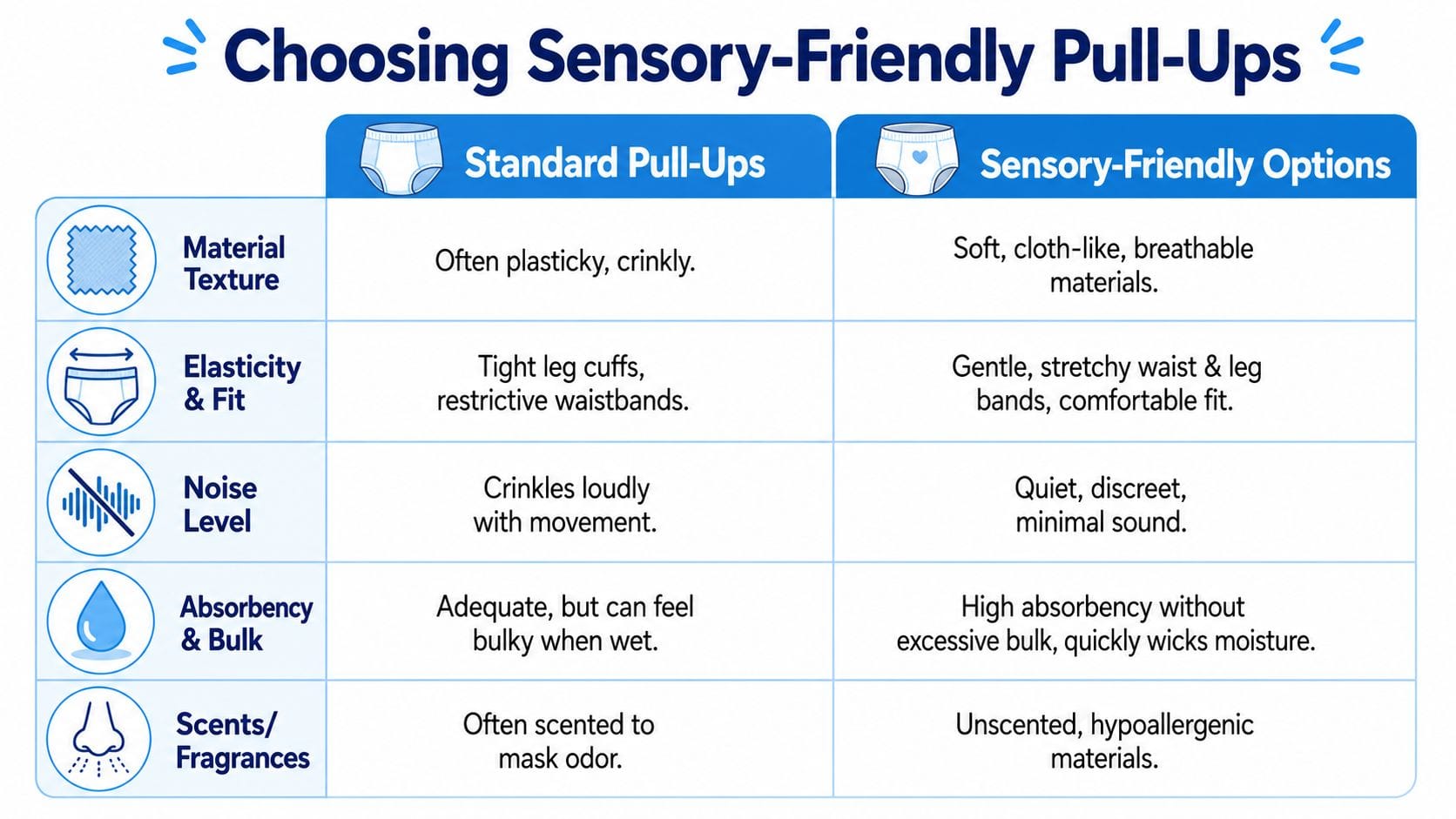
A simple comparison that helps
| Feature | Standard pull-ups | Sensory-friendly options |
|---|---|---|
| Material feel | Can feel plasticky or crinkly | Softer, cloth-like surfaces tend to be easier to tolerate |
| Waist and leg fit | Some children experience pressure from tighter elastic | Stretchier, gentler bands may reduce resistance |
| Noise | Movement can create noticeable rustling | Quieter construction helps with discretion |
| Bulk when wet | Some products feel heavy or puffy | Better designs balance absorbency with lower bulk |
| Scent | Added fragrance can bother smell-sensitive kids | Unscented options are often easier to accept |
What tends to work better
When I help families sort products, I tell them to rank the decision in this order:
- Can my child stand wearing it? If the answer is no, the absorbency rating doesn't matter.
- Does it fit like underwear instead of equipment? Discretion matters at sleepovers.
- Will it hold through the night my child has? Not the ideal night. The genuine one.
For many families, the best choice is the product that causes the least friction at bedtime while still offering solid overnight protection. If you want to support the rest of the sleep setup around that choice, this guide to a sensory-friendly sleep environment is a practical next step.
The Practice Run Preparing for the Big Night
The sleepover should never be the first trial. If a child is going to notice every seam, shift, or waistband squeeze, you want that to happen at home, not in someone else's guest room.
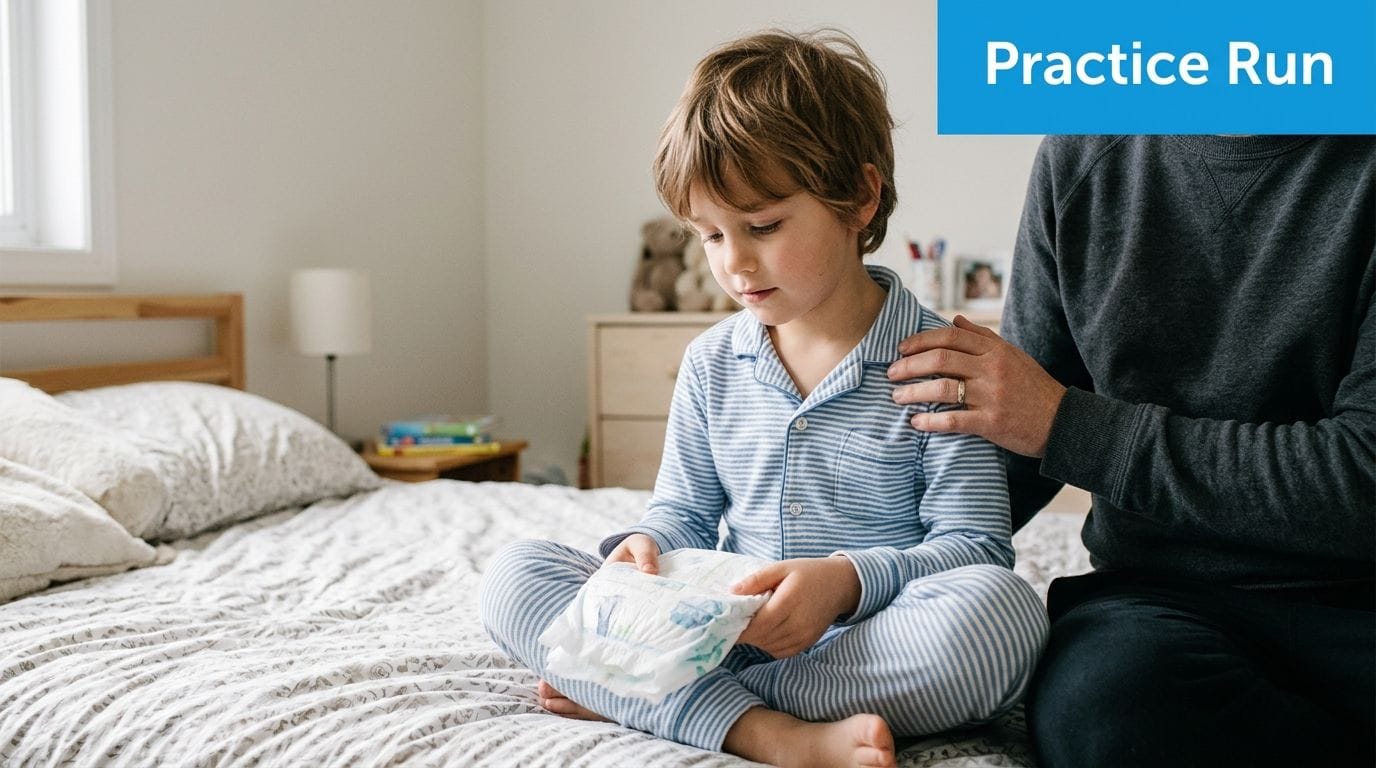
Start before the sleepover
A practice run works best when it feels ordinary. Not clinical. Not loaded.
Try a short home rehearsal over a few evenings. You might do popcorn in the living room, pajamas a little later than usual, a sleeping bag on the floor, and the exact nighttime product your child will use away from home. The point is familiarity.
A simple sequence often helps:
- Show the product in daylight: Let your child touch it, stretch it, and ask questions.
- Pair it with a preferred routine: Favorite blanket, same bedtime song, same body lotion, same order.
- Test movement before bed: Walk, climb into bed, curl up, and notice what feels off.
- Debrief in the morning: Ask concrete questions like “Was the waistband okay?” instead of “Did you like it?”
Practical rule: If your child complains about a sensory detail at home, believe them. It usually gets harder, not easier, in a new house.
Later, you can build in other sleep supports. Families looking for steadier evenings often benefit from a more structured sleep routine for nonverbal kids, especially when changes in environment tend to ripple into bedtime resistance.
Rehearse the change routine
The other piece to practice is what happens if a change is needed. Keep it brief and low emotion. Products like SleepOvers include tear-away sides, which can allow a quicker change without removing pants, and one source describes this as reducing nighttime care time by an estimated 30% in routines where speed and predictability matter, according to Aeroflow Urology's video on SleepOvers pull-ups.
That feature is useful for two reasons. It lowers disruption, and it preserves dignity. A child who doesn't need to fully undress may feel much calmer during a nighttime change.
A short visual demonstration can help if your child learns best by seeing the sequence first.
Don't over-rehearse. If practice starts feeling tense, stop and return to it later. The goal is “no big deal” energy.
Packing the Sleepover Bag with Confidence
A well-packed bag reduces parent worry and gives the child a quiet sense of control. The best version is not a giant announcement in luggage form. It's a compact, private setup they can recognize and manage.
Build a private go-kit
Put nighttime items in a separate zip pouch or toiletry bag inside the main overnight bag. That keeps the routine discreet. It also means your child doesn't have to rummage around in front of peers.
If your family already struggles with bags becoming a jumble of clothes, wipes, snacks, and backup items, this article on how to streamline your on-the-go tote has good organizing ideas you can adapt for a sleepover kit.
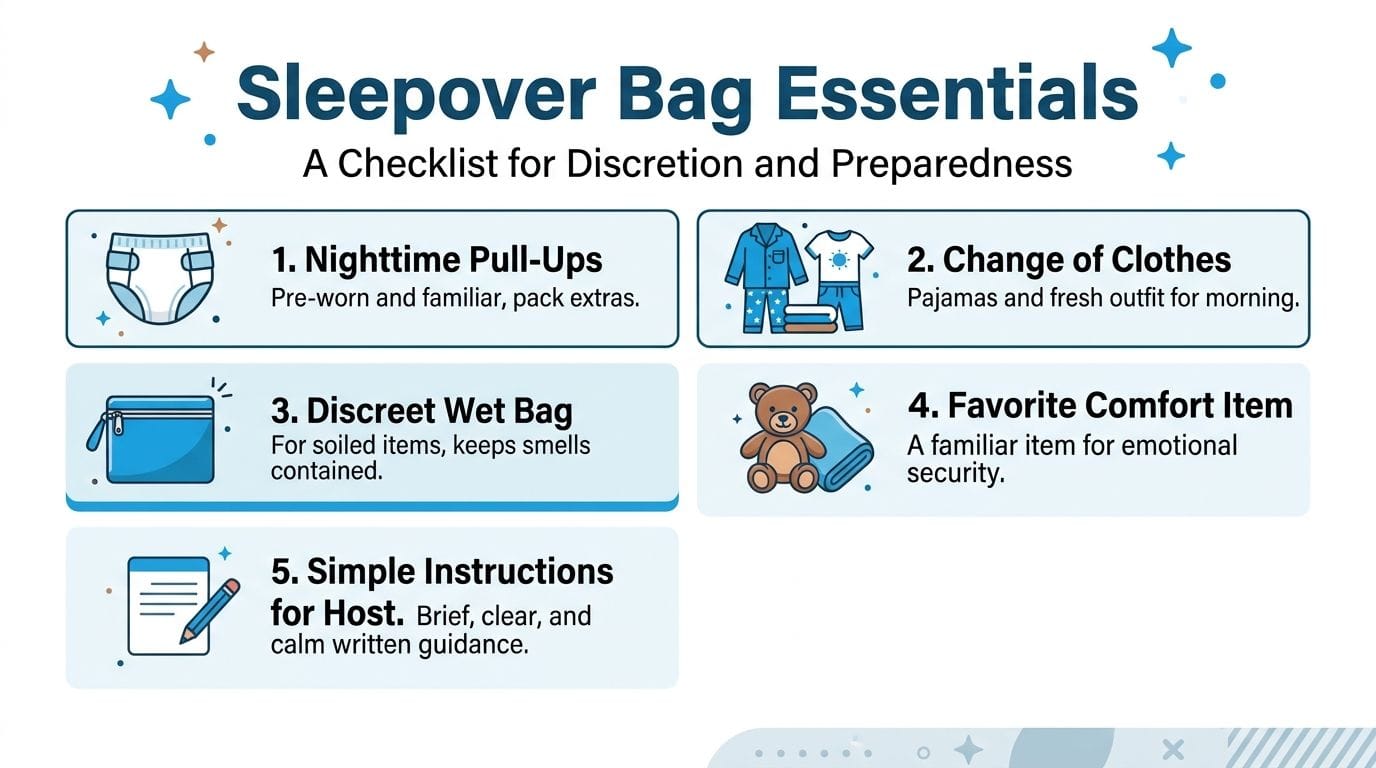
What to include and why
I recommend packing with one principle in mind. Assume your child will be tired in the morning and won't want to problem-solve.
- Nighttime pull-ups: Pack the exact product already used in practice. Add extras.
- Fresh pajamas and underwear: Morning confidence matters as much as overnight protection.
- A discreet wet bag: A sealable pouch for soiled clothing or a used pull-up makes cleanup much easier.
- Wipes or washcloths: Helpful for quick refreshes.
- Comfort item: A small blanket, stuffed animal, or familiar pillowcase can steady the whole routine.
- Brief written instructions: Keep them short enough that another parent can scan them half-asleep.
Pack for privacy, not secrecy. Your child should know exactly where everything is, but they shouldn't feel exposed.
Some older children like to “own” the kit themselves. That can be powerful. It shifts the message from “I packed this because something might go wrong” to “I know how to take care of my night routine.”
Communicating Clearly with the Host Family
For many parents, this is the hardest part. Not because the logistics are impossible, but because the topic can feel vulnerable.
A calm, direct conversation usually lands better than a long explanation. You don't need to apologize. You don't need to overdisclose. You only need to share what helps your child get through the night comfortably.
Keep the conversation simple
Many children with autism stay in pull-ups or youth pants beyond age 6, and that longer timeline is one reason families often benefit from routine tracking and behavior logging tools over time, as discussed in Autism Parenting Magazine's article on finding big-kid diaper protection that fits. That reality is more common than many host families realize.
Start from that quiet confidence. This is a care need, not a character issue.
A useful structure is:
- Lead with logistics: “Just one bedtime detail so the night goes smoothly.”
- State the routine clearly: “They wear a nighttime pull-up and keep supplies in a small pouch.”
- Say how much help is needed: “Usually none, but here's what to do if they ask.”
- Keep the response easy: “No big deal if not. We can always plan a late pickup instead.”
A script that sounds natural
You can say something like this:
“I wanted to mention one bedtime routine item. My child wears nighttime protection for sleep, and I've packed everything in a small zip bag. They're used to handling it, but I included a short note just in case. I just like host parents to know so nothing feels confusing in the morning.”
That framing does three things well. It normalizes the need, gives the host an action plan, and signals trust without handing them a medical file.
If communication is generally hard for your child, it can also help to strengthen the broader toolkit you use for expressing needs. This guide on autism communication strategies offers useful approaches for helping other adults understand and respond more clearly.
Your Partner in Parenting Milestones
A successful sleepover isn't just about staying dry. It's about helping your child participate in ordinary childhood moments with a little more confidence and a little less fear.
The families who do this well usually focus on the basics. They choose a product their child can tolerate. They practice before the big night. They pack with privacy in mind. They give the host just enough information to be helpful. None of that is dramatic. That's why it works.
There's also a bigger takeaway here. Supporting sleepovers pull ups well means supporting regulation, dignity, and social belonging at the same time. That's skilled parenting.
Frequently Asked Questions About Sleepovers
Even with a solid plan, a few hard questions tend to stick around.
What if my child refuses the pull-up that night
Don't turn the moment into a battle. If refusal happens, step back and ask what changed. Is it the feel, the sound, the smell, the setting, or the fact that friends are nearby?
Existing product guides often focus on absorbency, yet parents of neurodivergent children are more concerned with skin irritation and sensory overload. 70% of children with autism have heightened tactile sensitivity, according to Aeroflow Urology's guide to kids pull-ups. If your child refuses, the barrier may be sensory first and practical second.
Try this sequence:
- Lower the pressure: Move to a private bathroom or bedroom.
- Offer one concrete choice: “Do you want to put it on now or after brushing teeth?”
- Reduce sensory load: Dim lights, lower noise, switch to familiar pajamas.
- Use the practiced script: Repeat the same short phrase you used during home rehearsals.
What if there is an accident at the host house
Keep your response brief and warm. The host does not need a big apology performance, and your child does not need a postmortem before breakfast.
A practical response is to thank the host, handle cleanup calmly, and speak to your child in neutral language. “That was an accident. We brought what we needed.” That tone protects dignity.
If your family is thinking beyond pull-ups and wants another option for nighttime support at home, this guide on choosing a bed wetting alarm may be useful as part of a broader plan.
What if the host parent seems unsure
Take the pressure off immediately. Some parents are willing but inexperienced. Others are uneasy about overnight care details. Either way, offer an easier version.
You can say, “No problem at all. We can do a late-night pickup, or you can let us know if a future sleepover feels like a better fit.” That gives everyone a graceful exit.
A sleepover is supposed to widen your child's world, not prove a point. If a partial plan works better, use the partial plan.
The win is not forcing the full event. The win is protecting trust so your child wants to try again.
Guiding Growth can help you keep all of these moving parts in one place, from bedtime routines and sleep notes to behavior patterns, sensory triggers, and caregiver communication. If you want a calmer way to prepare for overnight events and track what works for your child, explore Guiding Growth.