You're halfway through a school pickup conversation when your child suddenly goes rigid, covers their ears, and bolts for the car. The teacher looks worried, another parent stares, and you're trying to decide whether this is a meltdown, a bad mood, or something you should have prevented. That moment feels personal, but it's usually a sign that autism and stress are colliding with a day that has become too loud, too fast, or too unpredictable.
For many families, the hardest part isn't one obvious crisis. It's the slow build of tiny overloads, missed cues, unclear expectations, rushed transitions, and everyone trying to keep up. Stress in autism often shows up as a coordination problem, because the child's nervous system, the home routine, the classroom, and the therapy schedule all affect one another.
Table of Contents
- The Overlooked Reality of Autism and Stress
- How the Autistic Stress Response Works
- The Most Common Stress Triggers in Daily Life
- Recognizing Stress Before It Becomes a Meltdown
- Evidence-Based Strategies That Actually Reduce Stress
- Tracking What Works So You Stop Guessing
- Stress Is Not the Same as Anxiety
- When to Get Professional Help and What to Ask For
The Overlooked Reality of Autism and Stress
A parent can spend the whole morning doing everything right, packing the preferred snack, warning about the schedule change, and skipping the noisy grocery store. Then one small surprise, a substitute teacher, a missed bus, or a sibling touching the wrong toy, and the whole afternoon unravels. That's not a moral failure. It's what stress looks like when a child has to work harder to process the same day other children move through with less strain.
The important shift is this, stress is observable data, not a character judgment. In autistic adults, a major study found much higher stress than in healthy volunteers, with perceived stress averaging 3.63 vs 1.73 and observed stress 2.76 vs 1.41, and the authors reported large effect sizes for the differences, including Cohen's d = 1.50 for composite stress, 1.38 for observed stress, and 1.18 for perceived stress (PMC4412754). The same paper linked greater stress with weaker social functioning, which helps explain why stress can spill into friendships, classrooms, and family life.
The burden lands on the child and the caregiver
Caregivers carry a second layer of stress that often gets missed. Families are not just responding to behavior, they're coordinating schools, therapies, medications, sleep routines, and expectations from relatives who may not understand what's happening. A guide to caregiver burnout causes and solutions can help parents recognize how easily that load builds.
Practical rule: When stress keeps showing up in the same settings, treat the setting as part of the problem, not just the child.
That's why the best starting point is to widen the lens. Instead of asking, “What's wrong with my child?”, ask, “What keeps overloading this system?” Once you look at autism and stress that way, the next steps become clearer, and a lot less blame-filled.
How the Autistic Stress Response Works
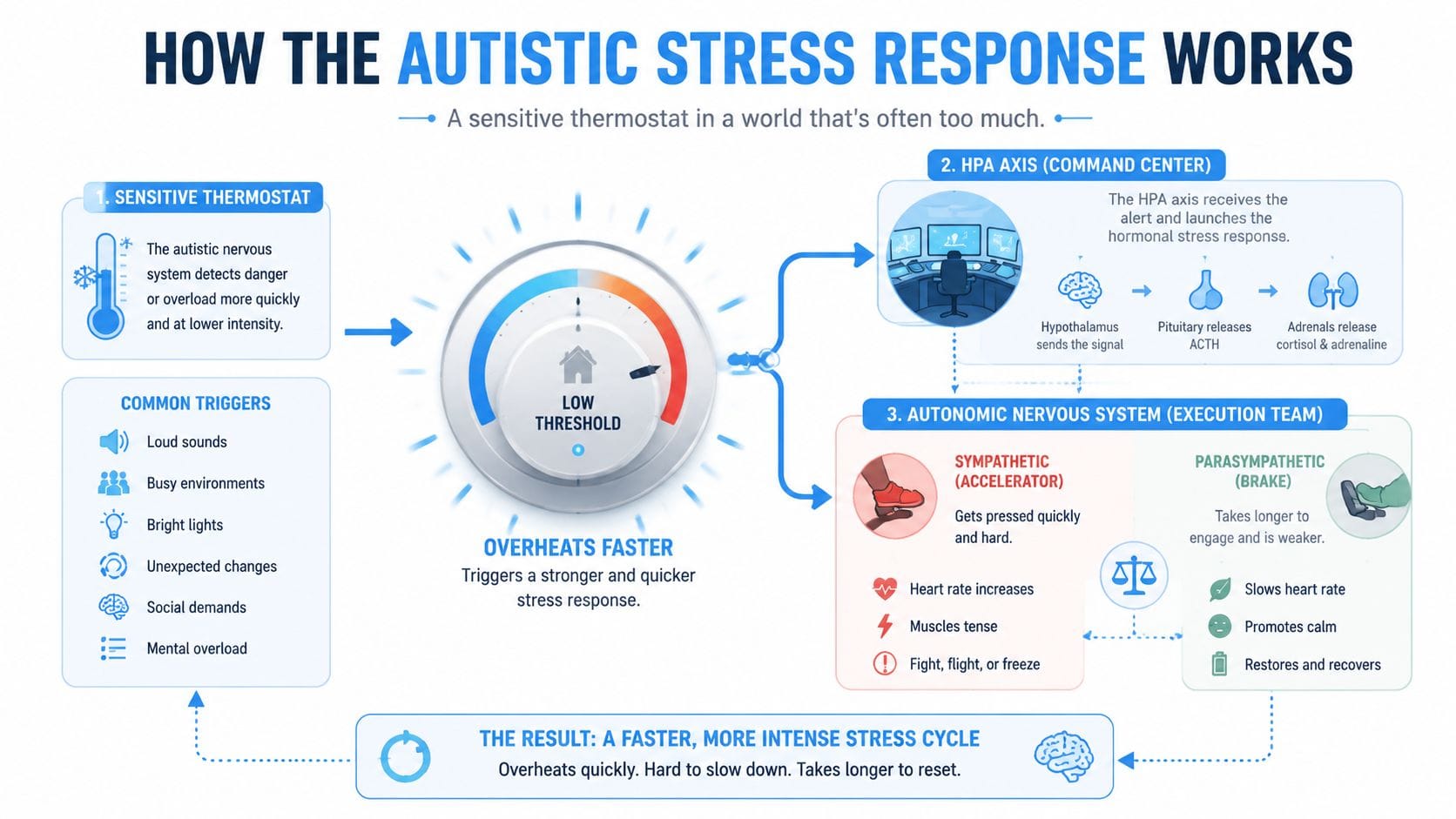
The simplest way to understand the biology is to think about a thermostat. In many autistic children, the thermostat seems more sensitive, flips on faster, and takes longer to settle back down after the room cools. That doesn't mean the child is choosing drama. It means the body is reacting as if the demand is bigger than it looks from the outside.
The HPA axis and the autonomic nervous system
Two systems matter most here. The HPA axis is the body's command line for stress hormones, including cortisol. The autonomic nervous system manages the “accelerator” and the “brake”, the sympathetic side that speeds things up, and the parasympathetic side that helps the body settle.
A review of autism stress physiology describes this as dysregulated HPA-axis and autonomic nervous system reactivity, not one simple cortisol pattern. It reports higher cortisol reactivity in school-aged autistic youth during naturalistic social interaction, reduced parasympathetic regulation at rest, and increased sympathetic responses to both social and non-social stressors (PMC11450691). In plain language, the stress system can turn on quickly and come down inefficiently.
One pediatric study found significantly higher peak cortisol and prolonged cortisol elevation in children with autism after a blood-stick stressor, suggesting less efficient negative-feedback control of the HPA axis (PMC3245359). That's why a child can seem “fine” during the trigger and only fall apart later, once the body can no longer keep up.
What parents can watch for
A body that's running hot often leaves clues before behavior changes. Breathing gets shallow, movement gets tighter, voice gets flatter or louder, and the child may need more space than usual. In some children, the stress sign is not panic, it's quiet withdrawal.
You don't need to guess the exact hormone pattern at home. You do need to notice when the child's body is acting like it can't reset.
That distinction matters because support works better when it starts early. If the thermostat is already spiking, you're not dealing with a choice, you're dealing with overload.
The Most Common Stress Triggers in Daily Life
The triggers that matter most are often ordinary things other people stop noticing. Bright lighting, layered noise, and crowded rooms can all pile onto a nervous system that already works hard to filter the world. A child may not say “the lights are hurting me”, but the body may show it in avoidance, pacing, or a sudden need to leave.
Sensory and environmental triggers
Fluorescent lights, echoing hallways, hand dryers, cafeteria noise, and strong smells can push a child into stress before anyone else in the room has a clue. What feels like background clutter to adults can feel invasive to a child who has to process every detail at once. In those moments, the problem is not defiance, it's overload.
Social and communication triggers
Some children are stressed by the rules people never say out loud. They may hear, “Be polite,” “Use your words,” or “Look at me,” while also trying to decode tone, timing, and facial expression. Social masking, keeping up a calm face while struggling internally, can drain energy quickly and make later shutdowns more likely.
Transitional and unpredictable triggers
Sudden schedule changes, a substitute driver, a canceled appointment, or “one more stop” after the child was told the day was ending can hit hard. Uncertainty adds work because the child has to keep re-planning in real time. That's one reason transitions often trigger distress even when the new activity is pleasant.
The Most Common Stress Triggers in Daily Life infographic fits neatly here as a quick family audit tool.
A practical way to use this is to trace one hard day backward. Start with the room, then the conversation, then the transition. The trigger is often obvious once you stop looking for a single big event and start noticing the stack.
Recognizing Stress Before It Becomes a Meltdown
The clearest signs of stress are often mistaken for behavior problems. A child who begins to repeat a phrase more often, flap their hands more intensely, or avoid a demand may be signaling overload, not stubbornness. If the adult response is correction alone, the child usually gets more stressed, not less.
Early cues are data, not misbehavior
Echolalia can rise when a child is trying to regulate or buy time. A child who suddenly goes quiet may be moving toward shutdown, especially if they were talkative earlier. Demand avoidance can be a protective response when the brain has already used up too much energy and can't absorb another request.
Meltdowns look different. They tend to be louder, more visible, and harder to interrupt once the threshold has been crossed. By the time the child is crying, yelling, or collapsing, the stress response has usually been building for a while.
A simple observation habit
Write down what happened right before the cue appeared. Note the noise level, who was present, what demand was introduced, and how long the child had been trying to cope. That short chain often reveals a repeat pattern more clearly than memory does.
If you can identify the three minutes before the rupture, you can often change the next one.
Parents begin shifting from reacting to preventing. Once early signs are visible, the next step is to reduce the load before the system tips over.
Evidence-Based Strategies That Actually Reduce Stress
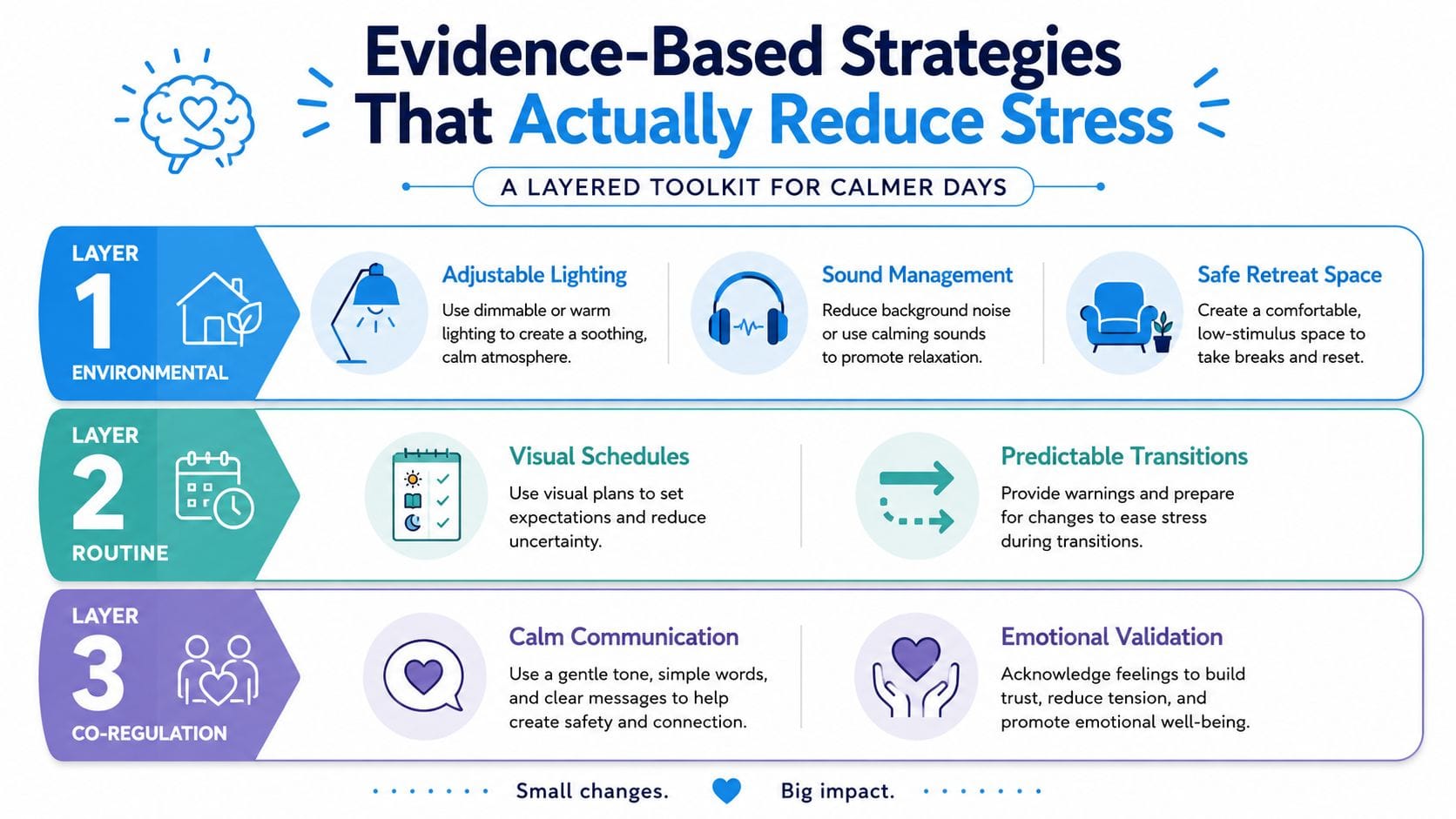
The most useful strategies are the ones that change the child's load in real life, not just in theory. Environmental changes, predictable routines, sensory supports, and calm communication work best when they're layered together, because stress in autism usually comes from more than one direction at once.
Start with the environment
If lighting is a problem, swap harsh overhead light for a lamp or dimmer space when you can. If noise is the issue, try noise reduction, a quieter corner, or a short retreat spot the child can use without asking permission every time. A safe space works best when it's treated as recovery, not punishment.
Make time more predictable
Visual schedules, simple previews, and transition warnings reduce the burden of constant re-orienting. A child who can see what comes next spends less energy scanning for surprises. Use the same language each day, then keep the sequence short and concrete.
Support the body and the conversation
Movement breaks, heavy work, deep pressure, or other sensory input can help some children settle, but the key is to watch the child's response instead of assuming one sensory tool works for everyone. Communication matters just as much. Give one direction at a time, wait longer than you think you need to, and use direct language instead of hints.
For families who want a broader overview of physiology-focused stress reduction, how to reduce high cortisol offers another helpful lens on sleep, routine, and recovery. For de-escalation support in the moment, 7 de-escalation techniques for autism meltdowns can be a practical companion.
Here's a simple same-day example. If your child melts down after school, try a predictable landing routine, snack first, quiet time second, questions later. If the child calms faster, you've learned something concrete about timing and regulation.
The embedded video below can also help families think about calm-down supports in a more visual way.
Tracking What Works So You Stop Guessing
A child gets home from school, drops their backpack, and everything seems fine for ten minutes. Then the crying starts, or the shutdown, or the pace of the evening falls apart. If that happens often, the question is rarely “What went wrong today?” It is usually “What pattern are we missing?”
Tracking is not extra homework. It is how families stop relying on a tired memory that blurs together the hard days and start seeing what repeats over time. One rough afternoon can send you in the wrong direction, but repeated notes about the same trigger, the same time of day, or the same recovery path usually point to a clearer answer.
What to log and why it matters
| What to Log | Why It Matters | Example Insight |
|---|---|---|
| Meltdowns and shutdowns | Shows which situations push the child past their limit | The hardest moments happen after school, not in the morning |
| Demand avoidance and echolalia | Helps separate stress signals from deliberate refusal | Repeating phrases increases when instructions come too fast |
| Sensory inputs | Links behavior to noise, light, touch, or crowding | Grocery trips go better in quieter stores |
| Sleep and routines | Sleep disruption often changes tolerance for stress | A rough night makes transitions harder the next day |
| Diet and appetite | Skipped meals can lower coping capacity | The child is more reactive when they haven't eaten enough |
| Transitions and appointments | Reveals where coordination strain is building | Therapy days need more recovery time afterward |
| Outcomes | Shows what actually helped the child settle | A quiet room works better than repeated verbal prompts |
The goal is to find within-person patterns, not to compare your child with anyone else. One family may learn that lighting matters most. Another may notice that the pressure point is the handoff between school and home, which makes the whole evening fragile. That difference matters because stress often travels through the day like a loose thread, and if you pull on the wrong part, nothing makes sense.
Guiding Growth fits this kind of tracking well because the behavior tracking app centralizes behavior logs, context, sleep, nutrition, appointments, and shared notes in one place, and it includes quick voice logging for busy parents. That matters because caregiver stress grows when information lives in too many places, and co-parents, therapists, and clinicians cannot see the same picture.
A log is useful when it helps the next adult respond better.
That shared picture lowers the coordination burden. It also makes appointments more productive, because you are bringing patterns instead of a stack of worries.
Stress Is Not the Same as Anxiety
Parents often get told to treat every distressed behavior as anxiety, but that shortcut hides important differences. Stress is often tied to a specific demand, environment, or transition. Anxiety is more persistent and may need a different kind of clinical attention.
A study on autism and anxiety found a lack of association between stress and anxiety in both autistic and typical-development groups, and concluded they should be treated as separate constructs rather than synonyms (PMC3586791). That matters because a child can be highly stressed without meeting criteria for an anxiety disorder.
The practical question is not, “Does this child have the right label?” It's, “What does the pattern tell us?” If the child only struggles in loud hallways, during abrupt change, or when instructions stack up too fast, tracking those triggers may be more useful than debating terminology.
When you talk with professionals, bring the context. Ask what happens before the distress, what helps it resolve, and whether the reaction looks situational, persistent, or both. That gives clinicians a better starting point and gives parents a clearer map.
When to Get Professional Help and What to Ask For
Escalate when the stress pattern keeps growing, not when you've already run out of options. If meltdowns are becoming more frequent, shutdowns are getting deeper, sleep is sliding, participation is shrinking, or caregiver burnout is becoming constant, it's time to bring in support. The same is true when stress follows the child across every setting, home, school, therapy, and community.
You'll usually start with a pediatrician or developmental specialist, then add an occupational therapist for sensory needs, a psychologist trained in autism, and speech or behavior support as appropriate. If you're looking for regional service navigation, the guide to autism services in Italy can help families think about what to ask for and how those services are organized.
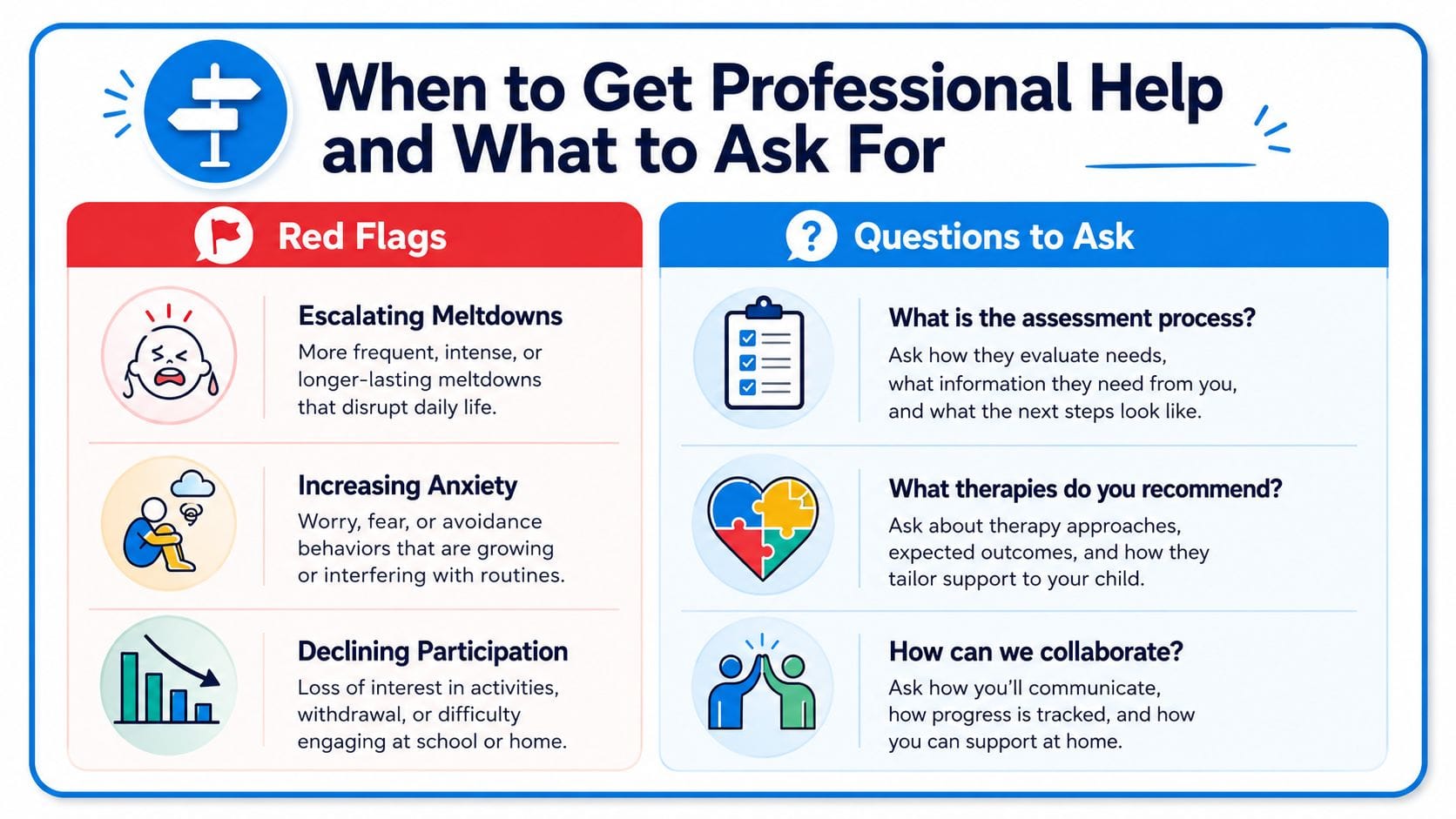
Bring a short log of triggers, recovery time, sleep, and the situations that seem to drain your child most. Ask providers how they assess sensory stress, how they coordinate with schools, and what they want caregivers to track at home. Those questions keep the visit focused on action, not just labels.
Guiding Growth helps parents centralize meltdowns, shutdowns, sleep, nutrition, appointments, and context in one shared place, so stress patterns don't get lost between caregivers and professionals. If you're tired of guessing, Guiding Growth gives you a structured way to track what happens, spot triggers, and bring clearer information to every conversation about your child's care.