You're standing in the kitchen, answering one text about a refill, checking the school portal for a therapy update, and trying to remember whether the strange shutdown after dinner happened before or after the noisy bus ride. The house is finally quiet, but your head isn't. That's the part people miss about caregiving, the care itself is only half the job, the rest is remembering, coordinating, documenting, and trying not to drop anything while you're already tired.
That's why family caregiver support can't be treated like a single favor or a one-time break. It has to work like a system that helps with the emotional load, the practical load, the money questions, the legal paperwork, and the medical coordination that never seems to end. For parents of autistic and neurodivergent children, and for the adults who do most of the daily tracking, that system matters even more because so much of the work stays invisible.
Table of Contents
- What Family Caregiver Support Really Looks Like Today
- The Five Core Types of Caregiver Support
- Why Caregiver Support Is Now a Mainstream Concern
- Finding and Accessing the Right Support Services
- Real Scenarios Where Support Comes Together
- Self-Care and Coordinating With Your Care Team
- Apps and Tools That Make Daily Care Less Chaotic
- Building Your Own Caregiver Support Plan
What Family Caregiver Support Really Looks Like Today
Tuesday starts before anyone feels ready. A medication refill still needs attention, the pharmacy was out, the doctor's office has not called back, and the parent who usually keeps everything moving was up late with a child who did not fall asleep until after midnight. By 8:10 a.m., there is a therapy reminder, a school note that needs signing, and a behavior you still cannot quite explain, except you know it appeared after a change in routine. Then there is the small mercy, the parent finally slept six hours.
That kind of morning is where family caregiver support has to work in real life. It cannot stay a vague promise or a nice idea. It has to be the practical help that keeps one rough day from turning into a full crisis. The latest Caregiving in the U.S. report says 63 million adults now provide care to an adult or child with a medical condition or disability, up from 43.5 million in 2015 and 53.0 million in 2020 (AARP's 2025 caregiving report), which shows this is no longer a hidden family task on the margins.
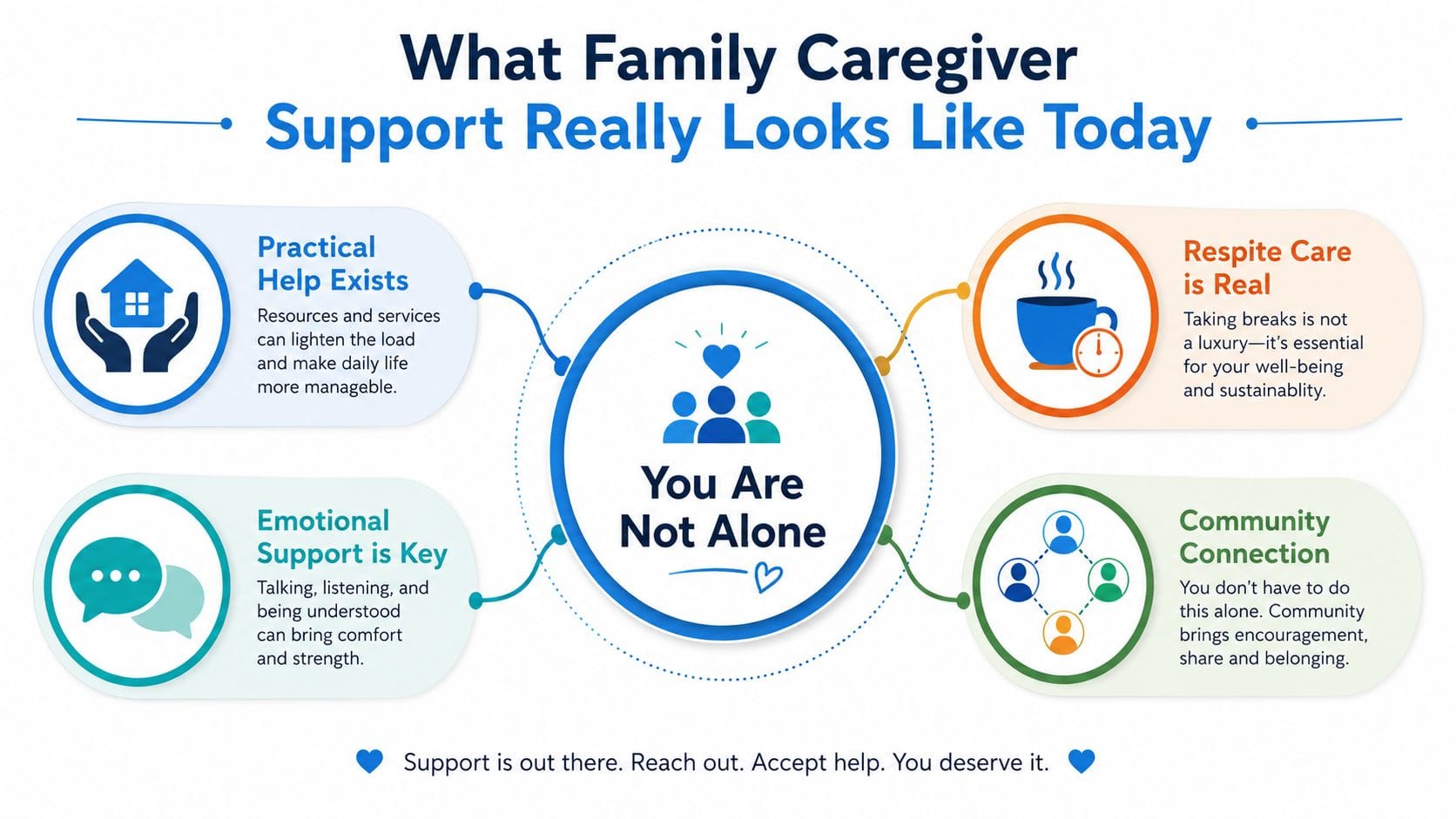
A lot of caregivers still hear the word support and picture a single break. Real support is more like a working system. It brings together emotional support, respite, financial help, legal guidance, and clinical coordination so the load is spread across more than one person. When those pieces show up together, the household gets a little more breathable, and the person doing the tracking does not have to hold every moving part in their head.
Practical rule: if a caregiver is doing all the remembering, all the calling, and all the tracking, support needs to reduce that load, not just acknowledge it.
That rule matters even more in families where autism, ADHD, anxiety, or other neurodivergent needs shape the day. The work can include sensory triggers, medication changes, school meetings, therapy notes, and the constant job of noticing patterns before they become problems. For many parents, especially the ones doing the daily tracking, support has to function like a shared control panel, not another pile of tasks. This guide on building support networks is a useful place to start if your family needs help putting that system together.
The Five Core Types of Caregiver Support
Support gets clearer when you stop treating it like one big bucket. Most exhausted caregivers don't need a lecture, they need to know which kind of help fits the problem in front of them. Think of the five core types as different tools in the same drawer.
Emotional support helps the person doing the caring
This is the part that gets skipped first, even though it's often the most urgent. Emotional support includes counseling, peer groups, and the simple but missing question, “How are you doing?” It matters because caregivers are often not the identified patient, so their strain goes unexamined until it turns into burnout.
A peer group can be as practical as a notebook for your nervous system. You hear what other parents are trying, what they're dropping, and what they've stopped apologizing for. That doesn't solve everything, but it makes the day feel less like a private failure.
Respite support is the pressure valve
Respite is temporary relief, and it's not a luxury. It can mean a few hours, a weekend, or a planned stay somewhere else so the caregiver can sleep, attend an appointment, or stop scanning the room for the next problem. If emotional support helps you keep going, respite helps you recover enough to keep going safely.
Financial support lowers the constant leak
Caregiving often drains money in small, repeated ways, gas, supplies, transportation, parking, co-pays, missed work, and the endless purchases that never feel optional in the moment. Financial support can include paid leave where it exists, tax help, and other ways to reduce out-of-pocket strain. A caregiver who is already exhausted should not also have to guess which bills are a crisis and which are a pattern.
Legal support keeps the paperwork from becoming a barrier
Legal support includes powers of attorney, guardianship when needed, benefits navigation, and paperwork tied to school or care plans. The point isn't paperwork for its own sake, it's making sure the right adult can act when decisions need to be made. If a sibling, partner, or relative is helping, legal clarity can prevent a lot of confusion later.
Clinical support turns care into something teachable
Clinical support covers skills training, telehealth, and better coordination with doctors, therapists, and other professionals. It's the difference between “good luck” and “here's how to do this safely.” In practice, it often looks like asking for demonstration, written instructions, or a follow-up visit that includes the caregiver, not just the person receiving care.
Why Caregiver Support Is Now a Mainstream Concern
The hard part is no longer whether caregiving matters. It is whether a household can keep all the moving parts from colliding. Caregiving now shapes work schedules, school routines, medication tracking, transportation, and the emotional tone of the whole home, so support has to work like a coordinated system, not a pile of disconnected favors.
The scale of the work helps explain why. Caregiving is no longer a niche family issue. The 2025 report shows a sharp rise in the number of caregivers over the last decade, and it now touches almost one-quarter of U.S. adults, which means care is part of ordinary family life, not a rare exception. One person may be tracking prescriptions, another may be handling rides, and a third may be trying to remember forms, passwords, or appointment times. That is a lot to hold in one head, especially for parents who already do most of the daily tracking themselves or for neurodivergent caregivers who spend extra energy just keeping the day organized.
The time burden is already close to a job
The Caregiver Action Network says the average family caregiver spends about 25 hours per week on caregiving, and 25% devote more than 40 hours weekly (Caregiver Action Network caregiver statistics). That is why so many caregivers feel like they are working a second shift before the day is over. In plain language, caregiving is often not a side task, it is a regular workload layered on top of paid work, parenting, and household management. The same source estimates average out-of-pocket spending of about $7,200 per year, which helps explain why one missed shift, one repair, or one medical bill can throw the whole week off balance.
The economic value is hard to ignore
AARP estimates that 59 million caregivers of adults provided 49.5 billion hours of care in 2024, with an average value of $20.41 per hour, producing a total economic value of $1.01 trillion for adult caregiving that year (AARP's 2026 update). That figure does not turn caregiving into a business transaction. It shows that the work is large enough to shape the wider system around it, from hospitals to schools to employers, and families should not be expected to absorb all of that pressure alone.
Some of that pressure is invisible until it starts breaking routines. A school office may need a form signed, a clinic may need a medication list, and a relative may need to know who can make decisions if the primary caregiver is stuck at work. If the family also needs help coordinating outside support, clear screening matters too, including practical steps such as background checks for nonprofits when outside helpers, volunteers, or respite support are part of the plan.
The practical takeaway is simple. If caregiving feels overwhelming, that is not proof that you are failing. It is proof that the role is bigger than one person, one phone, or one notebook can hold. A workable support plan has to fit the way your household runs, including the memory load, the emotional load, and the small tasks that never look important until they are missed.
Finding and Accessing the Right Support Services
A family can know support exists and still feel stuck at the point where somebody has to make three calls, fill out one form, and wait for a reply that never comes. That gap is common. The hard part is not just finding services, it is matching the right service to the actual problem in the house, then getting one person or one system to keep the pieces together.
Start with the gap, not the menu
The first step is to name the strain that is driving the week. Maybe it is emotional overload, maybe respite is missing, maybe the budget is too tight, or maybe school, therapy, and medical messages are piling up faster than anyone can sort them. Once that gap is clear, the request becomes sharper, and the odds of getting useful help go up.
A national entry point is the National Family Caregiver Support Program, which supports services such as respite care, counseling, support groups, and training for family and informal caregivers. The program's own guidance describes five service types, information, access assistance, counseling and support groups, respite care, and limited supplemental services. Its page also explains that ACL's NFCSP page is meant to help families understand what may be available, and it notes that more than 700,000 caregivers received services in FY 2014, with nearly 62% said that without those services the care recipient would have been living in a nursing home.
For many households, that kind of program works like a front desk for a crowded clinic. You do not need every answer at once. You need someone who can point you to the right door instead of sending you back to the waiting room with a brochure.
Ask for a warm handoff, not a pamphlet
When you call an agency, clinic, or school office, ask who can stay with the request until it reaches a real person. A pamphlet gives information. A warm handoff gets action started. That distinction matters when a tired parent is already juggling memory work, forms, and follow-up calls.
If a nonprofit or community program will be involved, ask about background checks for nonprofits before any volunteer or outside helper steps in. Families need to know who is coming into the home, who has access to the child, and who is responsible if plans change at the last minute.
A simple script helps keep the conversation focused. “I'm caring for a child with high daily needs. Which services help with respite, training, or care coordination, and who can connect me to the next step?” That wording does something important. It turns vague sympathy into a request that can be routed.
Use telehealth when the barrier is access
Telehealth helps when driving, scheduling, or childcare makes an in-person visit hard to pull off. A systematic telehealth review looked at 65 studies and found that 95% reported significant caregiver outcome improvements from telehealth-based support, especially in areas like anxiety, depression, stress, burden, irritation, and isolation. The bigger lesson is plain enough. Caregiver support only helps if the family can realistically use it on an ordinary Tuesday, not just on a day when everything else is already going right.
Telehealth can also be easier for caregivers who carry a heavy tracking load, including parents who keep the calendars, medication notes, and school messages in their own head. A video visit cuts down on the number of moving parts. For a parent who gets overloaded by phone trees or waiting rooms, that reduction can make the difference between getting help and putting it off.
For parents who are also trying to coordinate child care needs, this child care support services resource can help them figure out what to ask for and when. It is especially useful when the problem is not one service alone, but the way school, care, and home responsibilities keep colliding.
Real Scenarios Where Support Comes Together
A parent of an autistic child may start the week with a school meeting, a therapy update, and a new behavior to track. The most useful support isn't one thing, it's a combination. Emotional support might mean a condition-specific peer group, clinical support might mean a telehealth visit with the therapist, and practical support might mean a relative handling pickup so the parent can process the meeting notes.
Another family might be caring for a parent with early dementia. The adult child may need legal support first, because decisions and paperwork are already getting messy. A shared notes system with siblings can reduce conflict fast, especially when one sibling lives nearby and another only sees the problem after the fact. Telehealth can help here too, since caregiver-focused virtual support has been linked to better psychological outcomes in the earlier evidence base.
A spouse supporting a partner after a serious illness often looks “fine” from the outside and completely maxed out at home. That spouse may not need more advice, they may need respite, financial guidance, and a plan for who covers meals or transportation this week. One smart move is to ask the clinician, “Who on this team can help my spouse as the caregiver, not just the patient?”
Practical rule: if two people in the home are carrying the same burden silently, the household needs shared visibility before it needs more effort.
What ties these scenarios together is that the right mix rarely feels obvious in the moment. The caregiver who joins a peer group, asks for one telehealth visit, or sets up a shared family note on Sunday night is usually doing something far more powerful than “coping.” They're building support into the week where it can be used.
Self-Care and Coordinating With Your Care Team
Self-care gets talked about like a spa day, but caregivers need it treated like maintenance. NIH's NCBI review says family caregivers of older adults have higher rates of depressive symptoms, anxiety, stress, and emotional difficulties, along with lower self-rated physical health, raised stress hormones, and poorer health behaviors than non-caregivers (NIH review). That's why caregiver health can't be optional or postponed until the schedule clears up, because the schedule usually doesn't clear up.
Protect your own health like it's part of the care plan
Start with the basics that are easy to delay and costly to skip, your own doctor visits, sleep, meals, and exercise. A caregiver who stops getting checked, stops resting, and stops eating on time doesn't become “more committed,” they become less able to make good decisions. If you're noticing rising irritability, brain fog, or a shorter fuse, treat that as data, not a personality flaw.
A short, honest note to yourself can help, “My health is part of the system my family relies on.” That's not self-indulgent. It's operational truth.
Build a team with visible roles
The fastest way to reduce friction is to stop letting everyone assume someone else remembered it. A shared digital calendar, a list of who handles what, and a quick weekly check-in can prevent a lot of last-minute panic. This is the kind of coordination that keeps one person from becoming the permanent emergency manager.
If you need a practical lens on burnout warning signs, the guide to caregiver burnout for Texas families is a useful reference for spotting trouble early. Burnout doesn't always look dramatic, sometimes it looks like silence, numbness, or a parent who can't remember the last time they felt rested.
For many families, the missing piece is a shared record that keeps siblings, partners, and paid helpers on the same page. That is also where this self-care resource for caregivers can help you turn vague advice into a routine that fits a tired week.
Apps and Tools That Make Daily Care Less Chaotic
The best caregiver tools don't add another burden. They remove tiny frictions that keep piling up. A useful app should make it easier to remember what happened, when it happened, and who needs to know, without turning every update into a project.
Look for tools that reduce repetition
Shared timelines help families avoid the “I thought you told her” problem. Behavior and trigger logging helps scattered notes become patterns instead of random memories. Medication reminders, appointment tracking, and secure sharing with clinicians or therapists can all reduce the number of places where important details get lost.
For families who are coordinating school, therapy, home routines, and sleep changes, the value is simple, less hunting, less repeating, less guesswork. If the tool also makes it easy for a grandparent, aide, or sibling to see what's already happened, that's a real coordination win.
Why voice logging and AI matter for tired parents
When typing feels like one task too many, quick voice logging can make the difference between capturing a meltdown in the moment and forgetting the key detail later. AI features can also lower the burden of turning rough notes into something usable. The point isn't novelty, it's reducing the effort needed to keep a family record that helps.
For caregivers who also need live captioning in conversations, find captions for conversations is a practical resource to compare communication tools without wading through fluff. Different households need different tools, but the rule is the same, technology should support attention, not steal it.
Guiding Growth is one example of a tool built around those needs for parents of autistic and neurodivergent children, with behavior logging, shared tracking, and collaboration features designed to reduce the daily scramble. The strongest apps in this space don't replace care, they organize it so the right people can respond faster and with less confusion.
Building Your Own Caregiver Support Plan
A workable caregiver plan does not need to be fancy. It needs to answer three questions: what is hurting most, who can help, and how will we keep the help visible next week? The five categories, emotional, respite, financial, legal, and clinical, give you a clean way to sort the chaos. They work best when you treat them like parts of one system, not separate errands. If one part is missing, the whole household feels it.
Start with one urgent gap in each category, then mark the one causing the most strain right now. After that, choose one action for the week, one call, one form, one support group, or one shared note. Small actions count because caregiving rarely changes in one big leap. It changes through repeated relief, the same way a heavy bag gets easier when one strap is adjusted at a time.
The National Family Caregiver Support Program exists because families asked for help and kept asking until the system had to answer, as noted earlier. That matters for parents who already carry the daily tracking, because support is easier to use when it is treated as part of care, not as an extra favor.
As caregiving stretches across more and more U.S. adults, the families who manage best are usually the ones who coordinate people, programs, and tools into one steady routine. A support plan works like a household map. It shows where the pressure sits, who is covering which task, and where the next handoff needs to happen. That is especially important for neurodivergent caregivers and for the parent who keeps the calendar, the medications, the school notes, and the emotional temperature of the house in their head all at once. When the support is visible, shared, and easy to check, the quiet crisis gets smaller.