You can have a hundred group chats and still feel alone when your child melts down in the grocery store, the sleep routine falls apart at 2 a.m., and the only person who answers your text is your sister, who lives three states away. That's the reality for a lot of parents of neurodivergent kids. The problem usually isn't that people don't care, it's that nobody has been assigned a role, given context, or plugged into a system that provides tangible help.
Building support networks for a neurodivergent child is less about collecting friendly names and more about creating dependable infrastructure. That matters even more now, because U.S. households have become smaller over time, with single-person households rising from 13% in 1960 to 29% in 2022 according to the U.S. Surgeon General's advisory on social connection (HHS advisory). The same advisory notes that from 2003 to 2020, time spent alone increased while in-person social engagement decreased, and loneliness among young adults rose every year between 1976 and 2019 (HHS advisory). For families already juggling therapies, school concerns, and daily regulation, that shift means the old “village” often doesn't exist unless you build it on purpose.
Table of Contents
- Why Most Autism Families Have to Build Their Own Village
- Mapping Your Current Support Network
- Recruiting and Onboarding Your Support Team
- Coordinating Across Home School and Clinical Settings
- Maintaining Your Network Through Privacy Boundaries and Crisis Planning
- Using Guiding Growth to Centralize Communication and Tracking
- Your 30-Day Action Plan for a Stronger Support Network
Why Most Autism Families Have to Build Their Own Village
Monday starts with a missed bus, a therapy cancellation, and a child who refuses socks because the seam feels “wrong.” Tuesday is an IEP meeting where three adults use different language for the same problem. Wednesday brings an ABA session, a call from the school nurse, and a cousin who says, “Let me know if you need anything,” then disappears. By Friday, the emotional load isn't just heavy, it's scattered across too many people who aren't coordinated.
That's why building support networks has to be treated like care infrastructure, not social life. The point is not to have more names in your phone. The point is to have the right people, each with a clear job, a shared picture of the child, and a path for urgent issues when the usual plan breaks down.
Small and reliable beats large and vague
The strongest network I've seen is rarely the biggest one. It's the one where one person knows the school pickup backup, another knows the bedtime routine, and a third knows how to handle a sensory spike without turning it into a power struggle. That's especially important for autism families, where care often crosses home, school, and clinic boundaries.
There's also a practical reason to move away from vague “village” language. Family structure has changed, daily social contact has thinned out, and a lot of parents are trying to coordinate care without the built-in help previous generations relied on (HHS advisory). If your network feels thin, that doesn't mean you're failing. It means you're parenting in a different social environment.
Practical rule: if a supporter can't tell you what they're responsible for, they aren't really in the network yet.
That's the shift. Not more goodwill. More structure. A small, organized support system can absorb a crisis better than a large circle of people who all assume someone else is handling it.
Mapping Your Current Support Network
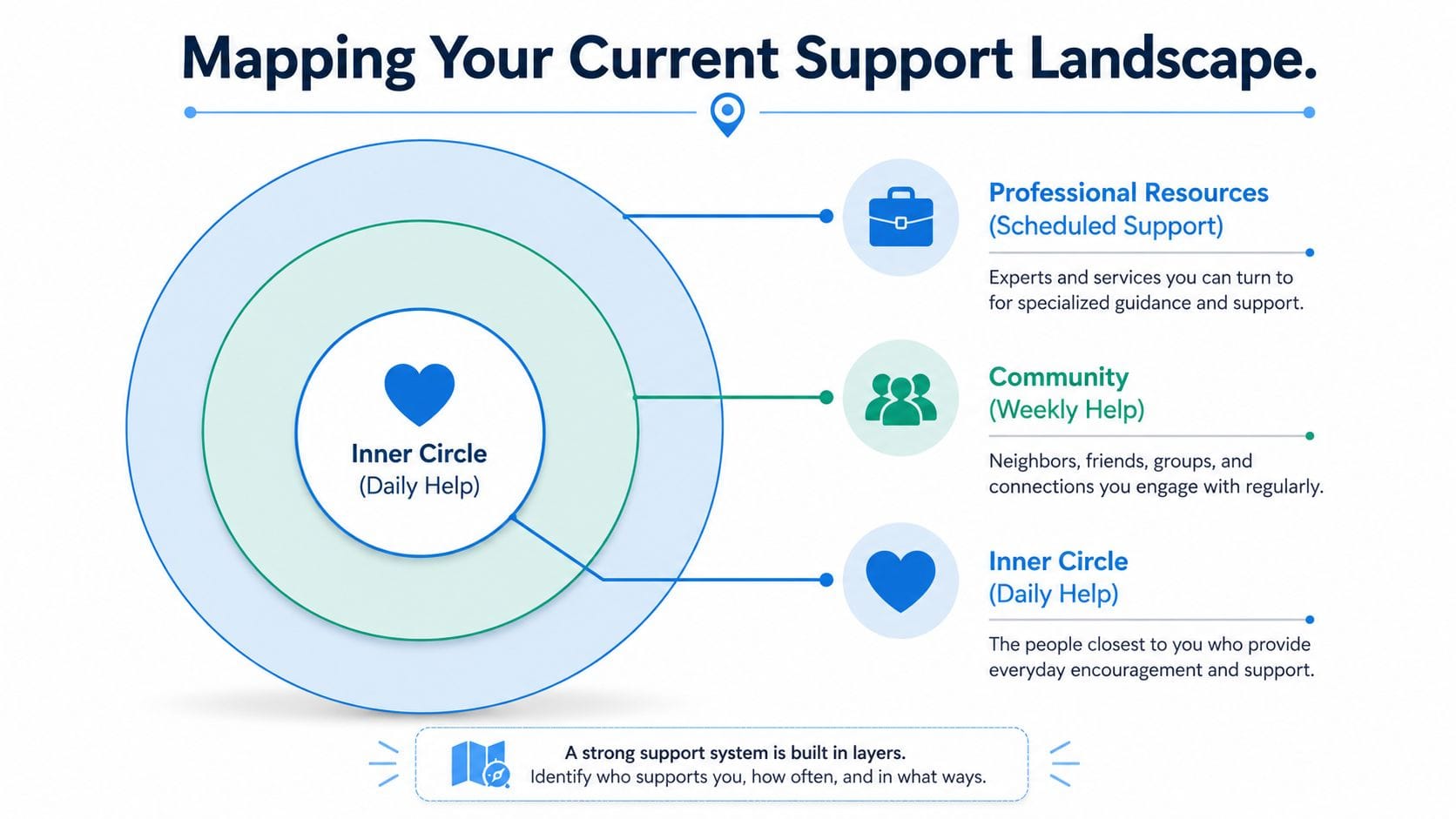
Start by identifying who already has a role in your child's day before you ask anyone for a new one. I use a three-layer view because it keeps expectations realistic. The common layer covers the people involved in daily life, the targeted layer covers smaller groups like school staff or therapists, and the bilateral layer is for one-on-one help when a specific need or emergency comes up. That structure matches the practical network design described in the URBAN ECHO transferability study, which emphasizes a shared layer, targeted support by need, and a bilateral path for specialized help (URBAN ECHO transferability study).
Fill in the map
Take one blank page and divide it into four columns. Then list the people you already know in each category.
- Emotional support: Who can listen without trying to fix everything?
- Practical help: Who can do pickup, meal drop-off, or sibling coverage?
- Clinical expertise: Who understands medication, therapy goals, or regulation patterns?
- Advocacy: Who can speak up at school, in medical visits, or in meetings?
Now add names under two headings, personal contacts and professional contacts. Personal contacts may include family, friends, neighbors, or another parent from extracurriculars. Professional contacts may include a pediatrician, ABA therapist, teacher, occupational therapist, counselor, or behavior specialist. University of Massachusetts Memorial Health notes that support networks include both personal and professional contacts, not just family and friends (UMass Memorial Health).
Look for the gaps, not just the names
A map only becomes useful when you can see what is missing. You may have strong clinical input but nobody who can stay with a younger sibling during a crisis. You may have friendly neighbors but no one who knows the school schedule. That is the audit.
A support network becomes functional when every layer has a purpose, not just a presence.
Families of autistic and neurodivergent children often find a hard gap between “knows about us” and “can help us.” If you are building from scratch, do not aim for a perfect roster. Aim for a clear picture of who already belongs in the system, where the holes are, and which jobs need a person who can carry them.
For outside caregiving support, the decision usually comes down to fit, consistency, and whether the person can handle your child's routines without constant correction. special needs care placement guidance can help you think through that choice, and child care support services can be part of the broader system if your family needs more structured backup.
Recruiting and Onboarding Your Support Team
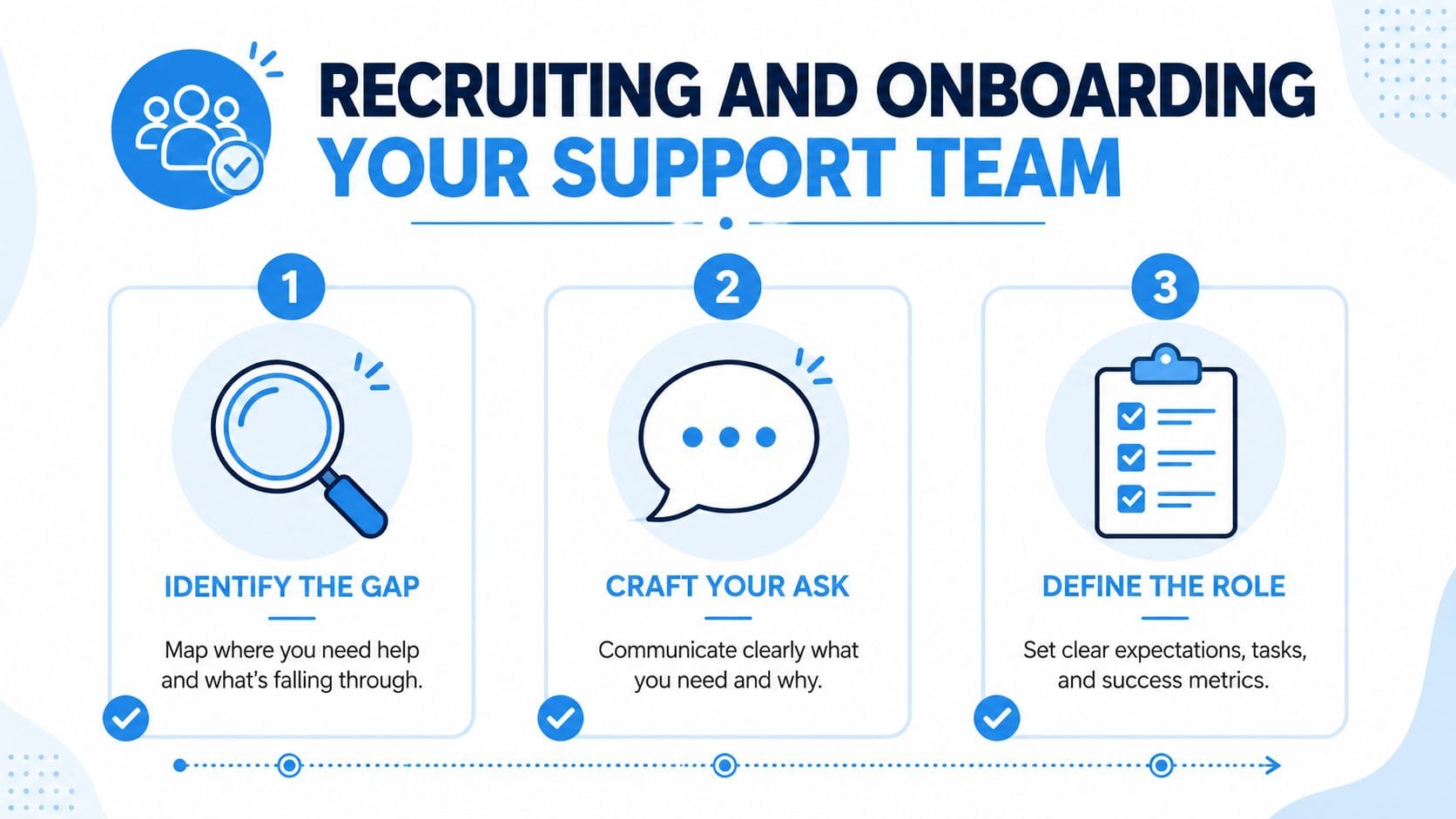
If you ask for help in a vague way, you usually get vague help. If you ask for a specific job, you're much more likely to get a yes. That's the difference between “Let me know if you need anything” and “Can you be the emergency pickup contact on Tuesdays until 4 p.m.?”
Use scripts that remove ambiguity
For a family member, try this:
“Sam gets overwhelmed when there's too much noise and too many questions at once. If that happens, the best help is to lower the noise, give him a few minutes, and keep your voice short and calm. Could you be my backup for school pickup next Thursday?”
For a neighbor:
“We're trying to set up a meal rotation for weeks when therapy runs late. If I text you by Sunday, could you cover one dinner every other week?”
For a coworker:
“I'm looking for one emergency contact in case the school calls and I'm in a meeting. Would you be willing to be my backup pickup person, just for true emergencies?”
Special needs care placement guidance can also help when you're deciding whether to bring in outside caregiving support, especially for in-home coverage that needs real structure. A useful reference is special needs care placement guidance from Superstar Nannies, because it shows how to think about fit, routines, and the demands of specialized care without treating every helper the same way.
Define the role before anyone says yes
Once someone agrees, put the role in writing. Keep it short.
- Role name: Emergency pickup contact, meal drop-off helper, sibling coverage backup.
- What success looks like: One clear task, one clear time window, one clear response expectation.
- Boundaries: What they are not responsible for, and when they should escalate instead of improvising.
- Duration: One week, one month, or until a specific appointment cycle ends.
That kind of clarity matters because it lowers the emotional cost of saying yes. It also prevents the resentment that grows when people feel they've been drafted into something they never fully understood.
For professional onboarding, a one-page child profile helps a lot. Keep it practical, with triggers, communication preferences, current goals, medications, and emergency contacts. If you use a digital care tool, the Guiding Growth child care support services page is a relevant example of how families can centralize that kind of information without relying on memory or scattered notes.
Coordinating Across Home School and Clinical Settings
Fragmentation is where good intentions break down. The therapist is working on flexibility, the teacher is handling transitions, and the parent is trying a new sleep routine at home, but none of them are seeing the same data. The result is predictable. Everyone works hard, but they are not always working toward the same target.
Build a simple alignment rhythm
A monthly 15-minute alignment call is enough for a lot of families. Keep the agenda tight.
- What's working at home.
- What's working at school.
- What's showing up in therapy.
- What needs escalation before the next check-in.
The point is not to pull every provider into one big meeting. The point is to create a repeatable touchpoint where the key adults see the same priorities and know who owns each next step. The SCOPE quality-improvement network study found that connectivity grew over time alongside structured activities such as learning congresses, cross-team collaboration, and regular progress meetings with an advisor (network study). Families usually need that same kind of structure, just in a smaller form. Relationships hold together better when people meet with a purpose and leave with clear follow-through.
Use one shared update format
A shared progress note should be short enough that people will read it. I keep mine to four parts:
- Observed pattern: What happened, where, and with whom.
- Likely trigger: Noise, change in schedule, hunger, transitions, or fatigue.
- What helped: Regulation strategy, visual support, break, snack, movement.
- What needs attention: A new concern, a request, or a question for the next provider.
That kind of structure keeps everyone aligned without flooding each other with paragraphs. It also gives each person a role. Parents can write the home pattern, teachers can note classroom changes, and clinicians can answer with the next adjustment instead of another long explanation.
A shared digital space helps here. If you use the Guiding Growth behavior tracking app, the point is not just logging behavior, it is keeping the same picture visible to parents, caregivers, and professionals who need to see patterns in context. Session notes matter too, especially when you need to connect what happened in ABA with what school staff are seeing. The ABA session notes page is a practical example of how that kind of record can stay usable across settings.
Shared updates work when they make the next decision easier, not when they document everything that happened.
Escalation matters too. If something urgent comes up between meetings, there should already be a point person and a preferred channel. One email thread, one text path, one decision-maker. Without that, even a strong team can stall while everyone waits for someone else to answer first.
Maintaining Your Network Through Privacy Boundaries and Crisis Planning
A support network decays if you never maintain it. People forget their role, details get stale, and boundaries blur. That's when a network starts causing stress instead of reducing it.
Decide what each layer gets to know
Not everyone needs the same information. A neighbor may need to know that your child may bolt near parking lots. A therapist needs much more detail. A cousin may only need a simplified version of how to help during visits. As your child grows, their assent matters too. Even young people can often tell you what feels private, what feels helpful, and who they trust.
Maintenance also means regular contact. Everymind at Work recommends making time to keep in touch with your network regularly, giving back to the people who support you, meeting new people through events or classes, and being willing to let go of people who don't fulfill support needs (Everymind at Work PDF). That lines up with lived reality. A supporter who never responds, forgets key boundaries, or judges your child instead of helping is not neutral. They're making the load heavier.
Keep a crisis plan where people can find it
Michigan State University Extension recommends families learn their rights to services, ask lots of questions, explore government assistance, and not stop when one person says no. It also recommends an emergency plan, accessible emergency numbers, and a small amount of cash set aside for emergencies (MSU Extension). For families, that becomes a practical crisis sheet.
Use this structure:
- First call: The person who knows the child best and can de-escalate quickly.
- Second call: The backup who can physically arrive or relieve a caregiver.
- Third call: The medical or school contact, depending on where the crisis is happening.
- De-escalation notes: Quiet space, preferred language, sensory supports, food, water, movement, or no-touch expectations.
- Hospital details: Preferred facility, insurance card location, medication list, and key diagnoses.
If people have to improvise in a crisis, the plan wasn't finished.
That's also where reciprocity matters. A one-way network burns out fast. Even when you're the one asking for help, you can still thank people, update them, and offer support where it's appropriate. That keeps relationships alive instead of transactional.
Using Guiding Growth to Centralize Communication and Tracking
The fastest way to lose a support network is to let the information scatter. Sticky notes get lost, texts disappear in a thread, and nobody can remember whether the sleep issue started before the medication change or after the schedule shift. A single digital hub solves that by giving everyone one place to look.
Put the child's real-life patterns in one place
Guiding Growth is built for exactly this kind of coordination. It lets parents voice log behavior in real time, including meltdowns, shutdowns, demand avoidance, echolalia, and hand flapping, while capturing triggers and outcomes so patterns aren't trapped in memory or guesswork. It also keeps sleep habits, diet and nutrition details, medications, and appointments in the same system, which helps separate “what happened” from “what might be driving it.”
Shared access matters just as much as logging. When family members, caregivers, and therapists can see the same information, they stop building separate versions of the child. That reduces the usual miscommunication that happens when one adult is tracking behavior by feel and another is tracking it by fragments.
Use technology to support the network, not replace it
A digital tool can't be the relationship, but it can make the relationship easier to sustain. For a parent who wakes up at 2 a.m. with a question, Alma AI can serve as an always-available companion inside the broader support system. For day-to-day coordination, the app keeps the running picture in one place instead of burying it in screenshots and forgotten messages.
The advantage is practical, not flashy. When everyone is looking at the same notes, the same routines, and the same updates, the team can respond faster and with less second-guessing. If you're trying to replace chaos with coordination, that's the shift that matters most.
Your 30-Day Action Plan for a Stronger Support Network
Week 1, map the network and mark the gaps. Week 2, send three specific asks, not general invitations. Week 3, set one alignment call and onboard one professional into your tracking system. Week 4, run a mini crisis drill and schedule the first maintenance check-in.
That's enough to move from scattered goodwill to a functioning support structure. A small, reliable network with clear roles will outperform a big passive circle every time, because people know what to do when it matters. Building support networks isn't a one-time clean-up project. It's a repeatable practice, and each round makes the next one easier.
If you're ready to stop juggling scattered notes, forgotten texts, and half-finished plans, Guiding Growth gives you one place to log behavior, share updates, and keep the adults around your child aligned. It's built for families who need a real coordination system, not more guesswork. Visit it when you're ready to turn your support network into something people can use.