The night is finally quiet, the tabs are still open, and you're staring at a forum thread that feels half helpful and half overwhelming. One parent says, “We were there too.” Another shares a therapy acronym you've never heard before. A third links a school form, but it doesn't match your child's situation at all.
That's where parent peer support starts to matter. Not as a casual chat group, and not as a replacement for clinicians, but as a practical way to hear from people who already know the maze you're in. For many autism families, that lived experience is the difference between feeling alone and getting a usable next step.
Table of Contents
- Why Parent Peer Support Matters for Autism Families
- What Parent Peer Support Means
- What the Research Shows About Peer Support Benefits
- Formal Versus Informal Parent Peer Support Models
- How to Find and Join a Safe Parent Peer Group
- Setting Boundaries and Moderation in Parent Support Groups
- Using Technology to Strengthen Peer Support and Reduce Isolation
Why Parent Peer Support Matters for Autism Families
The first real value of peer support is simple. It puts you in contact with people who understand the emotional weather of autism parenting without needing the whole backstory every time.
A parent who's just heard “let's wait and see” from a clinician doesn't usually need a lecture. They need someone who can say, in plain language, “I've sat in that chair too, and here's what I wish I'd asked next.” That kind of help feels small from the outside, but for a family that's trying to coordinate school, therapy, and home routines at once, it can steady the whole day.
Why the instinct to find other parents is usually right
That instinct to search for another parent is backed by the broader evidence base. A systematic review of peer support for parents and carers of children with disabilities or chronic illness screened 3,605 articles and included only 13 studies source. That tells us two things at once, the topic draws wide interest, and the rigorous research base is still relatively small.
The same review reported that peer support appeared to reduce distress and improve well-being and quality of life, though the authors also cautioned that the included studies had a high risk of bias source. A separate Cochrane review found no clear benefit on psychological distress versus usual care or alternative interventions, and its pooled estimates were very imprecise source. That mix of promise and caution is normal here.
Practical rule: if a group promises to “fix” your child's behavior, it's overreaching. If it helps you feel less alone and more capable of acting, that's much closer to what the evidence supports.
Peer support matters because it gives families a place to compare notes without being judged for asking basic questions. It helps parents translate confusing experiences into language they can use with schools, therapists, and relatives. And for a lot of families, that's the first time the path forward feels visible.
What Parent Peer Support Means
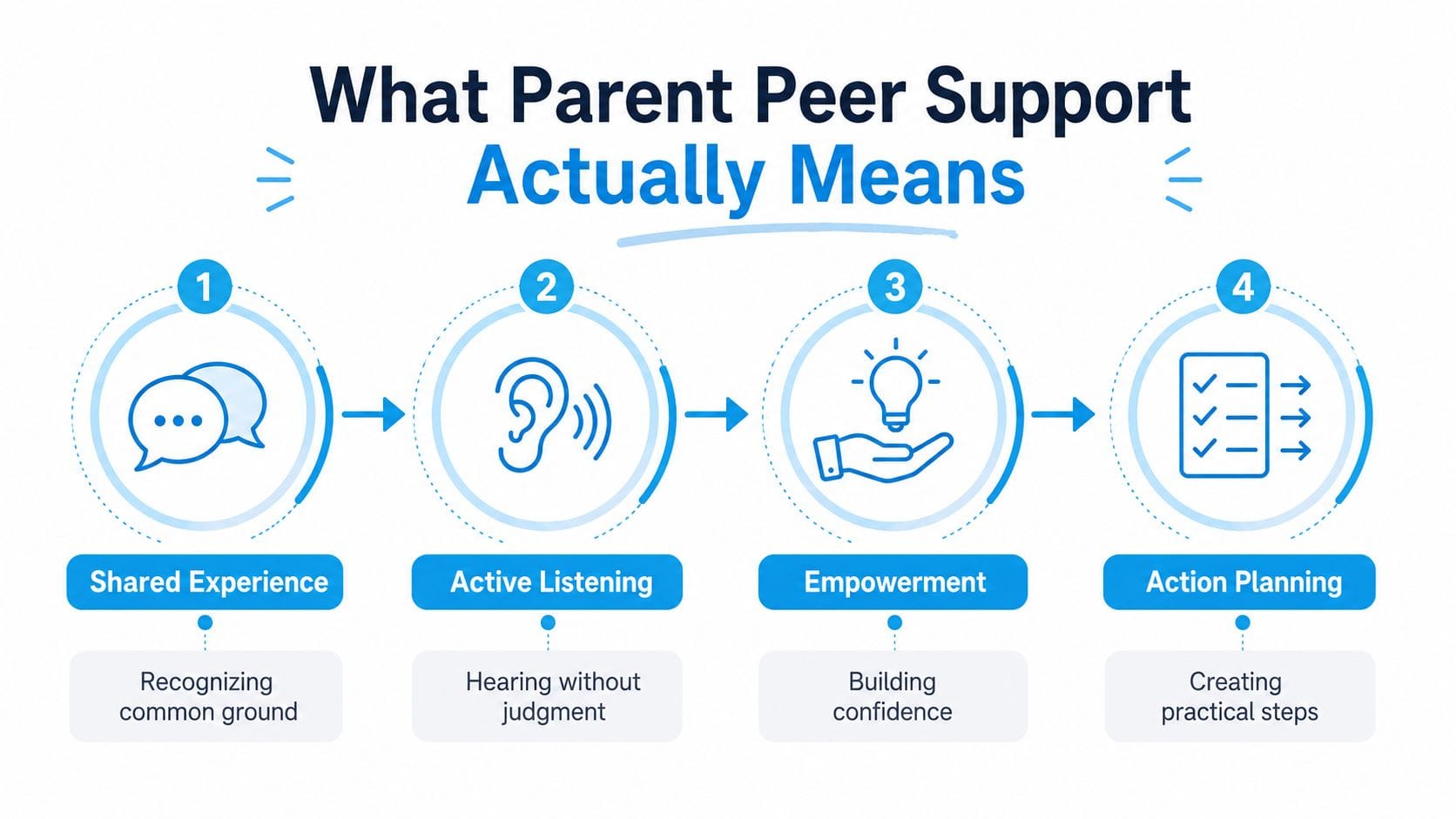
A parent support group is more than a place where people trade stories. It works best when it has a clear rhythm, a shared purpose, and a role that helps families take the next step.
The four functions that make support useful
Implementation reviews describe four core functions of effective parent peer support, engage, explore, plan, and access and advocate source. Engage means families are welcomed in a way that makes it safe to speak candidly. Explore means parents name what is happening at home, what feels confusing, and what they hope will change.
Plan is the point where talk starts turning into action. A parent may leave with a script for a school meeting, a question list for the pediatrician, or a clearer way to track triggers at home. Access and advocate connects families to services, rights, and referrals, which is often where the process slows down.
Those functions match what child and family services literature keeps emphasizing, psychoeducation, mutual support, facilitation when needed, and real parent participation in decisions source. The point is not to fill a room with sympathy and leave it there. The stronger groups help parents move from “I'm overwhelmed” to “here is the next call I need to make.”
What the best groups sound like
Tone matters. Good peer support sounds like someone listening closely, naming what they have lived through, and offering a practical next move without taking over the parent's choices. It is warm, but it is not vague.
Poorly run groups often jump straight to advice or comparison. The useful ones leave room for a parent to say, “My child is five, we are not diagnosed yet, and I do not know where to start.” That kind of honesty turns shared experience into something more useful, a clear map for the next conversation, the next form, or the next request for help.
What the Research Shows About Peer Support Benefits
A parent can sit in a waiting room, scrolling through school emails and therapy notes, and still feel alone. Peer support matters because it gives that parent another human being who understands the same system, the same uncertainty, and the same steady pressure to keep going. The research is encouraging, but it is not tidy, and families need an honest map rather than a sales pitch.
What the evidence points to
A 2022 systematic review of 13 quantitative studies found that peer-support programmes for parents and carers of children with disability or chronic illness were associated with decreases in distress and increases in well-being and quality-of-life outcomes source. That pattern matters for families whose stress comes from isolation, decision fatigue, and the sense that every next step has to be figured out alone.
A Cochrane review focused on parents and carers of children with complex needs found no evidence of effect on psychological distress in pooled intervention arms, and the certainty of evidence was low or very low source. That review looked at whether peer support changes distress directly, while the systematic review above examined broader well-being and quality-of-life outcomes. The difference helps explain the mixed picture. Peer support can be helpful without working like a treatment.
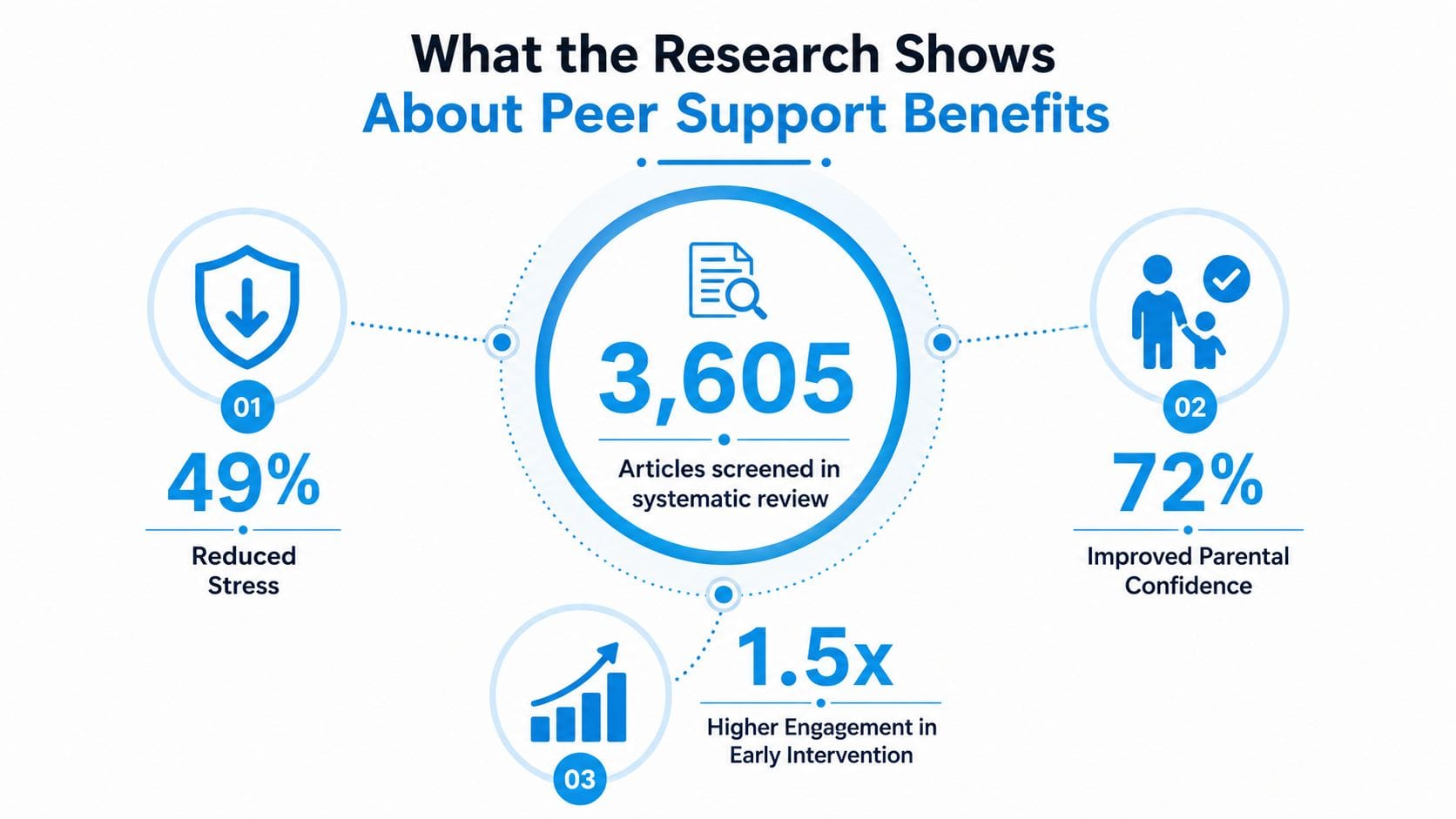
The most useful takeaway is narrower and more practical. Peer support appears more reliable for lowering isolation, improving confidence, and helping parents feel steadier in the system than for changing a child's behavior directly. That is why families get the most out of it when they enter with a clear goal and a clear idea of what kind of help they want.
Learn how peer support can fit into autism family life
What peer support can and can't change
Peer support can help you stay in the game when appointments, meetings, and home routines start to blur together. It can also make you more willing to ask questions, compare notes with other parents, and follow through on plans.
It usually cannot replace therapy, schooling supports, or medical care. It also does not have strong evidence for changing child-level outcomes on its own, which is why parents should treat it as one part of a larger care plan, not the entire plan. That is the boundary many groups blur, especially when they mix emotional support with advice about diagnoses, services, and daily routines.
Bottom line: if your goal is less isolation, more confidence, and a clearer head, peer support fits. If your goal is to change sleep, speech, or behavior directly, you will need broader services too.
Formal Versus Informal Parent Peer Support Models
A parent can walk into a group hoping for one kind of help and leave frustrated because the group was built for something else. Formal peer support and casual parent networks can both matter, but they serve different jobs, much like a toolkit with separate tools for listening, planning, and problem-solving.
How the models differ
Formal peer support usually includes trained facilitators, scheduled meetings, and some kind of structure, whether that is a curriculum, topic outline, or guided discussion. Informal support is looser, often parent-led, and may show up in social media groups, local meetups, or text threads. One is not automatically better than the other, because the better fit depends on the kind of help a family needs right now.
Research on home-visiting peer support in high-income countries describes the evidence base as limited and varied, which means there is no single format that fits every family source. The same research suggests online peer support tends to offer informational and emotional benefits, while effects on child behavior-related outcomes are small or minimal source.
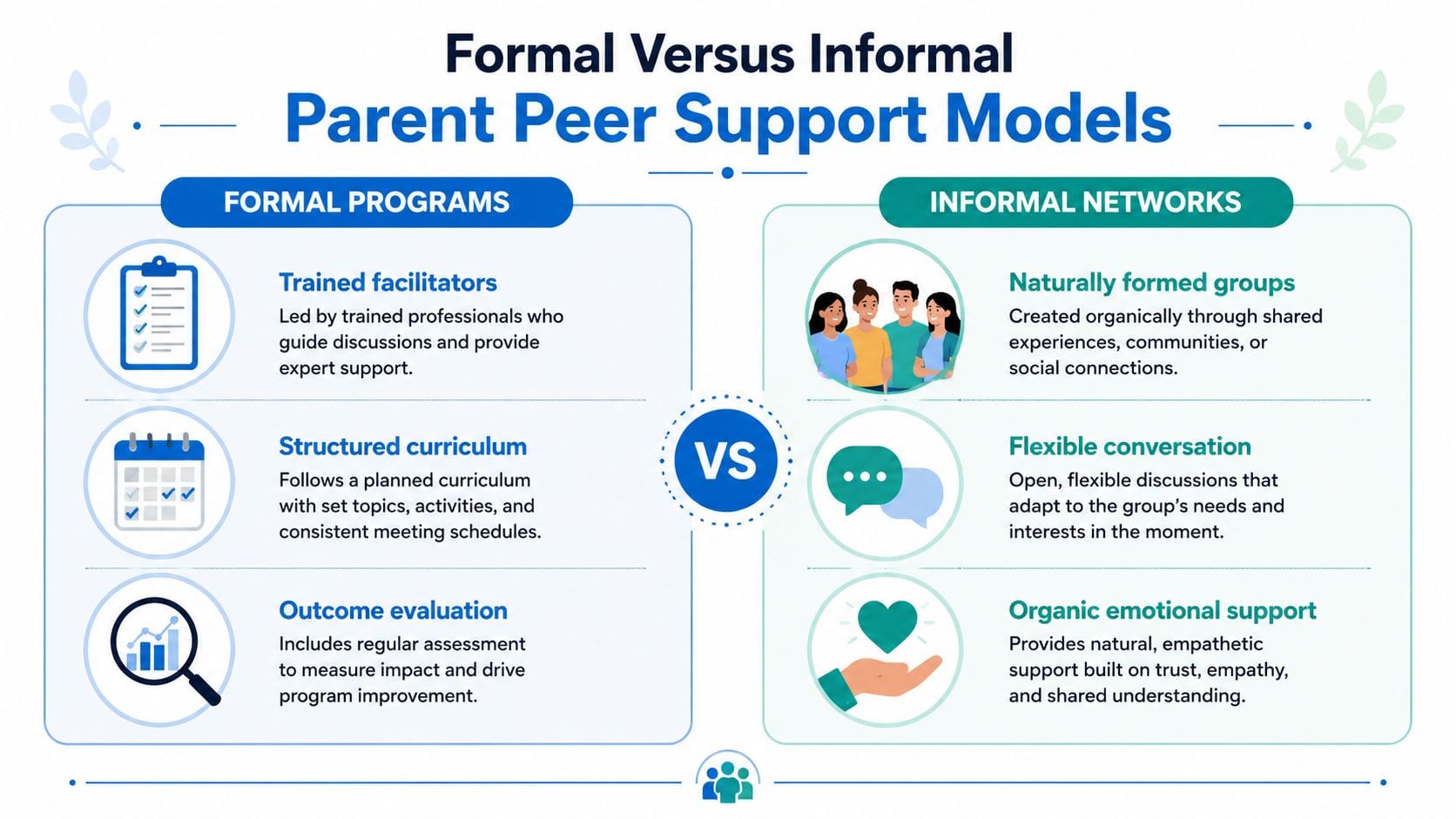
That difference matters because it keeps expectations realistic. A casual online group is not designed to fix meltdowns, mealtime battles, or sleep resistance on its own. It can still be useful when the goal is to learn how other parents handle evaluations, school meetings, or service referrals, since those are the moments when experience from another family can save time and confusion.
Choosing by need, not by label
Families who feel raw and overwhelmed often gravitate toward informal groups first, because they are easy to join and feel familiar. When the issue involves rights, referrals, or coordination across systems, a structured program may fit better. If you want a clearer way to sort those options, this guide to building parent support networks can help you match the format to the problem in front of you.
A short video can also help parents see the difference between casual community and organized support.
The practical question is not whether a group is formal or informal. The better question is what job you need it to do this month. Once that is clear, it becomes much easier to judge whether the group is a good fit.
How to Find and Join a Safe Parent Peer Group
The safest groups usually don't feel the most polished at first glance. They feel clear, calm, and specific about what they're there to do.
Start with the need in front of you
If you're looking for emotional validation, you can search differently than if you need help with evaluations or service coordination. Community centers, disability organizations, school district parent networks, and hospital family programs often know where the structured groups are, even when the groups aren't heavily advertised.
A large Australian review found the peer-support system for families of children with disability and developmental concerns is fragmented and lacks links to the broader early-childhood sector, with clear gaps for families who are pre-diagnosis or waiting for services source. That's the part many online groups miss, they can offer empathy, but not always the next practical step.
What to check before you commit
The best first visit is usually low stakes. Read the group rules, sit in on one meeting, or watch the tone of the chat before you post anything personal.
- Ask who the group is for: some groups are strongest for newly diagnosed families, others for parents further along the journey.
- Look for moderation: a person who keeps the conversation focused is usually a good sign.
- Check for practical follow-through: useful groups often mention resources, referrals, or meeting prep, not just feelings.
- Notice whether people can disagree respectfully: that usually tells you a lot about safety.
One useful resource for thinking through support networks is this parent-network building guide. It's helpful when you're sorting out which supports belong in your inner circle and which ones should stay occasional.
If a group can't address pre-diagnosis questions, say so out loud to yourself. That limitation doesn't make the group bad, it just means you may need another source for that phase.
The main mistake is assuming that any parent group is better than none. A group that leaves you more confused or more dysregulated isn't doing its job.
Setting Boundaries and Moderation in Parent Support Groups
A peer group without structure can turn into a venting loop. Venting has a place, but if it becomes the whole culture, parents leave feeling heavier than when they arrived.
Why moderation changes the experience
Moderation matters whether the group is led by a trained facilitator or a parent volunteer. A good moderator keeps the space focused, redirects stigma when it appears, and makes sure quieter parents aren't talked over.
Groups with clear norms also tend to work better because people know what belongs there and what needs professional attention. Peer supporters are not therapists, and they shouldn't be asked to carry the role of one. A healthier group says that plainly instead of pretending boundaries are rude.
Questions worth asking before you join
If you're evaluating a group, ask how it handles conflict, misinformation, and emotional overload. That sounds formal, but it protects everyone involved.
- What are the group rules: do they cover confidentiality, respectful language, and advice-giving?
- Who moderates: is there a named person with the authority to steer the discussion?
- How are tough posts handled: does the group correct misinformation or let it spread?
- What happens when someone is overwhelmed: is there a plan for redirecting them to professional help?
- Do the norms get revisited: good groups update their guidelines when the community changes.
A review of community-based peer programs found that when support is delivered as intended, parents report increased perceived social support and concrete support over time source. That phrase matters. The benefits show up when the program is managed with intention.
For a practical look at how structure helps online communities function, the enterprise Facebook group playbook is a useful reference even outside parenting spaces. It's not about autism specifically, but it does show how clear rules and moderation keep a group useful instead of chaotic.
Walk away if a group leaves you feeling shamed, pressured, or more confused than before.
Parents don't need to earn their right to leave. If the group's tone starts working against your well-being, that's enough reason to step out.
Using Technology to Strengthen Peer Support and Reduce Isolation
Peer support shouldn't stop when the meeting ends. The gap between conversations is where a lot of stress builds back up, especially when parents are trying to remember what happened, when it happened, and what came next.
Turning shared experience into shared action
Tools matter. Guiding Growth is one option for families who want to turn peer advice into something more organized, because it centralizes behavior logs, sleep, diet, medications, appointments, and caregiver sharing in one place. Instead of trying to reconstruct the week from scattered texts and memory, parents can review patterns together and bring cleaner information to the next conversation.
That matters because many peer conversations end with good ideas and no follow-through. A parent might leave a group knowing another family tracks triggers, but still not have a simple way to do that themselves. An app that stores observations in one place helps move from “someone told me” to “we can see what's happening.”
Why other tools can help too
Sometimes the support gap is less about what you know and more about whether you can capture it quickly. An AI Notetaker can help some parents record observations without losing the moment to typing, which can be useful when you're trying to keep track of patterns after appointments or tough evenings.
The main point is coordination. When peer support, digital tracking, and family collaboration line up, the conversation becomes more specific. Parents can compare notes with caregivers, share relevant observations with professionals, and stop relying on memory alone.
One more resource that can help families compare autism-focused tools is this special needs apps guide. It's a useful starting point if you're trying to choose between broad family tools and more targeted tracking support.
Helpful habit: after a peer conversation, write down one thing you're trying this week and one thing you're watching for. Small follow-through beats perfect note-taking.
Peer support works best when it makes life feel less solitary and more coordinated. That's the win, not just feeling understood, but being able to act with more clarity the next day.
If you want a place to organize behavior patterns, daily routines, and shared notes after the conversation ends, Guiding Growth brings those pieces into one family-friendly app. It's built for autistic and neurodivergent families who want peer insights to become trackable patterns and coordinated next steps.