You're sitting beside your child during an ABA session, watching a therapist place colored cards on the table. The therapist gives an instruction, waits, offers a prompt, delivers praise, records something on a clipboard, and starts again. Words like antecedent, prompt, and trial block move quickly through the room, while you wonder how these small exchanges fit into your child's larger goals.
That confusion is common. Discrete trial teaching ABA can look repetitive from the outside, but each repetition has a purpose. Once you understand the structure, you can recognize what the therapist is teaching, why feedback happens so quickly, how progress is measured, and how your observations at home can help the care team make better decisions.
Table of Contents
- Why Parents Keep Hearing About DTT
- What Discrete Trial Teaching in ABA Really Means
- The Five Parts of a Single Discrete Trial
- What a Typical DTT Session Looks Like
- The Evidence Behind DTT and Its Limits
- Choosing Between DTT and Other ABA Approaches
- Tracking Progress and Partnering With Your Therapy Team
- Your Next Steps as an Informed DTT Parent
Why Parents Keep Hearing About DTT
A parent watching a first DTT session might expect a lesson to look like school. Instead, the therapist may work on one small response, such as pointing to red, handing over a requested item, or imitating a movement. The therapist presents the same learning opportunity in carefully planned variations, records the child's response, and adjusts help as needed.
That rhythm isn't meant to make learning mechanical. It gives the therapist a clear way to see what the child understands, what still requires support, and which consequences help the child stay engaged. DTT emerged in the 1970s as part of early intensive behavioral intervention, with Ivar Lovaas at UCLA developing it as a structured ABA technique for teaching children with autism. The Indiana Resource Center for Autism's overview of discrete trial teaching describes how the format became a foundational, manualized teaching method within ABA.
A useful parent question: “What skill is this trial building, and what will my child use it for outside therapy?”
A thoughtful program shouldn't treat the table as the finish line. The therapist should be able to explain the target, the response that counts as success, the type of prompt being used, and how the skill will move into daily routines. You're not expected to memorize every technical term. You're entitled to understand what your child is practicing and how the team will know whether it's helping.
What Discrete Trial Teaching in ABA Really Means
Discrete trial teaching breaks a broad skill into small learning opportunities that have a clear beginning and end. “Discrete” means separate or clearly defined. Instead of asking a child to master an entire activity at once, the therapist isolates one teachable response and gives the child a focused chance to practice it.
Think about teaching someone to shoot free throws. You wouldn't begin by placing them in a full basketball game and expecting them to discover every part of the movement under pressure. You might first practice hand position, then aim, then release, with feedback after each attempt. DTT uses a similar building-block approach for communication, self-help, academic, imitation, and social skills.
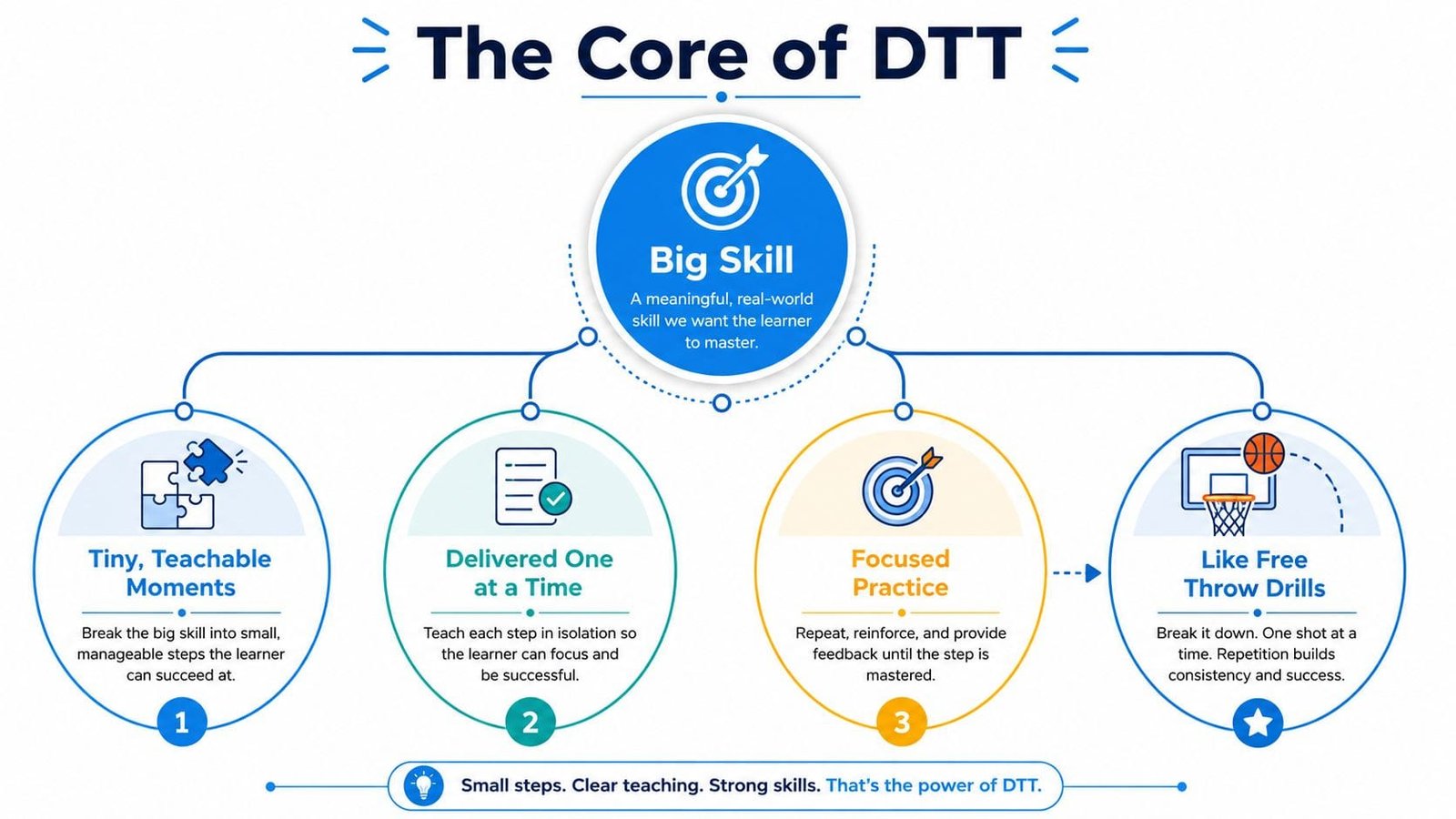
A structured DTT opportunity generally includes:
- An antecedent or instruction: The therapist presents the cue, such as “Touch red.”
- A learner response: The child points, touches, labels, imitates, reaches, or responds in another defined way.
- A consequence: The therapist reinforces a correct response or provides a neutral correction and another opportunity.
- A brief pause: The therapist resets materials and prepares for the next opportunity.
A 2024 expert summary of DTT's instructional format describes the method as a repeated contingency involving the instruction, learner response, and consequence. It also emphasizes frequent opportunities to respond, prompting, and reinforcement tied closely to accuracy.
This differs from natural teaching that happens during play, meals, errands, or conversation. In a natural moment, a child might request a snack because the snack is visible. In DTT, the therapist might deliberately create a controlled opportunity to practice requesting, then adjust the prompt and reinforcement based on the child's response.
The important point is simple: DTT teaches through repeated opportunities to respond with immediate feedback. It doesn't rely on a long explanation or lecture. The child gets a chance to act, learns what followed that action, and gradually practices responding with less help.
The Five Parts of a Single Discrete Trial
A single trial is small, but it isn't random. The ERIC description of the five-part discrete trial sequence identifies the antecedent, prompt, learner response, consequence, and brief inter-trial interval as the core parts of the teaching unit.
One trial: antecedent or instruction, prompt if needed, learner response, consequence, brief inter-trial interval.
Use a color-identification target to see how the sequence works. The therapist places a red card and a blue card in front of the child.
1. Antecedent or instruction
The therapist gives a clear cue: “Touch red.” The instruction should tell the child what response is expected without adding unnecessary language. Materials, positioning, and the wording of the instruction may stay consistent while the child is learning.
2. Prompt if needed
If the child doesn't respond, the therapist provides help. That might mean pointing toward the red card, moving the card closer, modeling the touch, or gently guiding the response, depending on the approved plan and the child's needs.
A prompt isn't the goal. It's temporary support. The therapist should track it and plan how to fade it so the child can respond independently.
3. Learner response
The child touches the red card, touches the blue card, reaches without choosing, or doesn't respond. Each outcome gives the therapist information. A correct independent response means something different from a correct response completed after a full physical prompt.
4. Consequence
For an independent correct response, the therapist might say, “Yes, red,” offer enthusiastic praise, or provide access to a preferred activity. If the child touches blue, the therapist may use a neutral correction, provide a prompt, and invite another attempt. DTT guidance describes correct responses followed by immediate reinforcement and incorrect responses handled through correction or prompt-and-retry procedures, as summarized in this explanation of consequence delivery in DTT.
5. Inter-trial interval
The therapist pauses briefly, resets the cards, and starts the next opportunity. This pause separates one trial from the next and gives the learner a moment to shift attention.
A progression might look like this:
- Trial one: “Touch red.” The therapist points to red. The child touches it. The therapist says, “You found red!” and provides reinforcement.
- Trial two: “Touch red.” The therapist moves a finger toward the cards but doesn't point directly. The child touches red and receives reinforcement.
- Trial three: “Touch red.” No prompt is given. The child touches red independently, and the therapist delivers the strongest planned reinforcement.
The exact prompt and consequence depend on the child's individualized program. The pattern parents can watch for is support when needed, immediate feedback, and gradual movement toward independence.
What a Typical DTT Session Looks Like
A DTT session often begins before the first instruction. The therapist arranges materials, checks the current targets, identifies possible reinforcers, and prepares a data sheet or digital recording system. The setting might be a clinic table, a play area, the floor at home, or another space where the child can participate comfortably.
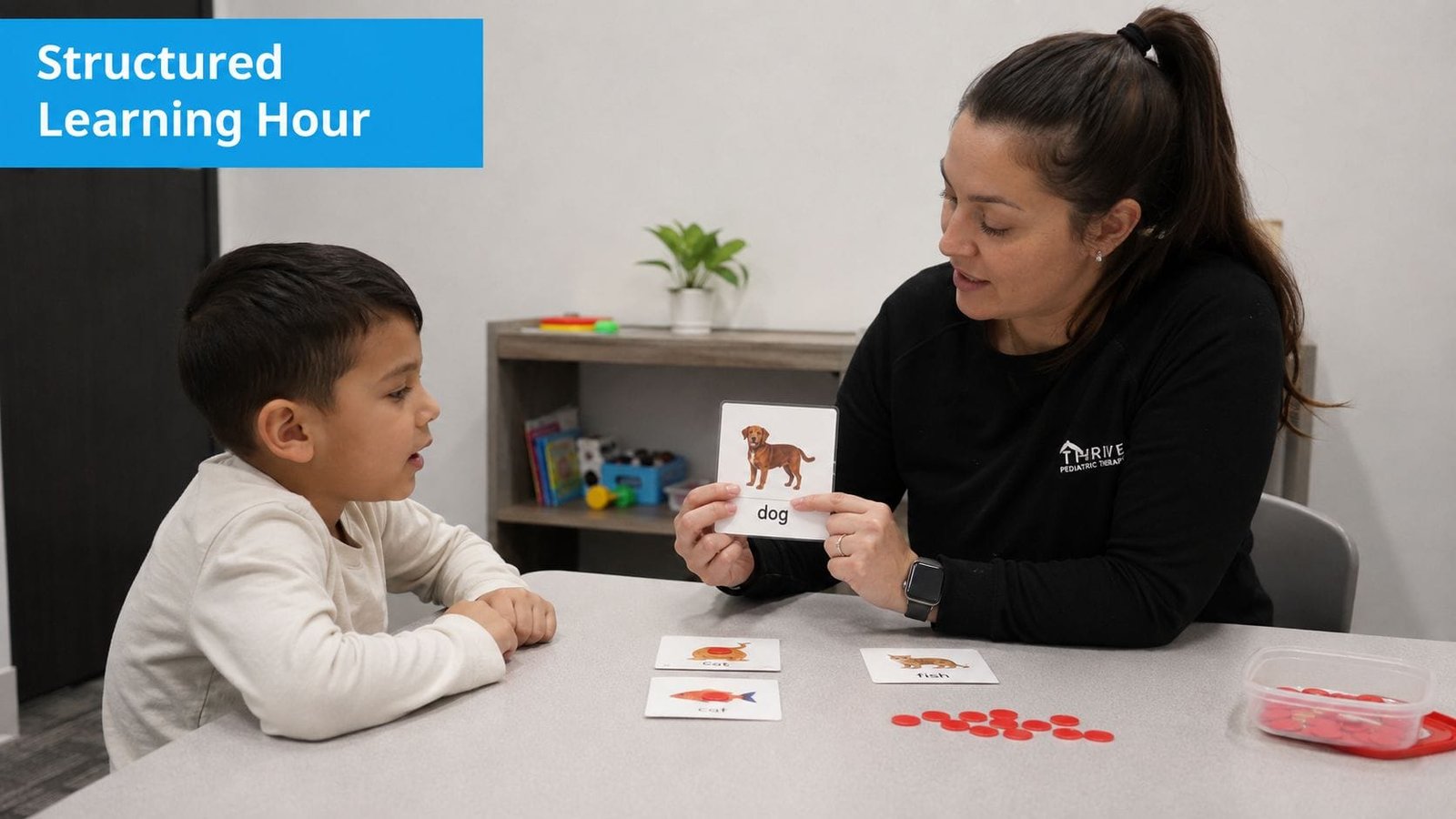
A representative hour might open with easy requests or familiar matching tasks. The therapist uses those established skills to build momentum, then introduces a newer target. After several opportunities, the child may receive a short break, play with a preferred item, or move to a different activity before returning to instruction.
Practical guides describe 10 to 20 trials per target skill in a block, while another format includes 8 to 10 trials per target with 3 to 5 targets in a typical hour-long session. These figures come from the DTT trial-block guide, and they illustrate why a session can generate many small data points.
Between opportunities, the therapist may mark whether the response was independent, prompted, incorrect, or absent. The therapist may also record the prompt level, the consequence delivered, and any relevant behavior that affected participation. That information helps the clinical team decide whether to continue, modify, pause, or generalize a target.
The pace should still reflect the child. A younger child or a child with limited attention may need shorter teaching periods, movement, varied materials, and frequent choices. A session can be structured without forcing a child to remain at a table continuously. Families exploring ABA home therapy options should ask how the team will balance focused teaching with play, communication, breaks, and daily routines.
The best sessions have a rhythm rather than a race. Therapists mix newer targets with easier maintenance skills, reinforce effort and accurate responding, and watch for signs that the child needs a pause or a different approach.
The Evidence Behind DTT and Its Limits
A parent may hear that DTT produced striking gains and wonder whether the same schedule will work for their child. DTT became influential because it gave clinicians a clear, repeatable format for intensive instruction. During the 1970s, Ivar Lovaas at UCLA developed it as a structured ABA technique within early intensive behavioral intervention. By the twenty-first century, educators widely used the method, particularly with young children with autism and related disorders. The historical account from the Indiana Resource Center for Autism describes this development.
The landmark 1987 Lovaas study remains an important historical reference point. Later summaries report that 47% of children in the treatment group reached typical functioning, characterized by average IQ and school integration, while roughly 90% showed substantial improvement on at least some measures. The program provided 40 hours per week of one-to-one ABA instruction for 2 to 3 years. Individual DTT was the main home-based teaching method during the first year, according to this summary of the Lovaas method.
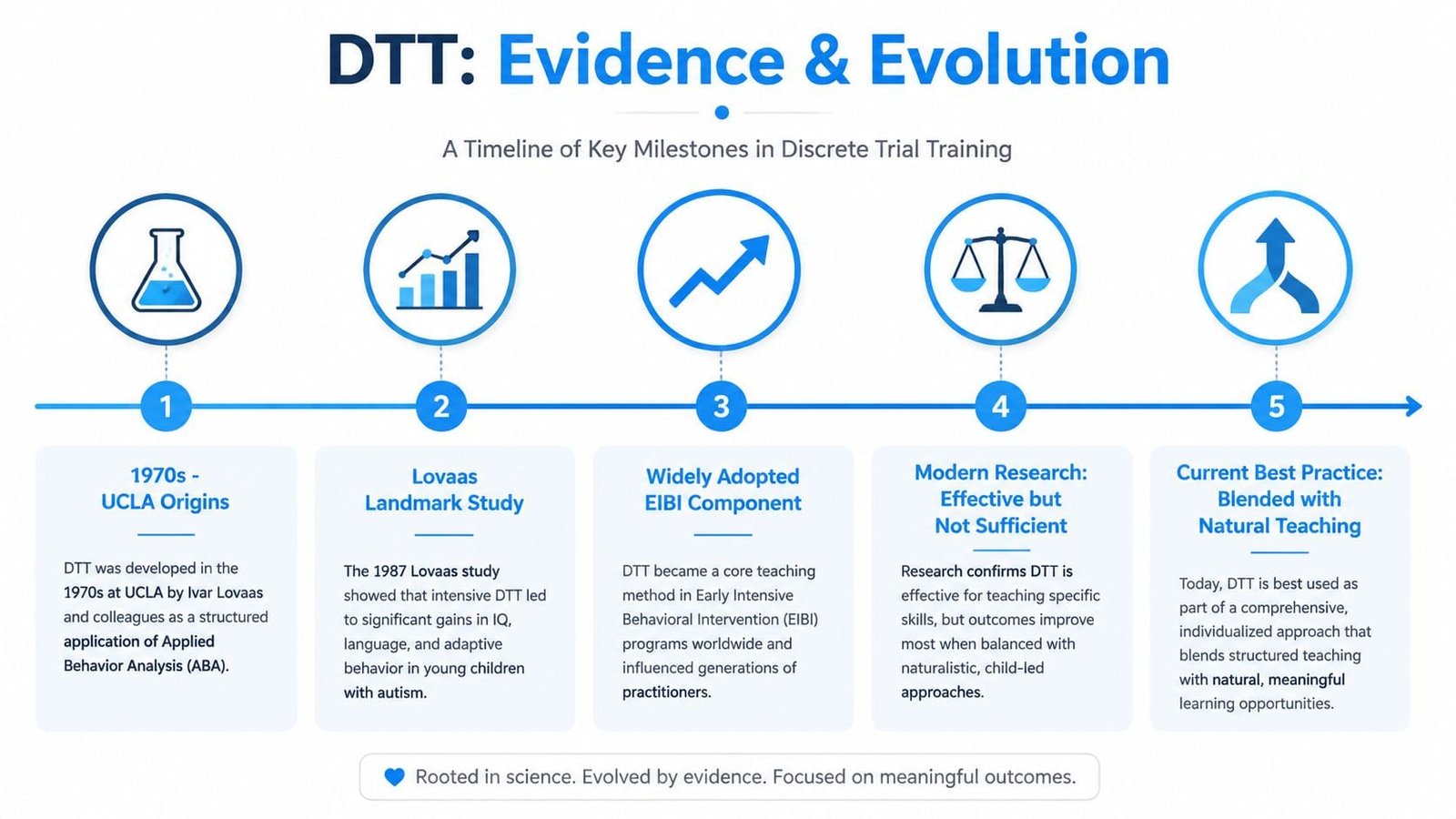
Those findings provide historical context, not a guarantee. Later critiques questioned the strength of the evidence. Outcomes also depend on the participants, intervention details, intensity, goals, and support surrounding each program.
What modern evidence supports
A 2024 scoping review found DTT generally efficacious for teaching new skills. The evidence was stronger for acquisition than for maintenance, generalization, and social validity, according to the review published in Behavioral Interventions. In practical terms, a child may answer correctly during a teaching block yet need additional practice to use that response with another person, in another setting, or with different materials.
Studies also differed in how they applied DTT. Prompting intensity, reinforcement schedules, trial density, and other details can change both the child's experience and the results. Families can help by logging the same three parts they observe at home: what happened before the response, what the child did, and what followed. Sharing those patterns with the therapy team helps connect clinic data with daily life.
DTT can teach new skills, while a strong program also plans for flexibility, dignity, communication, play, and useful routines. A broader review of evidence-based autism interventions can help parents judge how DTT fits within an individualized plan rather than treating it as the entire answer.
Choosing Between DTT and Other ABA Approaches
DTT is a good fit for some learning goals and some teaching moments. Naturalistic strategies, including incidental teaching and natural environment teaching, create opportunities inside play, routines, and meaningful activities. The choice shouldn't be framed as one method defeating another. Many contemporary programs combine structured and natural teaching so a child can first learn a response clearly, then use it in real life.
| Dimension | DTT | Naturalistic Teaching |
|---|---|---|
| Structure level | Highly structured, with defined instructions, responses, consequences, and brief pauses | Loosely structured around the child's activity, motivation, and daily context |
| Best skill types | Discrete responses such as matching, imitation, identification, or early communication targets | Functional communication, play, social interaction, flexible responding, and routine-based skills |
| Typical settings | Table work, floor teaching, clinic rooms, or a planned home activity | Playroom, kitchen, playground, classroom, community, or family routines |
| Child characteristics that may suit it | A child who benefits from clear cues, repetition, and predictable feedback | A child who is motivated by activities, people, objects, or naturally occurring choices |
The central decision is functional. If a child needs to learn to distinguish colors, imitate a movement, or respond to a specific instruction, DTT may provide useful clarity. If the goal is asking for help during a difficult zipper, joining a sibling's game, or using language while making a snack, naturalistic practice may show the team more about real-world use.
Generalization needs a plan
The 2024 review found stronger evidence for acquisition than for maintenance, generalization, and social validity. A response learned at a therapy table may not transfer automatically to a parent, teacher, sibling, unfamiliar room, or new set of materials. Clinicians need to deliberately vary those conditions and practice the skill where it matters.
A skill is more valuable when the child can use it with real people, during real routines, for a meaningful reason.
Parents can ask whether a target will be practiced beyond the original teaching setup. For ideas about applying ABA techniques to everyday play, see teaching functional play with ABA techniques.
Ethics belongs in the conversation, too. Parents can ask how the therapist checks for assent, responds to refusal, avoids pushing robotic responding, and prioritizes functional skills. Effective teaching should support communication and participation, not produce compliance in a narrow setting.
Tracking Progress and Partnering With Your Therapy Team
A therapist can't evaluate DTT from memory alone. During trials, the team may record whether the child responded independently, needed a prompt, made an error, or didn't respond. Over time, those observations can show whether a skill is becoming more independent, whether prompts are fading, and whether the target needs a change.
A simple example helps. Suppose the target is touching the red card. A therapist might distinguish between “correct independently” and “correct after a prompt,” rather than treating both responses as identical. That distinction matters because independence is the goal, even when prompted success is an important learning step.
What the data can answer
Progress records can help the team discuss questions such as:
- Is the child learning the target? Trial-by-trial records show how the child responds across repeated opportunities.
- Is help decreasing? Prompt information shows whether the therapist can fade support.
- Does the skill hold up? Practice with different people, materials, and settings reveals whether the response transfers.
- Is the goal useful? Parent and child observations help the team consider whether the target improves communication, participation, comfort, or independence.
The consequence also matters. Correct responses are followed by immediate reinforcement, such as praise, a preferred item, or an activity. Incorrect responses may receive neutral correction or a prompt-and-retry opportunity, with prompts often faded as independence grows, as described in this overview of reinforcement and prompting in DTT.
Home observations complete the picture
Clinic data can show what happened under planned conditions. Home observations can show what happens before breakfast, during a transition, after poor sleep, around siblings, or when a preferred activity ends. Those details don't replace clinical data. They add context that a therapy session may not capture.
Parents can log the trigger, the child's response, what happened next, and anything that may have affected participation. A brief note such as “asked to stop tablet, covered ears and moved away, settled after quiet time” can give the team a starting point for a more careful conversation. Patterns involving sleep, routines, meals, medications, appointments, or therapy timing may also help families organize questions for their providers.
Guiding Growth is designed for this kind of collaboration, with quick voice logging, visual patterns, and sharing among caregivers and professionals. Keeping home observations organized can make team conversations more concrete and help everyone work from the same context instead of scattered notes.
Your Next Steps as an Informed DTT Parent
DTT is a structured, evidence-supported format for teaching new skills. A trial has five parts, sessions are made from blocks of opportunities, and progress depends on more than correct responding at the therapy table. The evidence supports skill acquisition, while maintenance and generalization require deliberate planning.
Try these three steps:
- Observe one complete session. Watch for the instruction, prompt, response, consequence, and brief pause. Ask the therapist to name each part if the sequence isn't clear.
- Ask about the target and its purpose. Find out which skill the team is teaching, how independence is measured, and where your child will practice it with different people, materials, and routines.
- Start a home logging habit. Record what happened before a response, what your child did, and what followed. Include useful context such as sleep, routines, transitions, or changes in the environment.
Your observations are legitimate data. When you understand the teaching format and share what happens beyond therapy, you become an active collaborator in your child's care rather than a bystander.
Guiding Growth helps families capture behavior, routines, sleep, nutrition, appointments, and therapy observations in one place, with quick voice logging and clear visualizations for easier collaboration. Visit Guiding Growth to start organizing the everyday details that can help your therapy team understand the full picture.