The same difficult moment keeps appearing. Perhaps your child becomes distressed shortly after school, withdraws under bright lights, or resists a request that seemed manageable yesterday. You can see the repeated event, but the trigger remains unclear.
Pattern recognition means noticing repeated relationships among events, context, behavior, and outcomes. It doesn't prove that one factor caused another. A useful pattern is a clue that helps you ask better questions, compare similar situations, and choose a careful next step.
The examples of pattern recognition below move through everyday and cognitive patterns, learning and machine learning, and autism-support applications. The shared method is simple: observe consistently, record context, compare conditions, test one low-risk adjustment, and discuss health or treatment decisions with qualified professionals.
A centralized record can make that process easier. Guiding Growth gives families a place to capture voice logs, routines, sleep, nutrition, medications, appointments, and shared observations, so important details don't remain scattered across memory, messages, and paper notes.
Table of Contents
- 1. Behavioral Trigger Identification in Autism Support
- 2. Sleep Cycle and Routine Pattern Recognition
- 3. Dietary Sensitivity and Food Reaction Pattern Recognition
- 4. Medication Efficacy and Response Pattern Recognition
- 5. Echolalia and Communication Pattern Recognition
- 6. Stimming Behavior Pattern Recognition and Sensory Needs
- 7. School Performance and Environmental Adaptation Patterns
- 8. Shutdown and Demand Avoidance Pattern Recognition
- 8-Point Pattern Recognition Comparison
- From Repeated Moments to Better Next Steps
1. Behavioral Trigger Identification in Autism Support
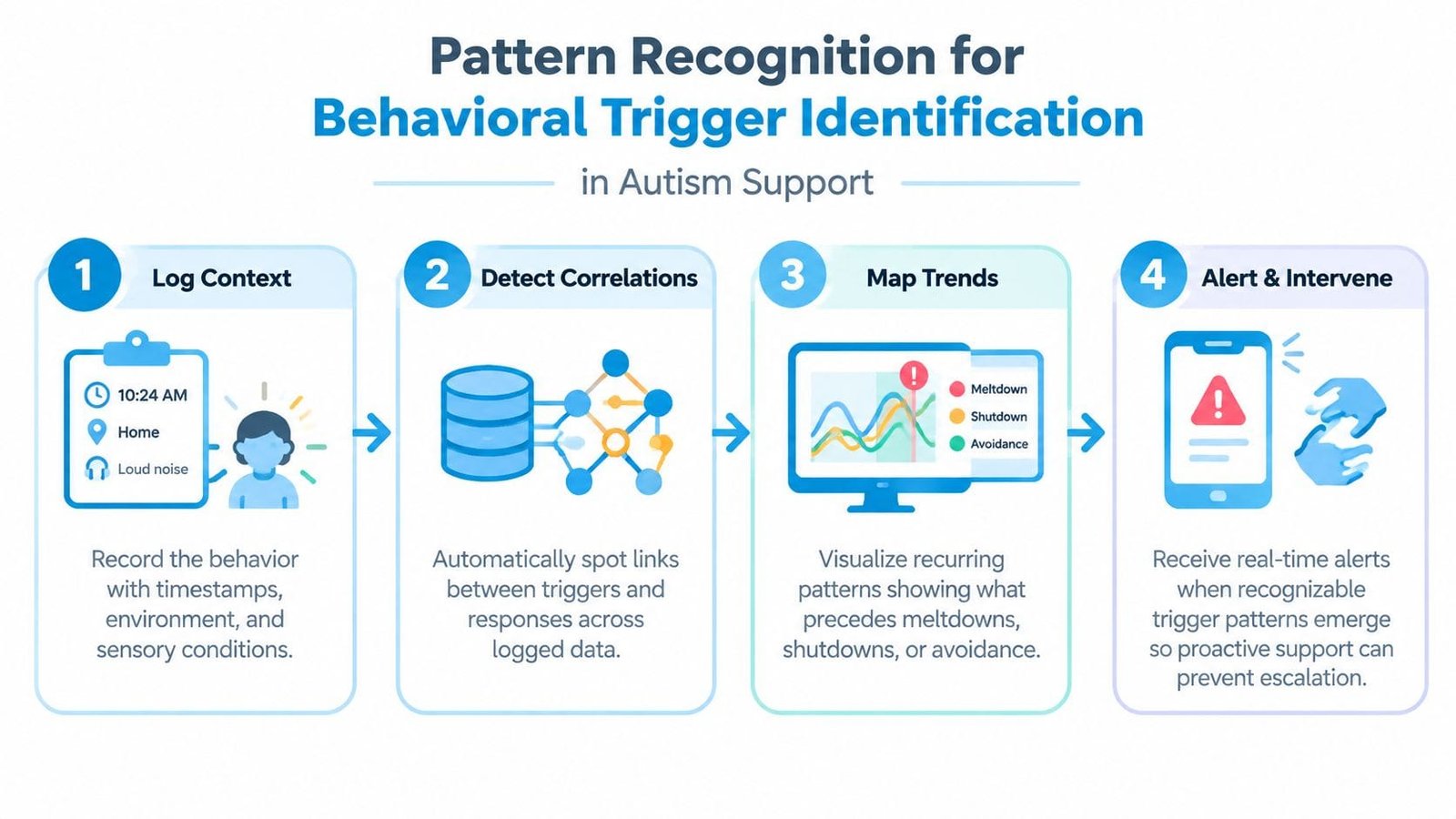
A behavior becomes more useful to interpret when you record what surrounded it. A meltdown after a family gathering may relate to crowding, noise, social demands, or accumulated fatigue. Stimming before visitors arrive may signal anticipation or anxiety, while shutdowns under fluorescent lighting may point toward a sensory condition that isn't obvious from the behavior alone.
Start with one observable event. Write down the time, location, people present, activity, sensory conditions, and what happened immediately beforehand. Also record what followed, such as a break, a change of demand, access to a preferred activity, or a longer recovery period.
A repeatable observation loop
A practical log might show that distress appears after transitions between activities, or that difficult moments tend to occur after arriving home from school. That doesn't establish a single cause, but it gives you comparable situations to review. Note meal timing, sleep quality, noise, lighting, textures, and changes in routine because context can alter how the same request feels.
- Define the event: Record what you saw, rather than using only a broad label such as “bad behavior.”
- Capture the setting: Include sensory details, demands, transitions, and who was involved.
- Compare similar moments: Look for recurrence across days with comparable routines.
- Test one adjustment: Try a visual warning, quieter space, transition time, or sensory break, then log the outcome.
This guide to tracking and understanding behavioral triggers can help families organize that process. Guiding Growth's voice logging is useful when a moment is moving quickly, and its connected records can bring behavior, sleep, nutrition, and routine context together. Its pattern tools may surface correlations worth discussing, but they shouldn't be treated as a diagnosis or proof of causation.
2. Sleep Cycle and Routine Pattern Recognition
A child may fall asleep more easily after late-afternoon movement, then take longer on evenings with screen use or a changed routine. Treat each observation as a clue, like matching pieces in a calendar, rather than proof that one activity caused the sleep difference. Record bedtime, estimated time to sleep, waking periods, wake time, and daytime mood, then add exercise, screens, meals, sensory activities, medication timing, and evening changes.
Begin with observable signals. “Awake and calling out” gives more usable information than “poor sleep.” The next day, note energy, irritability, attention, and regulation. A repeated pairing between disrupted sleep and daytime difficulty may deserve review, while a single night cannot establish a cause. Discomfort, excitement, schedule changes, or medication effects may also shape the pattern.
Build a comparable record
Compare nights with similar routines before interpreting differences. A simple log can include:
- Routine details: Record meals, movement, screens, bathing, sensory supports, and bedtime cues.
- Timing: Note sleep onset, waking periods, wake time, and medication timing. Do not change medication timing or dosage without guidance from the prescribing professional.
- Daytime signals: Connect the previous night with mood, focus, energy, and behavior.
- One adjustment: Change one routine element, such as reducing evening stimulation, then compare the next similar nights.
This observe, log, interpret, act cycle keeps the question specific. If movement appears helpful, repeat it under comparable conditions. If screens and delayed sleep occur together, log both without treating the relationship as a diagnosis. A structured approach to tracking sleep and health for autistic children can centralize sleep, activity, and medication context for family and clinician review. Guiding Growth visualizations may make recurring timing easier to discuss. Families can also consult practical 2026 circadian tips as general planning guidance, not an individualized treatment plan.

3. Dietary Sensitivity and Food Reaction Pattern Recognition
A meal is followed by food refusal, stomach discomfort, a rash, or unusual tiredness. That sequence may deserve attention, yet it does not identify a cause by itself. Pattern recognition works like comparing several similar observations: record what happened, look for repetition, then choose a safe next question.
Start with the meal context. Note ingredients, sauces, preparation, texture, temperature, presentation, portion description, and brand when relevant. Packaged foods that appear similar can differ in additives, so “snack” alone provides little to compare later.
Log observable responses rather than conclusions. Include digestive discomfort, skin changes, energy, sleep difficulty, refusal, or increased sensory sensitivity. Record when each signal began, how long it lasted, and what else differed that day, such as illness, stress, activity, or a changed routine. A single occurrence can suggest a question, not establish a sensitivity.
Preference and reaction may overlap. A child who refuses a crunchy food may be responding to texture, while stomach discomfort may emerge later. Describe both signals separately, including what was seen, heard, or reported.
A useful entry can answer four questions:
- What was offered? List ingredients, supplements, dyes, sauces, and brands when known.
- What was observed? Describe physical, behavioral, and sensory responses.
- When did it appear? Record the response window during the meal and afterward.
- What should happen next? Compare similar meals, share the record with a pediatrician or dietitian, and avoid restrictive experiments without professional guidance.
Use guidance for identifying food sensitivities to organize questions about nutrition and reactions. Guiding Growth can centralize meal details with later mood or behavior notes for family and clinician discussion. A repeated correlation is not a diagnosis, and a clinician can assess possible causes while protecting adequate nutrition.

4. Medication Efficacy and Response Pattern Recognition
A medication change may look helpful during one school morning, then appear different after poor sleep or a disrupted routine. The record should show what happened around the dose, not turn a single observation into a conclusion. Log the medication name, prescribed amount, administration time, missed doses, and observable effects. Separate focus, mood, behavior, appetite, sleep, and physical effects so “better” or “worse” does not hide important details.
For example, a repeated record might show harder settling at bedtime after an afternoon dose, or a benefit that is less noticeable under the same conditions. Compare similar days while noting weekends, school breaks, illness, stress, and schedule changes. These patterns can give a prescriber clearer questions, but correlation alone cannot show that medication timing caused every change.
Keep the observation specific: “Less able to settle at bedtime after the later dose” gives a clinician more useful information than “medication caused insomnia.”
Build a timeline before interpreting it
Mark the dose event first, then record what followed and when. A difficult day after poor sleep may reflect accumulated strain rather than a medication effect. A change that recurs across comparable days deserves review with the prescribing clinician.
- Record the dose event: Note the time, amount as prescribed, and whether it was taken as planned.
- Separate the signals: Track focus, mood, behavior, sleep, appetite, and physical effects independently.
- Log surrounding conditions: Include school changes, illness, family stress, sleep disruption, and other routine differences.
- Write the next question: Bring the timeline to the prescriber. Do not start, stop, skip, or alter medication from an app trend alone.
Guiding Growth can place medication, behavior, mood, sleep, and appointment notes in one shared record. Parents, caregivers, and medical professionals can review the context between visits, while the qualified professional familiar with the child's medical history makes treatment decisions. The app organizes observations for collaboration, not diagnosis.
5. Echolalia and Communication Pattern Recognition
A repeated phrase can serve different purposes. During anxious moments, a child may repeat comforting words. After hearing a conversation, delayed repetition may support language processing. During sensory overload, a movie line may provide a familiar script. The words alone do not identify the function, so record the event around them.
Start with the exact phrase, if possible. Mark whether the child repeated it immediately or later, then note observable signals such as tone, facial expression, gestures, body movement, and distance from others. Record what happened next. Did the phrase continue during a transition, decrease after a break, accompany a request, or appear alongside avoidance or an attempt to connect?
A repetition during relaxed play may differ from one during a crowded activity. Describe the difference without deciding that every echo has one meaning. Nonliteral language can still communicate. Interpretation should remain open for discussion with caregivers and the child's communication team.
Use a simple observe, log, interpret, act cycle:
- Observe the setting: Record the preceding conversation, demand, transition, sensory event, and people present.
- Log timing and state: Separate immediate from delayed repetition, and note whether the child appeared calm, excited, anxious, tired, or distressed.
- Interpret cautiously: Compare similar situations. A recurring pattern may suggest processing, self-regulation, connection, or transition support, but it is not a diagnosis.
- Act on the next opportunity: Offer time, a break, visual support, or a clear way to respond, then record the outcome rather than assuming the same support will always help.
Guiding Growth's contextual behavior logging can capture a voice note with the phrase, location, and change afterward. Parents, caregivers, and speech-language professionals can review repeated situations together. The aim is to understand support needs, not automatically eliminate repetition.
6. Stimming Behavior Pattern Recognition and Sensory Needs
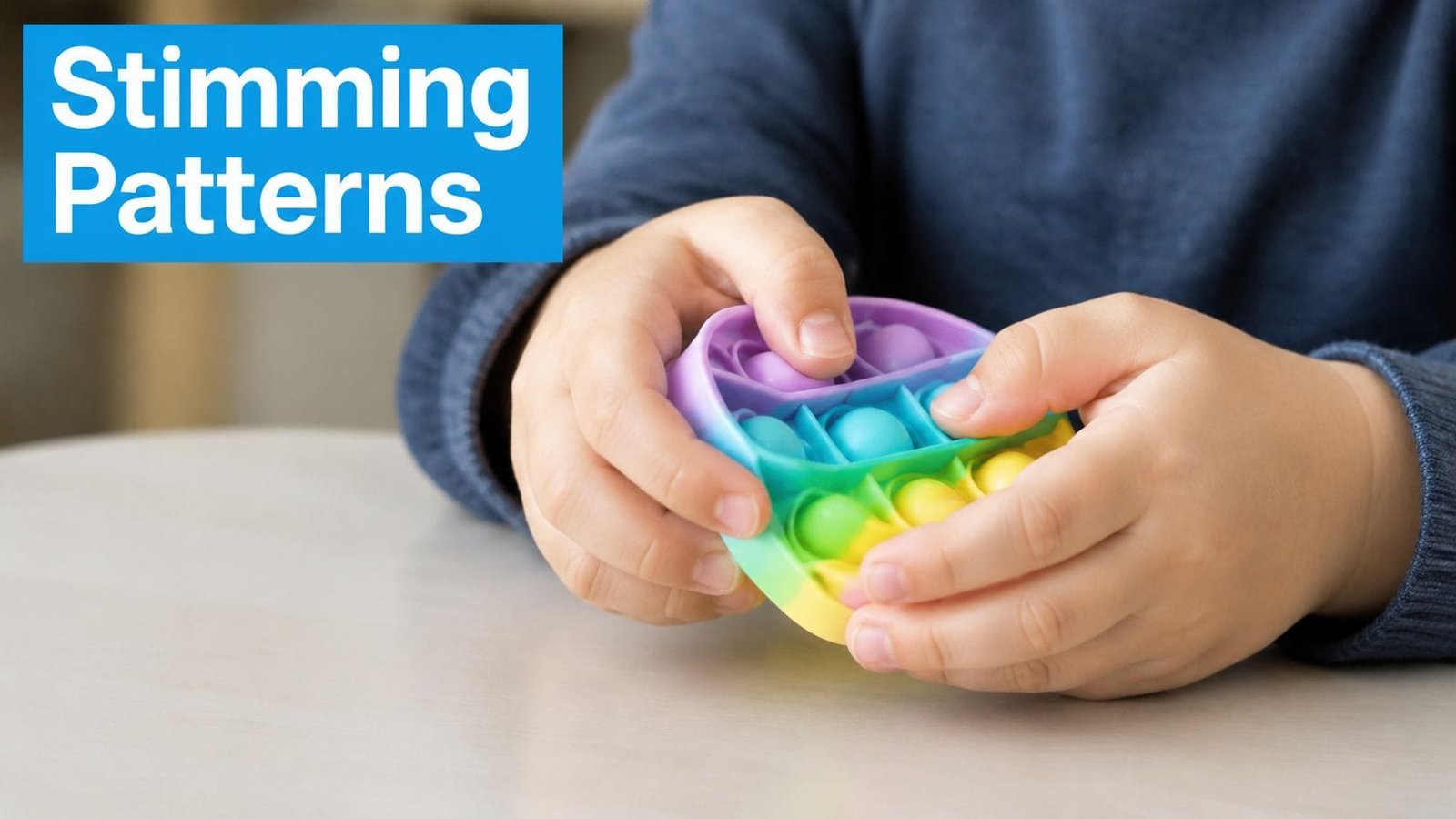
A child may rock while waiting, flap their hands during joyful play, or make vocal sounds after a demanding day. These actions can support concentration, anticipation, sensory regulation, or recovery from distress. The same movement can serve different purposes, so its frequency does not establish its meaning.
Start with a precise description, almost like recording a short scene: what movement or sound occurred, where it happened, what came immediately before it, and what changed afterward. Include noise, lighting, textures, crowding, activity demands, fatigue, and access to preferred sensory input. Note observable signs such as smiling, relaxed posture, covering ears, faster movement, withdrawal, or attempts to leave.
Follow the change in context
A useful record compares similar moments. Hand flapping that increases before a transition may coincide with uncertainty. Spinning after a demanding school day may provide movement or recovery. If quiet space, a movement break, music, texture, or a preferred tool changes the situation, log the conditions and response. One successful trial does not show that the same support will help every time.
The practical question is what the movement may be helping the child manage now, rather than how to suppress it.
- Describe: Record the form, duration, setting, preceding event, and observable state.
- Compare: Group entries by activity, sensory conditions, social demands, and fatigue.
- Interpret carefully: A recurring association can guide support planning, but it is not a diagnosis.
- Try and review: Offer an appropriate support, record the outcome, and share the context with caregivers and relevant professionals.
Guiding Growth can centralize stimming notes with activities and environmental conditions, allowing families and support teams to review patterns together. Use the record to improve access and communication, not to treat a repetitive action as a problem by default.
7. School Performance and Environmental Adaptation Patterns
A student may complete similar work differently across settings. A quiet small group, a crowded classroom, morning lessons, and afternoon demands can produce different levels of participation. Observable signals include grades, unfinished work, delayed task starts, engagement, or behavior reports. Compare these records with home observations instead of treating one result as a fixed ability.
Start with one learning event. Log the task, instruction format, time, setting, group size, sensory conditions, and the student's observable response. Add relevant context such as sleep quality, the morning routine, medication timing, schedule changes, social events, illness, and transitions. Teacher notes can clarify what a score or grade leaves out.
“Struggles with math” gives little direction. “Starts the worksheet, then stops as the room becomes noisy” identifies a condition that the team can review. If participation declines after poor sleep, compare other occasions with similar sleep and different workloads, classroom changes, or transition demands. A repeated association can guide a support trial, but it does not establish a diagnosis or a single cause.
Use a brief comparison table or shared log:
- Learning event: Record the task, instructions, environment, and completion behavior.
- Observable signals: Note initiation time, requests for help, breaks, errors, withdrawal, or sustained engagement.
- Context check: Compare sleep, morning transitions, medication timing, sensory input, workload, and social demands.
- Next action: Test one modest adaptation, such as quieter seating, a smaller group, visual instructions, processing time, or a planned break. Review whether participation changes.
Guiding Growth can centralize selected home observations with school notes, helping caregivers and educators review context together. The shared record does not replace school documentation or an individualized education process. It gives the team a clearer basis for discussing which conditions support access, participation, and learning.
8. Shutdown and Demand Avoidance Pattern Recognition
Shutdown may look like reduced responsiveness, withdrawal, limited speech, or little visible engagement. Demand avoidance can appear as refusal, delay, negotiation, escape, or distress after a request. These signals may reflect stress or overload, yet behavior alone cannot identify the cause.
Start with the moment before the demand. For example, “Put shoes on” may be manageable when shown in a calm routine but difficult as a sudden verbal instruction during a rushed transition. A fine-motor task may create a different barrier from a social request. Record the wording, timing, activity, sensory setting, apparent energy, and what happened after offering processing time or a break.
A useful comparison asks whether the difficulty belongs to the demand, the conditions around it, or both. Compare similar requests after a high-input environment, poor sleep, or a demanding social period with occasions that were calmer. Separate transitions, self-care, academic work, social requests, and fine-motor tasks. A repeated association can guide a support trial, but it does not prove one explanation or diagnose demand avoidance.
Use a brief observe, log, interpret, act cycle:
- Observe: Note withdrawal, silence, delayed movement, escape attempts, negotiation, distress, or continued participation.
- Log: Record the request, lead-up, sensory input, fatigue, social pressure, available choice, and response time.
- Interpret carefully: Compare similar demands across different contexts rather than treating refusal as intentional behavior or a fixed trait.
- Act: Try one change, such as visual information, a choice, extra processing time, a predictable sequence, or a planned break. Record whether the response changes.
Guiding Growth can connect these notes with emotional state, sensory context, activities, and sleep records, giving caregivers and educators a shared view for collaboration. The record supports discussion, not diagnosis. Safety concerns or a significant change from usual behavior warrant appropriate professional advice.
8-Point Pattern Recognition Comparison
| Approach | 🔄 Implementation Complexity | ⚡ Resource Requirements | 📊 Expected Outcomes (⭐) | 💡 Ideal Use Cases | ⭐ Key Advantages |
|---|---|---|---|---|---|
| Behavioral Trigger Identification in Autism Support | Moderate, consistent multi-week logging 🔄 | Medium, caregiver logging / app analytics ⚡ | High, clear trigger identification, fewer meltdowns 📊 ⭐⭐⭐⭐ | Transitions, sensory overload, routine-related meltdowns 💡 | Proactive interventions; clearer therapist communication ⭐ |
| Sleep Cycle and Routine Pattern Recognition | Moderate, nightly logs + correlations 🔄 | Medium–High, sleep logs, optional wearables, consistent input ⚡ | High, improved sleep quality and daytime functioning 📊 ⭐⭐⭐⭐ | Insomnia, delayed sleep onset, medication timing for sleep 💡 | Data-driven routine optimization; supports clinicians ⭐ |
| Dietary Sensitivity and Food Reaction Pattern Recognition | High, ingredient-level & delayed-effect analysis 🔄 | High, detailed meal logs, time investment ⚡ | Moderate–High, identify food-behavior/GI links 📊 ⭐⭐⭐ | Suspected food sensitivities, mood/GI symptoms after meals 💡 | Enables targeted elimination; reduces unnecessary restrictions ⭐ |
| Medication Efficacy and Response Pattern Recognition | High, multi-medication timelines & delayed effects 🔄 | Medium, precise med timing + symptom tracking ⚡ | High, objective evidence for dose/med changes 📊 ⭐⭐⭐⭐ | Polypharmacy, unclear side effects, dosing schedule reviews 💡 | Supports prescriber decisions; reveals interactions ⭐ |
| Echolalia and Communication Pattern Recognition | Moderate, context-rich phrase logging 🔄 | Low–Medium, voice/context logging helps ⚡ | Moderate, clarifies function of repetition (self-regulation/communication) 📊 ⭐⭐⭐ | Speech therapy, decoding self-soothing vs. communication 💡 | Reframes echolalia as meaningful; aids SLP work ⭐ |
| Stimming Behavior Pattern Recognition and Sensory Needs | Moderate–High, detailed type/intensity tracking 🔄 | Medium, sensory environment and behavior logs ⚡ | High, distinguish joy vs. distress; enable preventive supports 📊 ⭐⭐⭐⭐ | Sensory regulation planning, environment/tool adjustments 💡 | Destigmatizes stimming; enables preventive sensory input ⭐ |
| School Performance and Environmental Adaptation Patterns | High, requires educator collaboration & multi-factor data 🔄 | High, teacher input, shared logs, home-school coordination ⚡ | High, improved accommodations and targeted IEP goals 📊 ⭐⭐⭐⭐ | Academic struggles, timing/setting-dependent performance issues 💡 | Data-driven home-school collaboration; tailored supports ⭐ |
| Shutdown and Demand Avoidance Pattern Recognition | High, subtle signs and multi-factor triggers 🔄 | Medium, contextual demand & emotional logging ⚡ | High, reduced shutdowns/avoidance through proactive changes 📊 ⭐⭐⭐⭐ | Transitions, non-preferred tasks, high sensory/social demand scenarios 💡 | Reframes avoidance as distress; reduces family conflict ⭐ |
From Repeated Moments to Better Next Steps
Across all eight examples, the method stays consistent. Define the observable event, capture what came before and after, look for recurrence across comparable situations, test one practical adjustment, and review the result. This approach turns “it keeps happening” into a clearer record without pretending that every correlation explains the whole situation.
Start with behavior you can describe. Instead of “school was difficult,” record that the child covered their ears during a noisy transition and needed quiet time afterward. Instead of “sleep was bad,” record bedtime, approximate settling time, waking periods, evening activities, and the next day's observable energy or mood.
A careful pattern review
Comparison matters. A single difficult evening can't tell you whether a food, medication, screen, demand, or sensory condition caused the outcome. Look for recurrence under similar conditions, and note what differs on occasions when the expected pattern doesn't appear.
Correlation is a clue, not proof of causation. Sleep, nutrition, medication, illness, stress, sensory input, communication demands, and school conditions can overlap. Decisions about medication, restrictive diets, sleep treatment, or educational support should be discussed with appropriate professionals, who can consider medical history and other relevant evidence.
Use a compact starting plan:
- Choose one pattern: Pick a recurring event that matters to daily life.
- Define the signal: Describe what someone could observe, hear, or record.
- Capture context: Log the time, place, people, activity, sensory conditions, and preceding events.
- Compare fairly: Review similar situations rather than treating every day as equivalent.
- Test one low-risk adjustment: Change one support and record what follows.
- Share the record: Bring useful observations to caregivers, educators, therapists, or clinicians.
Guiding Growth can support this process with quick voice logging, connected behavior, sleep, nutrition, medication, appointment, and therapy records, plus visualizations for reviewing recurring context. Collaboration tools can help families share relevant information with caregivers and professionals, while Alma AI can help organize questions and observations for an autism-parenting conversation. It shouldn't diagnose a child or replace professional advice, but it can reduce the guesswork created by scattered notes.
A well-kept log also protects clarity. Write down what you observed, what you tried, and what changed, rather than copying another person's interpretation without checking the original context. Families and students who need guidance on responsible source use can review how to avoid plagiarism at school, while caregivers can apply the same principle to daily records by separating direct observation from inference.
Choose one recurring moment this week and record it consistently. After reviewing the context, discuss one reasonable adjustment with the people supporting your child, then keep the result for comparison rather than relying on memory.
Guiding Growth brings voice logging, behavior and sensory tracking, sleep and nutrition records, medication and appointment management, visualizations, collaboration tools, and Alma AI support into one mobile app. Visit Guiding Growth to turn everyday observations into shared context for more thoughtful next steps.