Your child is halfway through getting dressed when you say, “Please put on your shoes.” Suddenly, they hide under a table, change the subject, start laughing, or shout that they won't go anywhere. A request that seemed small to you has produced a reaction that feels far bigger than the task.
You may be wondering whether your child is being defiant, overwhelmed, anxious, or testing limits. Those questions can leave families caught between compassion and exhaustion. Demand avoidance is often less about refusing a task and more about a nervous system reacting to perceived pressure, especially when anxiety, uncertainty, sensory overload, and a need for control are involved.
Table of Contents
- A Parent's Guide to Understanding Demand Avoidance
- Defining Demand Avoidance and the PDA Profile
- Common Signs of Demand Avoidance in Children
- Is It Demand Avoidance or Something Else
- Understanding the Triggers and Underlying Causes
- Practical Strategies for Supporting Your Child
- Frequently Asked Questions About Demand Avoidance
A Parent's Guide to Understanding Demand Avoidance
Maya's parent notices a pattern. Maya can choose to draw for a long time, but when someone asks her to draw a picture for school, she suddenly says her hand hurts. If her parent repeats the request, Maya may begin telling elaborate jokes, ask unrelated questions, or become distressed. On another day, she may agree immediately, then become upset when it's time to begin.
From the outside, these reactions can look calculated. A parent might think, “She heard me, she understands the request, and she knows what needs to happen.” That interpretation misses what may be happening internally. For some children, a demand creates a rapid sense of threat, as though someone has taken away their ability to decide what happens next.
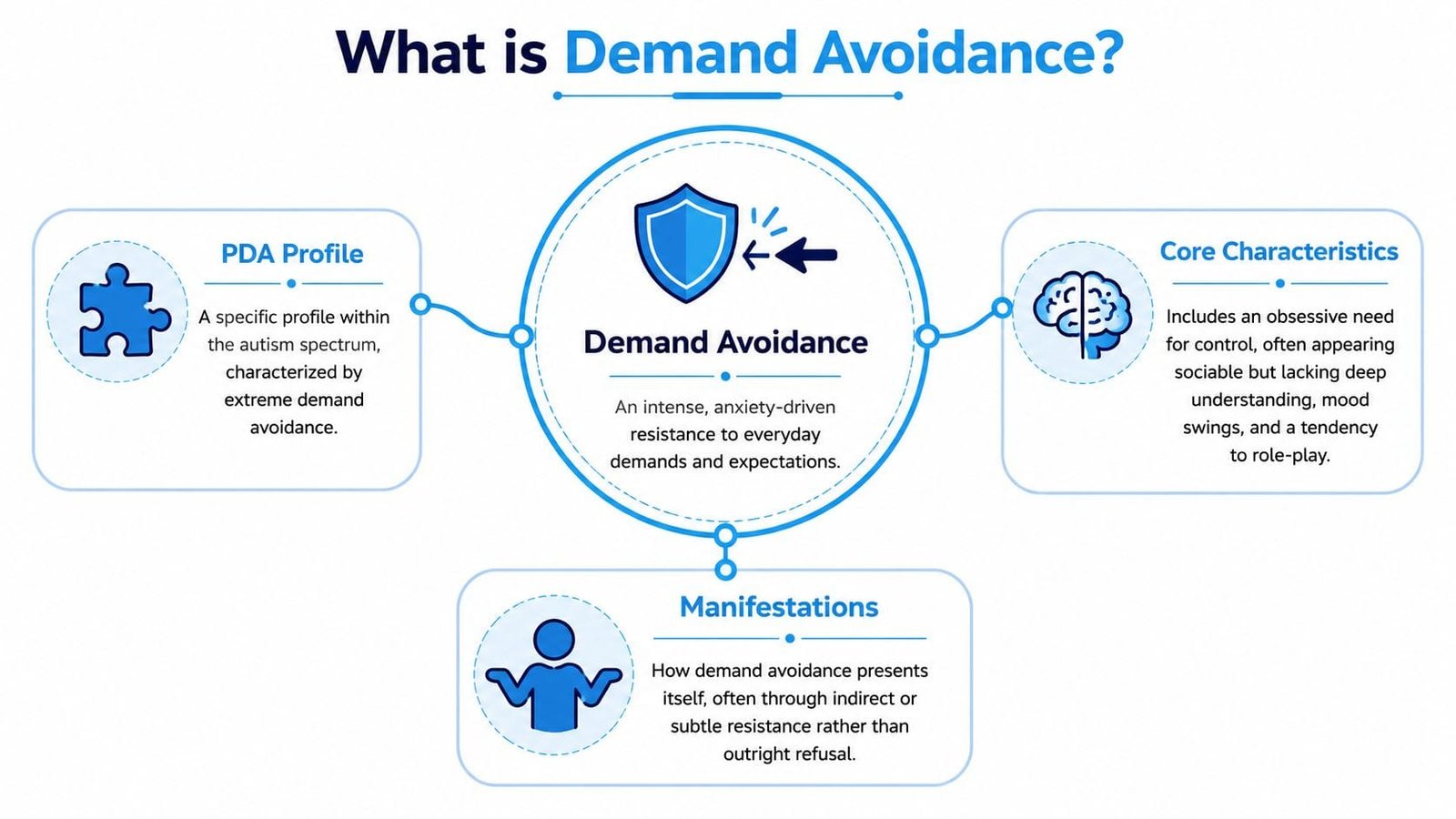
Demand avoidance is a pattern of intense resistance to everyday expectations. It can affect direct requests, indirect expectations, transitions, self-care, schoolwork, and even activities a child normally enjoys. The child may want the outcome but still feel unable to start once the activity becomes something they're expected to do.
A useful starting point: Treat the reaction as information about stress, not proof of bad character.
This perspective doesn't mean every request should disappear or that parents must accept unsafe behavior. It means the adult first asks, “What made this feel impossible?” rather than immediately increasing pressure. A calmer response can reveal whether the difficulty came from anxiety, fatigue, sensory discomfort, unclear instructions, a transition, or the feeling of being controlled.
The phrase Pathological Demand Avoidance, often shortened to PDA, is used for a profile associated with extreme demand avoidance in some autistic people. The terminology remains debated, and the pattern doesn't look identical in every child. What matters practically is recognizing the demand-stress interaction and adjusting support so the child can feel safer, more capable, and more involved in decisions.
Defining Demand Avoidance and the PDA Profile
Demand avoidance describes a strong drive to escape or resist demands. A demand can be obvious, such as “Brush your teeth,” or less direct, such as seeing a packed school bag and knowing it needs to be prepared. It can also be internal. Hunger, tiredness, or the thought “I should start my homework” may create pressure even when nobody else has said anything.
The threat-detector analogy
Think of your child's nervous system as having a smoke alarm. A well-calibrated alarm reacts mainly to smoke. An oversensitive alarm may sound when toast browns or steam rises from a shower. In a similar way, a child with strong demand avoidance may experience an ordinary request as a signal of danger, loss of control, or possible failure.
The body can then move toward fight, flight, freeze, or a more indirect escape response. The child might argue, run away, negotiate, joke, pretend not to hear, become suddenly interested in something else, or collapse emotionally. These actions can be deliberate attempts to regain safety, even when the child can't explain that process.
PDA describes a profile, not a simple choice to disobey. Many of the behaviors associated with it also occur in autistic children who don't identify with the PDA profile. A careful interpretation looks at the full pattern, including anxiety, social understanding, sensory experiences, flexibility, emotional regulation, and what happens when pressure is reduced.
Where the concept came from
The term Pathological Demand Avoidance was first described in the 1980s by British developmental psychologist Elizabeth Newson at the University of Nottingham. Newson identified children who showed an obsessive resistance to everyday demands and a strong need for control. She later published the first peer-reviewed paper on PDA in 2003, as documented in this historical overview of demand avoidance.
Autism classification shifted in 2013, when the DSM-5 replaced earlier pervasive developmental disorder categories with Autism Spectrum Disorder. That change helped renew debate about whether PDA or extreme demand avoidance should be understood as a profile within autism rather than a separate condition.
Common Signs of Demand Avoidance in Children
A child may avoid demands openly, subtly, socially, or through intense emotional reactions. The same child can use different strategies depending on the setting, the person making the request, and their current level of exhaustion.
Consider a child who is asked to leave the playground. They may say “No,” but they might also begin a long story, claim they need to find a particular leaf, ask a string of unrelated questions, or invite the adult into a game. These responses can look playful while serving an important purpose: delaying or escaping the demand.
Social and indirect strategies
Common patterns can include:
- Changing the subject: The child redirects conversation whenever an expectation appears.
- Making excuses: They may suddenly report a stomachache, missing item, impossible problem, or urgent need.
- Procrastinating: They negotiate for “one more minute” repeatedly or begin several unrelated activities.
- Using charm or humor: Jokes, role-play, flattery, or exaggerated friendliness may soften the demand or move attention elsewhere.
- Appearing socially confident: A child may seem sociable and talkative on the surface while struggling with deeper social rules, hidden expectations, or the reason a request matters.
Emotional and behavioral responses
Pressure can produce a rapid change in mood. A child who was calm moments earlier may become panicked, angry, tearful, silly, silent, or physically restless. Some children seem to switch quickly between emotional states because their capacity to cope has already been exceeded.
The response may be indirect rather than an outright refusal. A child might agree but fail to begin, hide necessary materials, become absorbed in fantasy, or repeatedly ask how the task should be done. Role-play and pretend identities can feel safer than direct participation because the child has more control over the situation.
Research comparing children identified with a PDA profile found autistic traits and peer problems comparable to an autism comparison group, while emotional symptoms exceeded those in both the autism and conduct-problem comparison groups. This supports understanding demand avoidance as closely connected to increased emotional distress rather than simple oppositionality, according to the comparative research on PDA features and emotional symptoms.
When a reaction becomes intense, parents may also need to distinguish a meltdown from a shutdown. The meltdown versus shutdown guide can help you observe whether your child is expressing overload outwardly or losing the ability to respond and engage.
Direct versus indirect demands
Some children resist direct instructions most strongly. Others struggle with implied expectations, such as seeing a pile of laundry, knowing a sibling is waiting, or realizing an appointment is approaching. A demand can become harder when it is urgent, public, unfamiliar, or connected to a previous experience of failure.
Look for patterns rather than isolated incidents. One refusal doesn't establish a PDA profile. Repeated reactions across daily routines, especially when they lessen after pressure and uncertainty are reduced, offer more useful information.
Is It Demand Avoidance or Something Else
Refusal alone doesn't identify the cause. Typical childhood resistance, anxiety, sensory overload, executive-function difficulty, trauma-related responses, and Oppositional Defiant Disorder can overlap in appearance. A qualified professional should consider the whole developmental picture rather than relying on one behavior.
The most helpful distinction concerns what the behavior is trying to solve. Demand avoidance is generally understood as an anxiety-linked response to pressure and a need to preserve autonomy. ODD involves a persistent pattern of angry, argumentative, or vindictive behavior and conflict with authority. Typical defiance often appears during developmentally expected struggles over limits, fatigue, preferences, or independence.
| Characteristic | Demand Avoidance, PDA Profile | Oppositional Defiant Disorder, ODD | Typical Childhood Defiance |
|---|---|---|---|
| Main motivation | Reducing anxiety, escaping perceived threat, and restoring control | Challenging authority, expressing anger, or responding to conflict | Testing limits, expressing preferences, or seeking independence |
| Type of demand | Many kinds of demands may trigger distress, including indirect or self-imposed expectations | Conflict may center more clearly on rules, authority, or interpersonal disagreements | Resistance is usually linked to particular tasks, limits, or developmental stages |
| Presentation | Avoidance may be subtle, playful, socially strategic, emotional, or silent | Arguing, irritability, deliberate annoyance, and defiance may be prominent | The child may complain or refuse but can often recover with support |
| Emotional state | Anxiety, panic, shame, overwhelm, or a strong sense of being trapped may appear | Anger and resentment are often central features | Frustration usually reduces after boundaries are clear or the child calms |
| Response to pressure | More pressure can intensify avoidance, escalation, or shutdown | Consequences may not resolve the underlying conflict and can increase argument | Consistent, calm limits often help the child return to the activity |
| Helpful first response | Lower pressure, offer choices, clarify expectations, and support regulation | Assess relationships, patterns of anger, and broader behavioral needs | Use predictable boundaries, empathy, and age-appropriate choices |
These distinctions aren't diagnostic rules. A child can have more than one area of need, and anxiety can accompany many developmental or mental-health presentations. The table is useful because it encourages adults to ask whether a child is protecting autonomy from an internal threat, fighting a relationship-based conflict, or pushing against a limit in a more typical developmental way.
Avoid using labels as accusations. Saying “You're being manipulative” or “You just want control” may add shame and increase the very pressure that makes the response worse. Describe what you observe instead: “The request seemed to become harder when it was repeated,” or “You looked worried when the plan changed.”
A professional assessment can consider autism, anxiety, attention differences, sensory processing, communication, learning needs, sleep, and family context. The goal isn't to win an argument about a label. It's to identify support that reduces distress while preserving safety and realistic expectations.
Understanding the Triggers and Underlying Causes
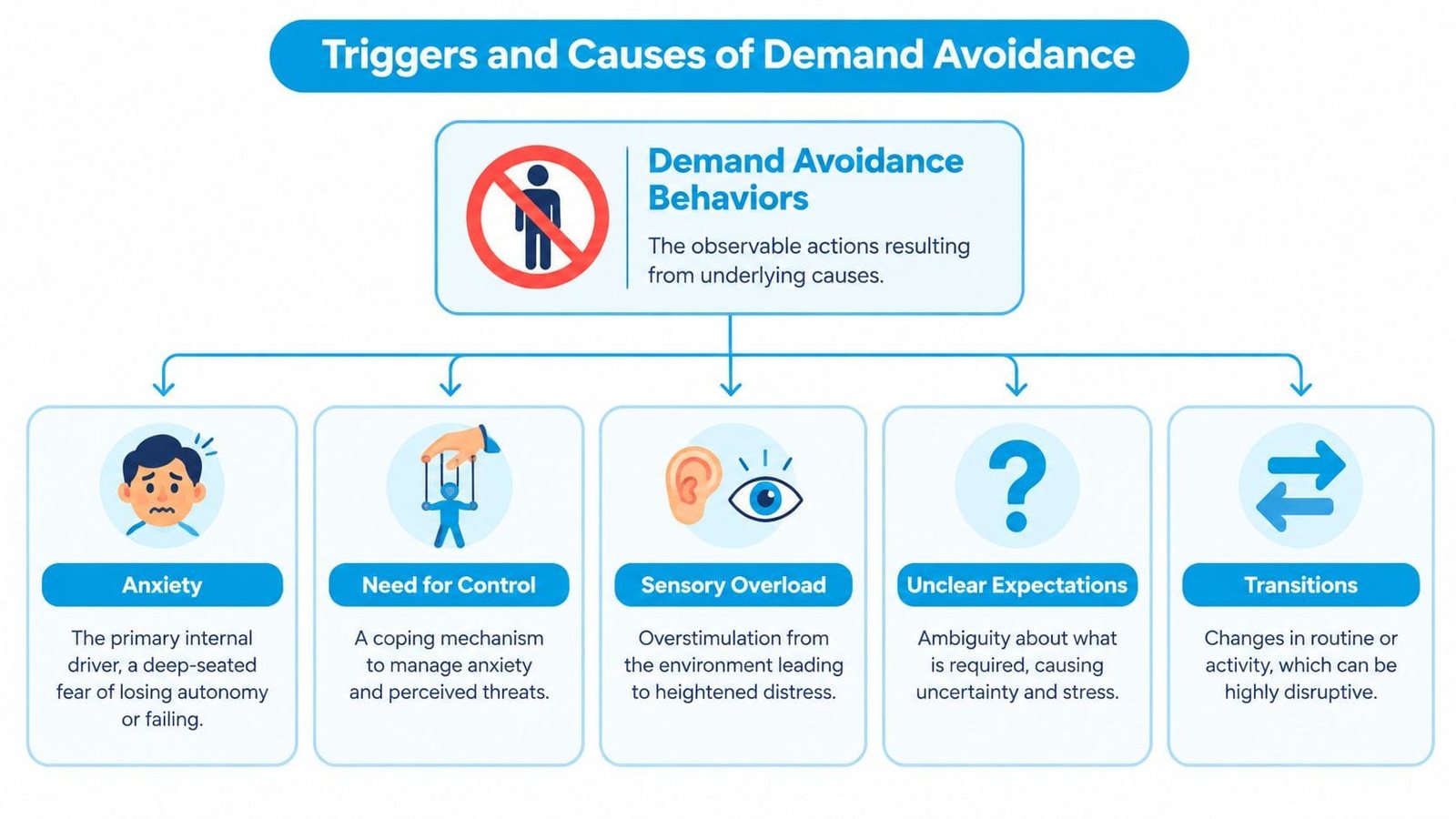
Demand avoidance usually makes more sense when adults examine what happens before the refusal. A request may be the final event in a longer chain that includes poor sleep, a noisy room, an unexpected transition, unclear instructions, fear of failure, and several earlier demands.
Anxiety and the loss of autonomy
Anxiety is a major part of the evidence base. A 2022 study using two large adult survey samples found that autistic traits and anxiety were both unique and equally important predictors of demand avoidance, supporting an anxiety-driven interpretation rather than simple defiance. You can review the study on autistic traits, anxiety, and demand avoidance.
For a child, “Put your coat on” may carry hidden meanings: “Stop what you're doing,” “Do it correctly,” “We're leaving now,” or “You can't decide anymore.” The words are short, but the perceived consequences can feel large. Avoidance restores a temporary sense of control, which can reinforce the pattern without the child consciously choosing it.
Sensory processing and uncertainty
Sensory input can raise the nervous system's baseline stress. Tactile sensitivity may make clothing, shoes, hair brushing, or physical guidance uncomfortable. Sensory seeking can also shape how a child regulates attention and emotion. A demand that arrives in a crowded, bright, noisy, or physically uncomfortable environment may be harder than the same demand in a quiet space.
Recent research summaries report that higher anxiety and autistic traits are consistently associated with demand avoidance. They also identify sensory reactivity, especially tactile sensitivity and sensory seeking, as a distinctive feature of the autism-plus-PDA group, as described in this research overview on PDA and sensory factors.
A demand is part of a system
Transitions, unclear expectations, and accumulated pressure can interact. The practical question becomes, “Which part of this situation can we make safer?” Parents might reduce the language load, show the next step visually, offer a choice about order, move to a quieter room, or build in recovery time.
The sensory-trigger guide for autistic children can support this kind of observation. The aim isn't to remove every challenge. It's to understand the conditions that raise distress so your child has a better chance of participating without entering threat mode.
Practical Strategies for Supporting Your Child
Support works best when it lowers perceived pressure without abandoning important needs. Start with one routine, such as leaving home, getting dressed, or beginning schoolwork. Changing everything at once makes it difficult to know which adjustment helped.
Reduce pressure while keeping the goal visible
Try these adjustments:
- Use declarative language: Instead of “Put your shoes on now,” try “Your shoes are by the door.”
- Offer bounded choices: “Do you want the blue shoes or the black ones?” gives control without creating unlimited negotiation.
- Shrink the first step: “Let's find one sock” may be more manageable than presenting the entire dressing routine.
- Make the request collaborative: “Should we pack the bag together or check the list first?”
- Use playful framing carefully: A race against a timer, a pretend mission, or a silly voice may help if your child enjoys it. Stop if play feels like another demand.
- Allow processing time: Repeating an instruction quickly can raise pressure. Say it once, pause, and watch your child's response.
- Prepare for transitions: A visual sequence, preview, countdown, or object representing the next activity can reduce uncertainty.
- Co-regulate first: Lower your voice, reduce extra words, move away from an audience, and help your child feel safe before discussing the task.
These are not tricks designed to force compliance. They're ways to protect autonomy and reduce the threat response while still working toward daily-life goals. The PDA strategies guide for autistic children offers additional examples focused on wording, timing, flexibility, and sensory context.
Practical rule: If your child's distress rises sharply, reduce the demand load before adding explanations.
Tracking can turn a confusing pattern into a clearer question. With a tool such as Guiding Growth, parents can log demand avoidance alongside meltdowns and shutdowns, record the request, time of day, setting, sensory conditions, and outcome, then review patterns over time. The app also supports records for sleep, diet, medication, appointments, and therapy sessions, which can help families bring organized observations to clinicians and educators.
A simple note might show that refusal is more likely after a noisy school day, during rushed mornings, or when instructions contain several steps. You can then test one change, such as offering a visual choice or moving a task earlier, and record what happens. This approach replaces memory-based guesswork with observations that support collaborative planning.
Parents and educators who want broader skills in inclusive practice may also find OCAD SEND courses useful for developing understanding of special educational needs and disabilities. Learning can help adults respond consistently across home and school rather than placing the entire burden on the child.
Guiding Growth can also help caregivers share the same context, so a parent, teacher, therapist, or family member isn't working from a different interpretation of the behavior. The point is not to collect data for its own sake. The point is to notice what lowers distress and repeat the conditions that help your child participate.
Research suggests that a meaningful minority of autistic people may show demand-avoidant traits, possibly as many as 1 in 5, according to the published study on possible clinical PDA. Your family isn't alone, and needing a different approach doesn't mean you've failed to set boundaries.
Frequently Asked Questions About Demand Avoidance
Is Pathological Demand Avoidance a formal diagnosis?
No. Demand avoidance is a recognized behavioral profile discussed particularly in relation to some autistic children, but PDA isn't currently listed as a standalone diagnosis in major diagnostic manuals such as the DSM-5. A systematic review found only 13 studies and highlighted continuing debate about definition, measurement, prevalence, cause, and whether PDA represents a distinct profile or a cluster of anxiety-linked behaviors, as reported in this review of the PDA research base.
Will my child grow out of it?
There isn't a reliable answer for every child. Demand avoidance may change with development, communication, self-awareness, anxiety support, sensory accommodations, and the environments around the child. The most useful goal is not waiting for the pattern to disappear. It's helping your child recognize stress, access autonomy, communicate needs, and build practical ways to approach necessary tasks.
How should I explain demand avoidance to school or family?
Use plain language: “Requests can trigger anxiety and a strong need for control. Pressure may increase the reaction, so we're using choices, fewer words, predictable transitions, and calm co-regulation.” Share specific examples and describe what helps, rather than asking others to accept a label without context.
Keep safety boundaries clear. A low-demand approach still includes limits around danger, health, and other people's rights. It delivers those limits with as much calm, clarity, flexibility, and collaboration as the situation allows.
Guiding Growth gives parents one place to log demand avoidance, meltdowns, shutdowns, sensory triggers, routines, and related care details so patterns are easier to recognize and share. Visit Guiding Growth to explore how structured tracking can help you replace daily guesswork with practical, compassionate support.