After another long IEP meeting, you may be sitting in the parking lot with a folder on your lap, trying to remember which details belong to the school team, which belong to the therapist, and which still need to reach your child's pediatrician. One caregiver has a text thread, another has a notebook, and someone else is waiting for access to a portal. The information exists, but it's scattered across people, places, and systems.
An information sharing platform brings those pieces into a coordinated space. For autism families, that means more than saving time. It means protecting context, building trust, and helping the people who support your child respond to the same picture.
Table of Contents
- The Moment Every Autism Parent Recognizes
- What an Information Sharing Platform Really Is
- Core Capabilities That Matter in Daily Care
- Why Families and Care Teams Benefit
- Privacy, Consent, and Security Done Right
- How to Choose the Right Platform
- Real Collaboration Scenarios in Practice
- Bringing It All Together With Guiding Growth
The Moment Every Autism Parent Recognizes
It's Tuesday afternoon. You leave an occupational therapy session with a handwritten note about a difficult transition and a strategy that helped. Your child's grandparent texts to ask whether the new afternoon routine is still working. Meanwhile, the behavior therapist is waiting for a portal login and doesn't know that school was unusually noisy today.
Everyone is holding one part of the story. Nobody has the whole week.
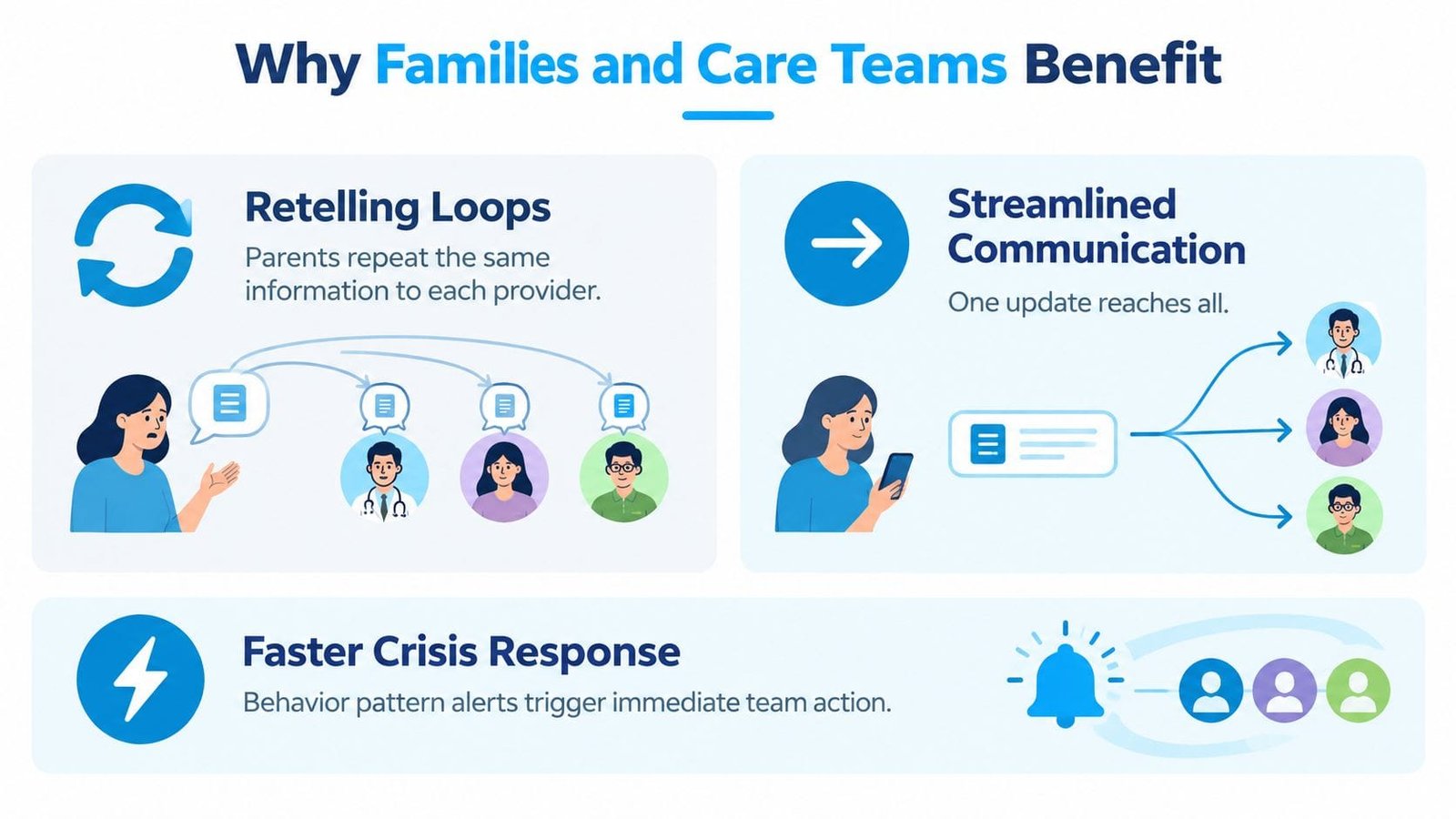
You may end up retelling the same event several times, but each retelling changes slightly. The clinic hears about the meltdown after the fact. The grandparent remembers the food refusal but not the earlier sleep disruption. The therapist knows the intervention but not what happened at school. You become the human router, carrying updates in your head and translating between home, therapy, and education.
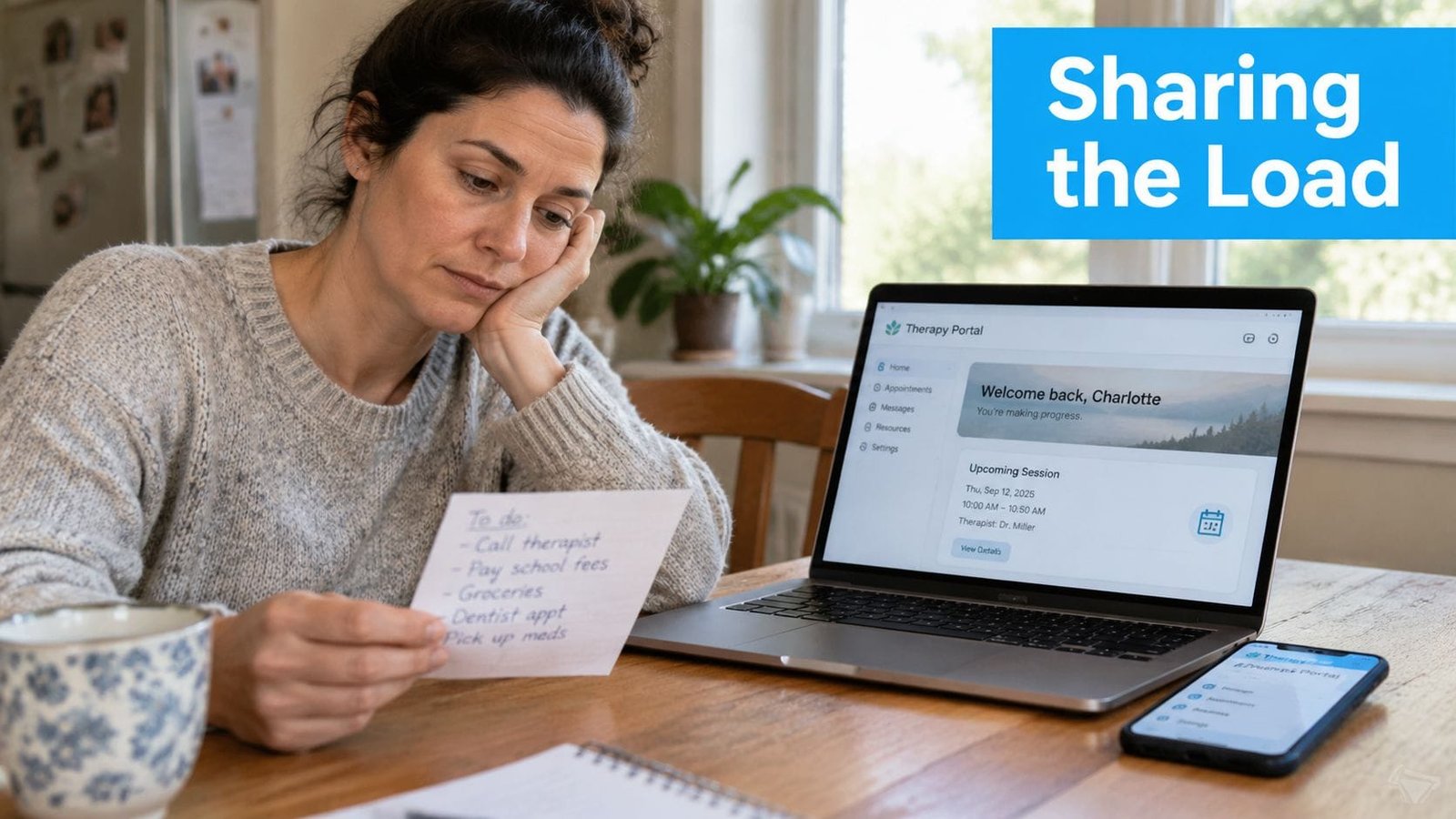
A shared timeline changes the handoff. The parent, grandparent, and therapist can see the same morning entry, including the setting, the trigger, what happened during the episode, and which response helped. They can also add their own observations without forcing one person to reconstruct the entire week.
That shared view matters because autism support depends on details. A behavior can look different at home, school, and therapy. A strategy that works in one setting may need adjustment in another. Caregivers need a way to preserve those differences without losing the common thread.
A single source of truth for care information doesn't remove the work of supporting a child. It keeps parents from carrying every update alone. The platform becomes relationship infrastructure, helping each person arrive with context, respect the family's knowledge, and contribute to decisions that make sense across settings.
What an Information Sharing Platform Really Is
Think of an information sharing platform as a shared family calendar that also stores notes, voice memos, photos, permissions, and care history. A calendar tells everyone where they need to be. A care platform helps them understand what happened, what changed, and what should happen next.
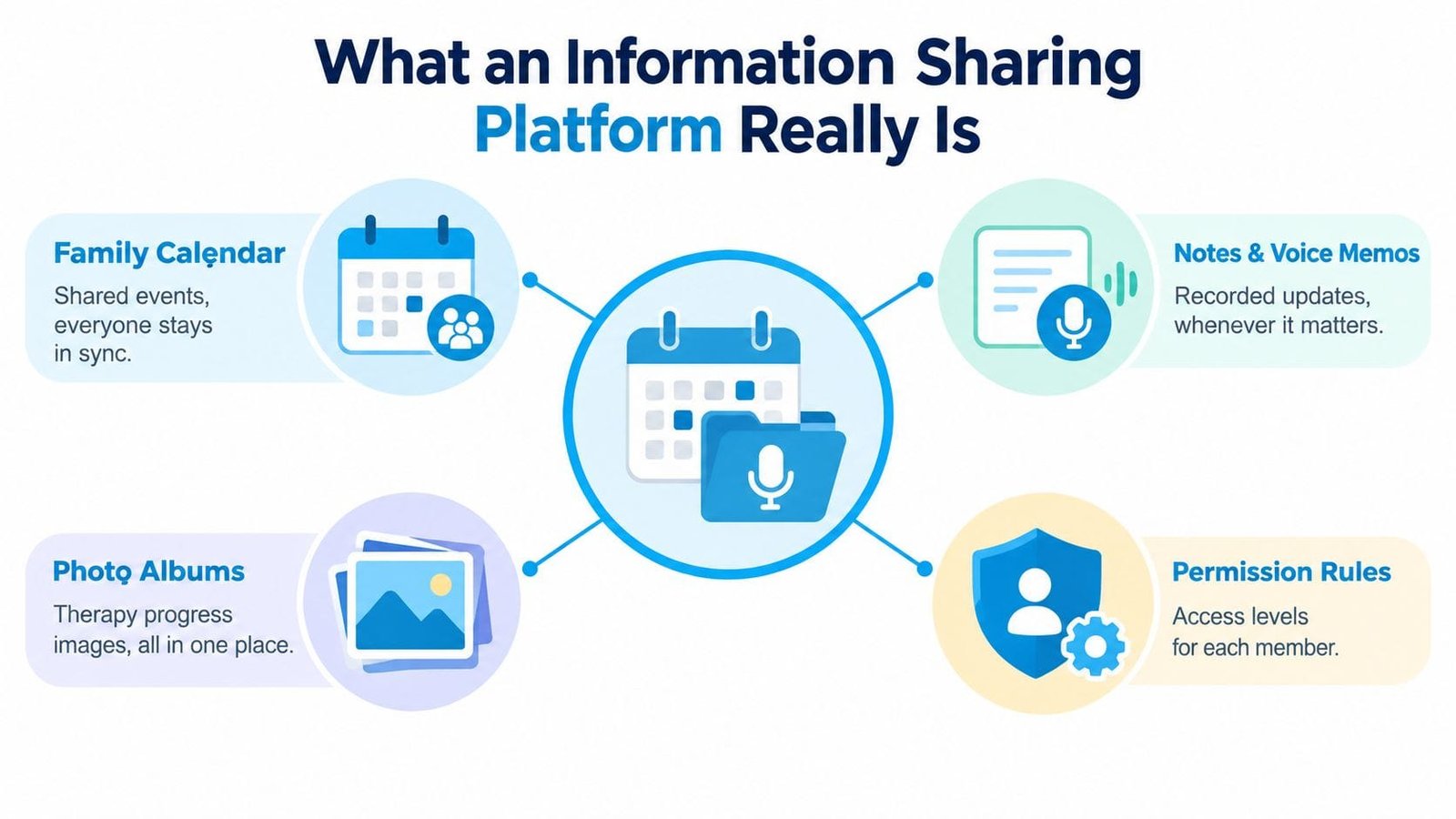
The practical building blocks are straightforward:
- Real-time sharing means a caregiver's update becomes available to authorized team members when it's recorded, rather than waiting for a weekly meeting.
- Access controls determine who can view, add, edit, or respond to information.
- Activity logging creates a record of what was added or changed and helps the family understand how information moved through the team.
- Interoperability allows systems to exchange information through standardized interfaces and shared data models.
Healthcare interoperability requires systems to exchange electronic health information securely and without special effort for authorized users, while avoiding information blocking, as described in the National Library of Medicine's interoperability overview. The important phrase for families is “without special effort.” If sharing requires repeated downloads, screenshots, and manual explanations, the system may technically hold information without making collaboration easier.
This isn't a chat app, social network, or generic project-management tool. A chat thread is useful for a quick question, but it can bury an important observation. A project tool may manage tasks, but it usually isn't designed for behavioral context, caregiver consent, or clinical records.
A purpose-built platform gives the child's information a stable home. Observations, goals, medications, routines, sensory triggers, and progress notes can remain connected while authorized people contribute from their own settings. If a parent records a voice update after a demanding day, a resource such as transcript.im free transcription can help turn spoken information into usable text, provided the family reviews the transcription and applies its own privacy standards.
The point isn't to collect everything. The point is to help the right people see the right information, in a form they can understand and use.
Core Capabilities That Matter in Daily Care
Features matter only when they support the family's actual rhythm. A behavioral technician may record a difficult transition in the morning, while a school aide adjusts the day's support and a parent prepares for pickup. The value comes from the shared response, not from the existence of a timestamp.
Real-time sharing
An update should reach authorized caregivers while it still matters. A note about a trigger, successful prompt, or change in routine can shape what happens later that day. Real-time access reduces the need for a parent to send separate messages to every person involved.
Access controls
Not every caregiver needs the same view. One co-parent might need clinical notes and appointment information, while a grandparent may only need the daily routine, meal log, and emergency instructions. Role-based permissions let the family match access to responsibility instead of treating privacy as an all-or-nothing choice.
Logging
A structured record helps a supervisor, therapist, or parent look at events in context. Sleep, meals, medication details, setting, behavior, and response can be reviewed together rather than reconstructed from memory. Caregiver tracking of place, duration, intensity, and triggers can also help families become more attentive to context and discuss intervention plans with clinicians, as described in the GenIAuti mobile data-collection study.
Interoperability
A pediatrician may need therapy notes, school observations, and routine changes before a short appointment. Data exchange can reduce the parent's need to provide a verbal recap, but only if the receiving system preserves meaning and keeps the information usable.
| Capability | Primary User | Daily Moment |
|---|---|---|
| Real-time sharing | Parent and therapist | A new trigger is visible before the next handoff |
| Access controls | Parent or account administrator | Each caregiver sees information suited to their role |
| Logging | Family and clinical team | Events are recorded with context instead of memory alone |
| Interoperability | Pediatrician, school, and therapy teams | Relevant information moves between approved systems |
Families looking for structured behavior records can review an autism data collection app as part of their comparison. The best choice is the one that caregivers can use consistently, professionals can interpret, and the family can control.
Why Families and Care Teams Benefit
The first benefit is often relief from retelling loops. Instead of explaining the same week separately to a therapist, teacher, pediatrician, and relative, a parent can point each authorized person to a shared record. The team still needs conversation, but the conversation can begin with what changed and what decision is needed.
The second benefit is better context. A challenging behavior may follow poor sleep, an unfamiliar setting, a difficult transition, or a change in communication demands. A structured record doesn't prove causation by itself, but it can help caregivers and professionals notice relationships that deserve discussion.
Evidence on autism care coordination links stronger perceived coordination with formal providers to lower parenting stress and a more positive effect on family functioning, as reported in this review of care coordination in autism. That finding supports a practical principle: families need more than separate services. They need services that connect around the child and communicate with the people providing daily care.
Practical rule: A platform should make the next conversation more informed, not make the family responsible for entering the same information repeatedly.
The coordinated state feels different from scattered texts and conflicting advice. A school team can see the home strategy. A therapist can understand what happened before an appointment. A sibling or co-parent who has permission can follow the same routine instead of receiving an outdated version through someone else.
Caregivers also need information that arrives on time, fits the situation, and is usable for real decisions. Research on caregiver information needs identifies those requirements while noting that no widely available mechanism consistently meets them well, as discussed in the RAND report on caregiver information and care coordination.
Training can strengthen the human side of coordination too. Families and providers may find resources such as Premiere Education autism training useful when they want shared language and a clearer understanding of support needs.
The human win is simple. At the next appointment, the parent already knows what the team has seen, and the team understands what the family has carried. The meeting can start with decisions instead of background.
Privacy, Consent, and Security Done Right
A shared record creates value only when families trust the people and systems handling it. Children's information deserves careful protection, and family sharing can involve different responsibilities than a clinical relationship. HIPAA may apply to a healthcare organization or its business associates, but a family-facing app may operate in a different context. Families should ask how those boundaries affect their data rather than assuming a compliance label answers every question.
Consent also gets complicated when several adults participate. Parents may disagree about access. A grandparent may need routine information but not clinical notes. A school team may need a specific goal or safety instruction without needing the entire family record.
Safeguards families can understand
Look for role-based access, separate consent settings, secure transmission, protected storage, and an audit trail. Families should be able to see who has access, change permissions, export their records, and understand the process for deletion or account closure.
A Business Associate Agreement is a legal arrangement between a covered healthcare organization and a service provider handling protected health information on its behalf. It isn't the same thing as a family-friendly consent experience. A platform can have formal agreements and still make it difficult for a parent to understand who sees a note.
An accessible resource on online privacy in medical training can help families think through privacy questions in healthcare settings. For an app comparison, review how a provider explains its HIPAA-compliant app approach and ask what that means in practice.
Questions to ask before sharing
- Data ownership: Who owns the record, and can the family export it in a usable format?
- Permission changes: Can access be changed for one person or one category of information?
- Audit history: Can the account holder see access and editing activity?
- Security: Is information protected while it travels and while it's stored?
- Deletion: What happens when the family closes the account?
- Third parties: Which vendors or integrations can receive information?
- Consent: Does each person understand what they can see and do?
Privacy isn't an obstacle to collaboration. It's the structure that lets collaboration remain respectful.
How to Choose the Right Platform
Start with the family's hardest handoff, not the vendor's feature page. If the main problem is missing context between home and therapy, prioritize fast logging and shared notes. If school coordination is the pressure point, look for controlled school-team access and records that can be exported for meetings.
Must-haves
- Real-time updates: A caregiver should be able to record an observation without creating a separate message chain.
- Role-based access: The family should control what each person can view or edit.
- Mobile-first design: The platform should work during pickup, bedtime, or a community outing, not only at a desk.
- Exportable records: Families need a usable way to share information with professionals and retain their own history.
- Clear privacy policy: The provider should explain storage, sharing, permissions, deletion, and third-party access in plain language.
Helpful additions
Visual schedules can support predictable routines. Behavior templates can make antecedents, responses, and outcomes easier to record. School sharing and connections with common health or education systems may reduce duplicate work, but only if the integration preserves meaning and gives the family control.
Red flags
Be cautious when a company gives vague answers about ownership, offers no audit trail, locks records into the platform, or makes cancellation difficult. A system designed only for clinicians may also leave parents without a meaningful view of daily care.
Pressure-test the trial
Add a co-caregiver and a therapist. Log one routine change and one behavior with context. Ask the second user to find the entry without help. Change that person's permission and confirm that the change takes effect. Export the record and inspect whether another professional could understand it.
Decision prompt: Who needs access? What information does each person need? What must stay private? Can we export the record? Can we change consent without contacting support?
If the answers are clear, the platform is easier to evaluate. If they aren't, more features won't solve the underlying trust problem.
Real Collaboration Scenarios in Practice
A mother, an in-home therapist, and a grandparent support a nonverbal child across different parts of the week. The mother records that a transition became difficult after a change in the usual sensory routine. The therapist adds the prompt that helped the child move forward, and the grandparent notes that the same approach worked during dinner.
At the next handoff, nobody has to begin with, “What happened at your house?” They can compare settings, preserve the child's communication signals, and carry the successful response into the next routine.
In another family, a parent prepares for a developmental pediatrician appointment by sharing medication details, sleep observations, and school notes in advance. The pediatrician reviews the information before the visit, and the parent can focus on what changed, what remains difficult, and what decision needs attention.
The platform doesn't replace medical judgment. It gives the clinician a clearer starting point and gives the parent a record that doesn't depend entirely on recall during a rushed conversation.
A third example involves a school team, BCBA, and family working from a shared goal tracker. The family posts what happens during homework and morning routines. The BCBA adds a response strategy, while the school team records how the same goal appears in the classroom and connects notes to the IEP.
The team can then discuss whether the plan is consistent across settings. If the child responds differently at school and home, that difference becomes useful information instead of evidence that one person recorded the situation incorrectly.
What makes collaboration work
Each vignette depends on three actions:
- Someone records a specific observation, including context rather than a broad label.
- Another team member responds with relevant information, not a duplicate summary.
- The group uses the shared record to choose a next step, then continues observing.
That sequence turns documentation into a conversation. Caregivers remain experts on daily life, while professionals contribute assessment, treatment, and educational knowledge.
Bringing It All Together With Guiding Growth
After an IEP meeting or therapy appointment, families usually need to make three decisions. Who should have access? What information should be shared? How will consent be granted, changed, and reviewed? Those choices matter more than a long feature list.
An information sharing platform should make those decisions visible. It should give caregivers practical control over permissions, make shared notes easy to create, support visual progress tracking, and keep communication connected to the child's routines and goals. It should also let families create records they can share with healthcare providers, educators, and other professionals when appropriate.
Guiding Growth is one mobile-first option that brings together behavior logging, sleep and routine tracking, diet and nutrition notes, medications, appointments, therapy information, visualizations, and collaboration with authorized caregivers and professionals. Its quick voice logging can help a busy parent capture an observation without typing, while shared access and reports can support more organized conversations with the care team.
On Monday morning, start small. Choose the people who need access, invite one caregiver and one professional, and agree on the first type of information to record. Begin with a routine, trigger, or successful strategy that the team already discusses often. Then review whether the shared record makes handoffs clearer and whether every person understands the permission boundaries.
The right platform won't remove every hard day. It can reduce the guesswork around those days and help the adults supporting your child act from the same information.
Guiding Growth offers mobile behavior, routine, sleep, nutrition, appointment, and care-team tracking with shared collaboration and report creation for authorized professionals. Visit Guiding Growth to explore a practical way to replace scattered updates with a clearer, caregiver-controlled information sharing platform.