You've saved the therapy summary in one notebook, the school communication in an app, medication details on the refrigerator, and your own observations in a phone note. At the next meeting, everyone cares about the same child, yet each person is looking at a different piece of the story. Outcome based planning brings those pieces together by asking a practical question: what meaningful change should this support create in daily life?
For autistic and neurodivergent children, progress rarely follows a straight line. A child may communicate more clearly at home but not at school, manage a transition with one therapist but struggle with a new substitute, or appear calmer while the family becomes exhausted from maintaining an unsustainable routine. A useful plan has to measure both the child's experience and the family's ability to support it.
Table of Contents
- Why Scattered Notes Fail Autistic Children and Their Families
- What Outcome Based Planning Actually Means
- Core Components That Make Outcomes Measurable
- Writing Effective Outcome Statements for Neurodivergent Children
- Bridging Planning and Daily Life with Behavior Tracking Tools
- Prioritizing Outcome Domains for Your Child's Current Stage
- Making Outcome Based Planning a Sustainable Practice
Why Scattered Notes Fail Autistic Children and Their Families
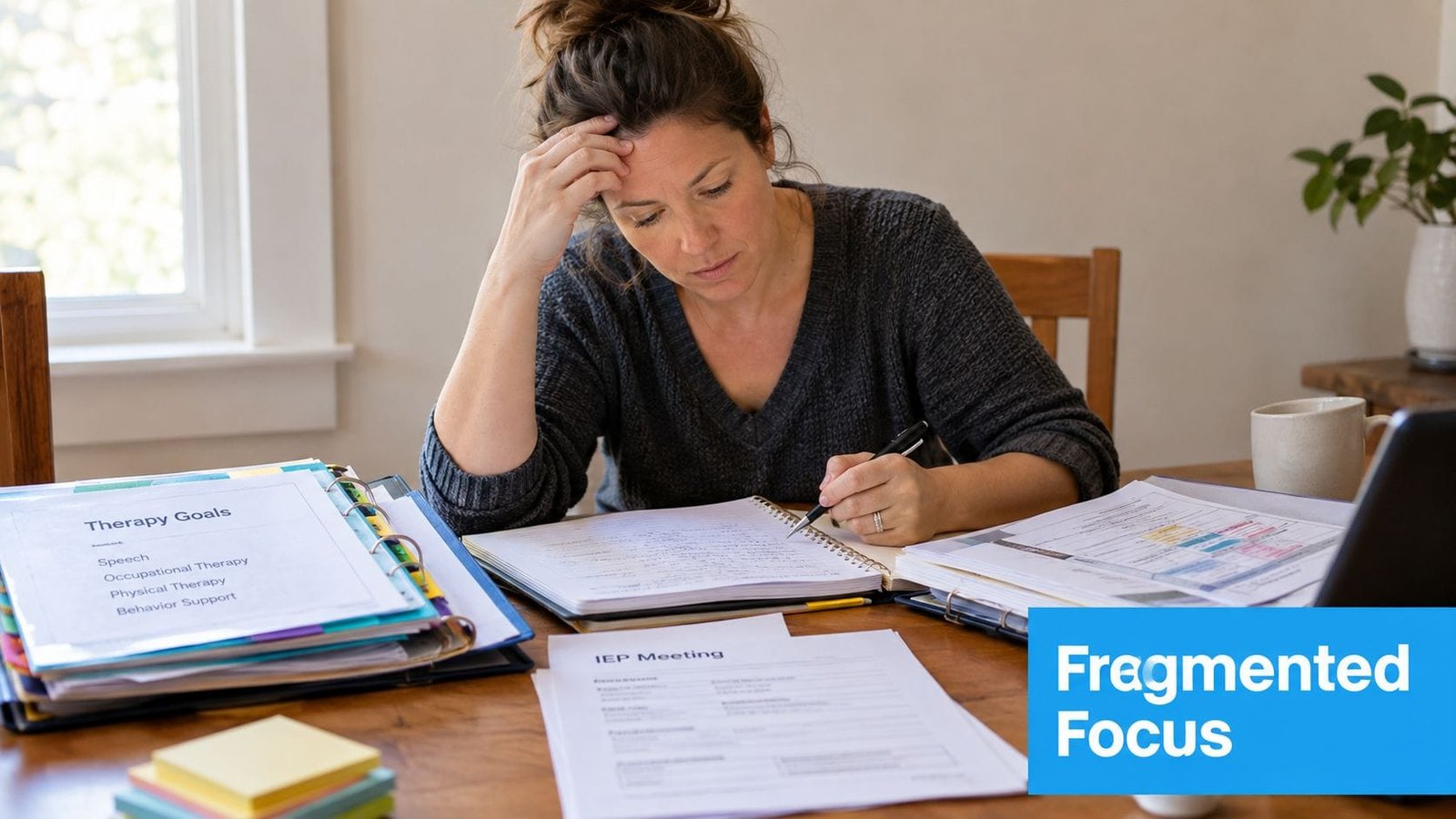
The meeting starts in two days. A parent spreads papers across the kitchen table: therapy binders, school IEP documents, appointment summaries, medication notes, and a list of observations typed into a phone. One page says transitions are improving. Another records several difficult mornings. The teacher has noticed fewer disruptions after visual prompts, while the parent remembers that bedtime has become harder.
None of these notes is useless. The problem is that they rarely share the same definitions, timeframes, or context. One adult records what happened, another records what was attempted, and a third remembers only the most recent incident. The family then spends valuable meeting time reconstructing events instead of deciding what to change.
Activity records aren't the same as progress
A list of attended sessions can show that a service was delivered. It can't show whether the child can request a break, participate in a morning routine, recover after a disappointment, or feel safer in a noisy environment. When teams track activities without agreed outcomes, they may repeat strategies that aren't helping or overlook a small change that matters greatly to the child.
Fragmented records also create emotional pressure. Parents can feel as if they're failing because the plan requires constant observation, while therapists and educators may work hard without seeing what happens outside their setting. The family isn't running in circles because nobody cares. They're running in circles because the information system doesn't connect the work to a shared result.
A useful test: If the team can't explain what will be different in the child's ordinary day, the plan probably describes activity rather than outcome.
A shared record can reduce that burden by placing observations, context, and follow-up in one accessible location. Families comparing options for organizing broader care or service workflows may also find this guide to the best GoHighLevel alternative useful for thinking about centralized information. For autism-specific coordination, a single source of truth helps each adult work from the same current picture.
Outcome based planning offers that structure. Instead of asking only whether a session happened, the team defines the change it wants to see, identifies how to recognize it, and reviews the evidence regularly. That shift turns scattered observations into a conversation about the child's participation, comfort, relationships, health, independence, and safety.
What Outcome Based Planning Actually Means
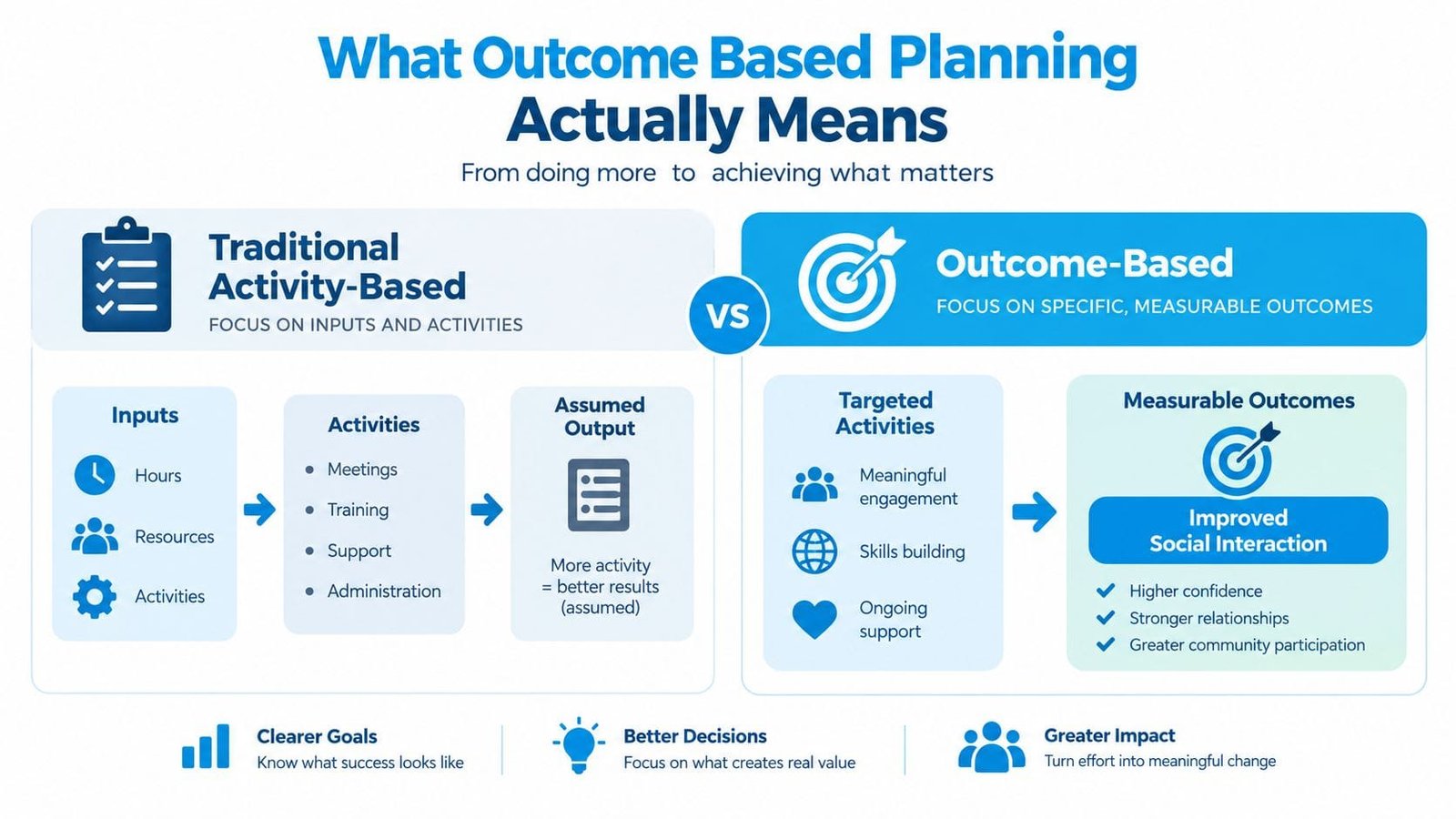
Outcome based planning starts with the result, not the service. An activity is something adults do, such as providing visual supports, practicing communication, or attending occupational therapy. An outcome is the meaningful change that follows, such as the child using a break request during a difficult transition.
Public services gradually formalized this distinction during the 2000s. South Africa's framework describes outcomes oriented planning as using desired results to design programmes, and it says government programmes and policies were organized in a medium-term strategic framework since 2004 (South Africa's outcomes-oriented planning framework). The framework distinguishes outcomes as impacts or consequences of government activity, rather than the outputs delivered.
Disability services developed the same logic. Tasmania's Disability Framework connected planning with self-directed decision-making in November 2008 (Tasmania's Disability Framework). Ireland's National Disability Authority reported that its “Outcomes for Disability Services” framework was approved in 2016 and organized around nine domains, including home, choice and control, relationships, development, work, quality of life, health, and safety (National Disability Authority outcomes framework).
Four principles guide the plan
Person-centered focus means the outcome reflects what matters to the child and family, not just what is convenient for the service. “Attends therapy” is an activity. “Communicates a need for help during a classroom task” describes a functional result.
Measurable results give the team a way to recognize change. Measurement doesn't have to mean a complicated test. It might involve recording whether a child uses a visual schedule, how often a routine ends without distress, or whether the child chooses between two activities.
Individualized domains prevent every child from receiving the same goals. One family may prioritize safe community participation, while another needs to address sleep, feeding, self-advocacy, or caregiver coordination.
Continuous review treats the plan as a living working document. If a strategy isn't producing the intended change, the adults adjust the environment, teaching approach, expectation, or outcome measure rather than waiting for a final review to discover the mismatch.
For families who think visually, a tool for spatial idea organization can help map relationships between a desired result, contributing supports, and evidence. The map still needs to end in a clearly observable change. A beautiful plan that doesn't guide tomorrow morning's routine remains an activity list.
Core Components That Make Outcomes Measurable
A strong plan has a small number of connected parts. Start with an outcome domain, write a specific outcome statement, select indicators, describe the baseline, and set a target. Each part answers a different question.
The domain identifies the area of life involved. Examples include communication, relationships, personal development, health, safety, choice and control, or family wellbeing. The domain keeps the plan connected to real life rather than isolated performance.
The indicator is the evidence you'll watch. Results-based management guidance recommends defining no more than three indicators per output or outcome and pairing them with baseline data and targets (United Nations Development Group results-based management handbook). Limiting indicators protects the family from turning every routine into a data collection exercise.
Baselines make change visible
A baseline describes what happens before a new support begins. It might be the current number of difficult transitions observed in a typical week, the level of prompting needed for a routine, or the parent's rating of confidence coordinating appointments. The baseline doesn't judge the child. It gives the team a starting reference.
A target describes the intended change. It should be meaningful and feasible, with the context clearly stated. “Improve communication” is too broad. “During snack, the child will use speech, a sign, or a communication device to request a preferred item with no more than one prompt” is easier to observe and discuss.
Separate proximal and distal outcomes
Autism intervention reviewers recommend distinguishing proximal outcomes, which are context-bound and incremental, from distal outcomes, which are broader and more generalized (review of outcome measurement in autism intervention). Combining them can make progress appear larger or more complete than it really is.
Consider sleep. A child following the bedtime sequence with fewer prompts is a proximal outcome. Improved sleep quality across the night and into the next day is a distal outcome. The first may change quickly, while the second may require environmental adjustments, health review, and consistency across caregivers.
Track both without treating them as interchangeable:
- Proximal indicator: follows the bedtime sequence in the agreed setting.
- Distal indicator: family observes better rest and daytime participation.
- Context note: record changes in routine, illness, travel, sensory environment, or support.
Families can use behavior assessment tools to organize observations before choosing indicators. The purpose isn't to collect more information. It's to collect the smallest amount of useful information that helps adults decide what to do next.
Writing Effective Outcome Statements for Neurodivergent Children
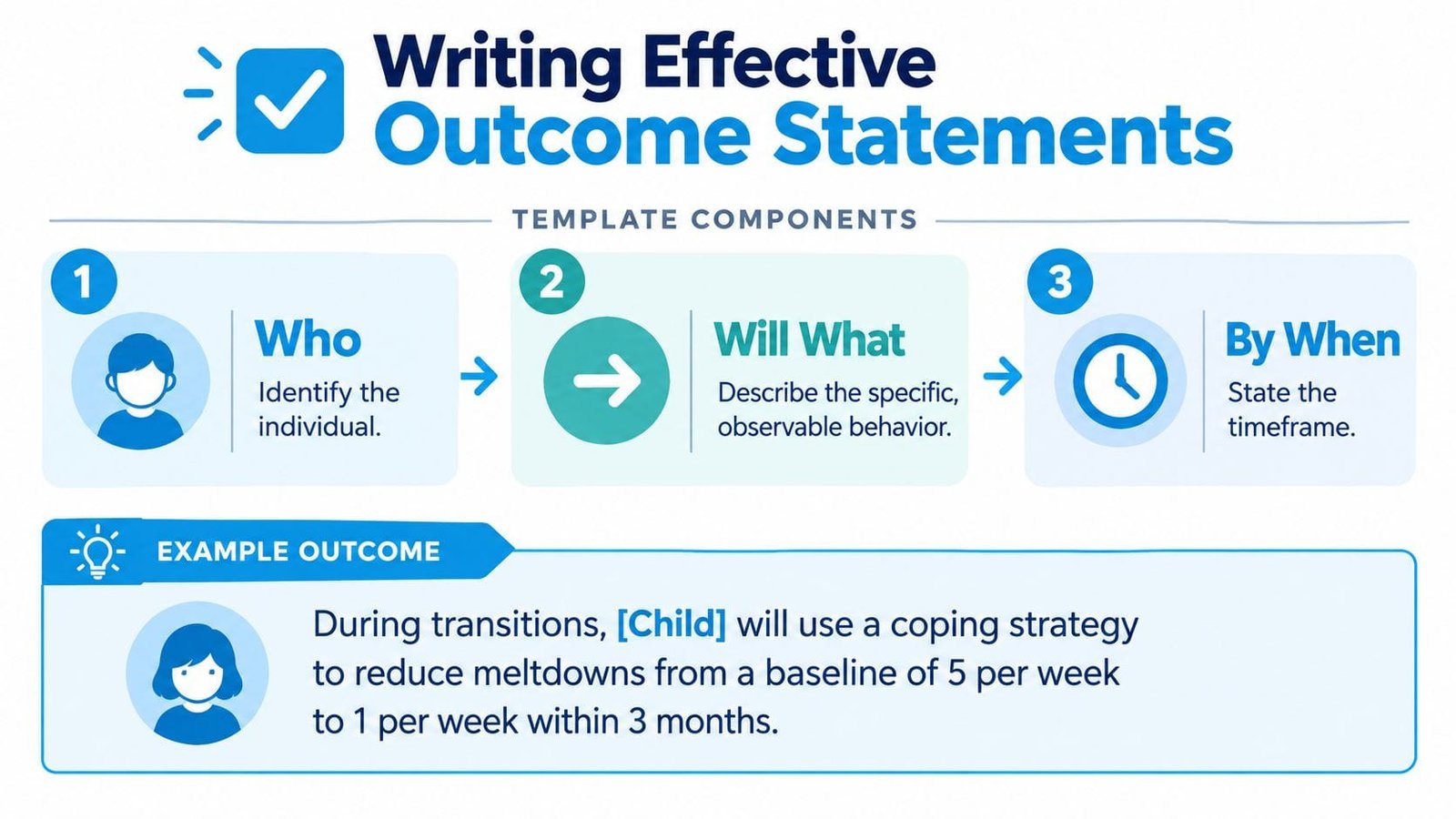
A useful outcome statement names who will change, what observable behavior or experience will change, where or when it will happen, and by when the team will review progress. This structure keeps the goal meaningful without making it vague.
A simple formula is:
During [context], [child or family member] will [observable change], supported by [relevant strategy], with progress reviewed by [timeframe].
Avoid writing the support as the outcome. “Will receive social skills therapy” describes a service. “Will initiate or respond to a peer interaction during a preferred activity” describes the intended result.
Child-level examples
A family and school team might write:
- “During classroom transitions, the child will use a visual schedule or break request to communicate a need for support.”
- “During free choice, the child will engage in an independently selected activity for a period agreed by the team.”
- “During a change in routine, the child will use an individualized coping strategy with adult support.”
- “At home and school, the child will indicate ‘no,’ ‘help,’ or ‘finished' through their reliable communication method.”
The wording should respect neurodivergent communication and regulation. Hand flapping, echolalia, movement, or withdrawal shouldn't automatically be treated as problems to eliminate. The outcome should address safety, access, autonomy, participation, or comfort, not force a child to appear less autistic.
Family outcomes belong in the plan
A 2024 peer-reviewed study found that parents rated their own physical and mental wellbeing, autism knowledge, responsiveness to the child, and satisfaction with supports as medium-to-high priority outcomes (2024 study of parent-rated outcomes). That finding supports a practical change in planning: measure whether the support system is becoming sustainable.
Possible family statements include:
- “The caregiver will report greater confidence using the agreed transition plan across home routines.”
- “The family will have one shared update method for communicating changes to school and therapy staff.”
- “Caregivers will identify which strategies help and which create additional stress during review.”
- “The parent will record satisfaction with coordination and identify an unresolved barrier at each review.”
Use a rating rubric, not a pass-or-fail label
Goal Attainment Scaling provides a mechanics-based approach with three steps: identify an individualized goal, create a scaling rubric describing possible outcomes, and rate attainment later (Goal Attainment Scaling overview). The rubric can describe a less successful result, the expected result, and more advanced or generalized results.
For a transition goal, the team might define the expected level as the child using a chosen coping strategy with support in one familiar setting. A higher level could involve using that strategy with less prompting or across another setting. A lower level might show that the child needs a shorter transition, a different sensory support, or a revised communication option.
Practical rule: Measure the change that improves access, comfort, communication, or participation. Don't measure compliance simply because it's easy to count.
Bridging Planning and Daily Life with Behavior Tracking Tools
A plan can be carefully written and still fail between meetings. Home, school, therapy, and health services may each see a different trigger, routine, or response. A child may avoid a demand because the task is unclear, the environment is overwhelming, sleep has been poor, communication has broken down, or the support changed without anyone telling the next caregiver.
Daily logging turns those possibilities into reviewable context. A useful entry can capture what happened, where it happened, what came before it, what support was offered, and what followed. The behavior might be a meltdown, shutdown, demand avoidance, echolalia, or hand flapping. The purpose isn't to label the child. It's to identify patterns and improve the environment or response.
Keep the record practical
A parent might log that a difficult morning followed a late bedtime and an unexpected change in transport. A teacher might note that a visual preview helped during an assembly transition. A therapist could connect the same communication strategy to a successful request for a break.
The record becomes more useful when everyone agrees on review intervals. At each review, ask:
- What changed: Which indicator moved, and in what setting?
- What stayed local: Did the improvement appear only with one adult, routine, or environment?
- What needs adapting: Should the prompt, sensory support, communication method, or expectation change?
- Who needs the update: Does the information affect home, school, therapy, or medical care?
Tools such as using widgets for habit stacking can help families attach a small tracking habit to an existing routine. The tracking method should reduce effort, not add another demanding project.
Guiding Growth is one option for centralizing behavior logs, triggers, sleep, diet, medications, appointments, therapy sessions, and shared updates with caregivers and professionals. Its quick voice logging can help a busy parent capture an observation without typing, while visualizations support review of patterns over time. Used carefully, an app doesn't replace clinical judgment or the child's voice. It gives the team a common record for making decisions.
Recent policy work emphasizes measurable outcomes, monitoring, transitions, and integrated care, while also highlighting the practical need for better interoperability and communication across settings (Australia's National Roadmap to Improve the Health and Mental Health of Autistic People). A living record helps the plan follow the child instead of remaining trapped in a file.
Prioritizing Outcome Domains for Your Child's Current Stage
Families often try to address every concern at once. A better approach is to choose the domain that will make the greatest difference to the child's current access, safety, autonomy, or family stability, then keep other concerns visible for later review.
Person-centered frameworks make this easier by using defined domains rather than relying on vague phrases such as “improve wellbeing.” Ireland's disability planning guidance includes living in one's own home, choice and control, social and civic participation, meaningful relationships, personal development, valued work or social roles, quality of life and wellbeing, best possible health, and safety free from abuse (Ireland's person-centered goal-setting guide).
| Life Stage | Priority Domains | Example Indicators |
|---|---|---|
| Early intervention | Communication, health, safety, family wellbeing | Communicates needs, tolerates essential routines with support, caregivers understand the plan |
| School-age | Choice and control, relationships, personal development, participation | Chooses activities, accesses learning, joins preferred social experiences, uses accommodations |
| Transition to adulthood | Self-direction, valued roles, health, safety, relationships | Makes informed choices, explores work or social roles, manages essential routines with support |
Match the domain to the immediate barrier
If mornings are unsafe and chaotic, safety and regulation may come before a broad social goal. If the child is physically safe but has no reliable way to refuse, request help, or choose, communication and choice deserve priority. If a caregiver is close to burnout, family wellbeing isn't a secondary concern. It may be the condition that makes every other support possible.
Life transitions deserve special attention because an outcome that works in one environment may not transfer automatically. In an autism transition study, the year-1 group showed statistically significant increases in all four measured variables, while the year-2 group showed no significant changes. The year-1 group also reported higher expectations for the future, self-determination, and vocational decision-making ability (study of person-centered transition planning).
Choose one primary domain and one supporting domain when the plan feels overloaded. For example, a communication goal may support safety, while a caregiver coordination goal supports consistency. Prioritization isn't giving up on other needs. It gives the team enough focus to learn what works.
Making Outcome Based Planning a Sustainable Practice
Outcome based planning works best as a routine of noticing, discussing, adapting, and trying again. It isn't a one-time document placed in an IEP folder. The adults around the child need shared definitions, clear indicators, honest attention to context, and permission to revise a goal when it no longer reflects the child's needs.
Start with a meaningful domain. Define a small set of indicators with a baseline and target. Keep proximal changes separate from broader generalization. Include caregiver wellbeing and coordination alongside child-level outcomes. Review the record at agreed intervals, and treat difficult data as information rather than blame.
A mobile tool can make the practice easier to maintain when it combines behavior logging, routine tracking, voice notes, and collaboration in one place. Guiding Growth supports those functions for families and the professionals who work with them, helping turn daily observations into a shared planning conversation.
Begin with one routine, such as bedtime, school arrival, or transitions between activities. Record what happens, note the context, agree on one meaningful outcome, and review it with the people supporting your child. Then build from what you learn.
Use Guiding Growth to bring behavior observations, routines, care details, and shared updates into one practical record for outcome based planning. Start with one daily outcome today, invite the adults who support your child, and use the shared information to choose your next small, meaningful adjustment.