After bedtime, you try to explain one difficult week to a therapist. Monday's behavior notes are in the school notebook. Tuesday's food log sits in a phone app. Wednesday's pediatrician advice is buried in an email thread, and sleep details depend on memory. Each record may be accurate, yet the connections between them remain hard to see.
A single source of truth, or SSoT, gives the family and care team one agreed-upon place to find current information. For neurodivergent care, that record might include routines, observations, medications, appointments, goals, and recent changes. It works like a shared care map: people can compare what happened, when it happened, and what was tried.
The purpose is not to document every moment or give everyone unlimited access. It is to reduce searching, guesswork, and repeated explanations, so parents carry less of the information burden.
Table of Contents
- When Three Notebooks Are Not Enough
- What a Single Source of Truth Really Means
- Why Families and Care Teams Benefit
- Seven Steps to Build Your Family SSoT
- Risks, Pitfalls, and Privacy Trade-offs
- A Week in the Life of a Centralized Care System
- Measuring Whether Your SSoT Is Working
- Bringing It Together With Guiding Growth
When Three Notebooks Are Not Enough
Mia arrived at her son's occupational therapy appointment with records in several places. The school notebook described increased hand flapping during a noisy classroom activity on Monday. Her phone app showed that he refused a familiar breakfast on Tuesday. The pediatrician's advice about a recent medication change was somewhere in an email thread.
The therapist asked whether the sleep disruption had begun before the afternoon overwhelm.
Mia remembered a restless night, but she could not confidently line it up with the behavior changes. Every detail existed, yet comparing the timeline took work. Families often have plenty of data, but lack organized context.
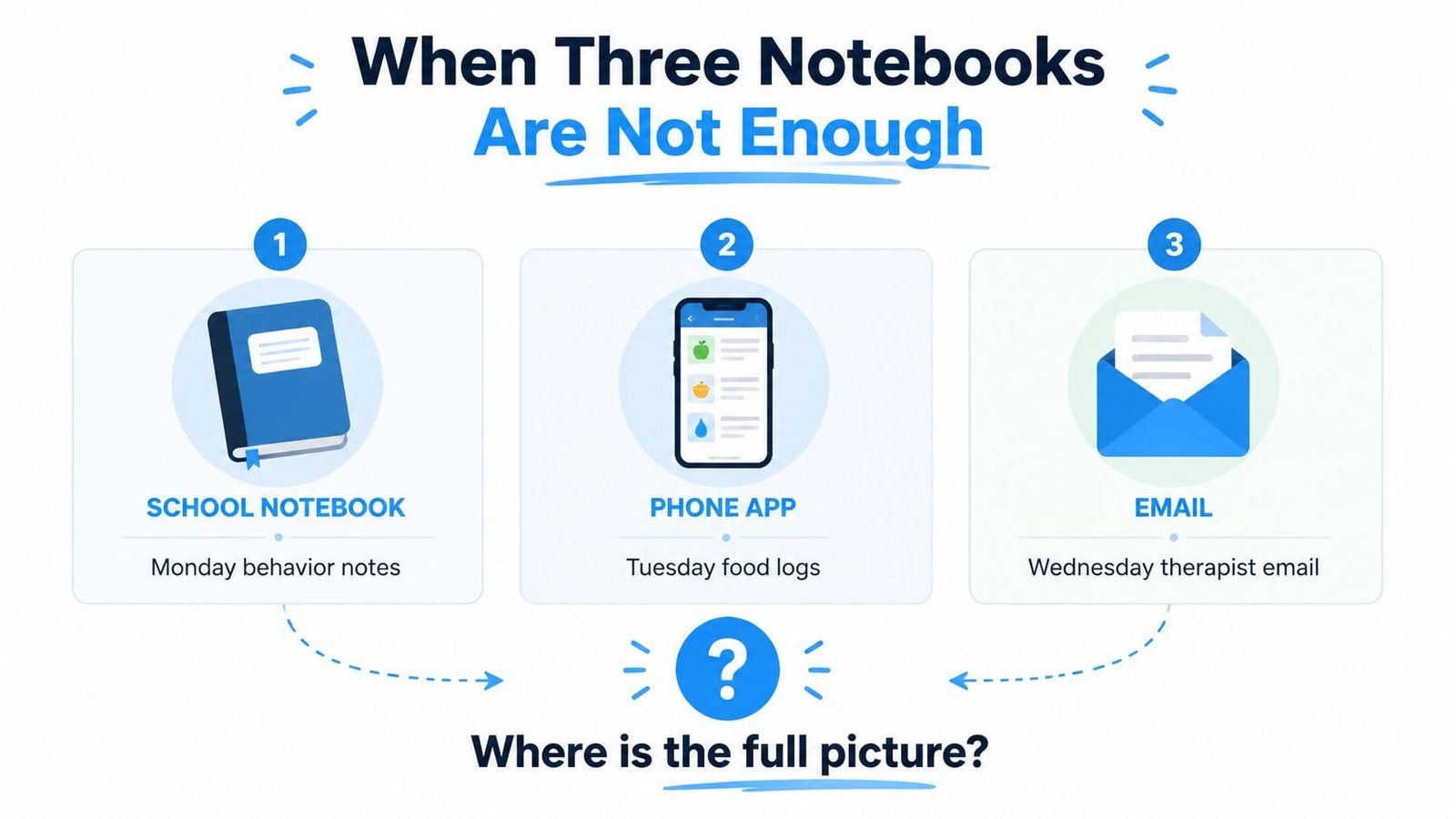
The hidden cost of scattered notes
A teacher may describe a difficult transition. A parent may record poor sleep. A therapist may document a successful visual schedule. Each observation captures part of the child's week, while the connections between those events remain difficult to see.
Fragmentation creates practical problems:
- Repeated explanations: Parents retell the same history to teachers, clinicians, relatives, and support workers.
- Conflicting details: One note may list the current routine while another still reflects an older plan.
- Missed patterns: Shifts in sleep, food, sensory load, communication, or demands become harder to compare.
- Uneven support: Adults may respond differently because they are using different information.
A shared record provides one dependable reference point for the people involved. It can contain the current support plan, recent observations, therapy goals, medication details, and upcoming appointments, while older documents remain available for historical context. For a parent already tracking triggers, transitions, and recovery, that arrangement reduces the mental effort of reconstructing the week before every conversation.
Practical rule: Let the record carry part of the family's memory burden, without turning parenting into a documentation exercise.
Typing may be unrealistic after a difficult morning. A voice note can preserve what happened while the details are still fresh, and families exploring hands-free note-taking for caregiving can use that approach to capture context for later review. The goal is to preserve and share meaningful information with less effort, so the care team can work from the same picture.
What a Single Source of Truth Really Means
A single source of truth applies the logic of a shared calendar to information. School staff, clinicians, relatives, and caregivers can work from one authoritative record, provided they know who maintains it, which details belong there, and where updates should be made. For a neurodivergent family, that shared reference can reduce the need to reconstruct events from scattered messages, notebooks, and memory.
The concept comes from information-system design. Each data element is mastered in one place and reused elsewhere by reference. The broader idea has developed over roughly 40 years, moving from folders and files toward databases, data-management systems, and centralized repositories for operational information, as described in Wikipedia's overview of single source of truth.
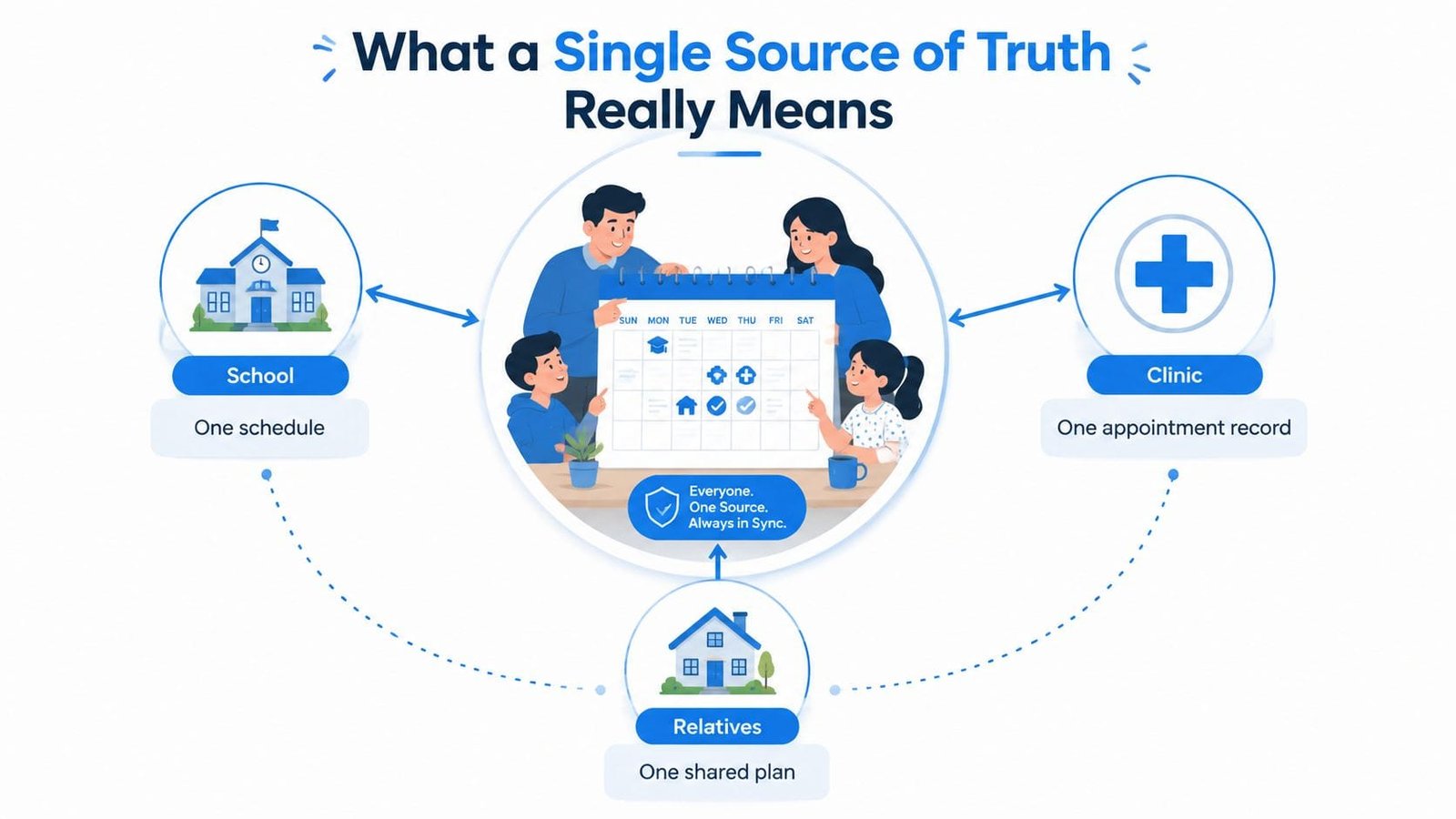
The four rules behind a dependable record
A family record might include sensory preferences, communication strategies, routines, therapy goals, medication changes, incident observations, and appointments. What matters is the governance around it, rather than whether the record is a spreadsheet, app, or database.
- Define what's authoritative. Decide where the current medication list, support plan, and appointment information live.
- Assign responsibility. Make clear who can add, approve, or correct information.
- Record dates and context. A dated observation gives the care team more to examine than an undated conclusion.
- Limit access by role. A school team may need classroom strategies, while a relative may only need routine and safety information.
A dependable SSoT separates observation from interpretation. “Slept poorly and covered ears during lunch” records what happened. “Noise caused the afternoon shutdown” proposes an explanation. Keeping both entries with their context lets parents and professionals discuss possibilities without presenting an assumption as an established fact.
The record can hold several perspectives at once. A parent, teacher, therapist, and clinician may notice different parts of the same day. Preserving each contributor's name and date helps the group understand how an interpretation developed, rather than forcing every observation into one unquestionable narrative.
For readers shaping a wider information practice, these knowledge management best practices for 2026 provide context on ownership, organization, and keeping shared information usable.
The following video explains how centralized records work in practice. Watch for the roles, update process, and connection between the authoritative record and the people using it:
Why Families and Care Teams Benefit
A dependable record changes the questions a care team can ask. If increased stimming follows a new snack, a poor night's sleep, or a change in classroom demand, adults can review one timeline and compare the surrounding events instead of relying on separate memories.
The timeline cannot establish causation on its own. It gives the family and appropriate professionals clearer material for discussion. Parents can bring a concise current summary rather than reconstructing months of events, while teachers and therapists can see context that might otherwise remain hidden.
Fewer contradictions, better continuity
The value becomes clear during handoffs. A substitute teacher can review communication preferences and regulation strategies. A new clinician can see current goals and family priorities before an appointment. A grandparent can check the latest routine instead of following an older message.
The same coordination problem appears in organizations at a larger scale. According to One Tribe Advisory, Gartner research finds that organizations often maintain three to five competing sources of truth for the same financial data (One Tribe Advisory's finance discussion of SSOT). In family care, the cost rarely appears as a line item. It shows up as duplicated appointments, delayed questions, contradictory advice, and the fatigue of explaining the same situation repeatedly.
| Fragmented Care Challenge | Single Source of Truth Benefit | Practical Example |
|---|---|---|
| Sleep information sits separately from behavior notes | A shared timeline keeps observations together | The team can review sleep and afternoon regulation side by side |
| Each provider maintains a different goal list | One current goal view reduces version confusion | The therapist and parent discuss the same active target |
| Medication changes are buried in messages | A controlled medication record makes updates easier to locate | A clinician can verify the current entry before discussing the next step |
| School staff lack home context | Relevant permissions allow context to travel with the child | A teacher can see a routine change that may affect transitions |
| Parents prepare every summary manually | Structured entries reduce reconstruction work | A meeting can begin with problem-solving rather than fact-checking |
Better coordination, clearer decisions
Centralized information supports continuity, accountability, and pattern recognition. It can help a family notice when a strategy works better under particular conditions, prepare focused questions for a clinician, or identify an appointment record that needs correction.
Clinical judgment, family expertise, and the child's own communication remain part of the decision. A shared record makes these forms of knowledge easier to apply at the right moment, with fewer gaps between home, school, and clinical settings.
Families reviewing digital care infrastructure can also examine examples of healthtech solutions from Ekipa AI to understand how technology may support coordinated healthcare workflows. The practical test is simple: each person should know where to find the current information, what they are permitted to see, and how to flag an entry that needs review.
Seven Steps to Build Your Family SSoT
You don't need an enterprise data department to create a useful family record. You need a manageable scope, clear ownership, and a routine that fits around meals, school pickup, and therapy.
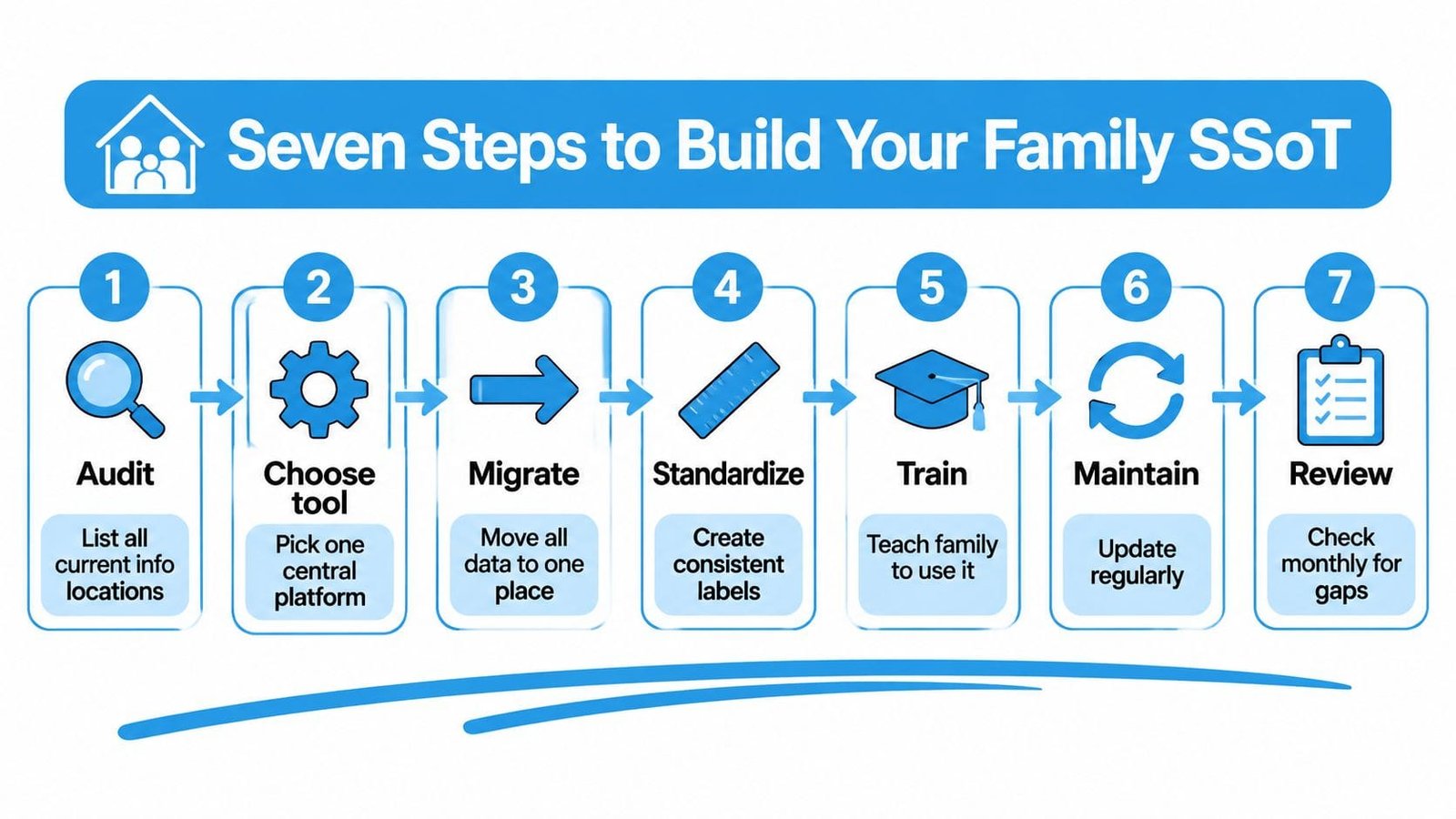
1. Audit where information already lives
List notebooks, text threads, phone apps, school portals, therapist PDFs, email chains, calendar entries, and paper documents. Don't judge the current system. You're identifying the places you'll need to check before deciding what belongs in one central record.
2. Choose the information that deserves central space
Not everything needs to move. Prioritize details that affect safety, daily support, communication, appointments, medication discussions, school planning, or therapy goals. Keep full historical documents elsewhere if they're rarely needed, but record their location and relevance in the central system.
3. Pick an accessible tool
Choose a platform the people who provide care can access and understand. Consider whether it supports mobile use, sharing, permissions, searchable entries, exports, and a clear way to correct outdated information.
4. Create simple labels
Use a small shared structure such as who, what, when, where, why, and next step. For example, “Parent, covered ears during assembly, Tuesday morning, school hall, loud microphone, ask teacher about quieter entry.” Consistent labels make entries easier to compare without forcing families to learn technical data modeling.
5. Set permissions before inviting everyone
Decide who can read, add, edit, or approve information. A grandparent may need routines and emergency details, while a clinician may need medication history and therapy notes. Permission settings should reflect actual responsibilities, not convenience.
6. Build a tiny daily habit
Attach logging to an existing routine, such as breakfast or bedtime. A brief entry about sleep, food, a significant behavior, or a successful strategy is often more sustainable than trying to document every transition.
7. Review and maintain it
Set aside a regular review to archive stale routines, check medication information, confirm appointments, and identify gaps. A central record that nobody updates becomes an attractive but unreliable archive. Continuous monitoring and governance are core parts of SSOT implementation, not optional finishing touches (Strapi's guide to single source of truth).
Start with the highest-value information, such as current medications, active school goals, safety details, and recent changes. Expand only when the system feels helpful rather than burdensome.
Risks, Pitfalls, and Privacy Trade-offs
On a rushed morning, a parent may open the family record to check a medication note, while the school team is waiting for an updated safety plan. If the platform is unavailable, everyone may lose access at the same moment. Centralization improves coordination, yet it also creates a single point of failure and concentrates more sensitive context in one place. A security incident could reveal far more than any single notebook contained.
The record also cannot replace direct observation. A dashboard may show yesterday's sleep pattern, while a child is struggling today because the classroom changed. Caregiving information is often a series of time-stamped observations, not one permanent answer. No Jitter's analysis of SSOT challenges identifies data quality, ownership, silos, bottlenecks, and the difficulty of maintaining one static source in fast-changing workflows.
Guardrails worth keeping
Logging fatigue can fill the record with details nobody uses. Permission errors can expose diagnoses or behavior notes to people outside the care decision. Sharing with a school team may speed support, while also creating a durable record that can follow the child.
| Risk | Mitigation |
|---|---|
| Platform outage or shutdown | Keep encrypted backups and export important records in a portable format |
| Richer privacy exposure | Use role-based access and review permissions regularly |
| Outdated information | Add dates, ownership, review reminders, and correction rules |
| Logging fatigue | Track only information that supports a real care decision |
| Over-reliance on one tool | Keep one offline trusted copy of critical documents |
| Duplicate or unclear entries | Use consistent labels and resolve conflicts during review |
A quarterly data audit can remove unnecessary details, confirm viewers, and test whether the record still serves the family. Families reviewing a HIPAA-compliant app for digital care can ask how access, exports, retention, and account recovery work before choosing a platform. These questions help caregivers keep the system useful without treating it as the only place where trustworthy knowledge lives.
A Week in the Life of a Centralized Care System
On Monday morning, a parent logs a poor night's sleep before the school session begins. The occupational therapist sees the entry and adjusts the planned sensory activities, choosing a lower-demand start rather than learning about the sleep disruption after the session.
Tuesday brings a small but meaningful relief. A grandparent checks the weekend update once and knows which breakfast options have been accepted, what transition language has helped, and what question to ask before changing the routine. They don't need to search through a group chat for the latest version.
One record, several care moments
On Wednesday, the pediatrician reviews growth-chart information and recent medication notes from the same shared view. The family no longer has to rebuild the timeline from a mixture of faxed pages and email attachments before discussing the current concern.
Thursday, the parent records a new meltdown trigger after a change in the usual route home. The behavior specialist reviews the observation, asks for context, and adds a strategy attachment that the family and school team can reference.
On Friday, the IEP team prepares a behavior summary from the entries already logged. The family doesn't spend the evening reconstructing every event from memory. The summary still requires interpretation and discussion, but the raw timeline is available.
The value isn't that every person sees every detail. The value is that the right people can find the right context when they need it.
By the weekend, the record contains a calm chronicle rather than a scavenger hunt. It doesn't eliminate hard days, and it doesn't guarantee agreement. It does reduce the frantic searching and contradictory advice that can make hard days harder.
Measuring Whether Your SSoT Is Working
A family record is working when it reduces effort and improves shared understanding. You don't need analytics training to check that. Use a simple note, calendar, or weekly review page and look for practical signals.
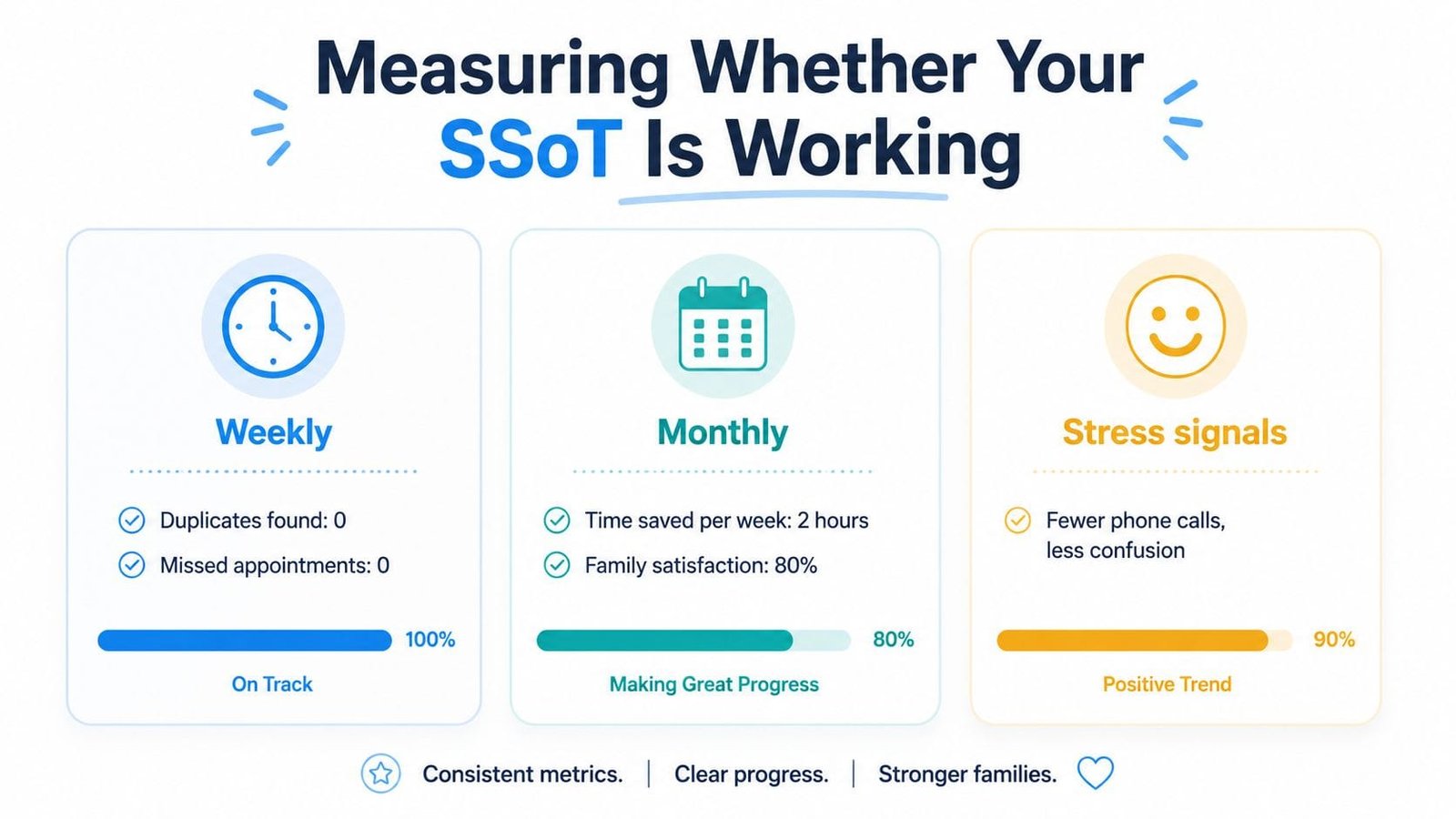
Time saved
- Search effort: Before a meeting, note how long it takes to find the relevant behavior chart, appointment detail, or medication update.
- Duplicate contact: Tally repeated calls or messages asking for information already shared.
- Preparation load: Record whether a parent still has to recreate the same summary from separate sources.
Consistency gained
Ask, “Did the adults involved use the same current plan this week?” Note disagreements rather than assigning blame. Also ask, “Did two providers give contradictory advice this month?” A falling tally may show that shared definitions and update rules are helping.
Child and family signals
Look for visible continuity in sleep, sensory load, communication, skill practice, or regulation patterns. The record won't explain every change, but continuous entries may make questions easier to identify.
Try these prompts during a weekly review:
- Retrieval: How many logins did it take to retrieve last month's behavior information?
- Clarity: Could another caregiver understand the current routine without calling the parent?
- Maintenance: Which entry is outdated or missing an owner?
- Stress: Did the system reduce confusion, or did it create another task?
For ideas on making patterns easier to understand visually, explore these ways to visualize data. Keep the measures simple enough that you'll use them.
Bringing It Together With Guiding Growth
The useful shift isn't from paper to technology. It's from scattered recollections to structured, shared context.
A parent's quick voice memo about a difficult morning, a teacher's behavior rating, and a therapist's session note can become related timeline information when the family uses a platform designed for care coordination. Tags and context can preserve what happened, when it happened, what came before it, and what helped afterward. Shared permissions can let approved caregivers collaborate while keeping sensitive information limited to the people who need it.
Guiding Growth brings behavior logging, sleep routines, diet and nutrition details, medications, appointments, and therapy information into one mobile care environment. Its visualizations are designed to help families review patterns without manually rebuilding spreadsheets, while collaboration features support sharing with family members, caregivers, and professionals.
That doesn't make the app the authority on a child's needs. The family remains essential. Clinicians, educators, and therapists still bring their own expertise. The app's role is to reduce the documentation burden and give the care circle a clearer place to begin.
Guiding Growth offers mobile logging, shared care-team collaboration, routine and appointment tracking, and pattern-focused views for neurodivergent family care. Visit Guiding Growth to turn scattered notes into a more dependable shared record for the people supporting your child.