At 10:47 a.m., a parent is crouched on the kitchen floor with a tablet in one hand and a wailing child in the other. The parent remembers that Tuesday was difficult, but not whether the meltdown followed a skipped snack, poor sleep, a change in routine, or all three. The appointment with the BCBA is in three days, and a stressed memory won't give the clinician enough detail to make a confident adjustment.
An autism data collection app helps close that gap. It turns observations about behavior, sleep, communication, routines, medication, and daily activities into structured records with times, context, and summaries that a care team can review. The point isn't to record every second of family life. The point is to make important patterns easier to see and easier to discuss.
Table of Contents
- What an Autism Data Collection App Actually Does
- The Core Data Families Capture Every Day
- How Modern Apps Capture Data in Real Time
- Habits That Make Logged Data Clinically Useful
- Turning Logs Into Better Collaboration
- Privacy, Consent, and Equity Considerations
- A Practical Parent Playbook for Getting Started
What an Autism Data Collection App Actually Does
A parent may remember, “There were several meltdowns this week.” A clinician needs a more useful picture: when the events happened, how long they lasted, what came before them, what followed, and whether sleep, food, communication demands, or transitions were involved.
An autism data collection app is a structured observation and sharing tool. Instead of keeping scattered notes in a phone, paper notebook, text thread, and email, a caregiver can enter an event in one place. A quick tap can record a behavior. Tags can identify a possible trigger. A short note can add context. A timeline can show when events cluster, and an exportable report can help a BCBA, pediatrician, teacher, or therapist interpret the information.
Practical rule: A useful log should reduce guessing, not create another full-time job.
The value of this approach has been demonstrated in naturalistic autism data collection. In a 2019 observational study, caregivers of individuals with ASD from age 6 through adulthood, 144 caregivers in total, used the My JAKE mHealth app for daily reports over an 8- to 10-week period, mainly recording sleep quality, affect, and self-selected behaviors. Caregivers reported behaviors in real time and made entries, on average, 2 to 3 days per week. The authors described the work as the first reported implementation of an mHealth app in a large caregiver sample for electronically tracking behaviors in ASD, highlighting a move away from retrospective paper notes toward structured digital tracking (the My JAKE caregiver-report study).
Why timestamps and context matter
A timestamp doesn't explain a behavior by itself. It gives the rest of the information somewhere to attach. A note such as “hand-flapping at 8:15 a.m. after a rushed dressing routine” is more useful than “agitated this morning.”
The app can also help a family compare events across days. Perhaps difficult transitions appear after nights with repeated waking. Perhaps food refusal is more common when the child has limited access to preferred fluids. Those observations don't diagnose a cause, and the app shouldn't claim to do so. They give the care team a clearer starting point for questions and decisions.
Mobile collection can work outside a clinic. In the Duke-led Autism & Beyond study, the app received more than 10,000 downloads in one year, with 1,756 families participating, 5,618 parent surveys completed, and 4,441 home videos uploaded. Researchers reported that usable data were collected from 88% of uploaded videos, supporting the feasibility of collecting observational information in natural settings (the Duke-led autism screening app study).
The Core Data Families Capture Every Day
Most families don't need six separate tracking systems. They need one shared notebook with several clear columns. Each column answers a different clinical question, while the connections between columns often reveal the most useful context.
| Category | Example Entry | Clinical Use |
|---|---|---|
| Behaviors | “Meltdown began after tablet ended, lasted about 12 minutes, moderate intensity.” | Helps identify frequency, duration, intensity, antecedents, and consequences. |
| Sleep | “Bedtime recorded, night waking noted, morning rise time entered.” | Helps compare sleep patterns with next-day mood, attention, and behavior. |
| Routines | “Visual schedule followed until the transition to shoes, then the order changed.” | Shows how predictability and transitions affect participation. |
| Medications and supplements | “Medication given at the usual time, appetite and mood noted afterward.” | Gives a prescriber a time-linked record of observed effects or concerns. |
| Diet and hydration | “Refused the planned meal, accepted a preferred food, drank less than usual.” | Helps families discuss food preferences, refusal, hydration, and possible patterns. |
| Mood and communication | “Used AAC to request a break, made fewer vocalizations, appeared withdrawn.” | Adds information about affect, communication access, and social engagement. |
Behaviors need a shared definition
“Agitation” can mean pacing, crying, shouting, aggression, or attempts to leave. A family and clinician may use the same word differently unless they define it. A better entry identifies the observable action, such as hitting, dropping to the floor, throwing objects, or leaving the room.
For each target behavior, record frequency, duration, and intensity in a consistent way. Add what happened immediately before and after. The consequence isn't a judgment. It describes what followed, such as a demand being paused, a break being offered, or access to a preferred activity being restored.
Sleep deserves its own attention
Sleep records often become especially valuable when a child's daytime behavior changes. The CDC recommends sleep diaries when parents have difficulty describing a child's sleep pattern, because a diary can document bedtime, sleep onset, night wakings, and morning wake time (CDC autism-specific anticipatory guidance).
Some autism sleep research combines parent records with device data. One study paired seven consecutive nights of actigraphy with a parent sleep diary recording bedtime, sleep initiation, awakenings, awake minutes, total sleep, and morning rise time, with at least four nights required for inclusion (the autism sleep actigraphy study).
Context turns categories into a pattern
A sleep entry becomes more meaningful beside a behavior entry. A routine entry can explain why a transition was harder. A medication note can help a prescriber review mood, appetite, and sleep together. You don't need perfect detail in every field. You need comparable entries that a clinician can scan quickly and understand.
How Modern Apps Capture Data in Real Time
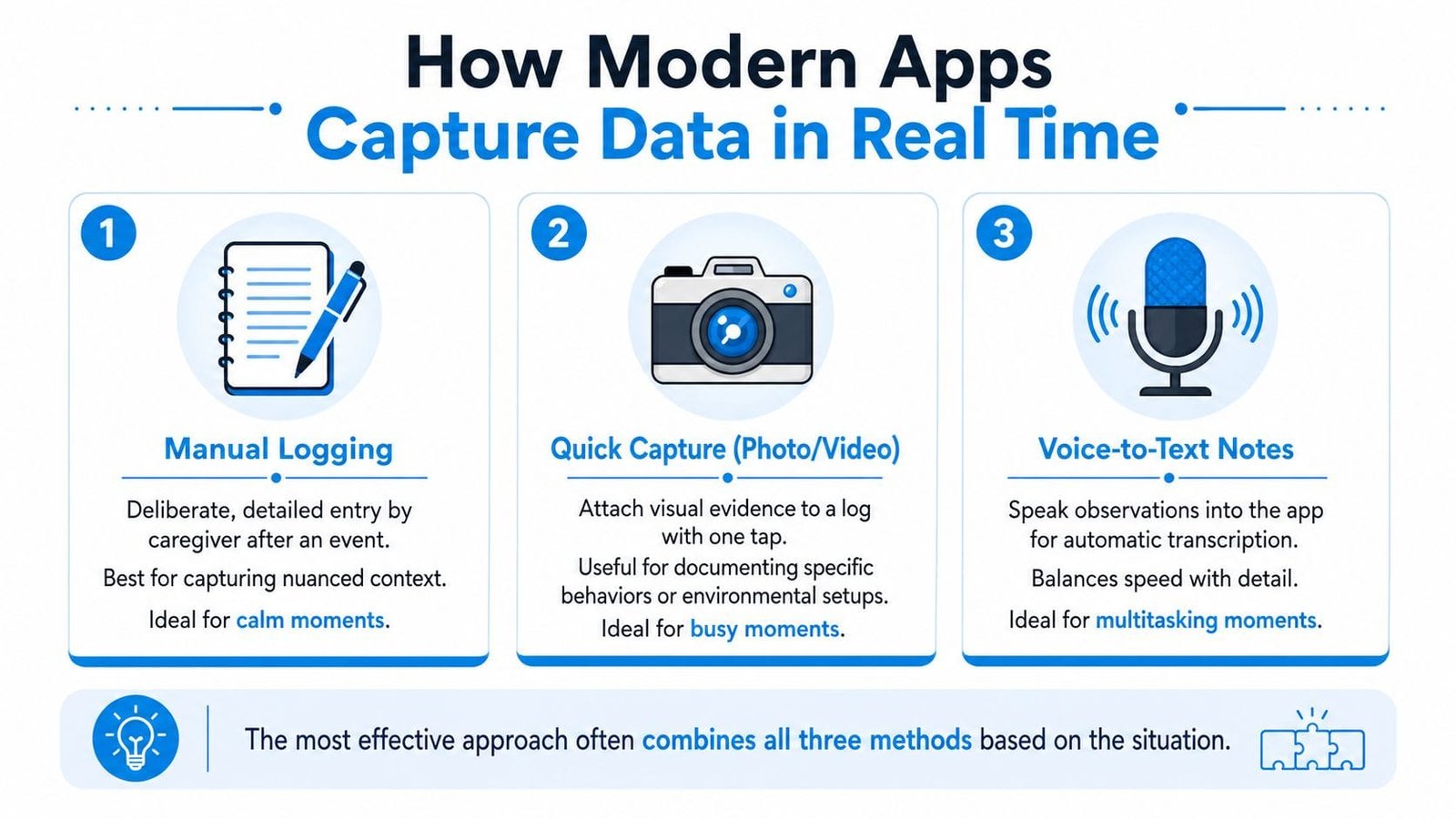
Families usually encounter three capture modes. None is automatically superior. The right choice depends on what must be recorded, how quickly it happens, and how much attention the caregiver has available.
Manual logging offers the greatest specificity. A parent can describe the exact demand, setting, communication attempt, and response. That detail is valuable for a complex behavior, but manual entry can be difficult during a crisis or after a long day. It works best when the caregiver can make a deliberate tap-and-note entry soon after an event.
Passive sensing collects signals from a wearable or device with less active effort. A wearable may provide information related to sleep or heart rate, while a phone may capture device-level activity. Passive streams can create a consistent baseline and reduce reliance on memory, but they usually don't explain what a behavior meant or what happened around it.
AI-assisted capture can make entry faster. Voice-to-note transcription lets a parent speak while helping with a bedtime routine. A photo or video may preserve information about an environmental setup. Pattern suggestions can draw attention to trends a caregiver hasn't noticed. Those suggestions remain suggestions, not diagnoses, and their quality depends on training data, settings, and human review.
A blended approach usually fits real life better
A practical setup might use passive information for sleep, quick taps for behavior events, and voice notes for context. A caregiver can then review entries later and correct anything unclear. A dual in-person and remote protocol described in autism measurement research combined a Fitbit, a passive smartphone collection app, and two active-reporting apps over 28 days, focusing on social communication, sleep, and mental health. The protocol measured usability, acceptability, adherence, and overall feasibility (the dual in-person and remote autism measurement protocol).
The trade-off is easy to underestimate. Every added sensor, permission, account, or AI feature creates another privacy question and another maintenance task. A system that captures everything but takes too much effort may be abandoned. A smaller system used consistently can produce a clearer record than an elaborate one used only during appointments.
Habits That Make Logged Data Clinically Useful
Clinicians can work with imperfect information. They struggle more with inconsistent definitions, missing timing, and entries that lack context. Small habits can make a family's record much easier to interpret.
Build logging into an existing routine
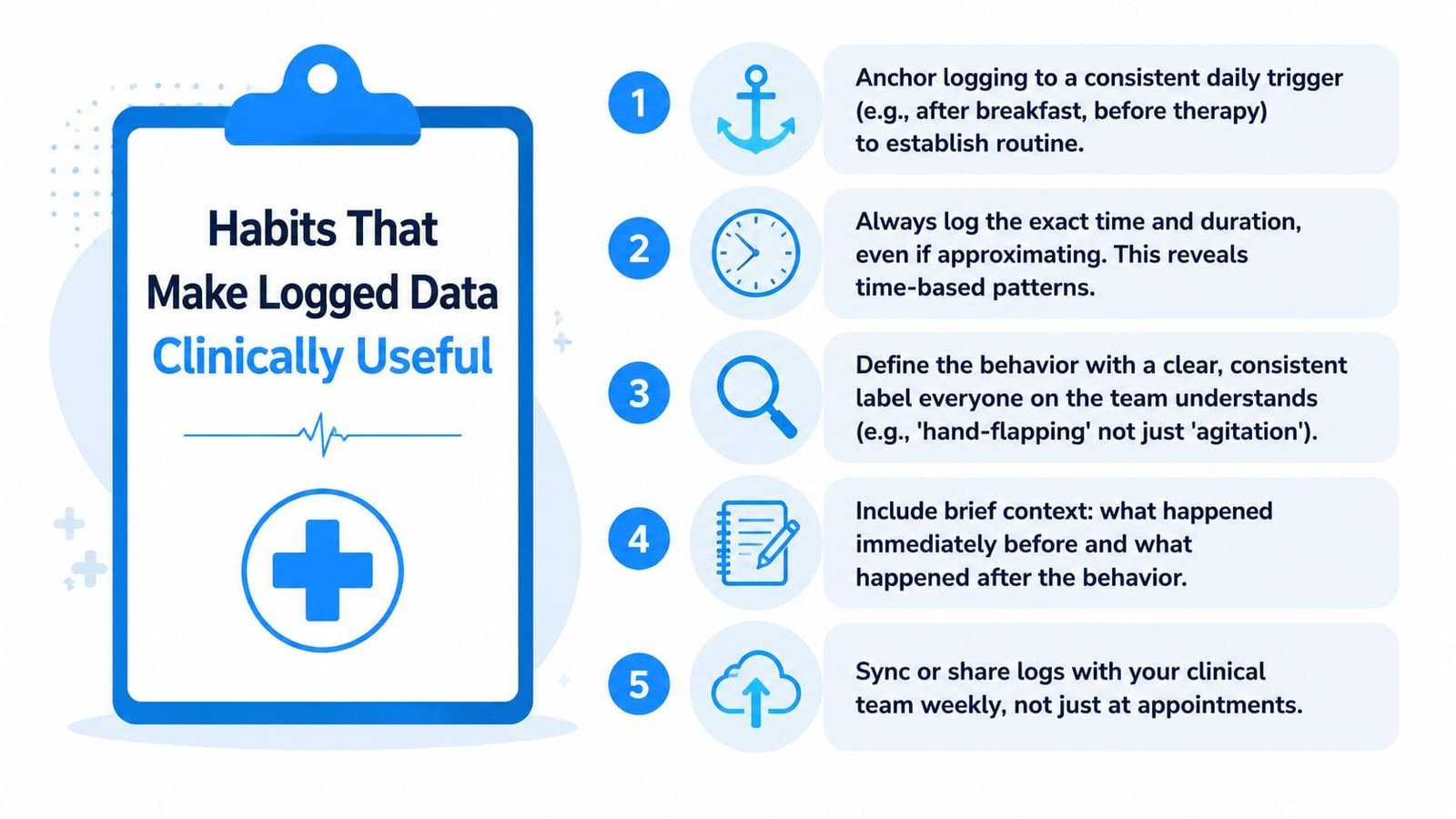
Attach logging to something that already happens, such as toothbrushing, dinner, school pickup, or bedtime. A quick review after breakfast might capture the previous night's sleep. A tap before therapy might record medication and mood. The anchor matters because it moves documentation closer to the event instead of relying on memory several hours later.
Define the behavior once in plain language. If the family is tracking “leaving the area,” write what counts, such as crossing a particular doorway without permission or moving beyond a designated space. Use the same definition throughout the week. Don't change “hand-flapping” into “agitation” halfway through the record unless the care team agrees that the target has changed.
Capture what happened around the event
The most useful context often fits in two short fields:
- Before: What demand, transition, sensory condition, communication problem, or change happened immediately before?
- During: What observable behavior occurred, for how long, and at what intensity?
- After: What did the child, caregiver, teacher, or environment do next?
- Alongside it: What were the sleep window, medication timing, meal pattern, and routine changes?
Behavior-analytic sleep guidance recommends baseline logging until a consistent pattern emerges and encourages families to include environmental factors and bedtime behaviors, including tantrums or disruptive behavior, so later intervention effects can be evaluated (behavior-analytic sleep assessment guidance).
Review before the appointment
A short weekly review can identify missing entries, clarify vague notes, and highlight one or two questions for the clinician. Export a brief summary rather than sending a flood of raw notes. A BCBA, pediatrician, or IEP team can act more readily when the record shows the behavior definition, timing, context, and trend in one view.
For practical ideas about making observations easier to interpret visually, see ways to visualize autism data. The purpose isn't to make a parent produce a research report. It's to create a dependable handoff that lets the care team spend its time interpreting the child's needs rather than reconstructing the week.
Turning Logs Into Better Collaboration
Data earns its value at the handoff. A parent may notice the pattern first, but the clinician, teacher, therapist, and prescriber each see a different part of the child's day. A shared record can connect those views without asking one person to retell everything from memory.
Before an IEP meeting, a useful package might include a one-page frequency trend, two weeks of antecedent notes, a sleep summary, and a short parent narrative. The narrative still matters. “Mornings felt harder after late nights, and getting dressed became the point where the routine broke down” gives meaning to the chart.
| Handoff | Useful Artifact | Lookback Window |
|---|---|---|
| IEP meeting | One-page trend summary, routine notes, and parent narrative | Recent school and home observations |
| ABA session | Shared behavior definitions, event records, and context notes | Current treatment period |
| Pediatric visit | Sleep, mood, medication, appetite, and side-effect timeline | Period surrounding the clinical question |
| Caregiver changeover | Daily routine, communication, and priority notes | Immediate care period |
| Team review | Updated summary with unresolved questions and agreed next steps | Since the previous review |
Different teams ask different questions
During ABA sessions, a shared log can help the technician and BCBA compare home observations with clinic data. If a behavior appears mainly at home, that difference becomes a question about setting, demands, sensory conditions, communication access, or reinforcement, not proof that one observer is wrong.
Medication reviews need another kind of timeline. A prescriber may want to see when a medication changed alongside sleep, mood, appetite, or other observed effects. The app doesn't determine whether the medication caused a change. It helps the family present the timing clearly enough for a qualified professional to assess.
Give each person the right level of access
A parent may grant a clinician read-only access, allow a partner to edit daily entries, and give a teacher limited contributor access. Access should be reviewed when a service ends, a caregiver changes, or a family arrangement shifts. The broader principle is to create a single source of truth for care coordination, rather than asking every person to maintain a separate spreadsheet or message thread. A related guide on creating a single source of truth for autism care can help families think through that handoff.
Privacy, Consent, and Equity Considerations
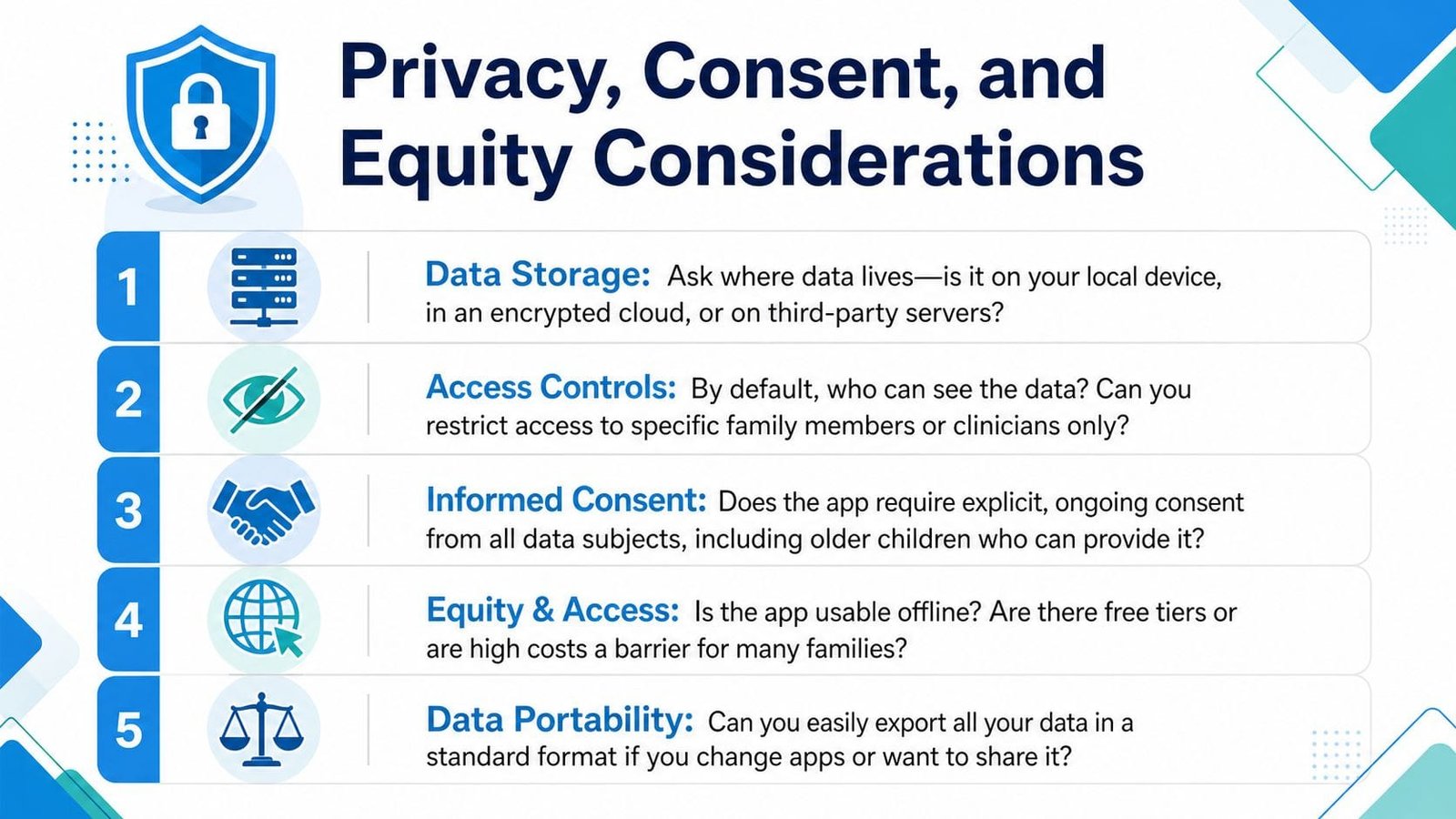
Convenience shouldn't be the only criterion. An app may collect behavioral notes, voice recordings, camera data, sleep information, medication details, or phone signals. Before using it, a parent should know where the data lives, who can access it, how long it remains available, and what happens if the account or subscription ends.
A 2026 review of data-driven autism detection identifies informed consent, clinical validation against gold-standard methods, diverse training data, and privacy-preserving approaches such as federated learning as future priorities (the review of data-driven autism detection). Those concerns apply beyond detection. They matter whenever an app makes inferences from a child's behavior, voice, image, or device activity.
Ask five questions before entering sensitive information
- Storage: Is information kept on the device, in an encrypted cloud, or on third-party servers?
- Access: Who can see it by default, and can you limit access to selected caregivers and clinicians?
- Consent: Can each relevant person provide consent, including an older child or teen who can participate in the decision?
- Portability: Can you export the complete record in a usable format if you change tools?
- Deletion: Can you delete information and revoke access cleanly, and does the policy explain what happens after cancellation?
Families should also look for analytics software that shares usage information with advertisers, unclear breach notification language, and platforms connected to insurance or other systems that may pool records. A careful review of protecting patient data in healthcare offers useful context for secure information handling beyond the app itself.
Equity belongs in the same decision. A data-heavy tool may exclude families with limited device access, unreliable internet, expensive data plans, English-only interfaces, or schedules that don't include a stay-at-home caregiver. Ask whether the app works offline, supports the household's language needs, allows more than one caregiver to participate, and remains usable when entries must be made quickly.
If a clinic is evaluating a tool for protected health information, review its HIPAA-compliant app considerations with the organization's privacy lead. HIPAA status alone doesn't answer every family's question, but it can start a more complete security conversation.
A Practical Parent Playbook for Getting Started
Start smaller than your worry tells you to. Choose two high-value data types, such as sleep and meltdowns, or medication timing and communication. If you track too many categories at once, the record can become burdensome before it becomes useful.
Choose one capture mode that matches your household. Use quick taps if events happen suddenly, voice notes if your hands are usually occupied, and deliberate notes when context matters more than speed. Set a realistic daily budget of three to five minutes. The purpose is sustained observation, not perfect documentation.
A manageable first week
- Choose two categories. Pick the questions your clinician is already asking or the pattern causing the greatest daily concern.
- Set definitions. Write down what counts as the behavior or event so every caregiver uses the same meaning.
- Log for five days. Record the time, brief context, and outcome. Approximate when exact timing isn't possible.
- Assign access. Give household members edit rights only if they need to enter information. Give clinicians or teachers view or limited contributor rights according to their role.
- Review for fifteen minutes. Meet with a partner, BCBA, pediatrician, or another trusted team member once during the week. Identify one pattern and one question.
- Prepare the handoff. Share a concise summary, not an unfiltered stream of every note.
Guiding Growth is designed to place behavior, sleep, diet and nutrition, medications, appointments, therapy sessions, contextual triggers, outcomes, shared timelines, and summaries in one care-coordination workflow. Its quick voice logging and AI-supported summaries can help organize observations while the family and clinical team remain responsible for interpreting them.
Guiding Growth gives parents and caregivers one place to record daily observations, review patterns, and share clinician-ready summaries with the people involved in care. Visit Guiding Growth to see how a more organized autism data collection workflow can replace scattered notes with clearer coordination.