A parent can set out a reward chart before breakfast, only to find that the same routine goes smoothly one day and falls apart the next. The difference might involve sleep, hunger, a crowded schedule, sensory discomfort, a difficult transition, or a request that suddenly feels impossible. A useful chart shouldn't only record whether a child complied. It should help the family understand what happened before, during, and after a behavior, while also making strengths and successful routines visible.
Behavior charts for home can mean a printable sticker grid, a chore board, a token system, a visual schedule, a spreadsheet, or a mobile app. The best choice depends on the child, the routine, and the question you're trying to answer. Start with a low-tech tool when you need immediate visibility, then move toward richer tracking when context, shared care, or professional collaboration matters. Families already coordinating multiple routines may also benefit from this family calendar sharing guide.
Table of Contents
- 1. Printable Behavior Chart Templates
- 2. Chore Charts and Responsibility Systems
- 3. Token Economy Systems
- 4. Visual Schedules and Pictorial Supports
- 5. Customizable Digital Behavior Charts and Spreadsheets
- 6. Behavior Tracking Apps and Specialized Platforms
- 7. Guiding Growth With Integrated Behavior Tracking and AI-Powered Insights
- Home Behavior Charts: 7-Option Comparison
- Turn Daily Tracking Into Better Support
1. Printable Behavior Chart Templates
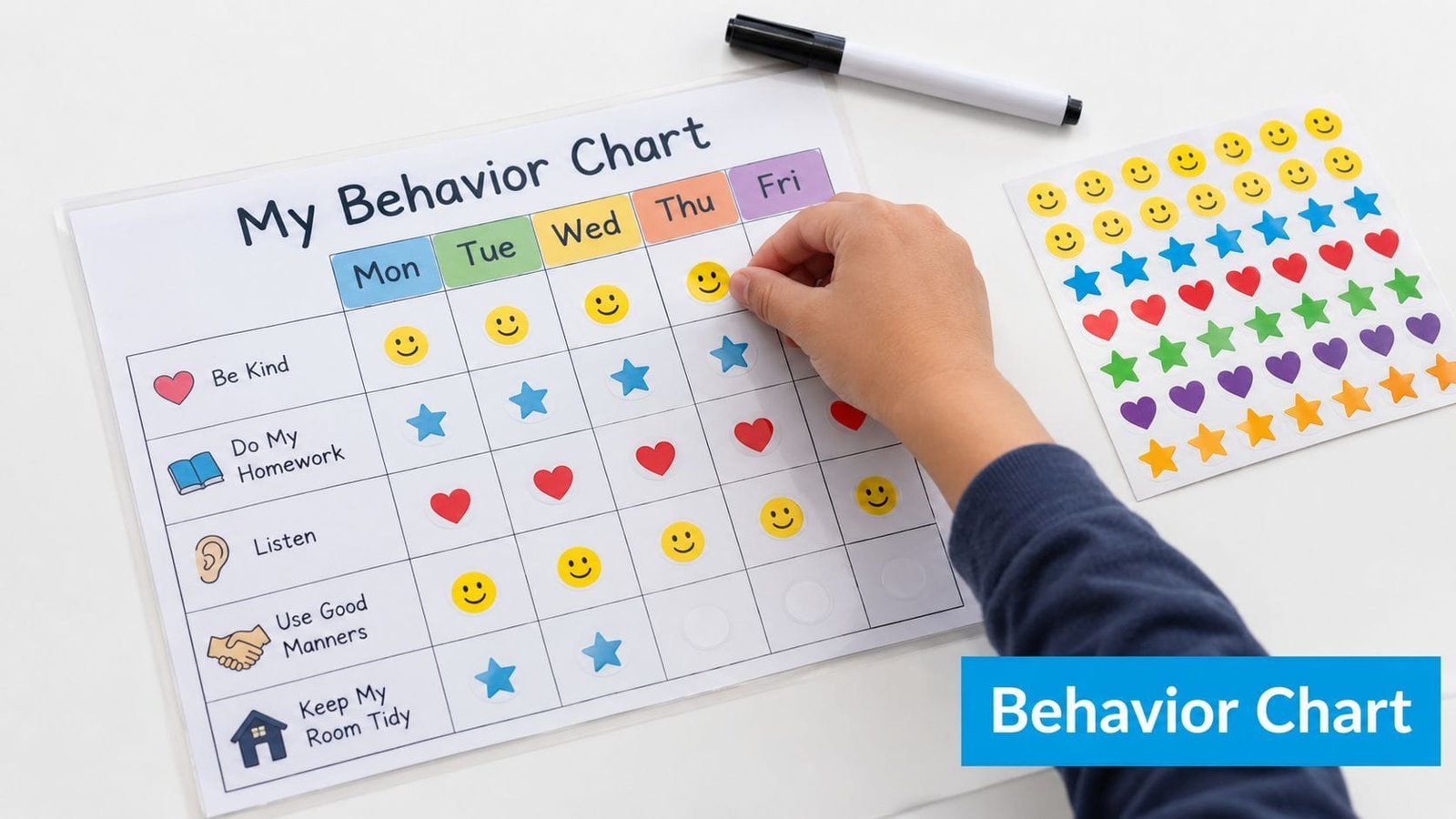
Printable charts solve the immediate problem of making expectations visible. A parent can download a grid, write in a few routines, and use checkmarks, stickers, or colors to record what happened. That physical record works well for children who enjoy a concrete representation of progress and for caregivers who need a reminder in the middle of a busy morning.
A daily chart might include getting dressed, brushing teeth, and starting homework. A weekly responsibility sheet might track household tasks, while a separate page could record preparation for therapy appointments. The strongest versions stay narrow. Guidance for home behavior systems recommends beginning with one or two specific target behaviors, using clear criteria, marking success immediately, and reinforcing it quickly, as described in this behavior chart guide.
Make the paper work for your household
Laminate the page and use dry-erase markers if the same routine repeats. Put it where the behavior happens, such as the kitchen for breakfast steps or the bedroom for bedtime. Review it with your child rather than treating it as an adult surveillance tool. Celebration can be brief and immediate, especially when the child has limited energy for a long discussion.
- Use concrete wording: Replace “behave well” with “puts plate in sink.”
- Keep the chart visible: A hidden chart can't support a routine.
- Photograph completed pages: A digital backup can help reveal longer-term patterns.
- Adapt the standard: A child who is overwhelmed may need a reduced expectation, not a consequence.
Practical rule: If completing the chart takes longer than observing the behavior, simplify the chart.
The Greenville County Schools guidance describes behavior charts as positive reinforcement systems and notes that some school guidance sets a reward milestone at 80% of expectations, giving families a measurable target instead of relying on a vague impression of improvement. Read the home behavior chart guidance before choosing a target, and remember that the milestone should support learning rather than turn regulation into a pass-or-fail test.
For families wanting a reusable display, the same visible-grid principle can translate to personalised blackboards for venues, adapted for a home routine rather than a public setting.
2. Chore Charts and Responsibility Systems
Chore charts address a different problem. They organize shared household work so a child can see what needs doing, when it happens, and how their contribution fits into family life. A morning board might show brushing teeth, getting dressed, and eating breakfast. A sibling system might rotate kitchen responsibilities, while a pet-care chart can show feeding and play.
The chart becomes more respectful when it records participation in real family routines rather than labeling a child as good or bad. Some children respond well to a visible responsibility board, while others experience a long list as pressure. A choice between two tasks can reduce demand avoidance more effectively than repeating an instruction.
Track the task, not a vague character judgment
“Clean your room” is too broad to score consistently. “Put clothes in the hamper” gives the child and caregiver a shared definition of completion. Picture symbols can sit beside words, and magnetic tokens can show finished steps without requiring writing.
- Offer meaningful choices: Let the child choose between available tasks when possible.
- Adjust for capacity: School deadlines, therapy increases, illness, and sensory stress can change what's realistic.
- Record resistance neutrally: Note which task, setting, time, or sensory feature preceded difficulty.
- Acknowledge contribution promptly: Praise or a small reward should follow completion closely.
A chore chart shouldn't become a permanent demand that ignores fluctuating energy. If brushing teeth repeatedly triggers distress, the useful question isn't only whether the task was completed. Note the toothpaste texture, bathroom noise, time pressure, and whether the child had already used significant effort elsewhere. That information can guide a better routine.
For families building predictable daily structure, this routine guide for an autistic child can complement a responsibility chart. The chart can show the sequence, while the caregiver's notes explain why the sequence worked or failed on a particular day.
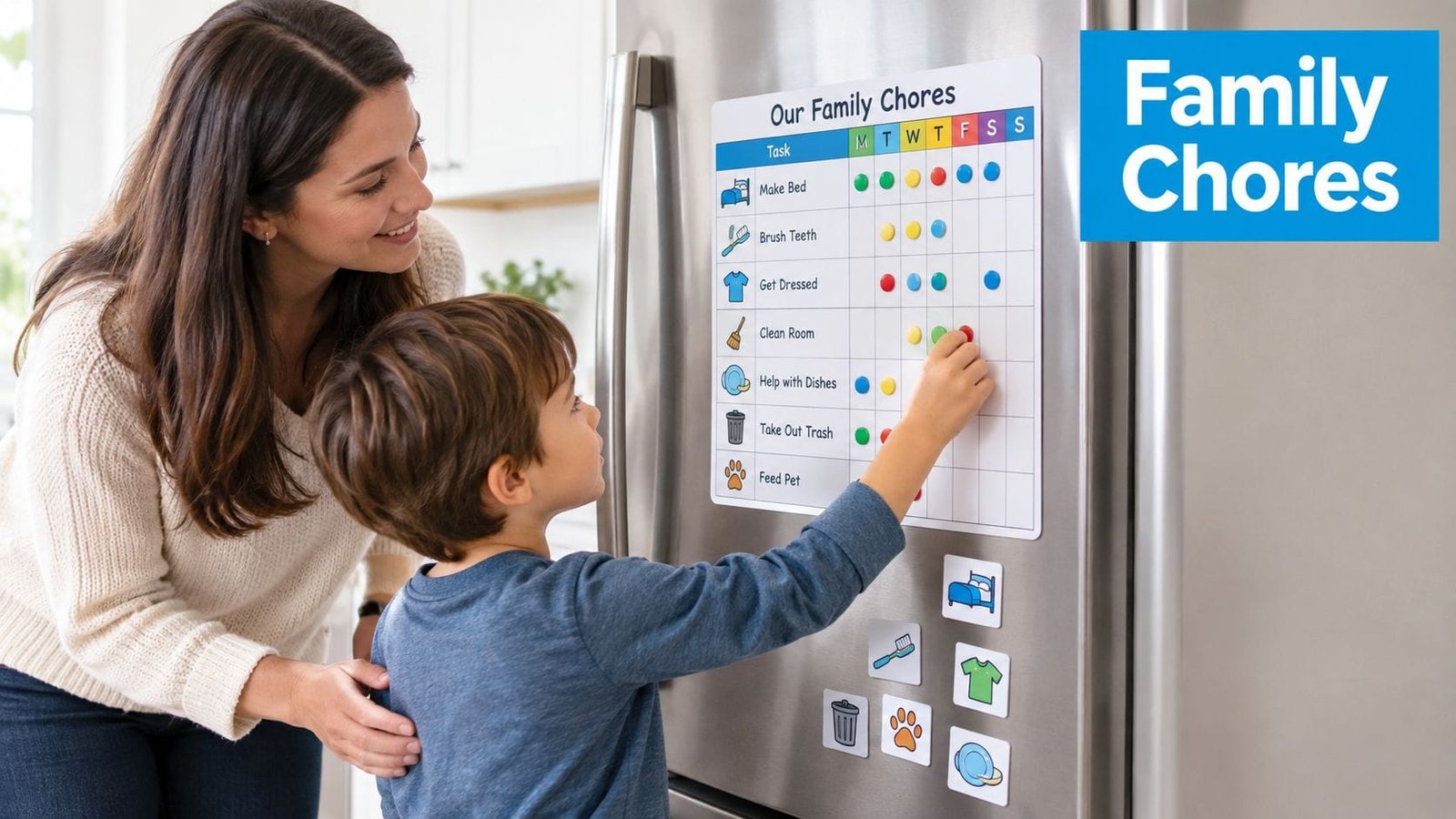
The trade-off is clarity versus flexibility. A rigid board may make expectations obvious but can create conflict when the child's nervous system is already overloaded. A flexible chart, with “help,” “later,” or “adapted task” options, can preserve participation without treating support needs as failure.
3. Token Economy Systems
Token economies solve the problem of connecting a specific action with a later reward. A child earns tokens, points, cards, or another visible marker for an agreed behavior, then exchanges the collected tokens for a reward. The system can be physical or digital, but the earning rule and exchange point must be clear before the routine begins.
A home token economy might support homework, transitions, greetings, reading, or getting ready. The Child Development Centre in Hong Kong describes a five-step process: prepare the chart, define the positive behavior, give a token each time it occurs, identify the reward, and deliver that reward immediately once the tokens are collected. Its home token economy guide also gives examples including following routines, completing tasks, homework, and reading.
Keep the exchange understandable
A token system works best when the child can see how earning leads to something meaningful. Start with easier targets so success arrives early, then increase expectations gradually after the child is succeeding consistently. A reward menu can include experiences, shared activities, or tangible items, depending on the child's actual preferences.
- Define the behavior precisely: “Starts homework after the visual timer” is clearer than “tries hard.”
- Deliver tokens immediately: Delayed feedback is harder to connect with the action.
- Use concrete markers: Buttons, coins, or cards may be easier to understand than invisible points.
- Review motivation: If a reward stops mattering, change the menu instead of adding pressure.
- Avoid loss-heavy systems: Taking away earned tokens can turn support into threat and increase distress.
One guide recommends selecting only one to four target behaviors and beginning with one part of the day, such as morning, afterschool, or bedtime. That narrow start protects the caregiver from an elaborate system that becomes impossible to maintain. It also makes the record more useful because the family knows which routine is being tested.
A token economy isn't the right fit for every child or every behavior. It may support a concrete routine, but it shouldn't be used to force communication, suppress harmless self-regulation, or make basic needs conditional. Track whether the system improves access, participation, and recovery, not only whether the child earns the reward.
4. Visual Schedules and Pictorial Supports
Visual schedules solve a planning and transition problem rather than a reward problem. They show what comes next, reduce reliance on spoken instructions, and break a multi-step routine into manageable actions. For a child who struggles to hold a verbal sequence in working memory, a picture or written card can serve as an external support.
A morning schedule might show waking, bathroom, dressing, breakfast, and teeth brushing. A bedtime version can include a sensory wind-down. A pickup sequence may show getting the backpack, putting on shoes, waiting by the door, and entering the car. For a shower, separate cards can show undressing, adjusting the water, wetting hair, shampooing, rinsing, and drying.
Build the schedule around the child's environment
Real photographs can be more relevant than generic symbols. A photo of the family's actual bathroom, backpack, or bedroom removes an extra layer of interpretation. Keep the schedule at the child's eye level, and let the child move, turn over, or mark each completed step.
- Use a First/Then board: Pair a less preferred activity with what follows without presenting it as a threat.
- Choose a symbol system carefully: Boardmaker, PictureThis, and PECS resources may help families create visual supports.
- Note skipped steps: Rushing or refusing one step can reveal fatigue, sensory discomfort, or an unclear instruction.
- Build in flexibility: Add cards for “break,” “change,” or “finished.”
A visual schedule can reduce uncertainty, but it won't remove every barrier. If the child becomes distressed at the shower card, the next step is observation, not escalation. Water temperature, sound, lighting, skin sensitivity, and the transition away from a preferred activity may matter more than motivation.
This morning routine visual schedule offers a starting point for families who want to make the first part of the day more concrete. The schedule should remain a support that can change with energy and sensory needs, not a test of independence.
The key trade-off is structure versus responsiveness. A fixed sequence helps some children prepare, while a fully fixed sequence can increase distress when plans change. Teach the schedule as a flexible map, and record what helps the child recover when the expected routine shifts.
5. Customizable Digital Behavior Charts and Spreadsheets
Spreadsheets solve the problem of flexible manual analysis. Google Sheets and Excel let a caregiver change categories, add a notes field, share access with another adult, and review entries without rewriting an entire chart. They're useful when the family has a clear question but doesn't yet need a specialized app.
A weekly sheet could include meltdowns, shutdowns, positive interactions, sleep observations, or transitions. Another might record bedtime, wake time, night waking, and a qualitative sleep note. A medication log can include date, time, dosage, and observed mood or behavior, but medication decisions belong with the prescribing clinician.
Capture context without creating paperwork
A spreadsheet becomes more useful when it separates observation from interpretation. Record what happened, where it happened, what came before, what followed, and what support helped. Avoid treating an intensity score as a complete explanation.
Useful spreadsheet features include:
- Dropdown menus: Standardize common entries and reduce typing.
- A context column: Add time, location, sleep, meals, transitions, and sensory factors.
- Shared access: Google Sheets can support real-time collaboration among caregivers.
- Conditional formatting: Highlight entries that deserve review without declaring a cause.
- Separate tabs: Keep longer records organized by month or tracking purpose.
ABC-style logging records the antecedent, behavior, and consequence. STAR-style sheets add time, setting, trigger, and adult response. This behavior tracking explanation shows why a short context record can reveal transition-related, attention-maintained, or escape-maintained patterns more clearly than a behavior label alone.
The trade-off is control versus maintenance. A spreadsheet can be customized almost endlessly, but that freedom invites overtracking. Start with a small set of fields, enter information soon after an event, and review repeated patterns rather than isolated incidents. If caregivers stop using the file, the system has become too demanding, no matter how advanced it looks.
6. Behavior Tracking Apps and Specialized Platforms
Dedicated behavior tracking apps address the friction of paper and spreadsheets. A caregiver can log an event from a phone, select a category, add context, and review visual summaries later. This matters during a meltdown or transition, when opening a spreadsheet and typing a long explanation isn't realistic.
A specialized platform can support records for meltdowns, shutdowns, demand avoidance, echolalia, sleep, medication, or sensory triggers. The useful question isn't “How often did this happen?” It's “What was happening around it, what support was offered, and what changed afterward?”
Use the app as an observation tool
Begin with a few meaningful categories rather than building a complete profile on the first day. Set a consistent reminder for review, but keep event logging brief. More detail can be added after the habit becomes manageable.
- Log close to the event: Memory can flatten the context that makes a pattern understandable.
- Use templates first: Familiar fields are easier to maintain than a completely custom setup.
- Compare connected routines: Look at behavior alongside sleep, activities, medication timing, or transitions.
- Share carefully: Give therapists and clinicians observations that help them ask better questions.
- Protect the child's dignity: Record support needs and successful regulation, not only visible distress.
Research on caregiver tracking describes a move toward shorter, structured capture, mobile tools, in-home video, and wearables, while emphasizing that observation needs enough context to be useful. The caregiver tracking research is especially relevant to the practical question of how much to record. More fields aren't automatically better if the family abandons the system.
A specialized app is a better fit than a spreadsheet when speed, mobile access, pattern review, and shared care are central. It still requires interpretation. An app can organize observations, but families and professionals must decide what support is respectful and appropriate.
7. Guiding Growth With Integrated Behavior Tracking and AI-Powered Insights
Guiding Growth is designed for families who need more than a single behavior score. The mobile app brings behavior logging, sleep, nutrition, medications, therapy sessions, routines, and contextual observations into one place. That connected record can help caregivers examine whether distress relates to a demand, sensory environment, sleep disruption, medication timing, or a combination of factors.
Voice logging is useful when typing would pull a parent away from the moment. A caregiver might record that a child became upset after being told the family couldn't go to the park, then add hunger, sleep, setting, and resolution details. Alma AI can act as a judgment-free reflection partner by helping interpret patterns such as demand avoidance and suggesting questions to discuss with the child's support team.
Turn scattered observations into shared questions
The platform is most valuable when the data leads to a conversation, not a verdict. A pattern of bedtime resistance during school weeks might prompt questions about crowded hallways, fluorescent lighting, recovery time, or medication timing. A rise in echolalia after a speech session might lead a therapist to examine the room, pacing, breaks, or sensory load.
- Use voice as the default: Real-time context is often easier to capture aloud than later from memory.
- Combine domains: Compare behavior with sleep, food, medication, therapy, and activity observations.
- Review insights regularly: Bring recurring patterns to therapists, doctors, educators, or caregivers.
- Share dashboards deliberately: Coordinated adults can respond more consistently when they see the same context.
- Track quality of life: Include distress intensity, recovery time, successful accommodations, and preferred regulation activities.
A mobile health study describes the value of caregiver-friendly systems that can support observation beyond simple behavior counting, including mobile capture and collaboration. Its research on mobile behavior tracking also supports a broader view of what families may need after collecting data: interpretation, coordination, and a way to connect observations with practical support.
Guiding Growth isn't a replacement for clinical judgment. Its role is to reduce scattered notes and help families arrive at better-informed discussions. The app can support records of meltdowns, shutdowns, hand flapping, echolalia, sleep, diet, appointments, and therapy, while keeping the focus on well-being rather than forcing every difference into a compliance metric.
Home Behavior Charts: 7-Option Comparison
| Tool | Core Features | UX & Effectiveness | Value & Price | Target Audience | Unique Selling Point |
|---|---|---|---|---|---|
| Printable Behavior Chart Templates | Pre-designed printable grids, customizable sections, sticker-friendly, notes space | ★★, Immediate visual feedback; manual pattern work | 💰 Free / Low cost | 👥 Low-tech families; parents of young children | ✨ Tangible, simple, kid-engaging |
| Chore Charts & Responsibility Systems | Task assignment, pictorial icons, rotating duties, reward columns | ★★★, Builds independence; needs consistent monitoring | 💰 Low cost (time investment) | 👥 Families teaching responsibility; visual learners | ✨ Teaches life skills; clarifies expectations |
| Token Economy Systems | Points/tokens, reward menu, exchange rules, ledger | ★★★, Strong extrinsic motivation; can reduce intrinsic drive if overused | 💰 Low–Med (materials/time) | 👥 Children motivated by tangible rewards | ✨ Quantifiable reinforcement; teaches delayed gratification |
| Visual Schedules & Pictorial Supports | Sequential picture cards, Velcro/magnetic boards, digital/print options | ★★★★, Reduces anxiety; supports transitions and independence | 💰 Low cost (setup time) | 👥 Autistic & neurodivergent children; non-readers | ✨ Concrete routine supports; excellent for transitions |
| Customizable Digital Behavior Charts & Spreadsheets | Custom columns, formulas, cloud access, basic graphs, exportable | ★★★, Flexible and familiar; manual entry limits real-time insight | 💰 Low–Med (no subscription usually) | 👥 Tech-comfortable parents; budget-conscious families | ✨ Highly customizable; easy sharing via links |
| Behavior Tracking Apps & Specialized Platforms | Quick-entry logging, trend analysis, visual reports, multi-user access | ★★★★, Faster logging; automated trends; quality varies by app | 💰 Med (subscription models common) | 👥 Parents wanting mobile, automated tracking | ✨ Mobile real-time logging + visual analytics |
| 🏆 Guiding Growth: Integrated Behavior Tracking with AI-Powered Insights | Voice logging (zero typing), Alma AI insights, behavior+sleep+diet+med tracking, contextual logging, HIPAA-grade sharing | ★★★★★, Hands-free logging; AI identifies "why", strong collaboration features | 💰 Subscription, professional-grade ROI; saves hours of manual work | 👥 Parents of autistic/neurodivergent children, caregivers, therapists | ✨ AI-driven "why" analysis + voice-first logging + real-time care-team collaboration |
Turn Daily Tracking Into Better Support
The right chart is the one your household can use without increasing stress. Choose printables when you need an immediate, low-tech visual tool. Choose chore charts when shared responsibilities need clearer ownership. A token system may fit a concrete reinforcement goal, while a visual schedule is often better when the barrier involves sequencing, transitions, or uncertainty.
Use a spreadsheet when you want manual control over categories and notes. Choose a specialized app when quick capture, connected context, and collaboration matter. Guiding Growth can support that latter approach by bringing behavior, sleep, nutrition, medication, therapy, and routine observations together rather than leaving each record in a separate notebook or message thread.
Begin with two or three meaningful observations, not an exhaustive record of everything your child does. For each event, note the setting, what happened beforehand, the child's apparent regulation state, what support was offered, and what happened afterward. Include successful moments too. A routine that worked after a snack, a quieter room, a visual cue, or extra processing time may teach you as much as a difficult episode.
Review patterns over time, and don't treat one hard morning as proof that a strategy failed. A chart should help adults change the environment, adjust demands, offer communication support, and protect recovery time. It shouldn't shame a child for shutdowns, repetitive movements, echolalia, or other forms of neurodivergent communication and regulation.
When the record shows recurring triggers or meaningful changes, share it with the relevant professionals. A pediatrician, therapist, educator, or support worker can use specific observations more effectively than a general statement that behavior has been “worse.” Keep interpretation collaborative, especially when sleep, sensory load, health, food, medication, and routine changes overlap.
Guiding Growth is available at guidinggrowth.app for families who want voice logging, connected health context, AI-supported reflection through Alma AI, and coordinated sharing with caregivers and professionals. Use it when the main problem is no longer remembering what happened, but understanding the pattern well enough to choose kinder, more effective support.
Guiding Growth helps parents log meltdowns, shutdowns, demand avoidance, echolalia, sleep, nutrition, medication, and therapy context in one mobile app. Visit Guiding Growth to replace scattered notes with organized observations, AI-supported reflection, and clearer collaboration around your child's daily support.