You're halfway through the morning rush when you realize you can't remember whether your child received the antibiotic. The bottle is on the counter, the school nurse needs an answer, and your pediatrician will ask what happened if the symptoms continue. A verbal “I think so” won't give anyone a reliable basis for the next decision.
A well-designed medication log book for kids solves a larger problem than remembering a dose. It creates one shared record for parents, school staff, babysitters, clinicians, and other caregivers. The useful record shows not only what was prescribed, but what was offered, what was given, what was refused, and what happened afterward.
Table of Contents
- Why a Medication Log Book Is More Than a Checklist
- Core Fields Every Medication Log Book Should Capture
- Building a Medication Schedule That Actually Fits Your Child
- Documenting Side Effects, Refusals, and Behavioral Changes
- Paper, Printable, or App Choosing the Right Medication Log Book Format
- Sharing the Log With Caregivers, Schools, and Clinicians
- Your First Week Using a Medication Log Book
Why a Medication Log Book Is More Than a Checklist
A medication log book works best as a handoff document, not a private checklist kept by one adult. Medication safety guidance from the World Health Organization's medication reconciliation guidance describes a formal process for transferring accurate medication information during changes in care. That process starts with a Best Possible Medication History, gathered by speaking with the child's family or caregiver and checking the information against another reliable source.
For a child, that record may need to include prescription and non-prescription medicines, vitamins, nutritional supplements, interactive foods, herbal preparations, and other relevant substances. It should also capture dose, frequency, route, and the timing of the last dose. A medication log book turns those details into something adults can check instead of reconstructing from memory.
Three places where the record must stay connected
At home, a parent or caregiver records the medication offered and the actual time given. At school, authorized staff may need to document a midday dose, a refusal, a vomiting episode, or a PRN request. At the clinic, the pediatrician uses the record to compare the prescribed plan with the child's real experience.
Those entries can drift quickly when each setting keeps a separate notebook, phone note, or verbal update. The clinical value comes from keeping the same information connected across the day and across changes in care.
Practical rule: One medication change should create one clearly dated update everywhere the child's care is documented.
A strong log also gives clinicians a rapid scan of the recent pattern. The handoff section should show current medicines, recent changes, missed or refused doses, PRN use, side effects, and questions. That matters because the JAMA Network Open study of medication record accuracy found that electronic medication lists didn't consistently capture every medication as prescribed across the patient groups studied. A contemporaneous log adds a different layer, what the child received.
Version control is just as important. Keep the active medication list at the front, mark the effective date of every change, and archive old instructions rather than erasing them. That prevents a school nurse or co-parent from following yesterday's dose after a prescription update.
Core Fields Every Medication Log Book Should Capture
Start with the child, not the medication. Put the child's full name, date of birth, current weight when clinically relevant, allergies, and emergency contacts on the first page. These identifiers help a clinician, school nurse, or pharmacist distinguish the correct record during a refill, appointment, or urgent handoff.
Add the prescribing clinician's name and contact details, the pharmacy, and the date of the latest medication review. For each medicine, record both the generic and brand name when applicable. Include the strength and prescribed dose, such as the amount in milligrams or millilitres, the route, scheduled time, and whether the medicine is routine or PRN.
The actual administration row needs more than a checkmark. Record the exact time given, the person who gave it, and what happened if the dose wasn't completed.
| Field Group | Specific Fields | Why It Matters at the Next Visit |
|---|---|---|
| Child identity | Full name, date of birth, weight, allergies | Prevents confusion and gives the clinician essential context |
| Clinical contacts | Prescriber, clinic, pharmacy, review date | Speeds reconciliation and refill questions |
| Medication identity | Generic name, brand name, strength | Separates similar products and clarifies the active treatment |
| Administration plan | Dose, route, scheduled time, PRN status | Shows what should happen and when |
| Actual administration | Date, exact time, given by | Establishes what happened rather than what was planned |
| Exceptions | Refusal, vomiting, partial dose, omission, reason | Helps explain missed therapeutic effects or safety concerns |
| Response | Side effects, behavior, appetite, sleep, other observations | Gives the prescriber context for adjustment |
The fields parents often leave out
A refusal deserves its own entry. Write whether the child refused completely or took part of the dose, how it was offered, and whether the child vomited afterward. For liquid medicines, note whether the dose was given by syringe, spoon, cup, or mixed with food, because the method can affect whether the full amount was consumed.
The “given by” field is particularly valuable. If home records say a dose was given but the school record suggests otherwise, the clinician can identify which adult documented each event and reconstruct the handoff. Caregiver medication guidance also recommends capturing OTC medicines, supplements, allergies, start and stop dates, the prescriber, pharmacy, and side effects in a complete medication record, as outlined in caregiver medication management guidance.
Anyone administering medicines should understand the basics of safe documentation. A practical resource on nanny medication training 2026 can help families set expectations for caregivers before they begin.
For families who want medication records connected with broader care tracking, medication adherence monitoring can provide a digital structure alongside the core fields above.
Building a Medication Schedule That Actually Fits Your Child
A prescription sheet describes the treatment plan. Your medication log book must translate that plan into the hours when your child is awake, at school, eating, sleeping, and moving between caregivers.
Begin with a daily grid. Put each medication on its own row and place time slots across the page. Use the prescribed interval as the starting point, then confirm any practical adjustment with the prescriber or pharmacist. Don't independently compress doses, double a dose, or change an interval because the original time is inconvenient.
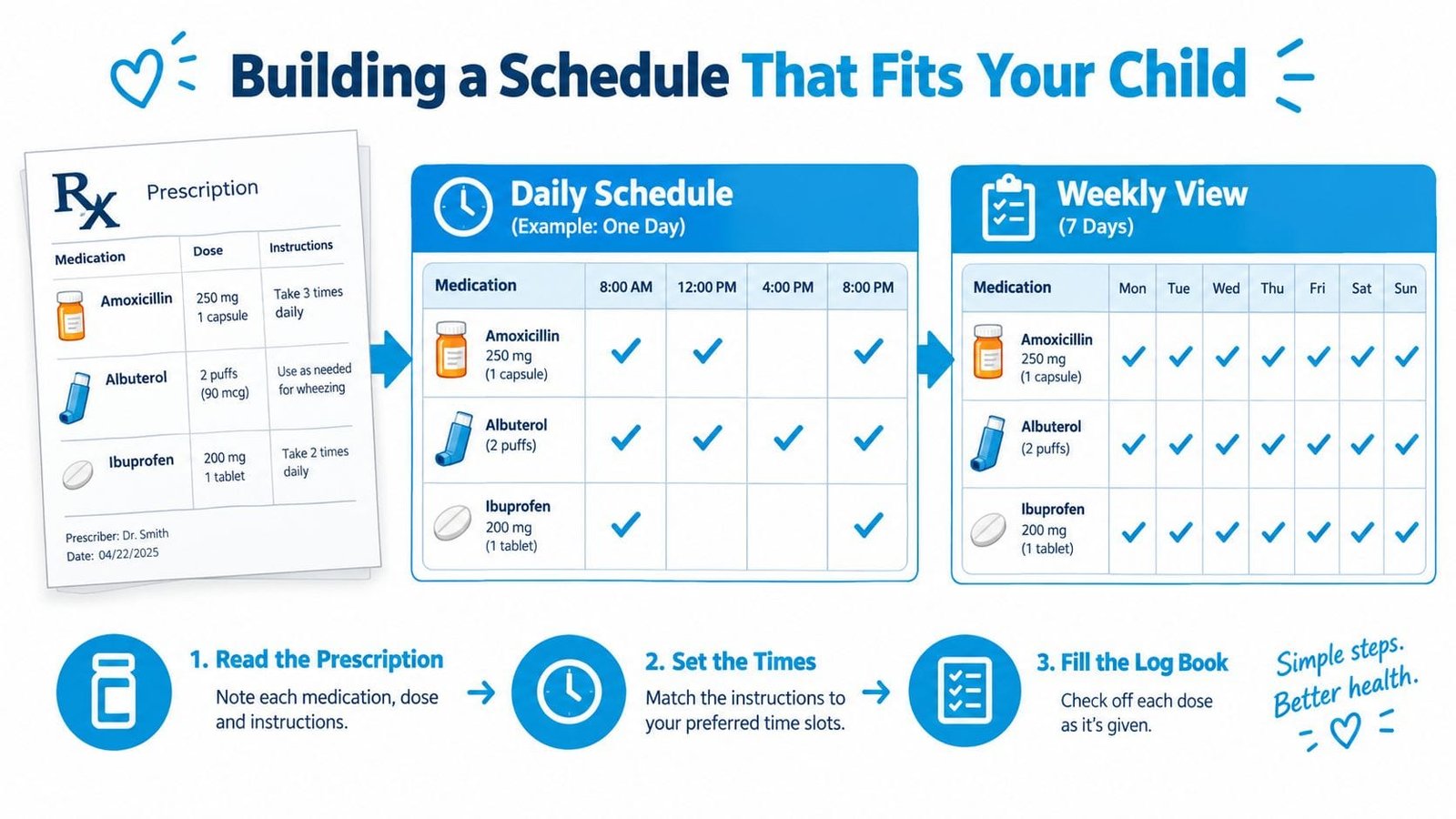
Use a weekly view to expose conflicts
A daily page can hide a weekend problem. Add a weekly view that shows school days, non-school days, travel, and changes in sleep routine. A stimulant may be used only on school days if that is the prescribed plan, while an antibiotic requiring evenly spaced doses may create a challenge around sleep. The log should make the conflict visible so the family can ask the right clinical question.
A sample schedule might include:
- Morning ADHD stimulant: Record the planned morning window, the actual time, and whether breakfast or school affected administration.
- Twice-daily antibiotic: Create two clearly separated dose rows and record the actual times rather than relying on an assumed morning and evening checkmark.
- PRN antihistamine: Give it a dedicated as-needed area with the reason, time offered, time given, response, and any later dose. That makes frequency visible to the prescriber instead of burying it in a separate notebook.
When a morning dose is late, follow the prescriber's or pharmacist's instructions for what to do. The log should record the delay and the advice received, not rewrite the schedule.
Documenting Side Effects, Refusals, and Behavioral Changes
A checkmark can tell you that a dose was recorded. It can't tell you whether your child became nauseated, stopped eating lunch, slept poorly, or became unusually fatigued afterward. Pair each medication row with space for side effects and behavior so the record shows the relationship between the dose and the child's response.
Record when a symptom began, how long it lasted, and whether it followed the dose, a meal, physical activity, or sleep. A note such as “nausea” is less useful than “nausea began after the dose and lasted through lunch.” Keep the observation factual and avoid assuming that the medication caused the symptom.
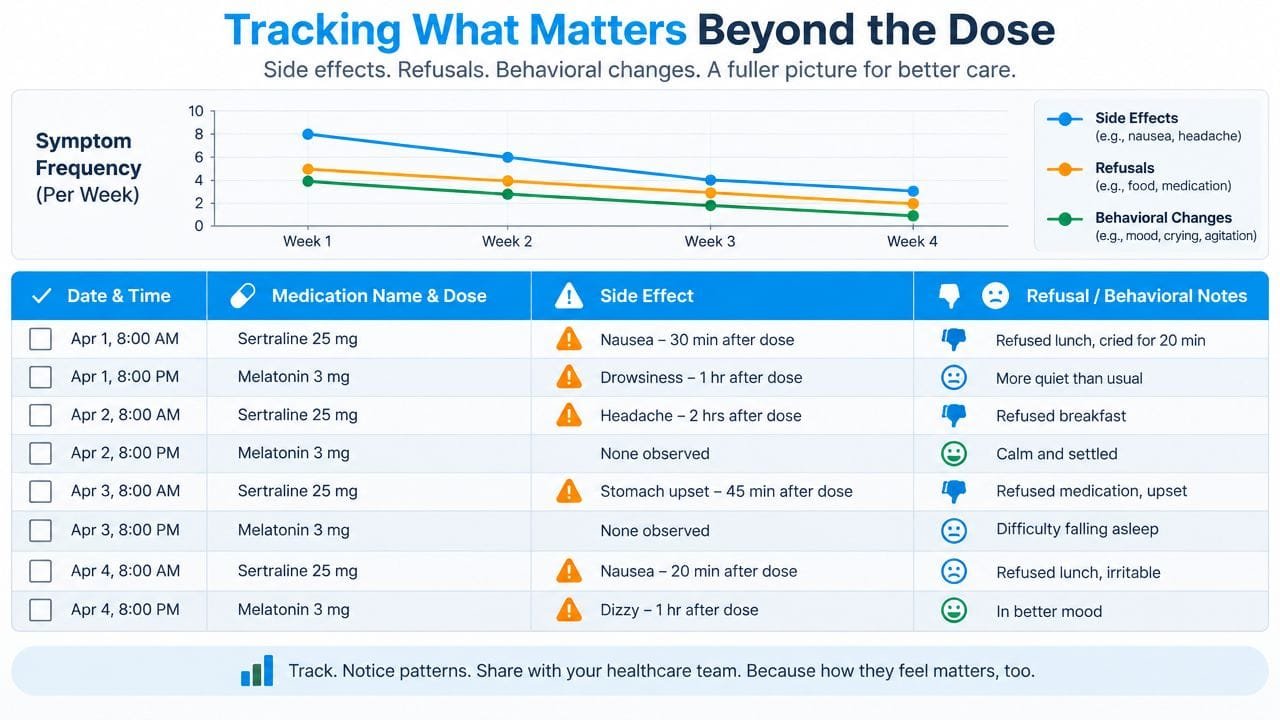
Refusal entries need context
For a refused dose, document the time offered, the delivery method, and whether the refusal was complete or partial. Note whether the child spat it out, vomited, accepted only part of the dose, or took it after a later attempt. Don't automatically repeat a dose after vomiting or partial administration. Contact the appropriate clinician or pharmacist for specific guidance.
If your child can't describe internal symptoms, record observable markers:
- Appetite: skipped meals, reduced intake, unusual food seeking.
- Sleep: difficulty settling, night waking, unusually long sleep.
- Mood: tearfulness, irritability, withdrawal, or a marked change from baseline.
- Physical signs: rash, stool changes, unusual fatigue, or visible discomfort.
- Behavior: a change in regulation, communication, repetitive behavior, or activity level.
A weekly notes page helps capture slower patterns that don't fit one dose row, such as a sustained mood change or appetite trend. For families tracking medication alongside behavior, managing behavioral medication side effects offers a useful way to connect observations with the wider care picture.
In home-care settings, administration errors can include omitted doses, the wrong medicine, the wrong dose, or the wrong time or route. A review of caregiver medication administration reports error rates from 1.9% to 33% of administered medications, while 12% to 92.7% of carers may make at least one error, as reported in this review of medication administration errors in home care. Those figures reinforce why a refusal, near miss, or correction belongs in the record rather than being fixed and forgotten.
Paper, Printable, or App Choosing the Right Medication Log Book Format
The right format depends on how many people administer medication and how often the record changes. A bound paper medication log book is portable, familiar, and usable during a power or connectivity problem. Its weakness is location. If it stays at home, the school nurse can't see the latest entry, and a clinician can't search for a dose from several weeks earlier.
A printable binder solves some organization problems. Use labeled sections for the current medication list, daily administration pages, PRN records, side effects, school communication, and discontinued medicines. A binder can be copied or scanned for an appointment, but every copy creates a version-control risk unless someone marks which copy is current.
A mobile app can centralize entries from multiple caregivers, provide timestamps, and produce a concise handoff without asking one parent to carry the entire history. The trade-off is practical. Every caregiver needs access, a shared process, and enough setup discipline to record the dose at the point of care.
| Format | Collaboration | Searchability | Handoff to Clinician | Reliability |
|---|---|---|---|---|
| Bound paper book | Strong only when kept in one shared location | Manual page review | Photocopy or show selected pages | Works without charging |
| Printable binder | Multiple copies are possible, but versions can diverge | Better with tabs and dates | Scan or print current sections | Depends on consistent filing |
| Mobile app | Supports multiple authorized contributors | Searchable digital history | Export or share a summary | Requires devices and consistent use |
For families comparing digital and paper approaches, XO health tracking solutions provide another example of a treatment-tracking format to evaluate. The comparison should focus on how records move between people, not on how many features appear in a product description.
Guiding Growth is one digital option that combines medication and therapy tracking with doctor-visit information, reminders, and broader care observations. Families can also review a dedicated medication reminder app approach when missed timing is the main problem.
My practical rule is simple: one caregiver managing a short course may do well with paper. Shared custody, school dosing, multiple caregivers, or frequent changes usually justify a digital layer or a tightly controlled binder workflow.
Sharing the Log With Caregivers, Schools, and Clinicians
A medication log protects a child only when every adult works from the same current record. Choose one source of truth, whether that's a shared app, a labeled binder, or a physical book that travels with the child. Name who records home doses and who records school doses, because “someone else probably wrote it down” is how gaps begin.
School handoffs need special care. The parent should provide the current medication instructions through the school's required process, while the log records the administration event. Don't rely on a message thread as the permanent record. Messages can contain useful context, but they shouldn't replace the dated administration entry.
Preventing double doses
Use a visible handoff line whenever responsibility changes. The outgoing caregiver records the last medication, actual time, amount, and any exception. The incoming caregiver reads that entry before offering the next dose.
During the weekly reconciliation:
- Compare records: Place the home and school entries side by side.
- Flag mismatches: Mark any dose appearing in one record but not the other.
- Check the timeline: Look for late entries, duplicate times, and undocumented refusals.
- Resolve before the next handoff: Ask the adult who was present rather than guessing.
- Update the active list: Record changes with an effective date and the source of the instruction.
A medication administration record should identify the patient, medicine, dose, route, time, administration status, and the administering person. Maine's medication administration rule illustrates this structured approach, including documentation for PRN use, refusals, and start or stop status. Local requirements may differ, so families and organizations should follow the rules that apply to their setting.
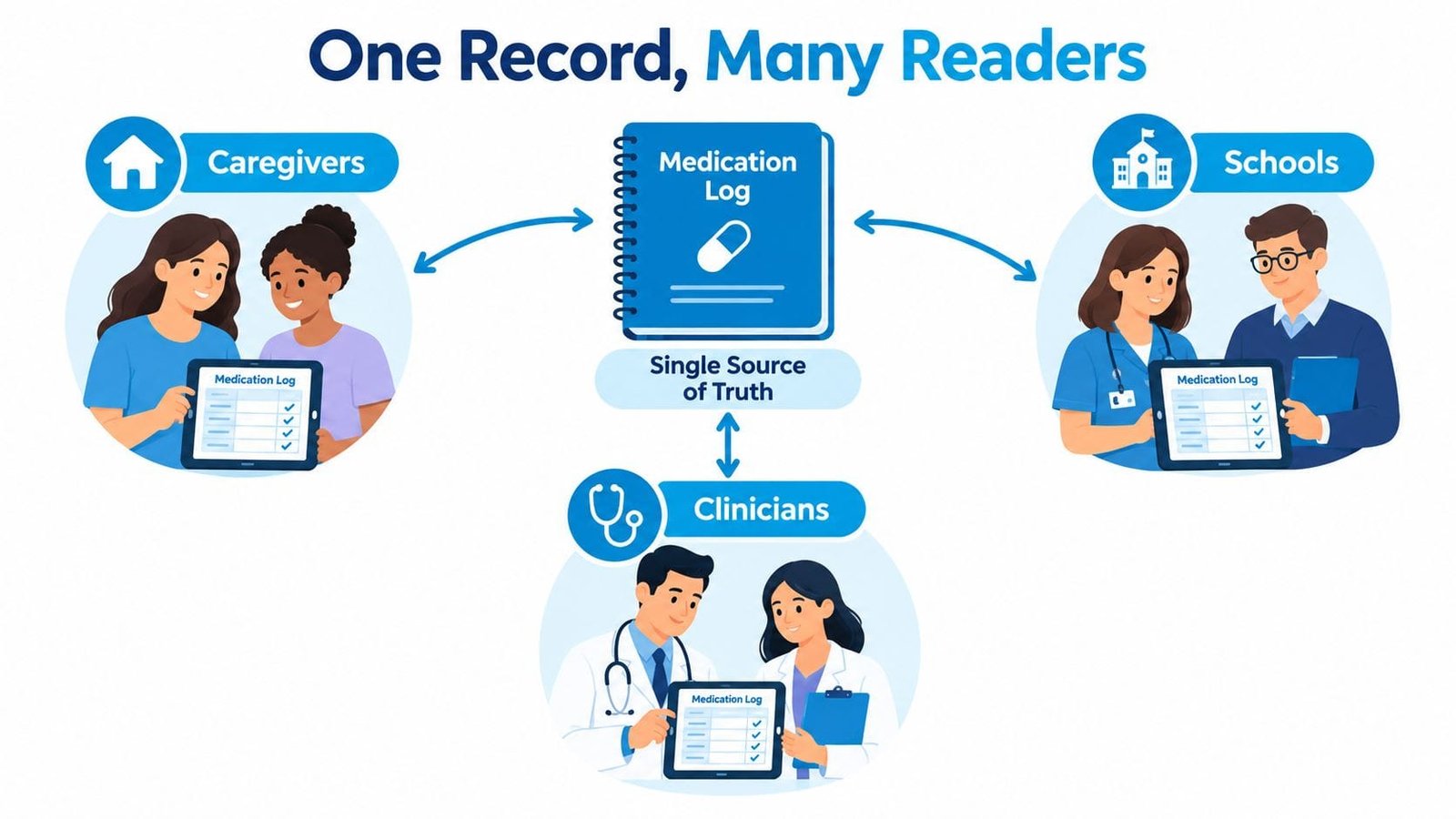
Before an appointment, prepare a one-page handoff summary. Include the current medicines, changes, refusals, PRN pattern, side effects, and questions. Give the clinician the summary first, with the full log available if a detail needs checking. Documentation should happen immediately after administration whenever possible, because a review of medication documentation quality emphasizes timely, dated, timed, and signed or initialed entries.
Your First Week Using a Medication Log Book
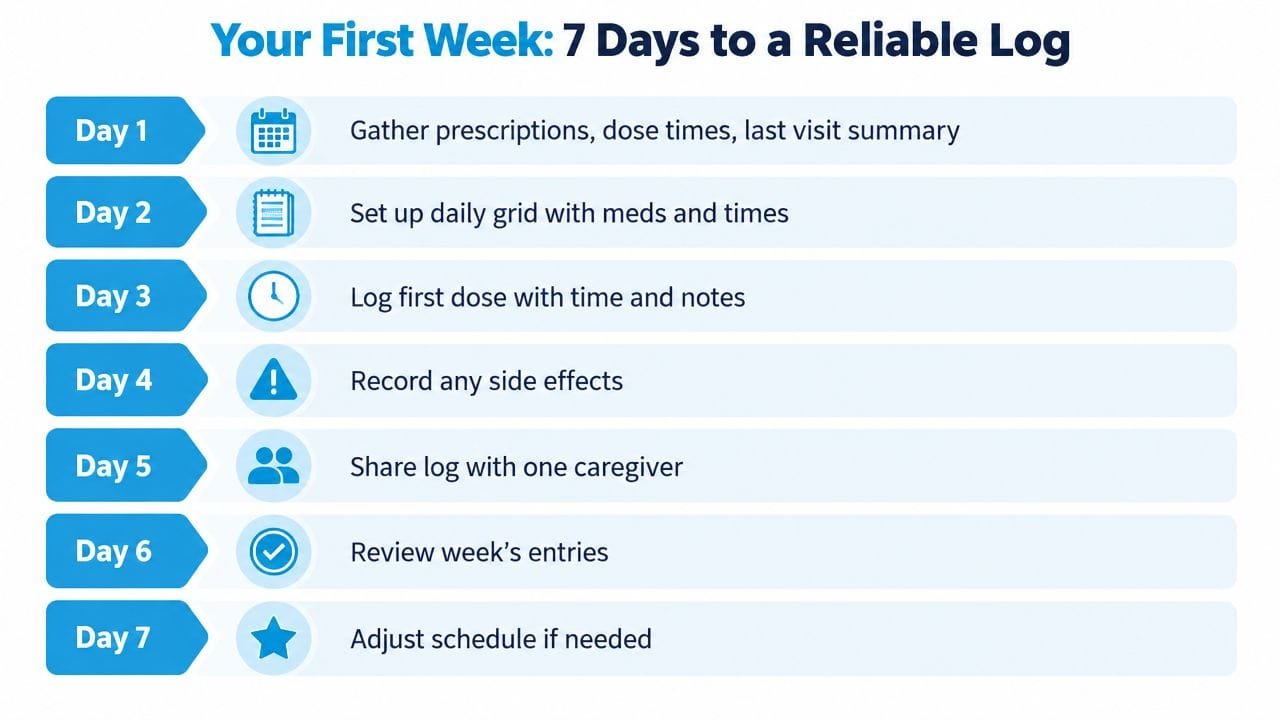
Don't wait for a perfect template. Build a working system over seven days and adjust it based on what your family uses.
- Day 1, gather the source material: Collect current prescriptions, dose times, the latest pediatric visit summary, pharmacy details, allergy information, and school medication instructions.
- Day 2, choose the format: Decide between a paper binder, printable pages, or a digital option such as Guiding Growth. Set up the active medication list, daily grid, and notes or handoff section.
- Day 3, enter the current week: Add each medicine, route, planned time, actual dose rows, and baseline observations about sleep, appetite, mood, and behavior.
- Day 4, test the exception fields: Use a recent real example to practice recording a PRN dose, refusal, partial dose, vomiting, or side effect. If nothing happened that day, don't invent an entry.
- Day 5, share one clear record: Give the current instructions and handoff process to the co-parent, regular caregiver, and school nurse through the channels their setting requires.
- Day 6, reconcile: Compare the entries with available medication supplies and caregiver recollections. Resolve gaps while the day is still easy to reconstruct.
- Day 7, review clinically: Use the record to prepare specific questions for the pediatrician or pharmacist. Keep the fields that reveal useful patterns and remove notes that create work without helping anyone make a decision.
A medication log book is a working document, not a permanent monument to one routine. Paper diaries can overestimate adherence. One review found an average 30% surplus of diary entries compared with MEMS electronic monitoring, with log-based estimates consistently higher in another study discussed in the review of self-reported medication adherence methods. Record at the point of care, reconcile when possible, and improve the system in small weekly steps instead of abandoning an overcomplicated setup after a fortnight.
Guiding Growth brings medication, therapy, appointments, behavior observations, sleep, and nutrition tracking into one mobile care record, with collaboration for family members, caregivers, and professionals. Visit Guiding Growth to create a clearer medication handoff system and replace scattered notes with shared, useful context.