ABA commonly costs about $120 per hour before insurance, with annual totals ranging from roughly $62,400 at 10 hours per week to about $249,600 at 40 hours per week. The bill swings so widely because intensity, provider credentials, payer rules, and the mix of direct treatment, supervision, and assessment all change the final amount.
You may be looking at a therapy estimate at the kitchen table, calculator open, trying to understand how a recommended schedule could cost more than a second household income. The hourly figure is only the starting point. The actual question is how many hours your child receives, who delivers those hours, what your plan allows, and what you'll owe before insurance pays its share.
The straight answer is uncomfortable but useful: ABA is often one of the most expensive recurring autism-related services when families pay privately. You need a written breakdown, not a single headline rate. You also need a way to compare billed hours with delivered care and documented progress.
Table of Contents
- What ABA Therapy Really Costs Per Hour and Per Year
- Why Two ABA Programs With the Same Hours Cost Different Amounts
- Key Factors That Push ABA Pricing Up or Down
- Ways to Pay for ABA Therapy and What Insurance Actually Covers
- Sample Annual Costs for Three Real Family Scenarios
- Practical Ways to Lower Your ABA Bill Without Cutting Care
- Tracking Whether the Cost Is Paying Off for Your Child
- ABA Cost Questions Parents Ask Before Signing a Contract
What ABA Therapy Really Costs Per Hour and Per Year
A parent reviewing an ABA estimate usually sees one hourly rate and one recommended schedule. That presentation hides the financial reality. A program billed at $120 per hour can look manageable until the schedule reaches multiple days each week, and insurance may not cover the full allowed amount.
Major cost guides commonly place direct ABA services around $120 per hour before insurance, while technician time may be priced around $65 to $100 per hour and BCBA oversight may cost more. This ABA cost model shows why the weekly schedule matters more than the hourly figure by itself.
The annual math parents need
At the commonly cited $120 rate, the arithmetic looks like this:
| Weekly Hours | Weekly Cost at $120/hr | Annual Cost, 52 weeks |
|---|---|---|
| 10 | $1,200 | $62,400 |
| 20 | $2,400 | $124,800 |
| 40 | $4,800 | $249,600 |
These annual totals use the same widely cited cost model linked above. They're before insurance, deductibles, copays, coinsurance, negotiated rates, and any authorization limits. A separate cost overview places typical ABA plans around 10 to 40 hours per week, with a 20-hour schedule estimated at roughly $2,400 to $3,000 per week, or about $125,000 to $156,000 per year before insurance. The financing overview provides that broader range.
The billable hour also doesn't necessarily mean an uninterrupted hour of a technician working one-on-one with your child. It can reflect direct treatment, BCBA supervision, assessment, treatment-plan development, family training, or related administrative work, depending on the service and payer rules.
Practical rule: Ask the provider to separate direct treatment, supervision, assessment, and family training before you compare quotes.
Use $120 per hour as a defensible benchmark, not a promise. Published summaries also describe rates around $120 to $150 per hour, with some higher-cost markets reaching $200 or more before insurance. This ABA pricing guide supports that wider benchmark.
Why Two ABA Programs With the Same Hours Cost Different Amounts
Two children can receive the same authorized hours and still leave their families with very different bills. The deciding factor is usually the billing roles and service mix assigned to those hours. Compare the services behind the total, not just the weekly schedule.
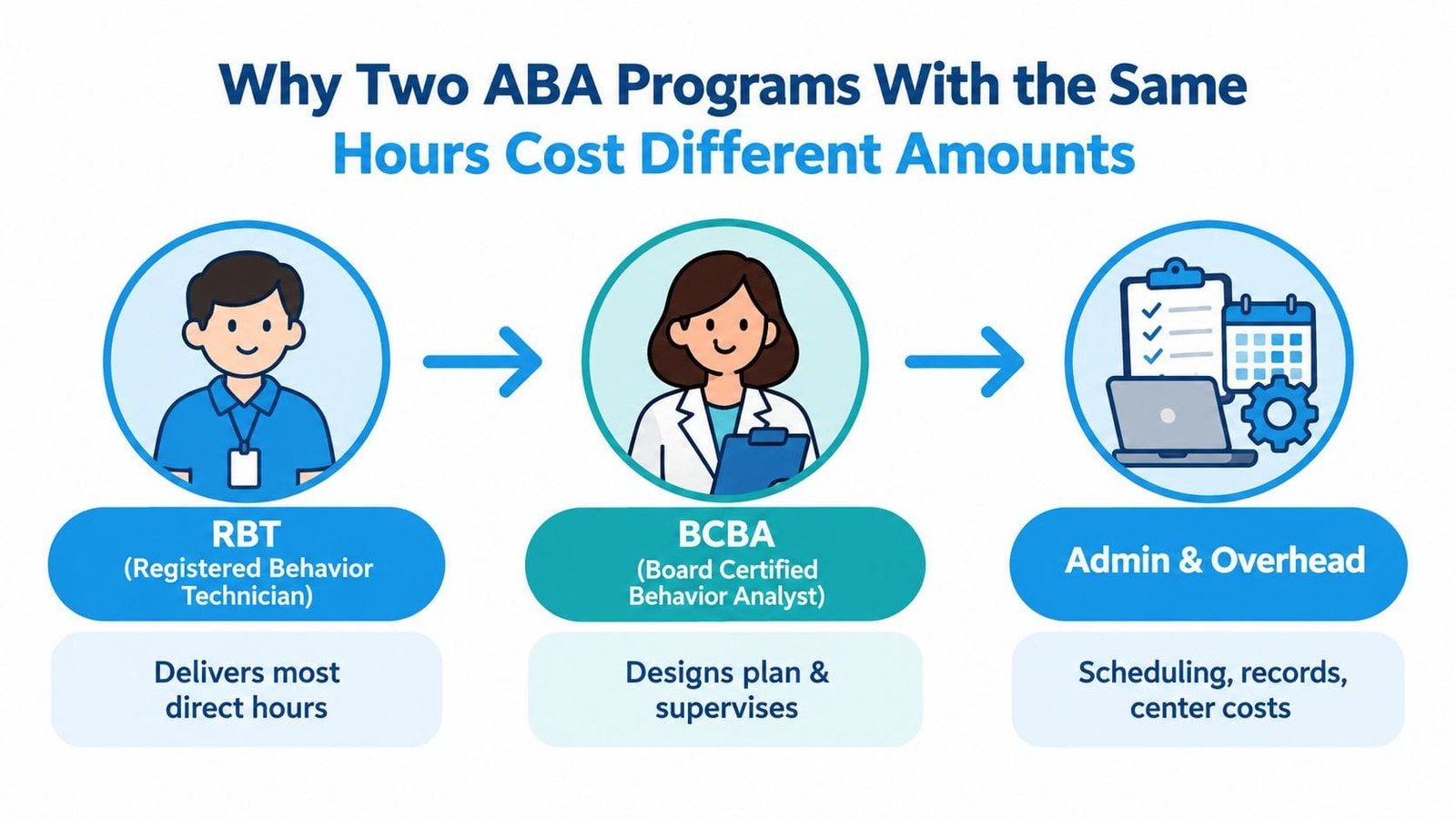
Three roles can appear on the bill
The Registered Behavior Technician, or RBT, usually provides much of the direct treatment. Technician-level time often costs less than BCBA-level work, but the payer, region, and provider contract determine the actual rate.
The Board Certified Behavior Analyst, or BCBA, sets goals, reviews data, changes protocols, supervises treatment, and may deliver direct services. Because this work requires a different credential and carries clinical responsibility, many fee schedules bill BCBA time at a higher rate.
The assessment and planning team handles intake testing, functional assessment, treatment planning, and reassessment. These services may be billed before regular sessions begin. Treat the assessment line as its own cost until the provider confirms otherwise.
Build the estimate around technician direct service, BCBA oversight, and assessment or planning. Independent fee summaries place technician direct service around $50 to $85 per hour and BCBA assessment or supervision around $120 to $200 per hour. This role-based ABA cost model shows why heavy supervision can move a program's blended rate toward the BCBA range.
Read the first invoice line by line
Before signing, ask the provider to identify:
- Direct treatment: Who delivers it, where it occurs, and which rate applies.
- BCBA supervision: How often the BCBA observes sessions, reviews data, and updates the plan.
- Assessment: Which intake or reassessment tasks are billed separately.
- Parent training: Whether caregiver coaching is included, optional, or separately authorized.
- Travel and administrative fees: Whether commuting, scheduling, or records create charges.
- Denied or noncovered services: Who pays if the insurer rejects a claim.
Track each billed hour in your records or care app by date, role, service type, authorization, and claim status. That record lets you compare the quote with actual care and challenge charges that do not match the plan.
Public fee schedules show the same separation. Nebraska lists different reimbursable amounts for technician treatment, professional treatment, and family treatment instead of treating every ABA service as one interchangeable hour. Nebraska's ABA fee information demonstrates why the service code and billing role matter.
Key Factors That Push ABA Pricing Up or Down
Parents often ask for the “normal” ABA price in their area. That question is too broad to be useful. The better question is, which part of this quote is driving the total?
The main pricing levers
Location changes the allowed rate. State Medicaid schedules, commercial insurance contracts, local wages, and provider availability all affect pricing. Historical reimbursement data from RAND found state Medicaid rates ranging from $25 to $75 per hour for BCaBA or technician services and from $55.50 to $125 per hour for master's- or doctorate-level providers in the period studied. RAND's analysis of ABA reimbursement shows why one national average can't explain every quote.
Credentials affect the mix. Technician-heavy treatment can produce a lower blended rate than a program using BCBA-level staff for more sessions. Doctoral oversight, assessment work, and frequent protocol changes can push the bill higher.
Intensity dominates the annual total. A lower hourly rate doesn't protect a family from a large bill if the schedule is intensive. The annual cost models above show the financial effect of moving from 10 weekly hours to 20 or 40.
Setting adds its own costs. Center-based programs may include facility overhead. In-home care may avoid center fees but can involve travel policies, scheduling constraints, and service-area limits. Ask which costs are included rather than assuming one setting is automatically cheaper.
The payer relationship can matter more than the clinical label. An in-network provider may produce a lower family responsibility than an out-of-network provider with a similar clinical model. Ask for the plan's allowed amount, not only the provider's charge.
| Factor | Lower Cost Range or Pattern | Higher Cost Range or Pattern |
|---|---|---|
| Provider role | Technician-led direct treatment | BCBA-led treatment, assessment, or supervision |
| Service mix | More direct treatment hours | More assessment, supervision, and planning |
| Setting | Lower-overhead arrangement | Center costs, travel, or additional operational fees |
| Payer status | In-network allowed amount | Out-of-network responsibility |
| Weekly intensity | Fewer authorized hours | Intensive recurring schedule |
A bill should make these levers visible. If the provider can't explain why the rate changes from one line to another, pause before authorizing care.
Ways to Pay for ABA Therapy and What Insurance Actually Covers
The first funding source to investigate is your health plan, not a grant application. Private insurance may cover medically necessary ABA, but the family's responsibility still depends on the deductible, copay, coinsurance, authorization, network status, and annual out-of-pocket rules.
Families commonly face $20 to $50 copays per session, 0% to 20% coinsurance, and deductibles ranging from $1,000 to $5,000 before the plan begins paying most of the covered bill. This overview of ABA financial responsibility explains why two families with the same provider can owe very different amounts.
Compare the funding paths
| Funding Source | Typical Coverage | Key Eligibility | Main Limitation |
|---|---|---|---|
| Private insurance | Covered services at the plan's allowed rate | Diagnosis, medical necessity, authorization, and network rules | Deductibles, cost sharing, denials, and limits |
| Medicaid | Medically necessary ABA for eligible children | Children under 21 through Medicaid and EPSDT rules | Eligibility and provider participation vary |
| Private pay | Provider's full or negotiated family rate | Ability to pay outside insurance | The family carries the entire bill |
| School support | Services tied to educational need | IEP eligibility and school-district responsibility | School hours and goals don't replace all clinical care |
| Grants and savings tools | Gap support or tax-advantaged payment | Program-specific requirements | Funding may be limited and isn't a substitute for coverage |
Medicaid and EPSDT can materially reduce direct payment. Coverage guidance states that medically necessary ABA must be covered for children under 21, often with little or no direct family payment and without annual or lifetime dollar caps that block medically necessary care. This Medicaid ABA coverage explanation gives families a useful starting point, but you still need to confirm eligibility and provider participation in your state.
School districts may fund behavior support through an IEP when the service is needed for access to education. That support is tied to educational goals, so it shouldn't be treated as a replacement for a medically authorized home or center program.
For a family budgeting across therapies, appointments, and insurance paperwork, this autism care financial planning guide can help organize the decisions. My recommended order is simple: confirm your plan's rules, verify the BCBA and agency are in network, check Medicaid eligibility, then look at grants, ABLE accounts, FSA or HSA use, and nonprofit assistance.
Sample Annual Costs for Three Real Family Scenarios
A family's annual ABA bill starts with its service mix, not the diagnosis alone. These examples show gross annual exposure before insurance, so use them to test a budget, not to predict your final responsibility.
Scenario A, focused weekly care
A child receiving 10 hours per week at $120 per hour creates a gross annual cost of $62,400 before insurance. This schedule may suit a family combining ABA with school or other therapies. Ask the provider to include supervision and assessment lines, since the headline technician rate may not represent the full program.
Scenario B, a 20-hour program
At 20 hours per week and $120 per hour, the gross annual model reaches $124,800. A blended estimate places 20-hour programs around $102,000 to $168,000 annually, depending on the mix of technician treatment, BCBA supervision, and coverage. The blended ABA estimate demonstrates why a single average can mislead. Track each billing role in your app or spreadsheet instead of recording only total hours.
Scenario C, intensive care
At 40 hours per week and $120 per hour, the gross annual model reaches $249,600 before insurance. This is a measure of financial exposure, not a prediction of what every family will owe. It shows how quickly an intensive schedule can increase the bill when the family pays the headline rate.
| Scenario | Weekly Hours | Hourly Rate | Gross Annual | Estimated Net After Insurance |
|---|---|---|---|---|
| Focused weekly care | 10 | $120 | $62,400 | Plan-specific |
| Mid-intensity program | 20 | $120 | $124,800 | Plan-specific |
| Intensive program | 40 | $120 | $249,600 | Plan-specific |
Gross cost and family cost are different numbers. The deductible may drive the first bills, followed by coinsurance or copays. Reduced work hours, transportation, missed shifts, and unpaid caregiver time can also affect the household budget, even after approval.
Request two estimates from the provider: one for month one and one after the deductible is met. Ask for the expected service mix, not just a claim that insurance “covers ABA.” That breakdown gives you figures to compare with authorization records and monthly charges.
Practical Ways to Lower Your ABA Bill Without Cutting Care
Lowering the bill doesn't mean accepting weaker treatment. It means removing avoidable billing friction and making sure the service mix matches your child's needs.
Start with the network. An in-network BCBA or agency may reduce your responsibility compared with out-of-network care, but don't rely on a verbal assurance. Ask the provider to confirm network status for every clinician who may bill, including the supervisor and assessment professional.
Actions to take this month
- Audit the service mix: Compare direct treatment, BCBA supervision, assessment, and parent-training lines with the treatment plan.
- Request a written authorization: Confirm approved hours, service types, dates, and the person responsible for submitting claims.
- Ask about telehealth: Parent training may be available remotely when clinically appropriate, which can reduce travel complications and cancellations.
- Review cancellation rules: Find out whether a missed session creates a family charge, an authorization problem, or no bill at all.
- Appeal denials promptly: Send the diagnostic assessment, treatment plan, authorization notice, and relevant clinical notes with the appeal.
- Check payment tools: Ask whether an FSA or HSA can be used for eligible out-of-pocket medical expenses, and investigate sliding-scale or supervised training clinics.
This home ABA therapy resource can help families think through the logistics of in-home care before they commit to a schedule.
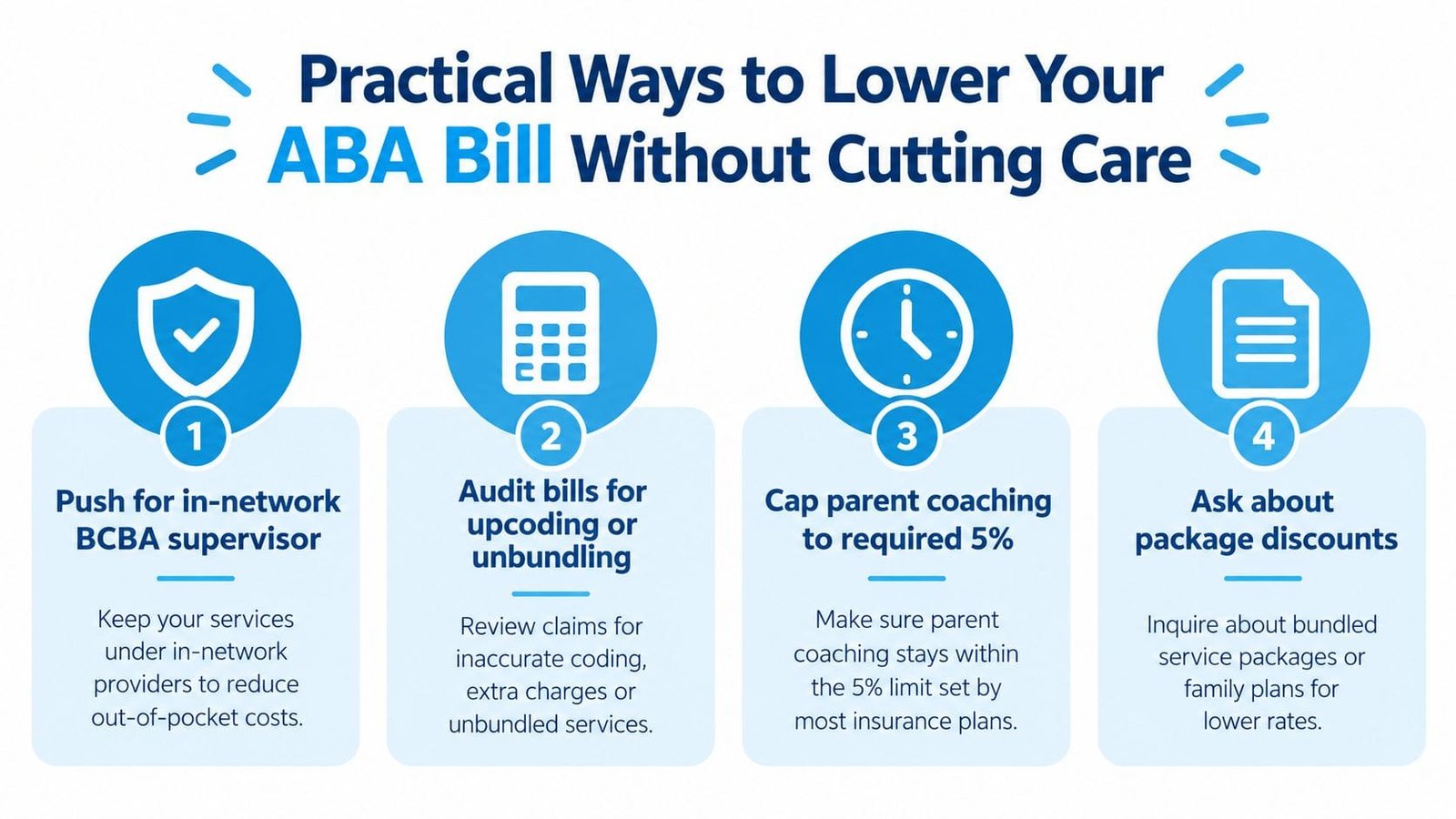
Don't cut hours automatically because the bill feels high. First determine whether every billed service is authorized, delivered, documented, and producing useful progress. A parent who keeps session records can challenge an inaccurate invoice with evidence instead of relying on memory.
Tracking Whether the Cost Is Paying Off for Your Child
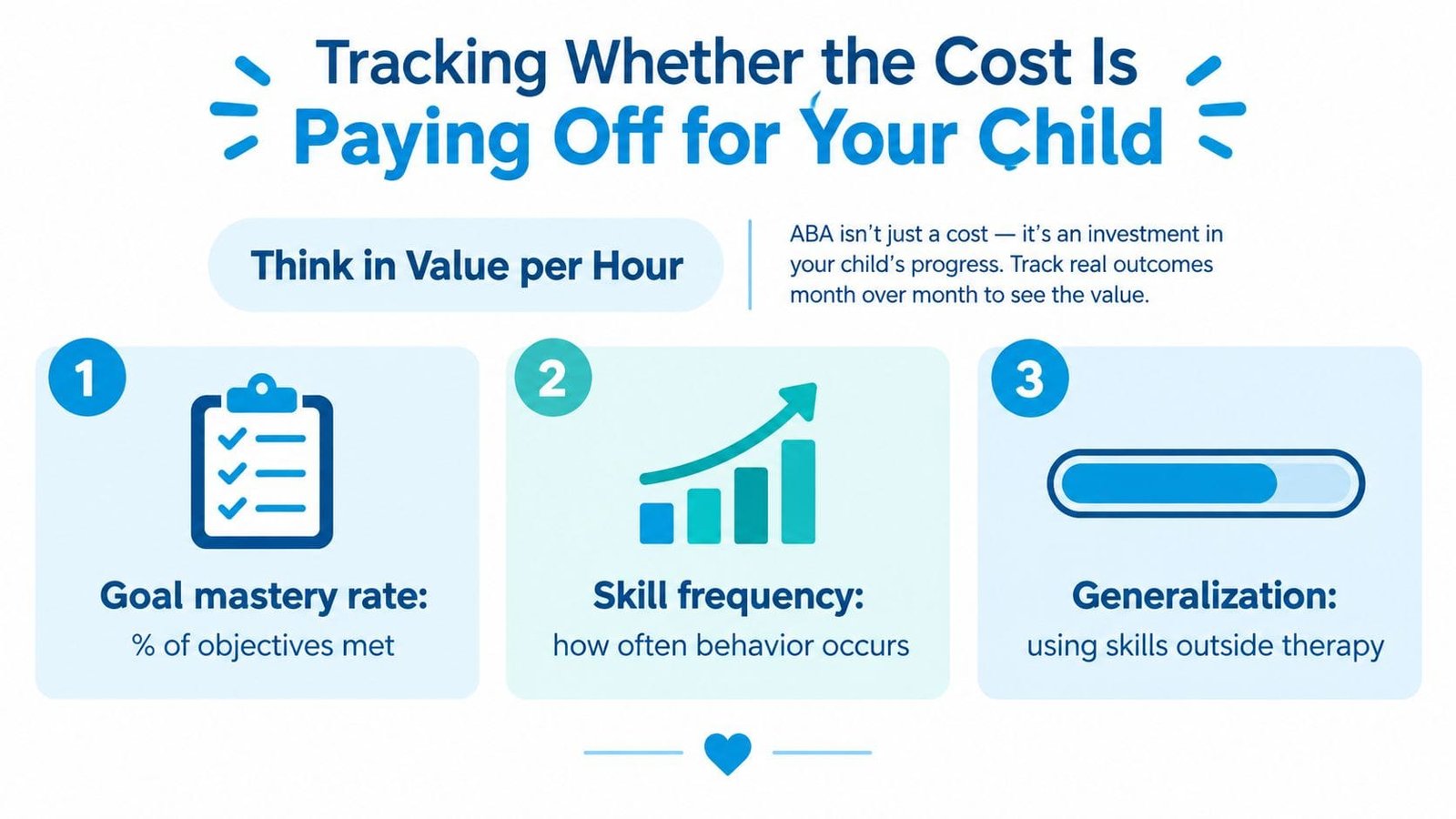
The cheapest hourly rate isn't always the best financial decision. ABA is a value-per-hour purchase, and value depends on whether your child is gaining practical skills, using them outside therapy, and moving toward goals that matter at home, school, and in the community.
Track three outcomes consistently:
- Goal mastery: Which objectives were met, which remain active, and whether the BCBA changed goals when progress stalled.
- Behavior frequency: How often a challenging behavior occurs, along with its triggers, duration, intensity, and setting.
- Generalization: Whether a communication, self-care, play, or regulation skill appears with different people and in different places.
A lower-cost program with stagnant data may be a worse use of family resources than a more expensive program that produces measurable, functional gains. That doesn't justify unlimited hours. It means you should connect the treatment plan to observable outcomes and review whether the current intensity still makes sense.
Keep billing and clinical data together
Your records should make it possible to compare:
- Scheduled hours with delivered hours.
- Billed roles with the staff member who provided care.
- BCBA supervision with documented protocol updates or feedback.
- Parent training with specific strategies you were taught.
- Progress reports with the goals the provider billed to address.
Use one running record for session notes, supervision touchpoints, parent-training hours, cancellations, and progress observations. A family can then bring concrete questions to the care team instead of asking whether therapy “seems” to be working.
Before renewing a contract or accepting more authorized hours, pull the last three months of progress reports. Look for mastered goals, persistent barriers, skills that appear only in therapy, and any mismatch between the invoice and the clinical record. This resource on ABA and daily living skills offers additional context for judging whether progress is reaching everyday routines.
ABA Cost Questions Parents Ask Before Signing a Contract
How long might we wait before the first billed session?
The answer depends on provider availability, assessment completion, insurance authorization, and staffing. Ask for the expected sequence in writing: intake, assessment, authorization, staffing, and the first treatment date. A provider shouldn't present an authorization as a guarantee that sessions will begin immediately.
Can cancellations change the invoice?
Yes, depending on the contract and payer rules. Read the sick-day, late-cancellation, weather, and provider-cancellation language before signing, and ask whether a missed appointment is billed to you, billed to insurance, or dropped from the schedule.
Is technician travel time billable?
Sometimes travel policies affect the cost, especially for in-home or school-based care. Ask whether the provider bills travel separately, includes it in the service rate, or limits visits by geographic area. The answer should appear in the financial agreement, not arrive as a surprise on the first statement.
What triggers a reassessment?
A reassessment may occur when the authorization period ends, goals change materially, progress stalls, or the payer requests updated medical-necessity documentation. Assessment and supervision rates can be substantially higher than technician treatment, so ask what reassessment work is included and what requires a separate authorization.
Which contract clauses deserve the most attention?
| Contract Clause | Typical Range | Budget Exposure |
|---|---|---|
| Minimum-hours commitment | Contract-specific | You may owe fees or lose scheduling priority if hours aren't used |
| Cancellation policy | Contract-specific | Missed or late-canceled sessions may create a family charge |
| Reassessment terms | Plan and provider-specific | A new assessment can add a separate bill |
| Travel policy | Setting and provider-specific | Travel may affect availability or responsibility |
| Out-of-network language | Insurance-specific | The family may owe more than the in-network share |
The clause parents miss most often is the minimum-hours commitment. Don't sign a schedule you can't sustain because of school, transportation, illness, work, or caregiver capacity. Ask the provider to state exactly what happens when authorized hours aren't available or your family needs to pause.
If you're trying to defend ABA spending with clear daily records, Guiding Growth lets you log behaviors, therapy sessions, sleep, meals, medications, and observations, then organize that information for care-team and IEP conversations. Visit the app to replace scattered notes with a shared record your family can review before billing and progress meetings.