A teacher writes “off task” in the plan book. At pickup, a parent hears about refusal, stimming, or an attempt to leave the room. Both accounts may be accurate. The problem is that neither one explains the full day.
The need for practical support is growing. CDC-linked historical estimates moved from about 1 in 150 children in 2000 to about 1 in 88 two decades later and about 1 in 36 by 2020, while more recent U.S. reporting has placed identification at 1 in 31 students according to a review in Frontiers in Psychiatry. Supporting ASD in classroom settings now depends on more than a list of accommodations. It requires school and home to compare patterns, record what happens, and turn those observations into supports that hold up in real life and in meetings.
Table of Contents
- The Morning Gap Between School and Home
- Setting Up the Physical Classroom
- Building Routines and Communication Supports
- Behavior Strategies That Actually Reduce Problems
- Bridging School and Home Through Shared Data
- Logging and Documentation for Meetings
- Inclusion Quality Over Inclusion Label
The Morning Gap Between School and Home
At 8:10, a child with ASD may be lining up chairs instead of joining circle time. The teacher sees a student who isn't following the opening routine and writes “off task again” beside the date. The note may be understandable, but it doesn't say whether the chairs provide sensory order, whether the child slept poorly, whether the room is louder than usual, or whether the transition from the bus was already overwhelming.
By afternoon pickup, the parent hears a different account. The child refused work, covered their ears, stimmmed intensely, and tried to run from the room. At home, the same child may settle over a puzzle and appear focused and happy. This isn't necessarily dishonesty from either adult. It's fragmented observation.
Teachers see one setting, one group of peers, and a slice of the day. Parents see evenings, weekends, sleep patterns, meals, siblings, and the recovery period after school. Without shared records, both sides fill the gaps with assumptions. A teacher may conclude that the child is capable of managing because they are calm during one lesson. A parent may conclude that the school isn't noticing distress because the child releases it only after getting home.
Practical rule: Treat “fine at school” and “falling apart at home” as two observations to connect, not as competing verdicts.
A simple shared log can capture the time, setting, demand, sensory condition, behavior, and response. It can also record successful moments, such as joining an activity after a visual warning or completing work beside a quieter peer. Families who need additional support outside school may also find it useful to find teen autism counseling in Katy, particularly when anxiety, self-advocacy, or school stress needs attention beyond classroom accommodations.
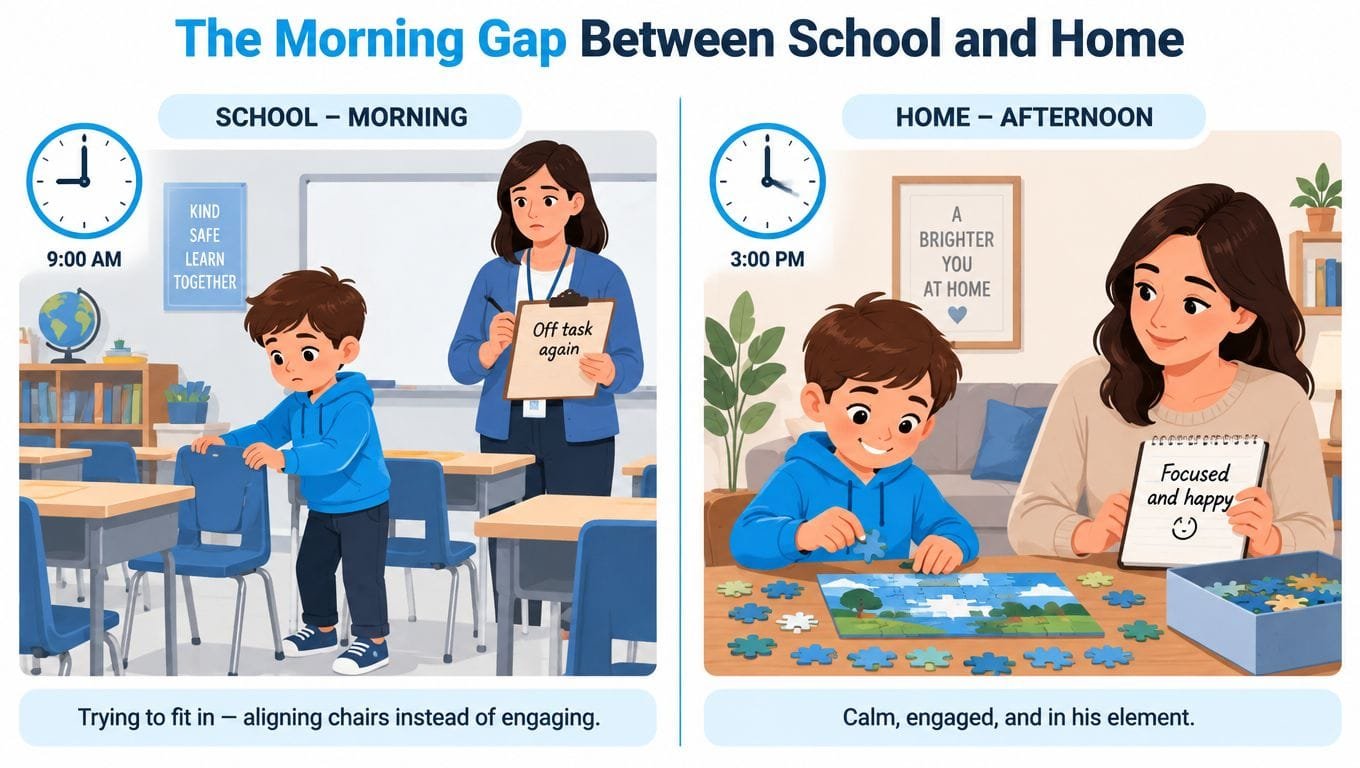
The purpose isn't to create another burdensome form. It's to replace competing memories with a shared picture. Later, that picture can show whether a quieter entrance, a first-then board, or a break request is helping the child participate, regulate, and reconnect.
Setting Up the Physical Classroom
The room often communicates before the teacher speaks. A bright doorway, visual clutter around the instruction board, scraping chairs, and unpredictable movement can consume attention that a student needs for learning. Small environmental changes won't solve every difficulty, but they can remove unnecessary barriers for autistic and neurodivergent students.
Start with a Monday morning scan:
- Choose a predictable seat: Place the student away from busy doors and windows, while preserving a clear view of instruction. A consistent seat near a trusted peer can be more useful than a seat chosen only for proximity to the teacher.
- Define personal and work space: Use colored tape, a desk mat, or a visual boundary to show where materials belong and how much space a student has.
- Create a quiet corner: Offer soft seating, noise-dampening options, and a clear return-to-work routine. A quiet space shouldn't become an unstructured exclusion area.
- Reduce glare and clutter: Use task lighting where possible, close storage with labeled bins, and keep dense displays away from the main teaching zone.
- Build a sensory station: Provide agreed tools such as fidgets, noise-reducing headphones, a weighted lap pad where appropriate, and safe chew options approved by the family and school team.
- Post a noise meter: A simple visual scale can help students notice the room's volume and choose a support before distress escalates.
The National Autistic Society's classroom adjustment guidance includes sensory profiles, calm spaces, reduced harsh lighting and visual clutter, advance warning for loud sounds, sensory tools, and extra processing time with written or visual instructions. These aren't indulgences. They're ways to make the learning environment legible.
The Vanderbilt IRIS Center also distinguishes an accommodation from a change in curriculum. A graphic organizer, preferential seating, smaller task steps, or increased wait time can change how a student accesses learning, not what the student is expected to learn. Its overview of autism-related needs includes executive function, emotional regulation, flexibility, independence, social interaction, and self-advocacy, all of which affect how a physical room is used.
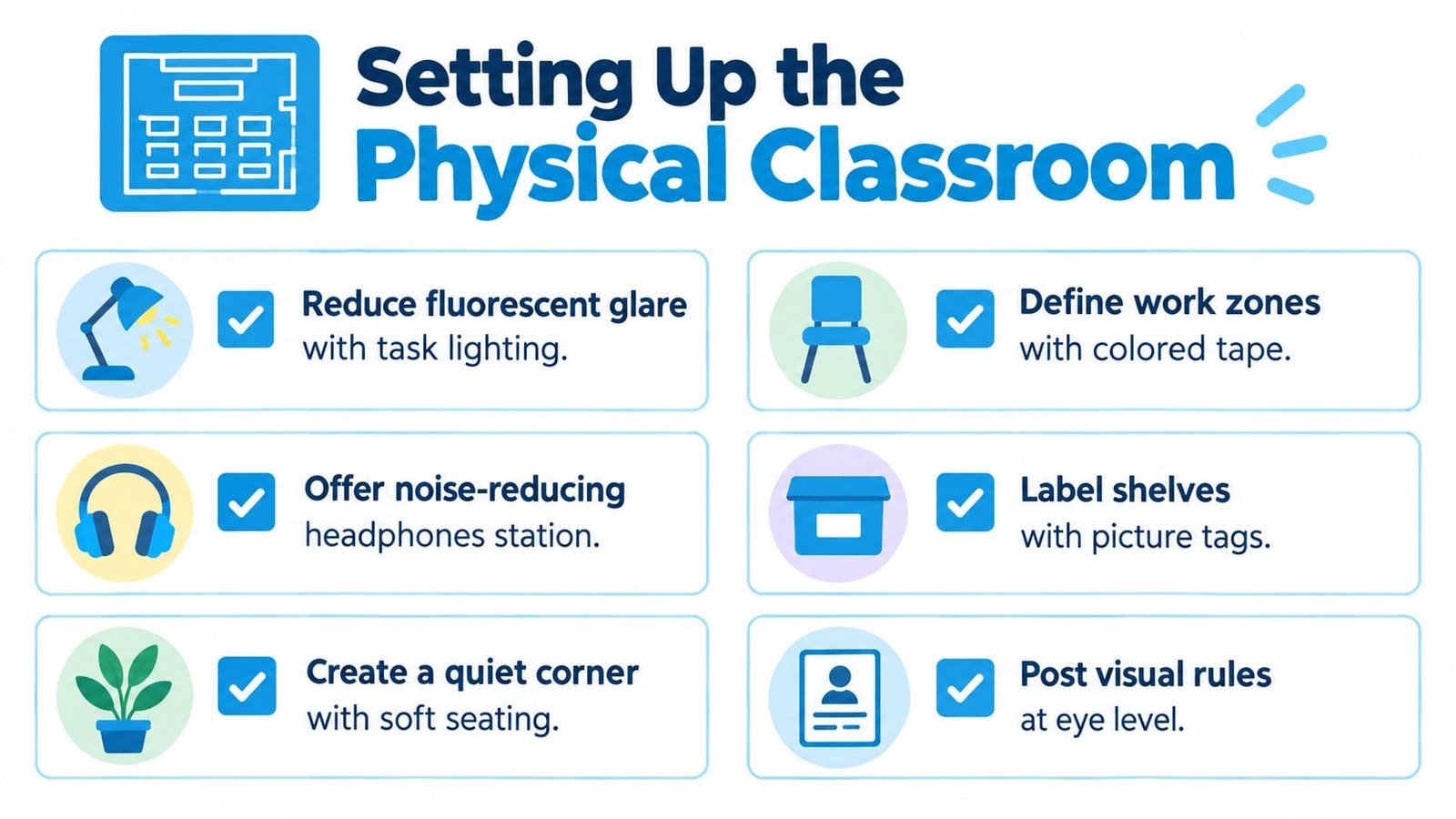
For a fuller planning checklist, the guide to sensory-friendly classrooms can help families and educators discuss which environmental changes are practical. The room is only the starting point. If the student doesn't know what happens next or how to request help, even a well-designed space can become difficult during transitions.
Building Routines and Communication Supports
Predictability doesn't mean every minute must be identical. It means the student can see what is happening, what will change, and what they can do when a task feels too hard.
Build the daily schedule from blocks such as arrival, morning work, group instruction, independent work, lunch, and dismissal. Use pictures, icons, photographs, or written words according to the student's communication level. Put completed cards in a finished bin so progress is visible rather than relying on repeated verbal reminders.
A handwashing routine shows why visuals matter. Post five photographs at eye level: turn on water, wet hands, add soap, rinse, and dry. A student who misses a spoken instruction can refer to the sequence without waiting for an adult to repeat it.
Transitions need more than “five minutes left.” Pair a five-minute timer with a verbal cue, then use a consistent cleanup song or visual countdown. In secondary classrooms, a color-coded timetable, printed homework directions, and a predictable place for equipment can reduce the executive-function load created by moving between subjects.
Make communication easier than refusal
A first-then board can say, “First two math problems, then puzzle.” A choice menu can offer two or three acceptable options, such as pencil or keyboard, desk or quiet table, or drawing response or spoken response. After asking a question, pause for at least ten seconds before repeating it or prompting. Processing time is part of access, not a reward for compliance.
Accept AAC in every form the student uses, including PECS, speech devices, gestures, and sign. A request to pause, move, reject, or ask for help is communication even when the form is unusual or inconvenient. Staff should never punish a communication attempt because they prefer spoken language.
The clinical guide to iPad apps may help families and teams compare speech and language tools, but the device is only useful when adults honor the message it carries.
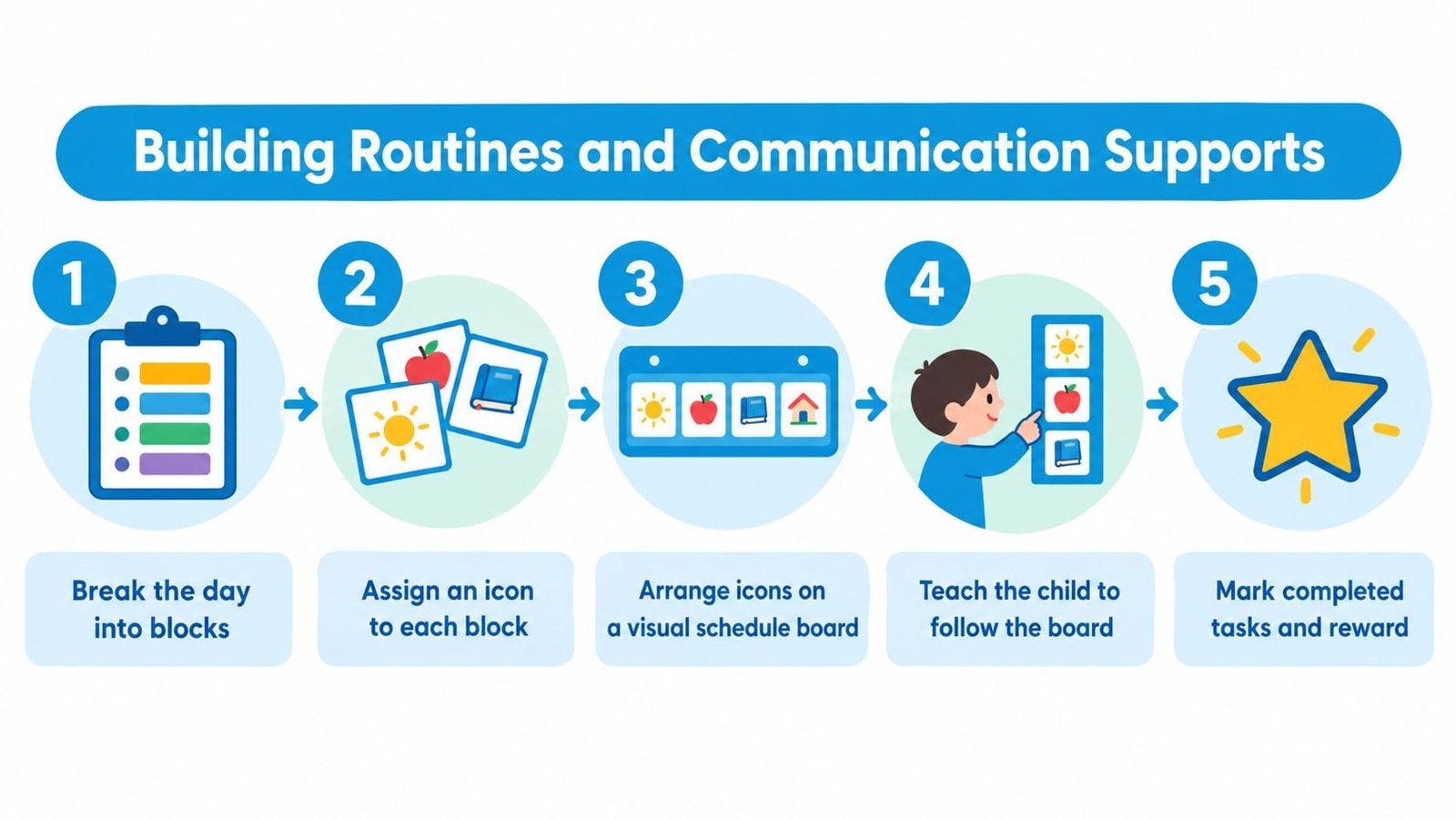
A predictable routine also prevents behavior by reducing uncertainty. When distress still occurs, the team needs to study what happened rather than treating the visible behavior as the whole problem.
Behavior Strategies That Actually Reduce Problems
Before changing anything, spend one to two weeks recording the target behavior exactly as it occurs. Reactive discipline often begins after the useful intervention window has closed, when a student is already shouting, hiding, hitting, or leaving the room. Positive Behavior Support, or PBS, starts with a measurable baseline and examines what the behavior accomplishes for the student.
Record frequency, time, location, likely trigger, duration, intensity, who was present, and what happened immediately afterward. Define the target clearly. “Refusal” might mean pushing materials away and not beginning within a stated period. That definition gives every adult the same event to record instead of relying on labels that invite different interpretations. The positive behavior support strategies resource explains this baseline-and-function sequence in more detail.
Move from observation to function
Use the record to test practical hypotheses:
- Antecedent change: Offer a break before a known difficult transition, reduce the first task demand, or provide a visual model before group work.
- Replacement skill: Teach a card, gesture, sign, or device button for “pause,” “help,” or “finished.”
- Consequence adjustment: Respond calmly and consistently. Do not require a long verbal explanation from a student who is already overloaded.
- Implementation check: Record who used the strategy, when it was used, and whether the student returned, communicated, or completed the next step.
A classroom study of CW-PBS combined with individualized intervention recorded behavior for 10 baseline days and found less problem behavior after the intervention began. The useful lesson is not that every classroom will produce the same result. Repeated daily observation gives the team a stronger basis for judging change than anecdotal notes alone, as described in the classroom behavior study. A dated log also gives an IEP team something specific to review when staff disagree about whether a support works.
A separate special-school study of virtual PBS reported interfering-behavior averages dropping from a baseline range of 9 to 15 to 0 to 2 after implementation, with 0% overlap between baseline and intervention data. The Springer study of PBS for students with ASD shows how clearly data can separate phases when implementation is consistent. It does not promise the same outcome for every child. Measure level, trend, and overlap instead of writing “better” or “worse.”
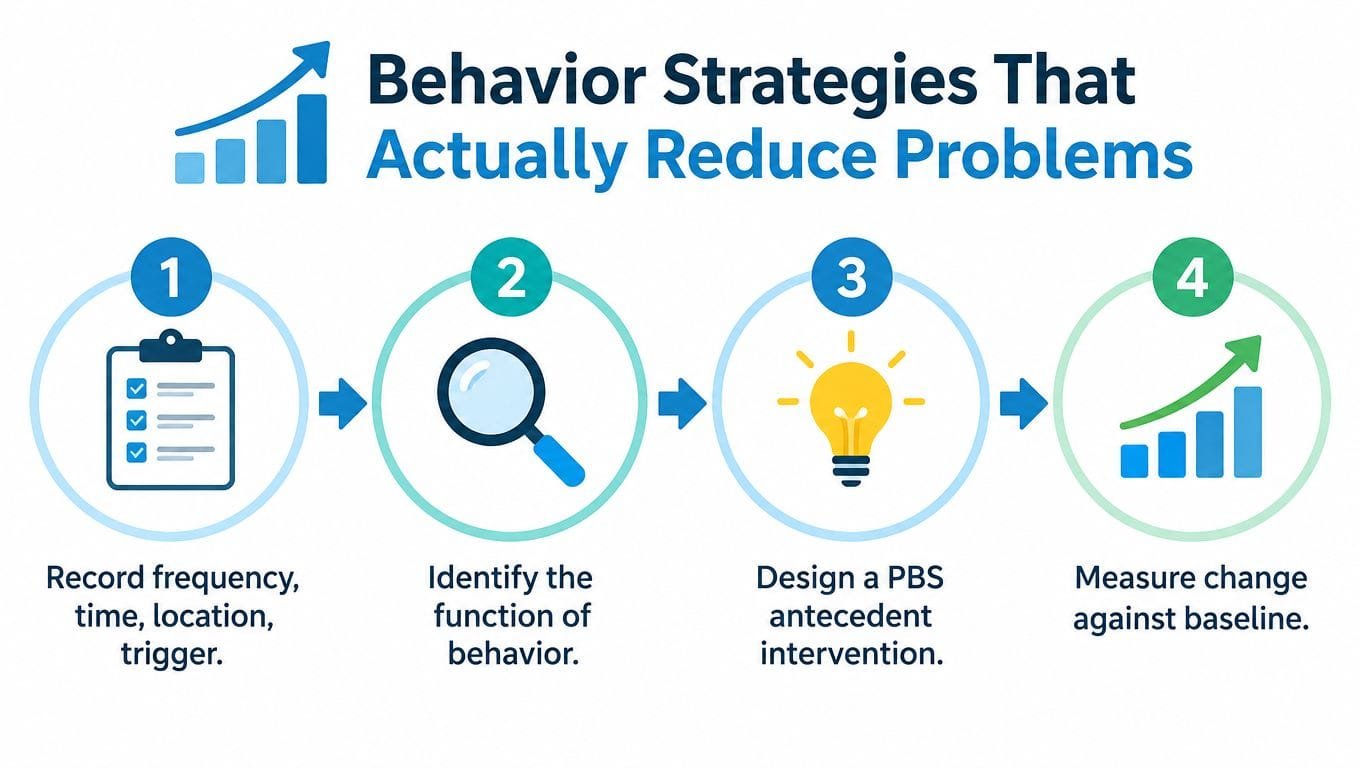
If behavior is dangerous, intensifying, or unchanged despite a faithfully implemented plan, request a formal Functional Behavioral Assessment and consult a BCBA or other qualified behavior professional. Review whether the definition, data collection, and response plan are being applied consistently across adults. A short, shared summary from tools such as Guiding Growth can turn scattered observations into a meeting-ready record.
Bridging School and Home Through Shared Data
The phrase “my child is fine at school” can leave a parent feeling dismissed, especially when the child collapses at home. It can also mislead a school team if calm behavior is being maintained through constant adult prompting, delayed distress, or a student suppressing communication until they reach a safe person.
School and home each catch patterns the other cannot. A Sunday night sleep disruption may precede a Monday morning meltdown. A new seat may correlate with afternoon refusal. A sensory routine that works on school days may be absent on weekends, revealing that the child needs a support rather than just more discipline.
| Observation Domain | What School Catches | What Home Catches | Combined Insight |
|---|---|---|---|
| Transitions | Response to arrival, class changes, and cleanup | Response to leaving home, bedtime, and weekend changes | Identify whether unpredictability or accumulated fatigue is driving distress |
| Sensory load | Noise, lighting, crowding, and seating | Clothing, food, household noise, and recovery after school | Separate a setting-specific trigger from a broader sensory pattern |
| Communication | Requests for help, breaks, or clarification during lessons | Requests during meals, play, siblings, and routines | Choose one replacement communication response to practice across settings |
| Regulation | Engagement and recovery inside the classroom | Delayed shutdowns, meltdowns, or exhaustion after pickup | Measure participation alongside the cost of getting through the day |
| Successful supports | Visual schedules, peer proximity, and task adaptations | Preferred activities, sleep routines, and calming strategies | Carry effective supports across environments without assuming they transfer automatically |
The aim isn't to monitor every moment. A weekly five-minute note from each side can be enough to identify a question worth testing. A shared Google Form, notebook, or journal can work if adults use the same definitions and avoid turning entries into judgments.
A dedicated platform can make collaboration easier when it lets parents and educators share selected events and export a meeting-ready summary. The shared information platform is one option for organizing those records, with permissions that can be considered carefully before school staff or outside providers are added.
Bring the combined pattern to the IEP or 504 team as an observation and a proposed test. For example, “Afternoon refusal appears after noisy lunch on several logged days, so the team should trial a quieter transition and track return-to-learning.” That is more actionable than “Lunch is always a problem.”
Logging and Documentation for Meetings
A useful record answers five questions: What happened, when did it happen, what came before it, what did adults do, and what happened next? A meeting-ready summary then turns those answers into a pattern and a decision.
Use the same fields at home and school:
- Date, time, and setting: Include the classroom, playground, bus, home, or therapy environment.
- Antecedent: Record the demand, transition, person, sensory condition, sleep issue, or change that came before.
- Observable behavior: Describe what the child did, not an interpretation such as “was manipulative.”
- Duration and intensity: Use a team-agreed scale and define what each level means.
- Consequence and intervention: Note what adults changed, offered, removed, or taught.
- Response: Record whether the child communicated, recovered, returned to the activity, or needed a longer separation.
A practical starting cadence is two incidents per week logged with fidelity, plus a weekly check-in between home and school. That isn't a universal requirement, and a team may need more or less information depending on safety and frequency. The point is to avoid recording only the worst crisis or the day immediately before a meeting.
Turn raw notes into a usable summary
A notebook or shared spreadsheet may be sufficient for a simple plan. Structured behavior-tracking apps can reduce missing fields and may allow photos, videos, tags, or shareable reports. Whatever tool you use, protect privacy, limit access to people who need it, and make sure families can export their own information.
Raw entries are not the same as evidence that a team can act on. A summary should identify the setting in which the behavior clusters, the supports already attempted, the child's response, and the accommodation or goal that should be tested next.
Use this quick-start template:
Date and setting:
What came before:
What the child did:
What support was used:
What changed afterward:
What to try or measure next:
At an IEP meeting, bring the summary beside the current accommodation list. Ask which supports are being delivered, by whom, how often, and how the team will decide whether they are working. Documentation should make the plan more specific, not just create a thicker folder.
Inclusion Quality Over Inclusion Label
A student can sit in a general education classroom and still miss instruction, avoid peers, or spend the day managing sensory overload. Placement matters, but presence alone isn't participation.
U.S. education data cited in one review show the share of students with ASD spending at least 80% of the school day in general education rising from about 9% in 1992–93 to 31% in 2005–06. Later estimates placed the figure around 30% in the U.S. or about 41% in one review of elementary autistic students, while another education source reported approximately 70% spending the majority of the day in general education classrooms. These figures appear in the education inclusion review, and they show movement toward access alongside continuing questions about support quality.
Consider two classrooms. In the first, a student sits in the back with a paraeducator but receives the same unadapted worksheets, unclear group-work directions, and no reliable way to request a break. In the second, the student has sensory tools, structured peer support, visual choices, adapted access to the assignment, and a teacher who uses explicit instruction. Both rosters may call the placement inclusion. The daily experience is not comparable.
Measure the experience, not just the location
A 2026 classroom study reported high academic engagement but low social engagement for autistic students in general education, reinforcing the point that placement doesn't automatically create connection. Research summarized in recent autism education findings also links autism-specific training with teacher knowledge, attitudes, and self-efficacy. Schools need capacity, not just a placement decision.
Useful implementation supports include:
- Teacher coaching: Practice visual instruction, sensory-aware prevention, communication access, and function-based responses.
- Co-planning time: Give general and special education staff time to adapt tasks before the lesson, not during a crisis.
- Peer supports: Teach peers how to include, wait, offer choices, and respect communication differences.
- Structured collaboration: Replace vague group work with defined roles, clear products, and a predictable turn-taking routine.
- Measurable targets: Track engagement, task completion, communication, peer connection, recovery, and wellbeing across the school year.
Families should ask, “What does successful inclusion look like for my child, and how will we know?” A meaningful answer includes observable data, not only the room number. It may show that the student begins work, uses a break request, returns after regulation, demonstrates mastery through an accessible format, and participates with peers without paying an unsustainable cost afterward.
Guiding Growth lets parents log behavior, sleep, routines, sensory triggers, meals, therapy, and other parts of a child's day, then organize patterns into shareable summaries for IEP, 504, and specialist meetings. Visit Guiding Growth to replace scattered notes with a shared record that helps your family and school team discuss specific supports and measurable next steps.