A child repeats the same line from a favorite show while getting dressed. You ask, “Are you ready?” and hear the question returned in exactly the same words. During the car ride, humming and clicking grow louder as the route changes. By the time you reach school, you may be wondering whether to interrupt, ignore, or correct the behavior.
Those reactions are understandable, but the sound alone rarely tells you what's happening. Autism verbal stimming can communicate a request, help someone process language, provide predictable sensory input, express excitement, or signal that a situation has become overwhelming. The useful question isn't, “How do we stop this?” It's, “What job is this behavior doing right now?”
Table of Contents
- Why Repeated Words Matter More Than Adults Realize
- What Autism Verbal Stimming Is
- How Understanding of Verbal Repetition Has Changed
- Different Types of Verbal Stimming and What They May Mean
- When Verbal Stimming Helps and When It Signals Distress
- How to Track and Understand Verbal Stimming Patterns
- Support Strategies That Respect Communication and Regulation
- Moving From Reaction to Clear, Calm Support
Why Repeated Words Matter More Than Adults Realize
At breakfast, a child might repeat, “Do you want juice?” after a parent asks the question. Later, the same child may quote a line from a cartoon while waiting for the school bus, then hum continuously during a noisy assembly. To an adult who hears only the repeated words, these moments can look unrelated or meaningless. To the child, each vocalization may be helping with a different task.
The echoed question could be a developing way to answer, a request for juice, or a way to hold the conversational turn while language is being processed. The cartoon line might bring comfort during an unpredictable transition. The humming could provide steady sound when the environment feels too intense. Identical words can have different functions in different settings.
Practical rule: Listen for the situation around the phrase, not only the phrase itself.
Research and clinical guidance describe verbal stimming as varied rather than uniform. It may involve echolalia, scripting, humming, repeated sounds, or other vocal patterns. The National Center for Biotechnology Information clinical overview notes that repetition should be interpreted alongside context, communication partner, emotional state, and what happens before and after it.
Instead of writing “talking too much” in a notebook, record what took place. Note the exact phrase, who was present, whether the child appeared calm or distressed, and what changed afterward. That small shift in observation can reveal a request, refusal, social opening, rehearsal, or self-regulation strategy that would otherwise be mistaken for noise.
What Autism Verbal Stimming Is
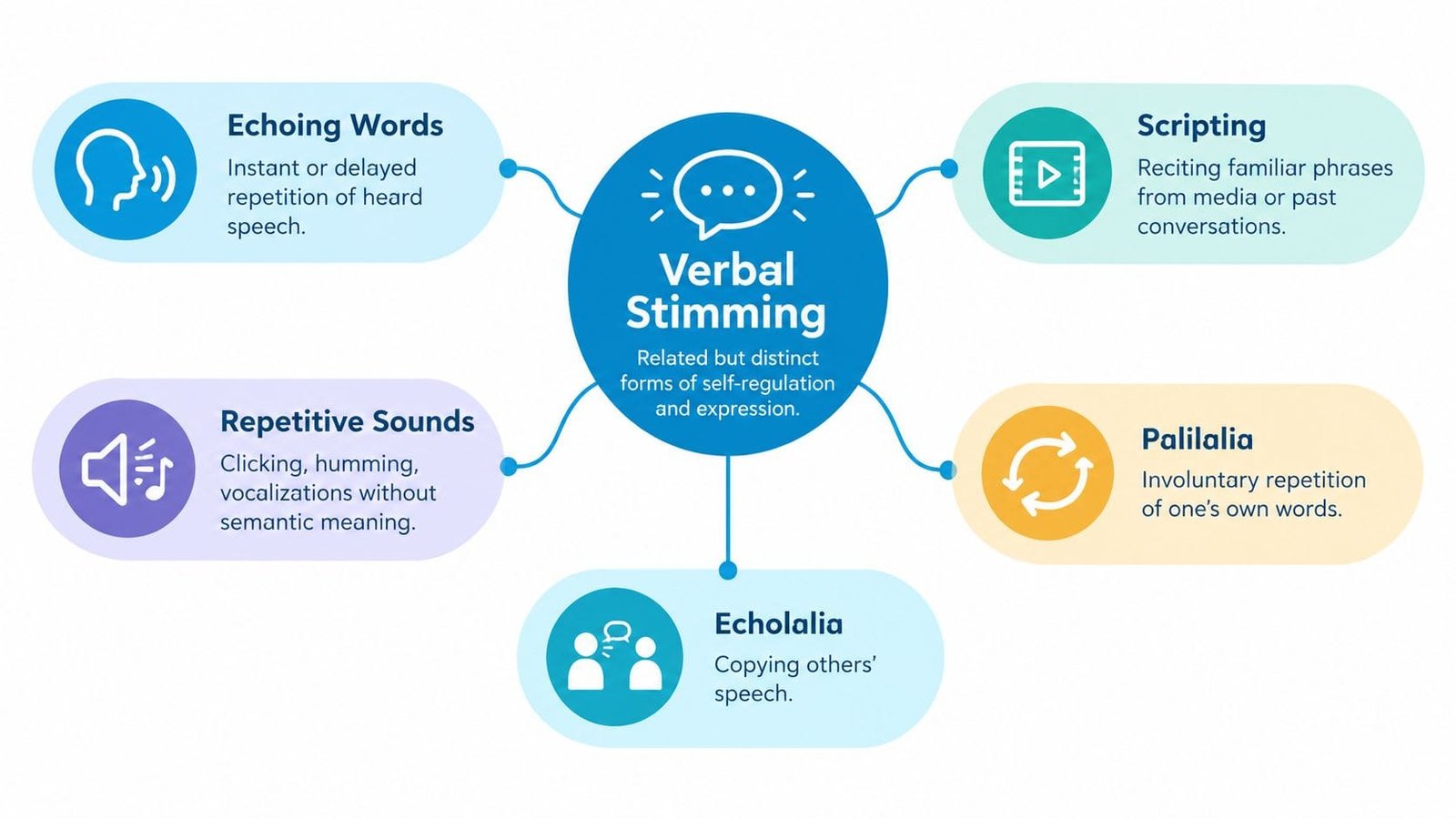
Verbal stimming is an umbrella term, not one behavior with one cause. It can include repeating another person's words, reciting familiar scripts, humming, clicking the tongue, making nonword sounds, singing, or looping language from a conversation, television program, or song. Echolalia is one commonly discussed form. It refers to immediate or delayed repetition of words, phrases, scripts, or previously heard language.
A useful distinction is topography versus function. Topography describes what the behavior sounds like; function describes what it does for the person. The same phrase may support communication in one moment and sensory regulation in another. A hum may accompany joyful anticipation, fatigue, a transition, or overload. Treat the sound as a clue, not a conclusion. Observe what precedes it and what changes afterward.
Why prevalence doesn't give a simple answer
Echolalia is widespread among autistic people who develop speech, but estimates vary substantially. A clinical review reports that approximately 75% of children with autism spectrum disorder exhibit echolalia, while historical studies estimated occurrence in up to 85% of autistic people who develop speech. A recent rapid review found estimates among autistic children and young people ranging from 25% to 91%, as summarized in the clinical review on echolalia and autism.
These figures do not score an individual child. Differences in age, language ability, definitions, observation methods, and sampling help explain the range. Frequency alone cannot show whether a child is progressing, distressed, communicating, or regulating. Track immediate repetition and delayed scripting separately, along with duration, setting, audience, emotional state, and outcome. Patterns over time provide a better basis for deciding whether to preserve a strategy, add support, or seek an alternative.
How Understanding of Verbal Repetition Has Changed
Older clinical descriptions often treated echoed language as mimicry or nonfunctional repetition. Leo Kanner's 1943 observations appeared within that earlier tradition, where adults frequently judged speech by how closely it resembled typical spontaneous conversation. That framing encouraged people to discard repeated language before asking what it meant.
Research beginning in the 1980s offered a more detailed view. Prizant and Duchan's 1981 analysis of immediate echolalia identified seven interactive functions, including turn-taking, answering yes, requesting, making declarations, and self-regulation. In one analysis from that research tradition, more than 30% of utterances served a turn-taking function and 27% were declarative vocalizations, as reported in the peer-reviewed review of echolalia's changing interpretation.
What this shift means at home
Later work documented delayed repetitions used to request, refuse, object, provide information, affirm, direct another person, or maintain interaction. Parent-report research also found that almost all participating parents regarded their children's echolalia as functional in at least some situations, including expressing needs, wants, refusal, and emotional state. Families were often noticing meaning in the behavior before professional language fully reflected it.
That history leads to a practical habit: interpret first, label second. Write down the exact words, the apparent trigger, the timing, the audience, and what happened after the repetition. If the phrase consistently appears when a preferred activity ends, it may be connected to protest or transition. If it occurs while the child searches for an answer, it may help organize language. Memory tends to preserve the most noticeable sound, not the surrounding pattern.
Different Types of Verbal Stimming and What They May Mean
Two children may both repeat a television line, yet one may be using it to request the program and the other may be enjoying the rhythm of the words. That's why the technical distinction isn't just “speech” versus “noise.” Function matters more than surface form.
Echolalia repeats language heard from another person or source. Scripting may involve longer, familiar sequences from media, books, songs, or past conversations. Humming, tongue clicking, throat sounds, and nonword vocalizations may provide auditory or physical sensations without an obvious social message. Palilalia, the repetition of one's own words, can also appear in a person's communication profile, but it shouldn't be assumed to have the same cause as echolalia.
| Form | Typical Function |
|---|---|
| Immediate echolalia | Processing a question, taking a turn, affirming, or repeating language before producing a response |
| Delayed echolalia | Requesting, refusing, commenting, recalling an experience, or expressing an emotional state |
| Scripting | Rehearsing language, predicting a routine, sharing an interest, or creating familiar structure |
| Humming or singing | Sensory regulation, enjoyment, focus, or emotional expression |
| Nonword vocalizations | Predictable auditory input, excitement, self-soothing, or automatic sensory reinforcement |
| Palilalia | Repeating one's own words as part of a communication or speech pattern that needs individual assessment |
Communication and sensory reinforcement
Echolalia generally repeats speech and may serve communicative, compensatory, or emotional-regulation purposes. Vocal stereotypy can include nonwords and is often maintained by automatic sensory reinforcement rather than an obvious social consequence. The same person may show both, so a listener shouldn't assign one explanation to every vocalization.
A functional assessment examines the antecedent, the exact vocal form, the consequence, the setting, and whether the behavior changes when access to attention, escape, preferred items, or sensory input changes. Parents who want to understand related speech patterns can also review what a monotone voice may mean, while remembering that vocal quality alone doesn't determine communication ability.
When Verbal Stimming Helps and When It Signals Distress
A child repeats “We're going home” while packing a bag. If the phrase helps the child anticipate the next step, it may be a useful bridge through transition. Another child repeats a phrase while covering their ears, pacing, and becoming increasingly upset. In that situation, the repetition may be part of escalating overload rather than a behavior to correct in isolation.
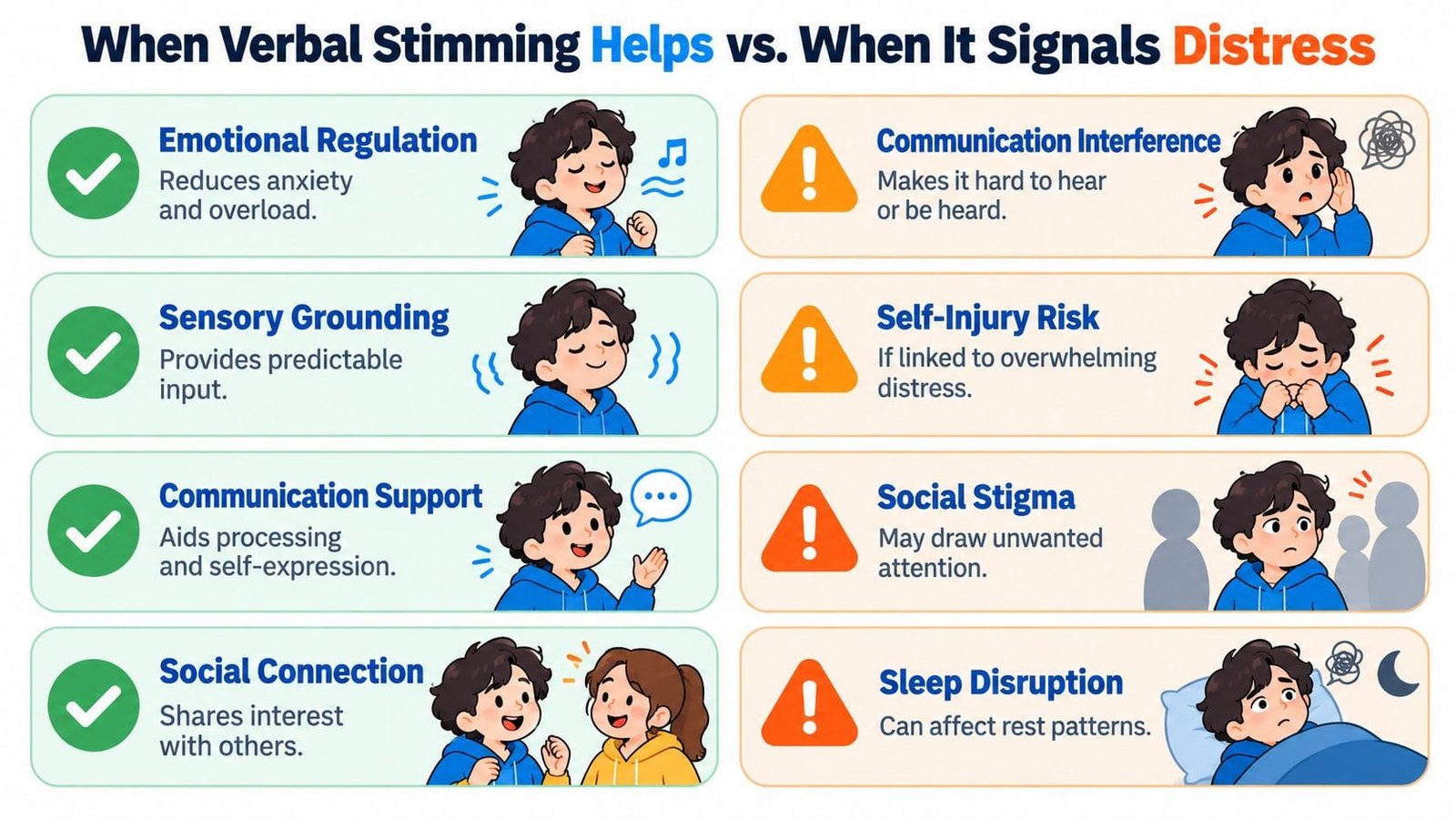
Verbal stimming can support communication, emotional regulation, sensory grounding, enjoyment, and social connection. It can also interfere with being heard, interrupt sleep, limit participation, or accompany distress. The decision shouldn't be based on whether other people find the sound unusual.
A three-part decision lens
Ask these questions before choosing an intervention:
- Is there danger? Does the behavior involve self-injury, tissue damage, unsafe movement, or distress that is rapidly escalating?
- Is there functional interference? Does it prevent the person from sleeping, communicating a necessary message, learning, participating, or accessing an important activity?
- Is the concern mainly social inconvenience? Is the behavior harmless but drawing attention or violating an adult's preference for quiet or typical speech?
The first two questions may justify collaborative support and professional assessment. The third calls for examining the environment and other people's expectations before asking the autistic person to change.
A 2025 study of 131 autistic adults in one sample and 117 in another found that stimming was often positive, while negative experiences were mainly associated with self-injury or social stigma, as reported in the study of autistic adults' experiences of stimming. The same evidence highlights purposeful suppression to avoid judgment. Fewer vocalizations aren't automatically a better outcome. Track participation, communication, comfort, sleep, and recovery after difficult situations.
How to Track and Understand Verbal Stimming Patterns
A useful record doesn't need to capture every sound. It needs enough consistent detail to show what changes around the behavior.
Start with the exact form. Write “repeated ‘go train' seven times” rather than “echolalia increased.” Then record what happened immediately before it, such as a demand, a transition, a noisy room, an exciting announcement, fatigue, or unstructured waiting. Include the setting, people present, apparent emotional state, duration, and what happened after the vocalization.
A practical observation record
Use the same questions each time:
- What did the person say or do vocally? Capture the words, sounds, rhythm, or script as accurately as possible.
- What happened before it? Note the activity, request, sensory conditions, change, or interaction.
- Who was present and where were you? A behavior at home may look different from the same behavior at school.
- What did the person seem to need? Consider a request, refusal, prediction, attention, escape, sensory input, or recovery.
- What followed? Record adult responses, access to an item, removal of a demand, a break, increased distress, or return to participation.
Short entries collected consistently are more useful than occasional descriptions such as “a difficult day.” They can help a speech-language pathologist, occupational therapist, teacher, or physician compare situations without relying on memory. Privacy-safe child tracking tools can also help families think carefully about how sensitive observations are stored and shared.
For voice-first notes, a caregiver can describe the event naturally and then organize it later with a voice recorder app. Guiding Growth can turn spoken observations into structured entries, attach notes or media, and help caregivers review triggers and outcomes over time. Use any tool as a support for observation, not as a substitute for clinical judgment or the child's own communication.
Support Strategies That Respect Communication and Regulation
Start by protecting meaning. If a child repeats “more bubbles” after the activity has ended, respond to the possible request before treating the repetition as a behavior problem. If the phrase appears during a difficult demand, offer a visual choice, a break signal, or an AAC option rather than insisting on spontaneous spoken language in that moment.
Environmental changes can reduce the need for intense regulation. Lower background noise, prepare the child for transitions, provide predictable schedules, and create a place where safe vocalizing isn't treated as wrongdoing. A private or quieter space should be an available option, not a punishment for making sound.
Match the response to the function
- Observe first: Look for repeated patterns in time, place, activity, and emotional state.
- Don't demand silence: Interrupting a harmless regulator can increase anxiety or remove a communication attempt.
- Offer communication tools: Try AAC, picture cards, written choices, gestures, or visual schedules with qualified support.
- Adjust the environment: Reduce sensory load and build in predictable breaks before overload peaks.
- Teach alternatives carefully: A replacement should meet the same need, such as a quiet hum, a break card, or access to a preferred sensory activity.
- Measure broader outcomes: Track engagement, functional communication, distress, sleep, and recovery, not only vocal-stimming frequency.
Intervention evidence supports function-based, individualized treatment rather than blanket interruption. A systematic review found large effects for interactive activity, self-management, and response interruption and redirection for certain types of vocal stereotypy, while emphasizing participation, communication, and access to regulation strategies rather than suppression alone (review of treatments for automatically reinforced vocal stereotypy). Professional supervision matters, particularly if an approach interrupts vocalizations that may carry meaning.
Caregivers can find additional autism communication strategies to discuss with a speech-language pathologist or care team. The right approach should be adjusted if the person becomes more anxious, exhausted, withdrawn, or distressed after suppression.
Moving From Reaction to Clear, Calm Support
Return to the child repeating the television line while getting dressed. Instead of correcting the phrase immediately, you might observe whether the child is anticipating the day, asking for the program, avoiding the transition, or regulating the pressure of getting ready. You can then offer the support that fits: a visual schedule, a clear choice, a quiet pause, an AAC message, or just room to continue a harmless vocal pattern.
The framework is simple, although applying it takes patience:
- Observe the form: What words, sounds, or scripts are present?
- Track the context: What happened before, where, and with whom?
- Interpret the possible function: Is the behavior communicating, regulating, rehearsing, connecting, or signaling overload?
- Choose the least intrusive support: Preserve safe regulation and add alternatives where they help.
- Review the outcome: Look for participation, comfort, communication, sleep, and recovery rather than volume alone.
A 2025 scoping review of 74 studies found that echolalia can support meaningful communication and self-regulation, while nearly all intervention studies reported reductions in echolalia and very few measured increased speech output or communicative attempts, according to the review of echolalia research and intervention outcomes. That finding reinforces an important safeguard. A quieter child isn't necessarily a more communicative child.
The goal is not to make every autistic person sound typical. It's to understand whether a vocal behavior is safe, useful, distress-related, or interfering with an activity the person wants to access. Consistent records can help families bring clearer examples to therapy reviews, school meetings, and medical appointments. They can also show when a strategy is helping and when it is merely making an adult feel more in control.

When adults slow down and ask what repeated speech is doing, their responses often become calmer and more precise. That change gives the child more than behavior management. It gives them a better chance to be understood while keeping the regulation strategies that help them participate in daily life.
Guiding Growth lets you log vocal stimming episodes by voice, record triggers and outcomes, attach notes or media, and review patterns across sleep, routines, meals, and settings. Visit Guiding Growth to turn scattered observations into organized information you can discuss with your child's care team.