A monotone voice is speech with reduced variation in pitch, rhythm, and intensity, not merely “flat” talking. In autistic children, it can reflect broader prosodic processing differences rather than a lack of emotion.
The most popular advice is often the least helpful: “Your child sounds monotone, so help them sound more expressive.” That wording turns a complex communication pattern into a performance problem. A child may feel excited, worried, amused, or overwhelmed while their voice gives listeners few familiar clues about those feelings.
The more useful question is not, “How do we fix the flat voice?” It's, “Which parts of prosody are different, when do they change, and what is my child trying to communicate?”
Table of Contents
- Rethinking the Monotone Voice Stereotype
- The Acoustic Building Blocks of Monotone Speech
- Why Monotone Voice Happens in Autistic Children
- How Monotone Voice Affects Daily Communication
- Signs of Monotone Speech to Watch for in Children
- Practical Strategies for Parents and Caregivers
- When to Seek Professional Support for Prosody Differences
Rethinking the Monotone Voice Stereotype
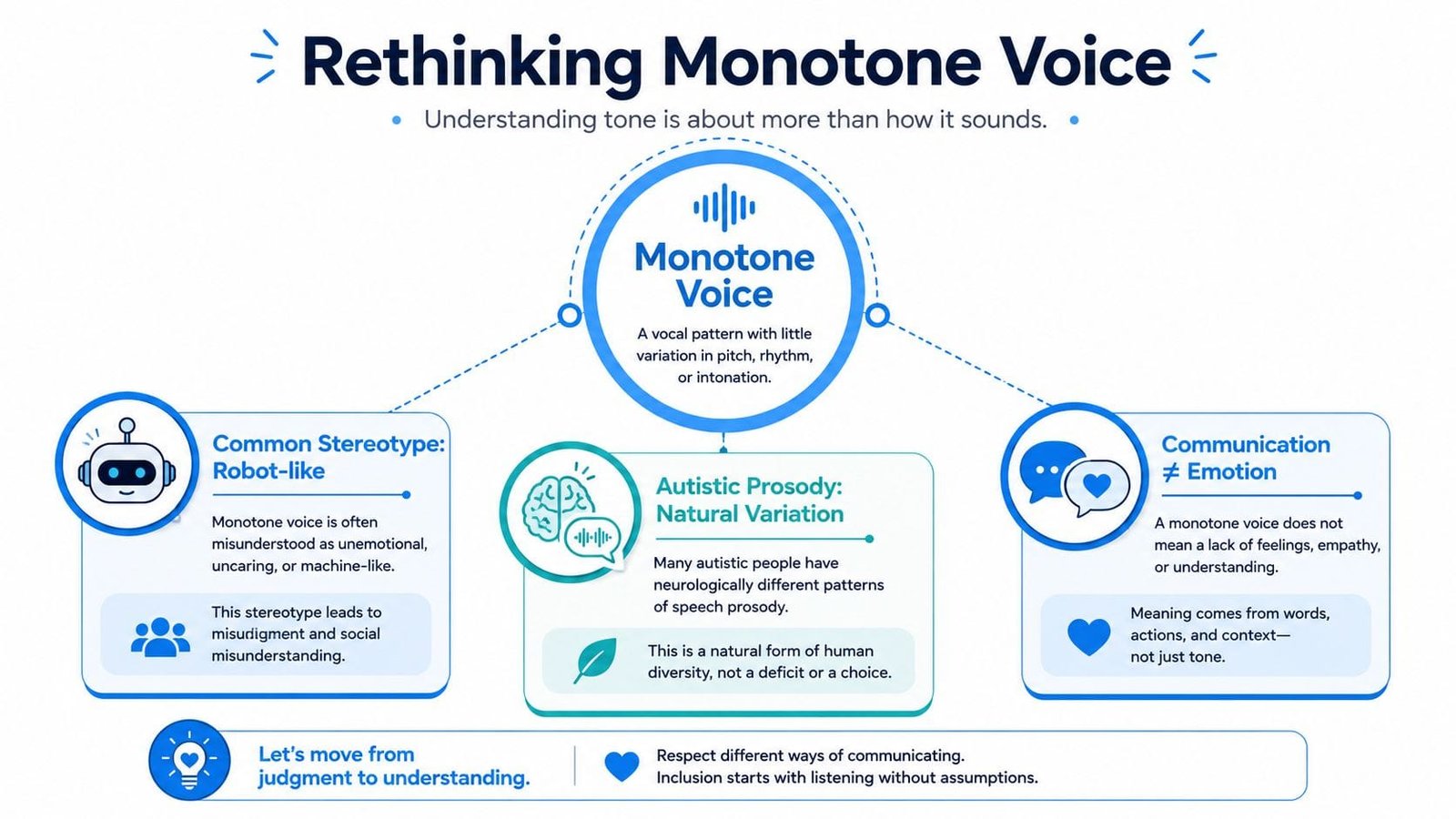
Many people hear “monotone” and picture a robot speaking without feeling. That stereotype misses an important distinction. Voice expression and emotional experience aren't the same thing. A child's vocal pattern may make emotion harder for other people to read, but it doesn't tell you how much emotion the child feels.
Autism research also challenges the idea that autistic speech is always flat. A 2021 systematic review and meta-analysis found that autistic groups showed significantly larger mean pitch differences, larger pitch range, longer voice duration, and larger pitch variability than typically developing controls. The reported effect sizes were SMD = -0.4 for mean pitch, -0.78 for pitch range, -0.43 for voice duration, and -0.46 for pitch variability (systematic review and meta-analysis of prosody in autism).
That finding doesn't mean every autistic child has a highly variable voice. It means the group pattern is more complicated than the familiar “flat voice” description suggests. The same review found no significant group differences for pitch standard deviation, voice intensity, or speech rate, which is another reason a single label can't describe every child accurately.
Monotone is one point on a wider spectrum
Prosody is the musical layer of speech. It includes pitch, loudness, timing, rhythm, stress, pauses, and intonation. A child might have a narrow pitch range but use appropriate pauses. Another might vary pitch widely but speak with an unusual rhythm or steady volume. A third might sound expressive in familiar settings and much flatter during fatigue, sensory overload, or a demanding conversation.
Historical clinical descriptions of atypical prosody in the Autism Diagnostic Observation Schedule included slow or rapid rate, irregular rhythm, odd intonation, inappropriate pitch and stress, markedly flat or toneless speech, and abnormal volume. These features describe a range, not a requirement.
A 2011 study also challenged the common impression of monotonic speech. In that dataset, autistic children showed significantly larger pitch range and variability across time, and a tuned pitch-variability measure achieved 86% classification success, with 90% specificity and 80% sensitivity (study of abnormal speech spectrum and pitch variability in autism).
Practical rule: Treat “monotone” as an observation to investigate, not a conclusion about your child's feelings, personality, or effort.
The Acoustic Building Blocks of Monotone Speech
To understand what monotone voice means, separate the parts of speech that listeners often blend together.
Pitch, or fundamental frequency, is how high or low a voice sounds. A narrow pitch range can make statements, questions, excitement, and reassurance sound similar. Intensity is loudness. Limited changes in intensity may make important words less noticeable, even when the words themselves are clear.
Rhythm and pacing concern timing. Rhythm is the pattern of stressed and unstressed syllables, while pacing is how quickly or slowly speech moves. A child may have ordinary pitch variation but use long pauses, an unusually even rhythm, or a consistently slow rate. Those differences can create a "flat" impression without a narrow pitch range.
Acoustic researchers quantify monotone speech rather than relying only on a listener's impression. Common measures include the standard deviation, range, and coefficient of variation of F0 and loudness, as described in clinical acoustic work on monotone speech (acoustic measures of monotone speech). Parents don't need to calculate these measures, but the concepts provide a helpful vocabulary. Standard deviation asks how much values vary around the average. Range compares the lowest and highest values. The coefficient of variation considers variation relative to the average.
| Prosody Component | What It Controls | Reduced Variation Sounds Like |
|---|---|---|
| Pitch | How high or low the voice moves | Similar pitch across a sentence, with fewer noticeable rises and falls |
| Intensity | Loudness and vocal emphasis | Important words don't sound much louder or softer than surrounding words |
| Rhythm | The pattern of stress and timing | Syllables may sound evenly weighted or phrasing may feel unusual |
| Pacing | The speed and spacing of speech | Speech may sound consistently slow, fast, or paused in unexpected places |
Classic perception research also shows that monotone speech can be operationalized through pitch fluctuation. One analysis reported average pitch fluctuation of 4.4% for 21 untrained talkers, compared with 2.4% for a trained phonetician (research on speaking condition and pitch fluctuation). Those values describe a specific study and shouldn't be used as a home diagnostic test.
For a parent, the most useful habit is to describe what you hear precisely. Instead of writing “monotone,” note “pitch stayed similar during a story,” “questions sounded like statements,” or “the child used pauses but little loudness change.” Guidance on autism speech patterns can help families build that more detailed vocabulary.
Why Monotone Voice Happens in Autistic Children
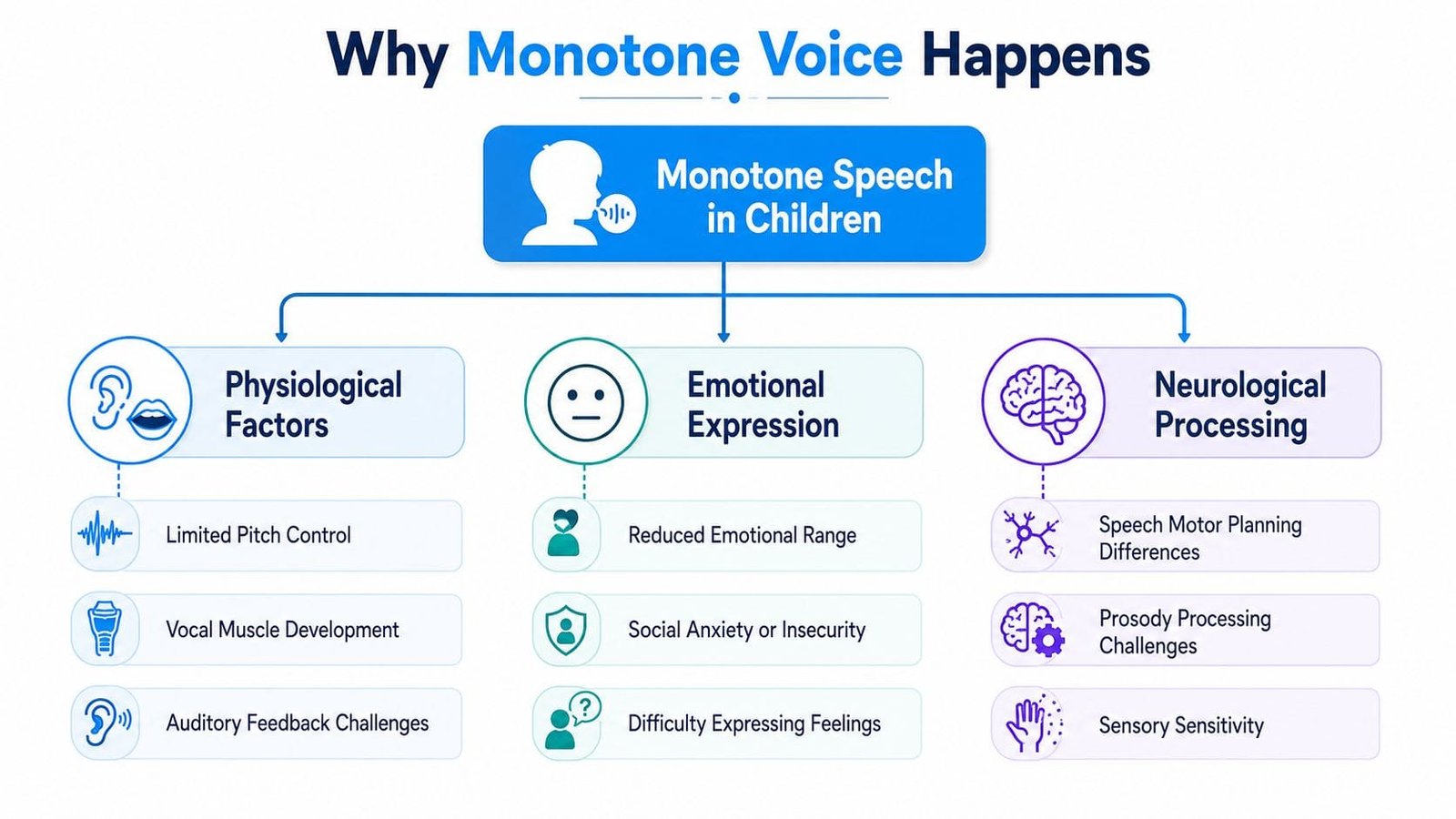
A child's voice emerges from several systems working together. The brain has to interpret social and emotional meaning, plan the message, coordinate breathing and vocal-fold movement, and adjust pitch, loudness, rhythm, and timing while speaking. If any part of that process works differently, the final speech pattern may sound less varied to a listener.
Autistic children may process prosodic information differently. They may not automatically use pitch or loudness in the way listeners expect, or they may find it difficult to notice which vocal changes a conversation partner is relying on. Motor planning can also affect the coordination needed for rapid shifts in pitch, volume, stress, and timing. This doesn't mean the child lacks motivation. It may mean the pathway from intention to vocal signal isn't automatic.
Context can change the sound
A child may sound more level during a difficult transition, a crowded activity, or a conversation that requires quick social responses. Shutdown, anxiety, fatigue, sensory overload, and demand avoidance can reduce available energy for vocal modulation. In those moments, a flatter voice may be part of conserving effort or communicating that the child can't manage more demands.
This is why a stable difference and a sudden change deserve different responses. A long-standing prosody pattern may be part of a child's communication profile. A new flattening, especially alongside withdrawal or reduced communication, calls for closer observation and possibly professional guidance.
The voice can also disconnect from the child's internal state. A child may say “I'm fine” in a level voice while feeling overwhelmed, or describe a favorite interest without the pitch changes adults expect from excitement. Listen to the words, body language, actions, and context together rather than treating vocal tone as a reliable emotional meter.
Families seeking broader developmental context may find Uptown Psychology Florida autism services useful when considering whether a full evaluation fits their concerns. For therapy planning, adapting speech therapy for sensory sensitivities can support a more comfortable, child-centered approach.
A quieter or flatter voice may be communicating reduced capacity, not reduced care.
How Monotone Voice Affects Daily Communication
At school, a teacher asks a child to stop tapping a pencil. The child answers, “Okay,” in the same level tone they use for ordinary information. The teacher hears defiance or sarcasm. The child may be acknowledging the instruction without knowing that the expected tone includes a particular combination of softness, speed, and emphasis.
At home, a child says, “I don't want to go,” without sounding upset. A parent may assume the request is minor because the voice doesn't carry visible distress. Yet the child may be experiencing intense worry and relying on the words alone to communicate it. When adults respond to the sound instead of the message, the child may feel misunderstood or may repeat the same statement more forcefully.
Peers can misread excitement, humor, or uncertainty in the same way. A child may share a favorite fact in a steady voice, make a joke without an obvious change in intonation, or answer a question with a pitch pattern that doesn't signal whether the answer is serious. Other children may not know how to respond, even though the speaker is participating sincerely.
These misunderstandings can become more complicated when prosody interacts with echolalia or scripting. Repeated phrases may carry a familiar rhythm from a show, conversation, or prior experience. The words can sound memorized, while the child is using them purposefully to request, connect, rehearse, or regulate. A script's vocal pattern shouldn't be judged in isolation.
Look for the whole communication profile
Ask what the child understands, what they intend, and what helps them communicate more clearly. Visual supports, written choices, gestures, facial expressions, augmentative and alternative communication, and extra processing time may reduce the pressure placed on vocal tone.
A useful response is, “I hear you saying you don't want to go. Do you mean worried, tired, or need more time?” That validates the words while offering another route to clarify the internal experience.
The aim isn't to make every child sound conventionally expressive. The aim is to prevent a listener's assumptions from blocking access to the child's meaning.
Signs of Monotone Speech to Watch for in Children
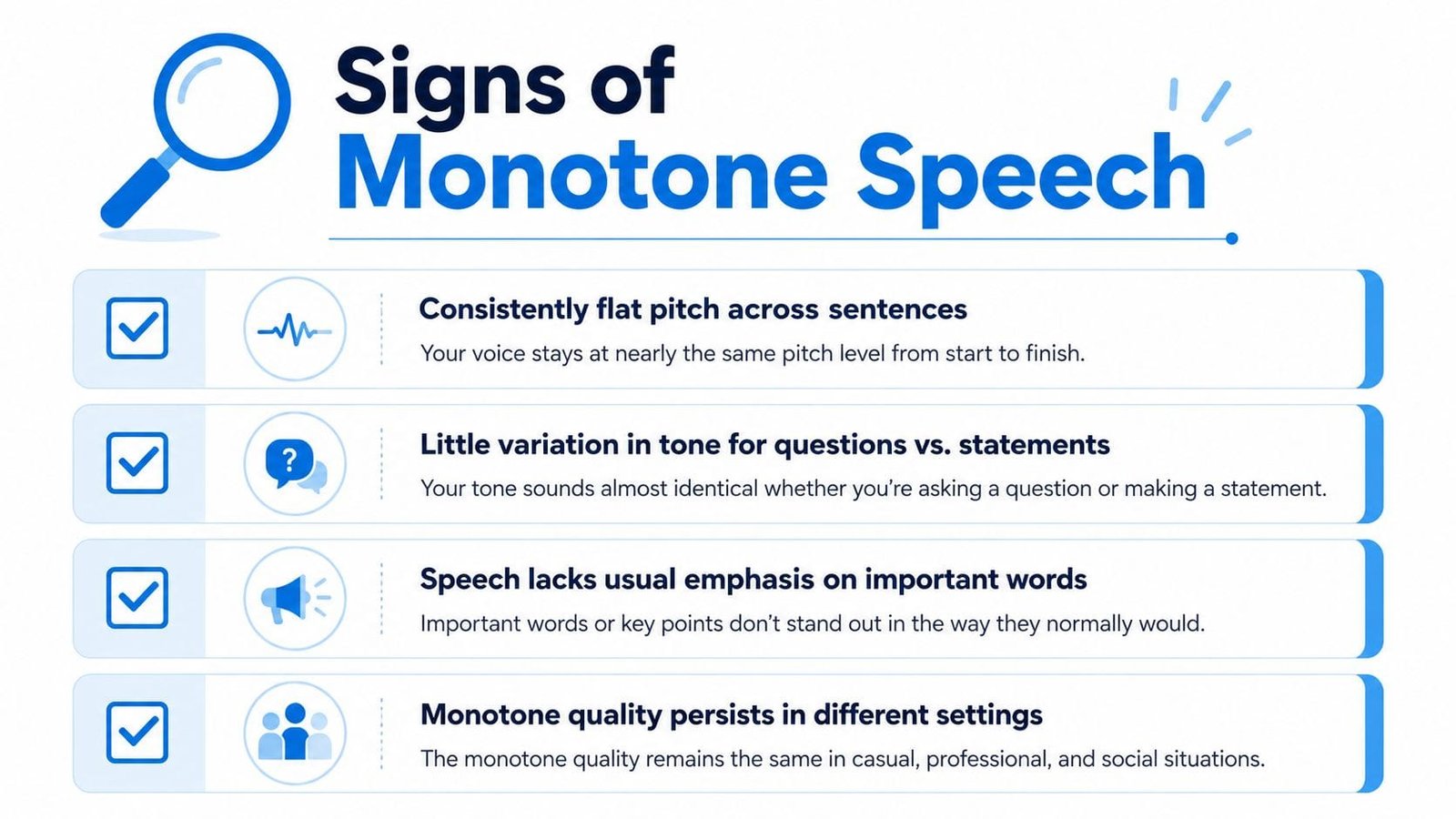
A single flat-sounding sentence doesn't establish a pattern. Children's voices change with fatigue, illness, excitement, familiarity, sensory load, and the demands of the setting. Observe across ordinary moments, not only during a formal conversation.
Watch for these features:
- Consistently level pitch: The voice stays within a similar high-low area across sentences, stories, and emotional topics. Occasional steadiness is common; persistence across contexts is worth tracking.
- Questions and statements sound alike: The child may use the correct words but show little rising or falling intonation to distinguish a question from a declaration. This can be a prosody difference rather than a language problem.
- Limited emphasis: Important words don't receive noticeable changes in pitch, loudness, length, or timing. The listener may need to ask which part of the message matters most.
- Even loudness: The child tells a story with little change in volume, including during parts that would usually sound more intense or softer.
- Unusual rhythm or pacing: Speech may include long pauses, an unusually steady beat, or a rate that makes turn-taking difficult.
- Scripted or robotic quality: Spontaneous speech may sound similar to memorized language, especially when the child is tired, anxious, or under social pressure.
Track conditions, not just sound
Write down what happened before the speech pattern, where it occurred, who was present, and how the child communicated afterward. Note whether the voice changed during play, reading, requests, conflict, transitions, or recovery after a demanding event.
A pattern is more useful than a label. “Flat voice” tells a clinician very little. “Pitch was level during the morning transition, but varied during quiet one-to-one play” gives the clinician something to investigate.
Practical Strategies for Parents and Caregivers
Start by protecting communication, not correcting the voice. If your child says something important in a level tone, respond to the content first. You can model a different prosody naturally, but avoid repeated prompts such as “Say it with feeling,” which can make speaking feel like a test.
Shared reading offers a low-pressure way to demonstrate variation. Give a character a gentle voice, pause before an important word, or make a question sound different from a statement. Your child doesn't have to imitate you. Hearing contrasts during an enjoyable activity can build awareness without demanding performance.

Visual emotion cards can bridge the gap between a feeling and its vocal expression. Offer choices such as calm, worried, excited, uncomfortable, or unsure, and accept pointing, writing, gestures, or communication devices. The card is a support for self-advocacy, not a demand that the child perform an emotion in their voice.
Create conversations that don't require eye contact, rapid replies, or dramatic vocal changes. Talk while drawing, walking, building, or driving. Give your child time to answer and let them end the interaction when their capacity is low.
For age-appropriate social learning, resources featuring classroom activities for building empathy can help children practice interpreting different communication styles without treating one style as the correct human response.
Record observations in a consistent format. Note the setting, sleep quality, food and routine changes, sensory demands, behavior events, and the child's speech pattern. Log whether the voice sounded flatter during a meltdown, shutdown, or demand-related situation, and whether it returned to baseline afterward. A structured record is easier to review than scattered memories.
The following video can provide another way to think about speech support and individualized practice:
Families can also use this guide to speech therapy for autism parents when preparing questions for a speech-language pathologist. Keep the focus on access, comfort, and clear communication. A child shouldn't have to sound enthusiastic, cheerful, or conventionally expressive to be believed.
When to Seek Professional Support for Prosody Differences
A monotone voice doesn't automatically require treatment. Some children have a stable prosody difference that doesn't limit their relationships, learning, participation, or ability to express preferences. Support becomes more important when the pattern causes repeated misunderstandings, distress, communication breakdowns, or barriers to self-advocacy.
Arrange a professional conversation if your child's voice suddenly becomes flatter after previously sounding more varied. Also seek guidance when a change appears with social withdrawal, loss of communication skills, unusual fatigue, reduced participation, or difficulty communicating pain and basic needs. These signs don't identify a cause by themselves, but they deserve careful attention.
A speech-language pathologist can assess pitch, loudness, rhythm, rate, stress, intelligibility, language, and functional communication together. Ask the clinician to consider whether the child's speech differs by setting, communication partner, task, sensory demand, and emotional state. The best plan may involve direct speech work, environmental changes, visual supports, alternative communication methods, or no intervention if the difference isn't causing difficulty.
Bring organized observations to appointments. Include short descriptions of what happened before and after the speech change, sleep patterns, routines, therapy notes, and behavior logs. A record from home and school can reveal context that a brief clinic visit can't capture.
A good evaluation asks what the voice is helping the child do, not only how it sounds to adults.
Professionals should also protect the child's autonomy. The goal isn't to erase autistic communication or force a performance of emotion. It's to help the child communicate safely, be understood when they want to be understood, and access additional ways to express meaning when speech alone isn't enough.
Guiding Growth offers structured tracking for speech patterns alongside routines, sleep, behavior, therapy notes, and daily context, helping you notice when a flatter voice appears and what may be happening around it. Visit Guiding Growth to replace scattered observations with an organized record you can use at home and share with your child's support team.