Most advice about ABA data collection software starts with a feature checklist, then ends with a favorite vendor. That approach misses the operational problem. A clinic can have excellent graphs, mobile forms, and automated notes while parents, schools, speech therapists, and occupational therapists still hold the rest of the child's story in separate portals, messages, and memory.
The better question is whether the software creates a usable, auditable record across settings. Clinical systems need precise measurement, payer-aligned reporting, reliability checks, and controlled access. Family tools need to capture what happens between sessions without pretending to replace a BCBA's assessment or treatment plan. This guide evaluates both layers.
| Evaluation area | What a serious buyer should verify | Why it matters |
|---|---|---|
| Measurement coverage | Frequency, duration, latency, interval, trial-by-trial, and time-sample workflows | Different behaviors require different measurement methods |
| Reliability support | Concurrent observers, IOA calculations, synchronized timestamps, and raw-record export | Agreement must be auditable, not reduced to a dashboard score |
| Mobility | Phone and tablet capture, offline behavior, and practical entry methods | Observations often occur away from a desk |
| AI assistance | Structured extraction, draft notes, and human review | Automation should reduce typing without hiding how data were produced |
| Privacy and access | Role-based permissions, consent workflows, secure transfer, and audit trails | Family and clinical records require deliberate sharing |
| Interoperability | Human-readable exports, standardized labels, and family-shareable views | A complete child picture rarely lives in one system |
Table of Contents
- What ABA Data Collection Software Actually Has to Solve
- How ABA Measurement Methods Shaped Modern Software
- Six Criteria That Actually Separate ABA Platforms
- What BCBAs Actually Use in 2026
- Mobile Logging, Voice, and the Family-Side Layer
- Reliability, Interobserver Agreement, and Audit Trails
- Privacy, Access Control, and the Cross-Setting Workflow
- Which Software Fits Which Team
What ABA Data Collection Software Actually Has to Solve
ABA documentation is still operationally fragmented. A 2022 survey of 232 BCBAs and BCBA-Ds found that 79% reported using paper data-collection systems and 45% reported using electronic systems in the published practice survey. Because respondents could use both, the figures describe overlapping workflows, not a straightforward migration from paper to digital records.
Payer requirements add a separate constraint. Fifty-nine percent of respondents reported that their funding sources required specific data reporting, and 66% used a prescribed system supplied by an agency or workplace, according to the same survey. A platform can support sound clinical measurement yet fail in practice if it cannot reproduce required fields, reports, or approval steps.
The record should determine the evaluation sequence, not the interface:
- Define the target behavior operationally.
- Choose a measurement method suited to that behavior.
- Capture the observation with timing and context.
- Check reliability when independent observers are available.
- Preserve the raw record and edit history.
- Export a report another professional can interpret.
This sequence separates useful infrastructure from feature volume. The relevant criteria are measurement coverage, reliability support, mobility, AI assistance, privacy and access control, and interoperability. Each addresses a different failure risk: invalid measurement, observer drift, missed observations, opaque automation, inappropriate disclosure, or siloed care.
Interoperability also has a family-facing dimension. Clinic staff need structured records that support payer review, while parents and caregivers need practical ways to document events between sessions. The team behind Matil provides context on structured capture as an alternative to disconnected note-taking. A family-side overview of special education data collection frames home observations as information to organize and discuss, rather than a replacement for BCBA assessment or treatment planning.
The strongest comparison therefore asks whether a platform can connect these records without erasing their different purposes. Capture, review, sharing, and auditability must work across settings.
How ABA Measurement Methods Shaped Modern Software
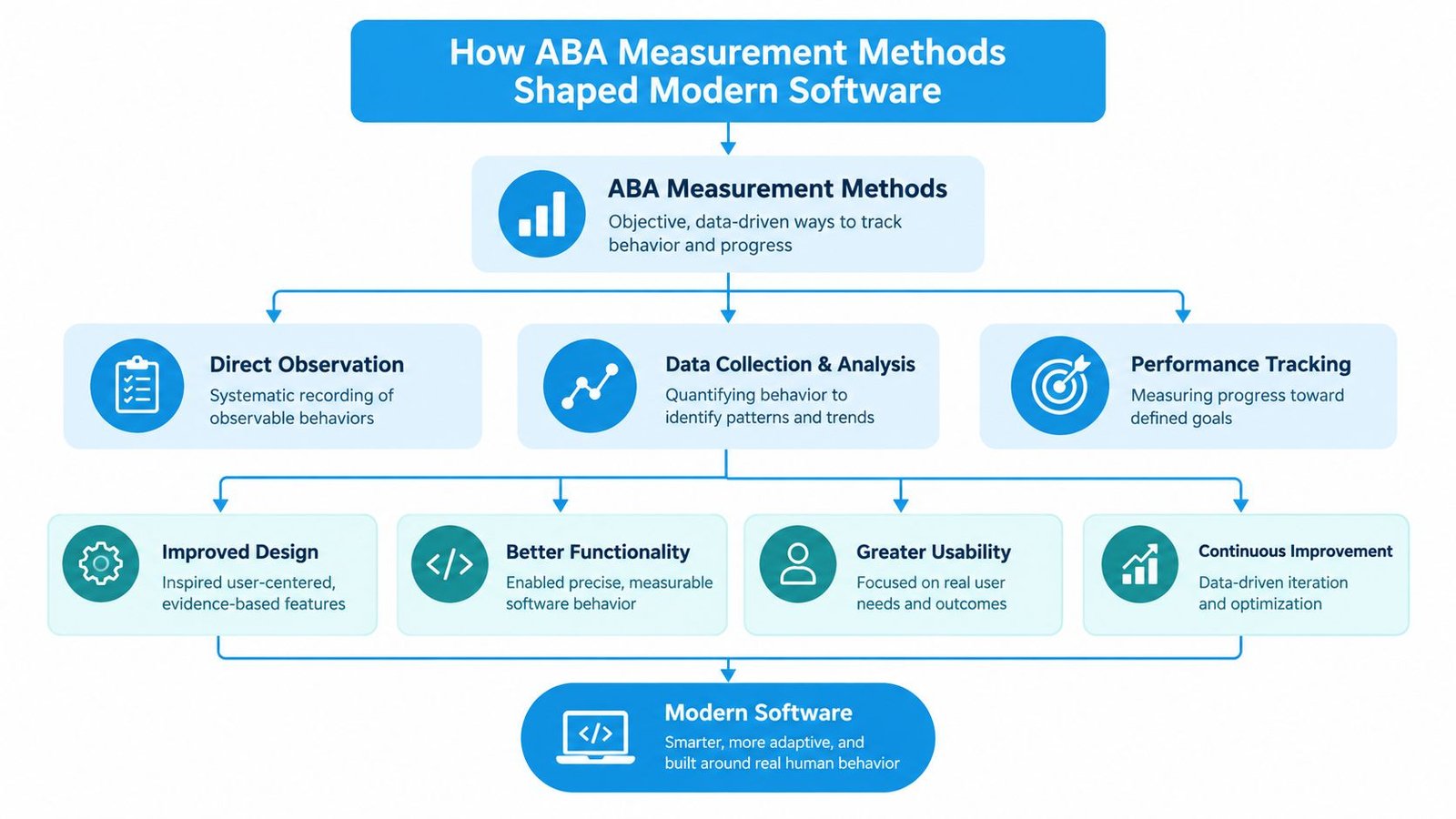
Modern interfaces often make measurement look like a software feature. Historically, it was a research discipline. A review of studies published in the Journal of Applied Behavior Analysis from 1968 through 1975 found that approximately three-quarters reported observational data, using event recording, trial scoring, interval recording, and time-sample recording in the historical review.
That history matters because the field's operational vocabulary predates smartphones and cloud dashboards. Frequency, duration, latency, interval recording, and trial-by-trial scoring aren't decorative options. They represent ways of linking a defined behavior to a count, a time period, a delay, or a specific learning opportunity.
Why free-text notes fall short
A narrative note may say that a child had a difficult transition. It doesn't necessarily preserve the operational definition, the exact duration, the observation window, the people present, or whether the event met the threshold for recording. Without those details, a later graph can display movement without explaining what was measured.
The measurement choice also affects interpretation. Frequency or rate fits behavior with clear beginnings and endings. Duration is more informative when the time occupied by the behavior is the clinical concern. Latency records the time between a specified stimulus and the response. Partial-interval recording can be useful for high-rate behavior but may overestimate occurrence, while momentary time sampling records whether behavior occurs at the end of an interval as outlined in recommended measurement practices.
A serious platform should retain the operational definition, timestamp, context, raw observation, and selected measurement method. A family-side app adds a different layer by recording triggers, location, sleep, meals, and people present. That context doesn't replace formal ABA measurement. It helps the care team understand what may be happening between structured observations.
Six Criteria That Actually Separate ABA Platforms
A demo should test the software under realistic conditions, not just display its dashboard. Use the following six criteria to compare the recording process, the quality controls around it, and the way data leave the system.
| Criterion | What to test in a demo | Red flag |
|---|---|---|
| Measurement coverage | Configure frequency, duration, latency, partial-interval, whole-interval, momentary time sampling, and trial-by-trial recording | Every target is forced into a simple event count |
| Reliability support | Add concurrent observers, compare event timing, inspect IOA calculations, and export raw records | The platform shows one percentage without the underlying entries |
| Mobility and offline capture | Log from a phone and tablet, disconnect the device, then verify synchronization and timestamps | Offline behavior is unclear or edits overwrite the original record |
| AI assistance | Dictate an observation, inspect extracted fields, correct errors, and identify AI-generated content | The system creates a polished note without showing source fields or review status |
| Privacy and access control | Create roles, restrict selected events, test consent and sharing, and inspect the audit trail | All collaborators receive the same broad access |
| Interoperability | Export event-level data, labels, timestamps, definitions, and summaries in readable formats | Only an image or aggregated chart can leave the platform |
Measurement coverage comes first
The platform should let clinicians choose the method per target behavior. It should preserve interval details, duration, latency, and trial outcomes for later analysis instead of reducing every observation to a total.
Reliability must be testable
Concurrent observation is more valuable than another dashboard tile. Buyers should ask whether the system supports synchronized timestamps, event-level comparison, multiple measurement types, and export of both observer records and the calculation method.
Mobility needs more than a mobile icon
A phone app is useful only if entry is practical during care. Check offline capture, synchronization, correction handling, and whether voice or media attachments preserve a clear relationship to the original observation.
AI should assist, not erase
Auto-summarization and structured extraction can reduce documentation burden. They shouldn't conceal uncertainty or make it impossible to distinguish manually entered, AI-extracted, and human-confirmed fields.
Access rules must follow the care relationship
A therapist, educator, co-parent, and grandparent may need different visibility. Role-based permissions and deliberate consent workflows matter more than a generic claim that the product is secure.
Interoperability is the overlooked differentiator
FHIR readiness can be useful, but families also need simple exports that a school team or clinician can read. No single platform reliably wins across all six criteria. The right question is not which app is best, but which combination of clinic and home tools produces a usable, auditable record.
What BCBAs Actually Use in 2026
The two most frequently named electronic systems each represented 22% of reported use, while nearly 40% identified unique electronic systems. That spread points to a fragmented market in which many clinicians manage parallel systems rather than working inside one standardized workflow. Familiarity, therefore, says little about whether a platform fits a clinic's reporting, supervision, and family-data requirements.
Quality assurance is part of the product
Data-collector maintenance depends on human processes as much as software features. Feedback, monitoring, and goal setting were the most commonly reported strategies, while a small minority reported using none of the listed strategies, according to the published survey findings. The practical implication is clear: supervision tools, review queues, and documented feedback loops belong in the product evaluation, not in an administrative checklist.
Paper persists because agencies and payers often prescribe templates, fields, and report structures. A digital replacement must accommodate those constraints while connecting with family-side tools that capture observations between sessions. Configurable forms, reproducible reports, staff training, and a migration plan matter more than a polished interface.
The strongest platforms make quality control inspectable. Supervisors should be able to identify changes in data-collector performance, document feedback, and trace a clinical decision back to the underlying observation. That requires timestamps, revision history, and clear separation between original entries, corrections, and reviewed records.
A recording screen cannot resolve inconsistent operational definitions or unreviewed data. Buyers should evaluate whether the clinic system can accept usable family-entered information without treating parent logs as an isolated data stream.
Mobile Logging, Voice, and the Family-Side Layer
Mobile capture has three distinct modes, and each serves a different job.
Structured forms are strongest when the observer must record trial-by-trial performance or follow a defined protocol. They create consistent fields and support later graphing, but they can be slow during a busy home routine.
Voice logging reduces friction when a parent or clinician needs to record several observations quickly. Speech recognition can turn a spoken account into candidate fields, but the user must review the extraction because a fluent sentence isn't the same as a validated measurement. A concise history of speech to text helps explain why voice interfaces can change how people enter information without eliminating the need for confirmation.
Photo and video capture preserve artifacts that text may lose, such as a meal, a visual schedule, or an environmental context. Media can enrich an observation, but it also raises stronger consent, storage, access, and transfer requirements.
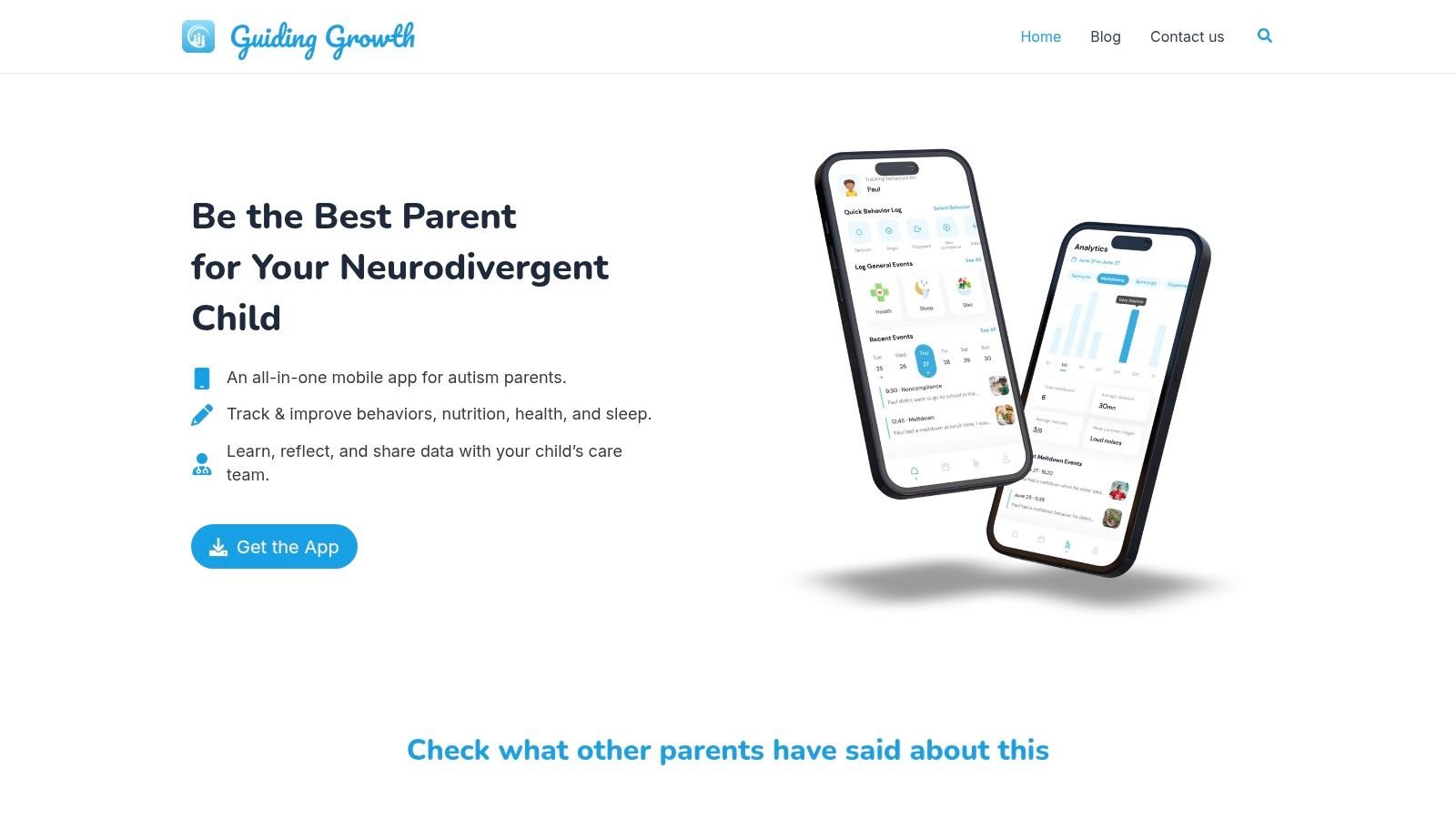
Assign each mode to the right observation
A practical division of labor looks like this:
- Structured entry: Use it for formal session measurement, trial scoring, interval recording, and other protocol-driven observations.
- Voice: Use it for high-volume events between sessions, especially when stopping to complete a form would cause the observation to be lost.
- Photo or video: Use it when the artifact or setting adds information that a field cannot capture, subject to the team's consent and privacy rules.
Guiding Growth operates on the family side of this boundary. Parents can use Quick Log by voice to describe a day, then review and correct AI-extracted entries covering behavior, sleep, meals, mood, screen time, and medications across multiple children before saving. The app also supports structured behavior records with triggers, intensity, duration, purpose, people present, and location.
That workflow is complementary to clinic-grade ABA software. It can explain what happened between sessions, while the BCBA's system remains responsible for formal measurement, treatment programming, and clinical interpretation.
Practical division of labor: The clinic system measures the target under defined conditions. The family layer preserves the context that makes those observations easier to interpret.
Reliability, Interobserver Agreement, and Audit Trails
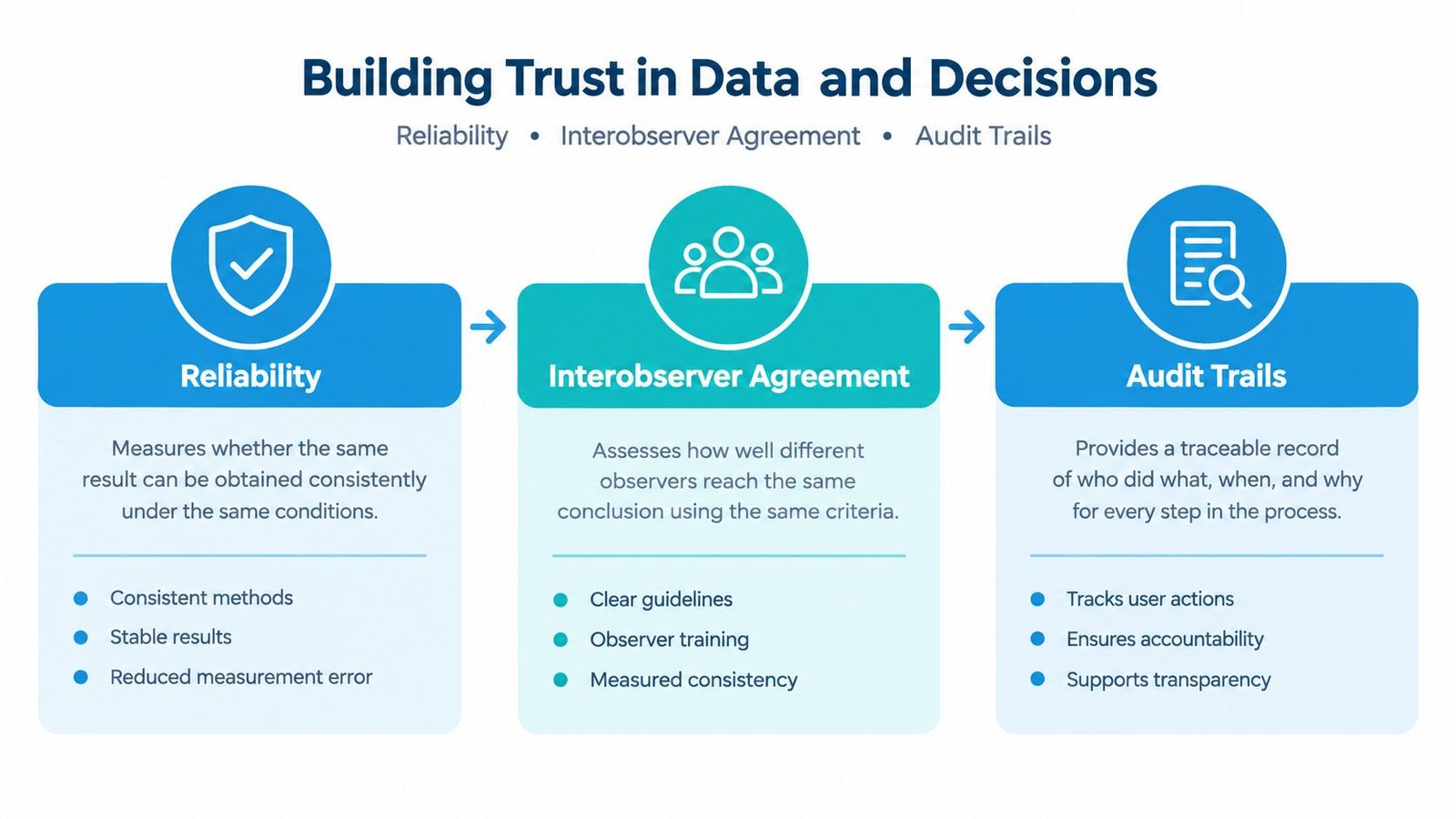
Interobserver agreement, or IOA, is the central reliability benchmark. Uptime, dashboard count, and visual polish don't establish that two observers recorded the same behavior consistently. The platform must help a behavior analyst determine whether disagreement came from event count, timing, duration, interval scoring, latency, or simultaneous coding.
Research on continuous, multiple-code observation warns that conventional agreement calculations can mislead when codes occur at different times in the analysis of agreement methods. A single percentage can conceal meaningful timing differences, so the software should expose the records behind the calculation.
Run validation cases, not marketing demos
Ask the vendor to test at least three scenarios:
- Two observers record the same number of events at different times.
- Two observers record overlapping durations.
- Two observers code multiple behaviors simultaneously.
Then verify that the system preserves synchronized timestamps, observer identity, event-level records, measurement type, and the method used to calculate agreement. A BCBA should be able to export the raw records and audit how the result was produced.
The same principle applies to family-entered data. The record should show who entered an event, when it was entered, whether it was edited, and which fields came from AI extraction versus manual confirmation. Those details protect the integrity of later summaries, especially when family observations enter therapy, medical, or school discussions.
For teams comparing broader electronic record approaches, compare electronic records software with TOOLii for a useful perspective on auditability and record workflows. Family teams can also use a focused guide to ABA session notes to distinguish a caregiver record from formal clinical documentation.
A graph without IOA and an audit trail is a picture, not a measurement.
Privacy, Access Control, and the Cross-Setting Workflow
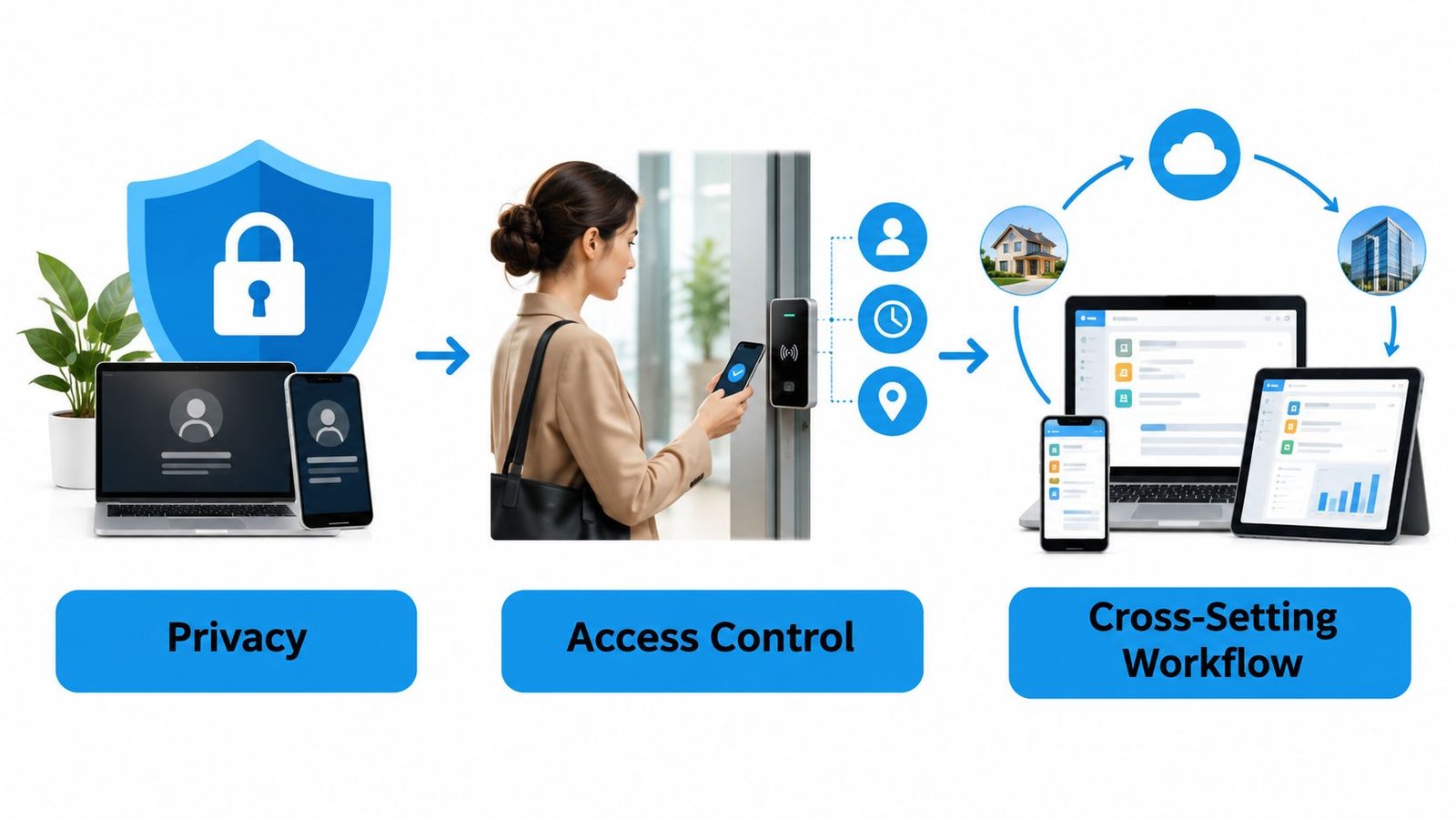
Confidentiality applies to electronic records just as it applies to paper notes. BACB guidance requires behavior analysts to protect confidentiality when records are created, stored, accessed, transferred, and disposed of, and it requires written client consent before obtaining or disclosing records from or to other sources for assessment purposes under the applicable ethics guidance.
That requirement translates into concrete product behavior:
- Role-based access: Give a therapist, educator, caregiver, and family member only the visibility their role requires.
- Consent-aware sharing: Let the family approve selected observations without exposing internal clinical notes.
- Secure transfer: Protect records during export, sharing, and handoff to another provider.
- Disposal controls: Support record-retention and deletion practices consistent with law and organizational policy.
- Audit history: Preserve access, edits, and sharing events so the team can investigate discrepancies.
The complete child picture needs selective sharing
ABA observations rarely stand alone. Speech therapy, occupational therapy, school supports, sleep, meals, medication, and home events can change how a team interprets a pattern. Families need a way to contribute those observations without turning every personal entry into an open clinical record.
Guiding Growth's family-side workflow supports per-person collaborator permissions, family-controlled exports, and meeting-ready Smart Summaries. Its role is connective. It helps organize selected home information for a therapy, medical, or school conversation while leaving assessment and treatment decisions with qualified professionals.
A product's privacy design should therefore answer a practical question: who can see which event, for what purpose, and with whose consent? A general security label isn't enough if the sharing model is too broad.
Families evaluating that model can review a dedicated explanation of a HIPAA-compliant app alongside the clinic's own policies. The strongest workflow treats privacy as a control families actively use, not as a setting hidden in an administrative menu.
Which Software Fits Which Team
The right platform depends on who owns the measurement process and where the data will be reviewed.
| Team scenario | Primary priorities | Sensible trade-off |
|---|---|---|
| Solo BCBA or small practice | Measurement coverage, graphing, IOA, and manageable setup | Accept a less expansive family-facing experience |
| Multi-clinician agency | Reliability workflows, role permissions, training, and payer-aligned exports | Invest in implementation and governance |
| School district or IEP-heavy caseload | Exportable timelines, consent controls, and family-shareable views | Avoid systems that trap data in clinician-only dashboards |
| Parent-led home program without a clinician | Voice logging, behavior and meal tracking, patterns, and meeting-ready summaries | Use clinic-grade software when a BCBA joins the team |
Solo practitioners need clinical depth
A solo BCBA should prioritize precise measurement and reliable graphing before practice-management breadth. A smaller system can work if it preserves definitions, timestamps, raw observations, and IOA records.
Agencies need governance
For a multi-clinician organization, the recording screen is only one component. Supervisors need feedback, monitoring, access controls, exports, and training workflows that can operate consistently across staff and cases.
Schools need controlled exchange
School teams often need a readable timeline that can be discussed with families and related-service providers. Exportability and consent workflows may matter more than a large library of clinic-specific dashboards.
Families need a connective record
A parent-led home program benefits from low-friction capture, customizable behavior and meal tracking, pattern views, and summaries prepared for an IEP, a 504 meeting, or a specialist visit. Guiding Growth is available on iOS and Android and is designed for caregivers who need to organize daily observations before sharing selected information with their care team.
The right answer is usually two tools, not one: a clinic-grade system for formal ABA measurement and a family-side layer for the context between sessions.
Guiding Growth helps parents and caregivers capture behavior, sleep, meals, mood, medications, and daily context through structured entries and voice-based Quick Log, then review patterns and prepare shareable summaries for care meetings. Visit Guiding Growth to see how a family-side record can complement ABA data collection software without replacing clinical assessment.