Sleep tracking is the use of sensors and structured logs to estimate sleep timing, duration, and awakenings, while consumer devices infer sleep rather than measuring it directly. In practice, it helps families notice patterns across nights, not prove exactly how much REM or deep sleep a child received.
A parent tiptoes past a child's room, phone in hand, and wonders whether last night was better than the week before. Was bedtime earlier? Did the child wake repeatedly? Is tomorrow likely to bring more sensory dysregulation, irritability, or difficulty with transitions?
Those questions explain what sleep tracking is really for. It turns a vague memory into an organized record that can be compared with daytime mood, behavior, medication timing, meals, illness, and routine changes. For families raising autistic and neurodivergent children, that context can be more useful than a polished score on a wearable.
The important distinction is simple: tracking estimates sleep. A clinical sleep study measures physiological signals directly, while a consumer device usually makes an educated classification from movement, heart rate, breathing, or related signals. Used carefully, tracking can support better decisions and better conversations. Used as a nightly verdict, it can create unnecessary worry.
Table of Contents
- What Sleep Tracking Actually Means
- The Core Metrics and What They Really Tell You
- How Different Trackers Actually Work
- Where Wearables Get Things Wrong
- Why Tracking Matters for Autistic and Neurodivergent Kids
- Turning Two Weeks of Data into Better Conversations
- A Gentle First-Week Plan for Tracking Sleep
What Sleep Tracking Actually Means
Sleep tracking uses sensors, algorithms, or structured observations to estimate sleep-related measures. Common measures include bedtime, estimated sleep onset, wake time, total sleep duration, sleep efficiency, awakenings, and sometimes sleep stages.
The technical foundation predates smartwatches. Polysomnography, or PSG, is the clinical reference method. It records brain activity, eye movements, muscle activity, heart signals, breathing, and other physiological signals. Actigraphy takes a different approach, usually estimating rest and activity from movement through a wrist-worn device. The CDC overview of sleep duration data describes these measurement contexts alongside population sleep information.
A smartwatch, ring, or bedroom sensor generally doesn't record brain activity. Instead, it looks at signals such as:
- Movement: Stillness may be classified as sleep, while movement may suggest wakefulness.
- Heart rate: Changes can help an algorithm estimate rest and activity.
- Breathing or temperature: Some devices use additional physiological signals to refine their estimate.
- Caregiver observations: A parent may record bedtime, night waking, or final awakening manually.
That distinction matters in a child's bedroom. A child who lies still and awake may be counted as asleep. A child who moves frequently during sleep may be classified as awake. A device can still show a useful pattern across many nights, but its stage labels aren't equivalent to clinical measurements.
Practical rule: Treat sleep tracking as a pattern journal with sensors, not as a laboratory report.
The need for practical sleep information is clear. In 2024, 30.5% of U.S. adults reported sleeping fewer than 7 hours on average, according to the CDC source above. Earlier CDC data from 444,306 respondents found that 11.8% reported 5 hours or less, 23.0% reported 6 hours, 29.5% reported 7 hours, and 27.7% reported 8 hours. The CDC estimated that 83.6 million U.S. adults slept fewer than 7 hours.
Those figures describe adults, not autistic children, and they don't tell a family what caused one difficult night. They do show why families and clinicians need reliable ways to discuss sleep. For a child, start with observable foundations: consistent bedtime, wake time, total time asleep, night waking, and changes from one routine to another.
The Core Metrics and What They Really Tell You
A sleep dashboard can look authoritative because it turns the night into neat numbers. Before reacting to any number, translate it into an everyday question: What happened, how sure are we, and does the pattern repeat?
Start with the sleep window
Bedtime is when the child begins the planned sleep routine or gets into bed. Estimated sleep onset is when the child appears to have fallen asleep. Those aren't always the same. A child may get into bed at 8:00 p.m., read, stim, vocalize, or remain awake before falling asleep later.
Wake time is the morning endpoint. For some children, the most useful detail is final awakening, especially when early waking affects school readiness or family routines. Recording both the planned schedule and what happened can reveal whether the issue is a late sleep onset, repeated waking, or an early start to the day.
Measure the night itself
Total sleep time estimates how long the child slept. Think of it as the amount of water that made it into a glass. Time spent in bed matters, but it isn't identical to time asleep.
Awakenings capture interruptions after sleep begins. A caregiver may notice a full waking, a call from the bedroom, or a long period of distress. A device may also flag brief movement that the caregiver never sees. Both records have value, but they represent different kinds of information.
Sleep efficiency compares estimated sleep with time spent in bed. A child who spends a long period in bed but sleeps for a shorter portion of it has lower estimated efficiency. The fuel-tank analogy helps: the tank may be open all night, but the amount collected is the sleep that counts.
The basics are useful for families who want to optimize training and recovery because they focus attention on routines and recovery rather than a single attractive score.
Treat stages as a second layer
Devices often display light, deep, and REM sleep. These labels can be interesting, but they require caution. A 2024 expert review found that epoch-by-epoch agreement with PSG varies widely, approximately 50% to 90% for light sleep and 30% to 80% for deep and REM sleep, depending on the device and study design, as reported in Sleep.
For a family dashboard, bedtime, wake time, total sleep, and repeated night waking usually deserve more attention than whether a device assigned a particular block of time to REM. If a stage number changes, ask whether the child's daytime functioning changed too. A number without context can distract from the question that matters.
A helpful record separates device-derived estimates from caregiver observations. “Tracker estimated sleep at 8:45” is different from “child was quiet in bed from 8:00 to 8:45.” Keeping both prevents false precision and gives a clinician more useful context.
How Different Trackers Actually Work
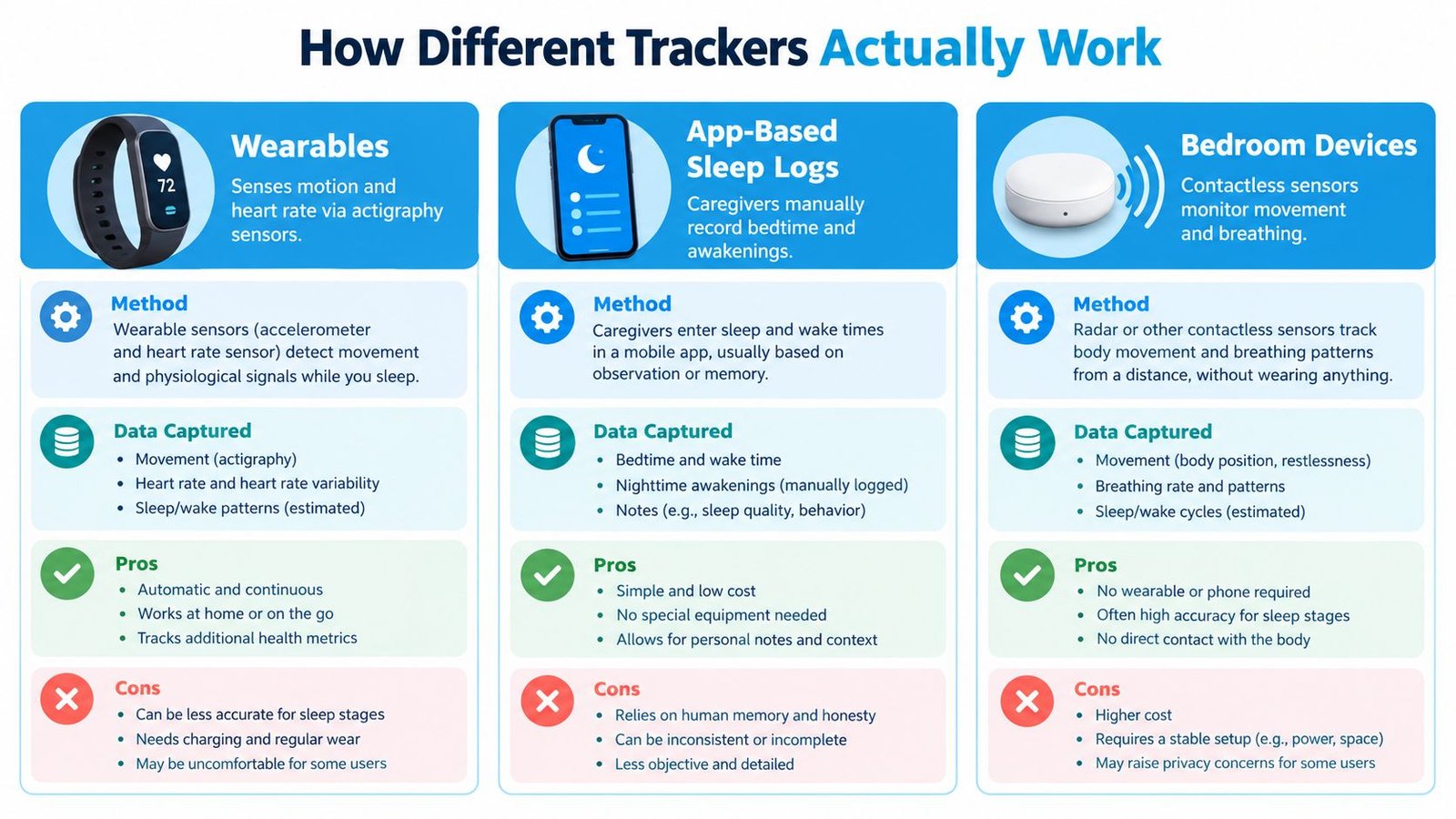
Sleep tracking methods answer slightly different questions. A wearable asks what the body's signals suggest. A manual log asks what the caregiver observed. A phone or bedroom sensor asks what movement or breathing occurred in a particular space.
Wearables
Wristbands and rings commonly use accelerometers, optical heart-rate sensors, and sometimes temperature or breathing signals. They can collect information throughout the night without requiring a parent to stay awake and write everything down. That makes them convenient for repeated measurements.
Their weakness is interpretation. A motionless child who is awake may look like a sleeping child to the algorithm. A child with atypical movement, sensory regulation needs, or frequent repositioning may produce a less familiar signal pattern.
App-based logs
A manual log can capture details a device can't understand. A caregiver can note whether the child woke crying, asked for a specific sensory input, had an illness symptom, needed toileting support, or settled after a medication change. The record is only as accurate as the caregiver's observation, but it carries meaning that an algorithm may miss.
A morning voice note can reduce the burden. Instead of completing a long form while exhausted, a parent can describe the night in ordinary language and organize it later.
Passive sensing
Phone sensing and bedroom devices may monitor movement or breathing without requiring a wearable. They're useful when a child won't tolerate something on the wrist or finger. However, a phone can confuse the child's movement with another person in the room, especially with co-sleeping or shared bedrooms.
| Method | What it senses | Strength | Key limitation |
|---|---|---|---|
| Wearable | Motion and physiological signals such as heart rate | Continuous overnight estimates | Quiet wakefulness may be labeled as sleep |
| App-based log | Caregiver observations and event times | Captures context, distress, and unusual events | Misses events the caregiver doesn't notice |
| Bedroom or phone device | Movement, sound, or breathing near the sensor | Contactless and potentially easier for sensory-sensitive children | May confuse people or pets sharing the space |
The most useful method is often the one a family can sustain. Some families combine a wearable estimate with a morning caregiver log. Others skip the device and record bedtime, wake time, awakenings, and next-day functioning. A comparison of smartwatch health features can help adults understand what a device claims to measure, but feature lists don't establish clinical accuracy.
Families can also explore the Guiding Growth sleep tracking app when they want sleep observations connected with the rest of a child's daily record. The purpose isn't to replace clinical assessment. It's to keep scattered observations in one place.
Where Wearables Get Things Wrong
A parent can watch a child lie still for forty minutes, eyes open, body calm, and then wake up to an app that labels that whole stretch as sleep. That mismatch is one of the most common ways wearables confuse families.
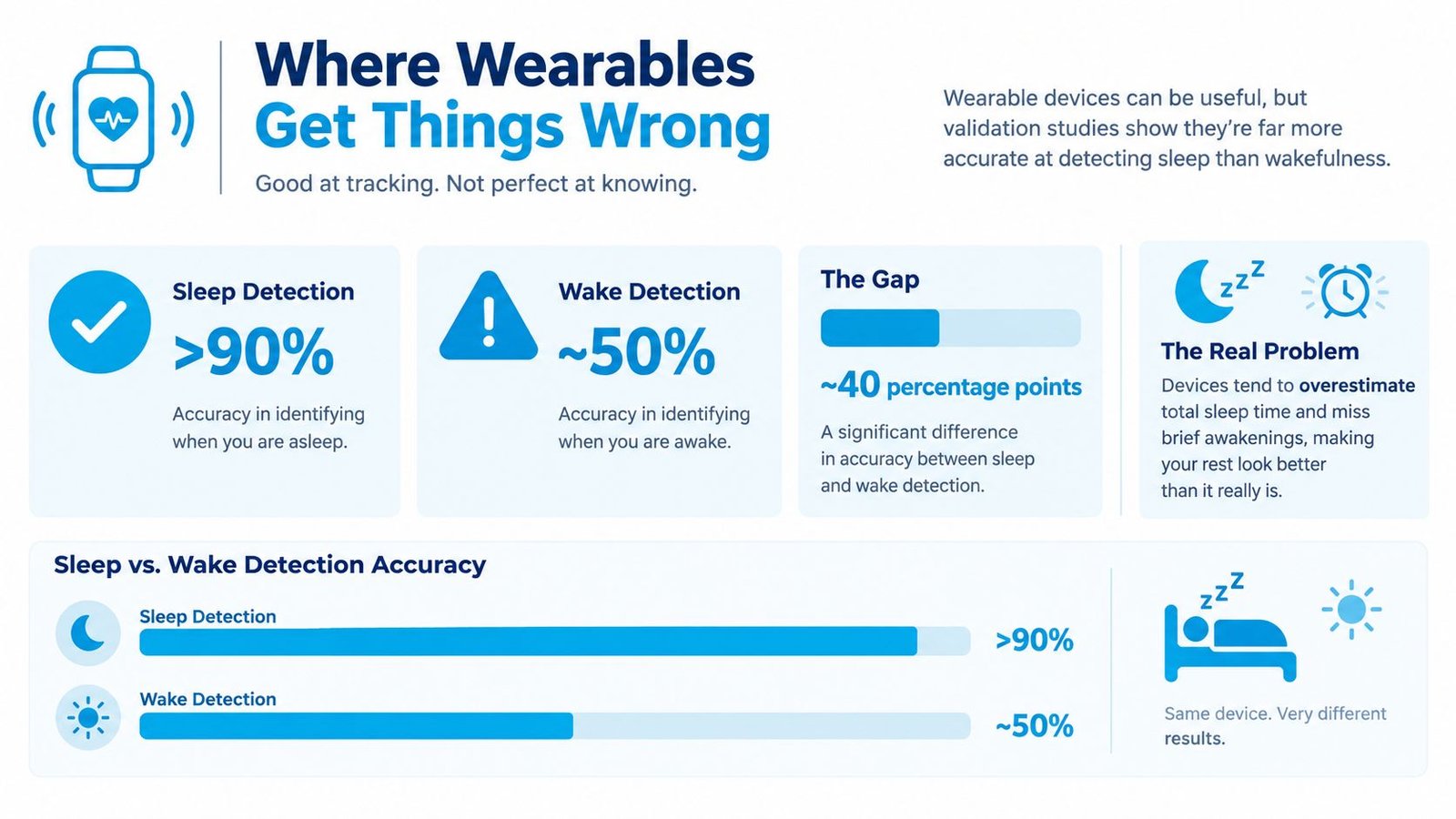
The pattern is consistent across studies. Wearables are usually better at detecting sleep than detecting wake. In practical terms, they often read stillness as sleep, which matters a great deal for neurodivergent children who may rest, wait for sleep, or wake without calling out.
An inpatient comparison of an Oura Ring, Fitbit, and Apple Watch against overnight PSG found strong performance for basic sleep versus wake classification in 35 adults aged 20 to 50 without sleep disorders. All three devices reached at least 95% sensitivity for detecting sleep, and each exceeded 90% agreement with PSG for the simpler sleep-versus-wake measure. Once the task became more detailed, agreement dropped. The Oura Ring reached 76.3% agreement across 30-second epochs for four-stage classification, compared with 92.0% for the two-category sleep-versus-wake approach, as reported in Sleep.
That is why stage graphs need a light touch. They can look precise while hiding a basic error: the device may have decided the child was asleep because the child was not moving.
The quiet-wake problem
A comparison of two activity trackers found sleep-detection sensitivity of about 96.0% to 96.7%, while wake-detection specificity was only about 39.1% to 44.8%, according to the consumer tracker validity research.
For families, that often means overestimated total sleep and sleep efficiency, and underestimated sleep latency and wake after sleep onset. A caregiver may remember a long stretch of quiet settling, a child humming, scripting softly, or lying awake under a blanket. The tracker may score that same period as solid sleep.
PSG remains the clinical comparison because it records brain activity, eye movements, muscle tone, breathing, and cardiac signals. A wearable does not do that. What it can do, used carefully, is help a family notice patterns over time, such as a later settling window, more fragmented nights, or changes after illness, travel, medication shifts, or a routine disruption.
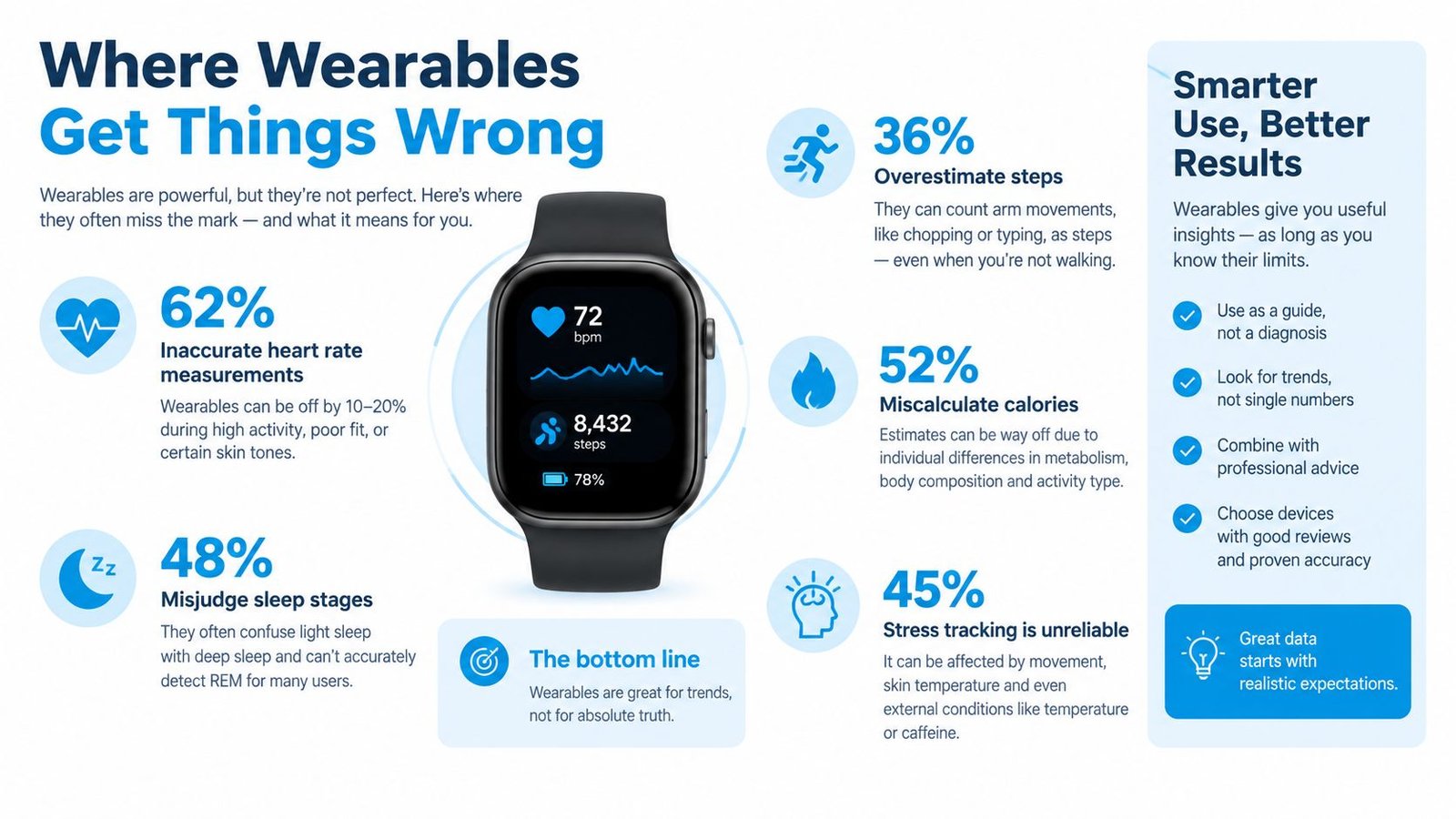
A broader how accurate are sleep trackers discussion reaches the same practical conclusion. Use wearables for trends, not diagnosis. For autistic and other neurodivergent children, the real value is context. A device can support better conversations with clinicians when paired with caregiver notes about bedtime routine, night waking, and next-day functioning.
Why Tracking Matters for Autistic and Neurodivergent Kids
Sleep challenges rarely stay confined to nighttime. A difficult night may appear the next day as lower frustration tolerance, more sensory seeking, reduced flexibility, difficulty communicating, or less capacity for therapy and school demands. Those daytime observations may be more actionable than a device's sleep-stage graph.
A useful family record begins with the measures that people can explain clearly:
- Routine: Was bedtime earlier, later, or inconsistent?
- Sleep timing: When did the child appear to settle, and when did the day begin?
- Night waking: How often did the caregiver notice waking, and what support was needed?
- Next-day functioning: How did mood, regulation, communication, appetite, and transitions look?
- Context: Were there medication changes, illness, constipation, school changes, travel, sensory stress, or unusual meals?
This approach avoids a common mistake: assuming that a poor sleep score caused a difficult behavior. A meltdown may follow a short night, but pain, sensory overload, a school disruption, or another factor may also contribute. Sleep data can show that two events occurred near each other. It can't establish causation by itself.
Connect sleep with the rest of the day
A 2025 feasibility study examined month-long, home-based heart-rate-variability monitoring in young children with autism spectrum disorder. Extended home monitoring was practical and methodologically transparent, but HRV did not predict next-day behavior, according to the published study. More biometric data doesn't automatically produce a clearer behavioral explanation.
That finding supports a balanced record. Pair passive measurements with short caregiver observations about sleep quality, illness, medications, sensory conditions, and next-day regulation. Guiding Growth can be one option for keeping nightly sleep notes, daytime behavior, meals, mood, and medications on a shared timeline. Its voice-first logging is designed to turn a spoken account into organized entries that a parent can review and adjust.
The benefit isn't a perfect score. It's a clearer conversation with a pediatrician, occupational therapist, sleep clinician, teacher, or co-parent. For neurodivergent children, tracking works best as shared context, never as a measure of parenting success or a diagnostic tool.
Turning Two Weeks of Data into Better Conversations
A collection of sleep entries becomes useful when you read it as a story rather than a scoreboard. Look for repeated relationships, not isolated nights. Did bedtime shift on school nights? Did night waking appear alongside illness? Did daytime regulation change after a routine adjustment?
Separate patterns from noise
Start by reviewing four anchors:
- Timing: Compare planned bedtime, estimated sleep onset, final awakening, and morning wake time.
- Interruptions: Note caregiver-observed wakings separately from device-detected movement.
- Functioning: Record next-day mood, regulation, communication, appetite, and transitions.
- Context: Add medication changes, illness, meals, sensory events, travel, and school changes.
A single unusual night deserves a note. A repeated pattern deserves a conversation. If sleep duration drops, don't immediately change several variables at once. Preserve the record, check for obvious context, and discuss persistent or concerning changes with the child's clinician.
A 2025 comparison of commercial trackers found disagreement even on wake after sleep onset. One Withings device underestimated it by a median absolute error of 25 minutes, while Fitbit overestimated it by 10 minutes, according to the Journal of Sleep Research comparison. That is why a parent's note, “awake and calling for support,” should remain visible beside the device estimate.
Prepare a meeting-ready summary
A practical workflow looks like this:
- Log sleep and relevant daytime events.
- Review the date range for recurring bedtime, waking, and behavior patterns.
- Filter for the events that relate to the question.
- Note possible triggers without claiming that one caused another.
- Export a concise summary for the appointment or school meeting.
In Guiding Growth, the analytics dashboard can show behavior frequency over time, common triggers, and time-of-day clustering. Smart Summaries lets a parent select a date range, choose relevant event types, identify the meeting context, and export a PDF for an IEP meeting, 504 review, or specialist visit.
For families who need clearer ways to present repeated observations, visualizing health and behavior data can make the difference between saying “sleep has been difficult” and showing when the change began, what accompanied it, and what happened next.
The summary shouldn't overwhelm the clinician with every detail. Include the question you want answered, the pattern you noticed, the uncertainty that remains, and the specific support you're requesting. Data helps most when it makes the next decision easier.
A Gentle First-Week Plan for Tracking Sleep
You don't need a laboratory setup to begin. Choose one method your child can tolerate and your family can maintain. The first week is about building a repeatable record, not earning a high score.
Begin with five small actions
- Choose one method: Use a wearable, a manual log, a bedroom sensor, or a combination that doesn't disrupt sleep.
- Record bedtime and morning wake time: Keep planned times and observed times distinct when they differ.
- Add a one-line quality note: Write “settled easily,” “restless,” “frequent support,” or another phrase that reflects what you noticed.
- Log observed night waking: Include what happened and what helped, without trying to convert every event into a precise minute count.
- Review the week: Look for repeated timing, interruptions, and next-day patterns rather than judging one night.
A parent might record that a child went to bed at 8:30 p.m., appeared asleep later, woke twice for support, and had a difficult transition to school the next morning. Another night may show the same bedtime but a calmer morning. That comparison is more useful than reacting to a single REM estimate.
Use the guide to tracking sleep and health for autistic kids if you want a more structured starting point. Keep the record light enough that it doesn't become another source of pressure.
Remember: Your observations are already important data. Tracking simply helps you remember, organize, and share what you know.
Share the week with a co-parent, therapist, or doctor when a question comes up. If the child has persistent sleep disruption, breathing concerns, severe daytime impairment, or a pattern that worries you, bring the record to a qualified clinician. The purpose of tracking is support, not self-diagnosis.
Guiding Growth gives families one place to record sleep timing, awakenings, quality, behavior, mood, meals, and medications, then review patterns and prepare shareable summaries. Start building a clearer picture of your child's nights and days by visiting Guiding Growth.