You're in the grocery store, halfway through the trip, when your child reaches for your hand and pinches hard. A relative gets too close and receives the same response. Later, during a transition away from a favorite activity, your child digs into their own arm. Everyone looks at you, and you're left trying to decide whether to stop the behavior, apologize, leave, or figure out what just happened.
Autism pinching behavior can be frightening, painful, and socially difficult. It can also carry useful information. A pinch may signal sensory overload, distress, a need for escape, limited communication access, or a physical problem that the child can't explain. Treating every episode as deliberate defiance often misses the reason the behavior is occurring.
The practical question is not only, “How do I stop the pinching?” It's, “What happened before it, what did the pinch accomplish, and what safer response could accomplish the same thing?”
Table of Contents
- When a Pinch Stops Being Background Noise
- What the Research Shows About Pinching
- Why Autistic Children Pinch in the First Place
- A Calm Safety Plan for the Moment It Happens
- Replacement Behaviors That Work Better Than Suppression
- Turning Observations Into Patterns Over Time
- Keeping the Data Without Burning Out the Family
- When to Bring in a Professional
When a Pinch Stops Being Background Noise
At the pediatrician's waiting room, Maya's mother noticed the pattern for the first time. Maya had been sitting, rubbing the edge of her sleeve. When another child moved close to her chair, Maya pinched her own forearm, then reached toward her mother's hand. Her mother gently moved away and whispered, "No pinching." A few minutes later, the nurse called them into the examination room. Maya pinched again when the blood-pressure cuff appeared.
At home, the same behavior looked different. A request to put away tablet time led to a pinch on her brother's arm. Bedtime brought scratching and self-pinching. A difficult dressing routine sometimes ended when the demand disappeared.
Those episodes may look like one behavior, but they aren't necessarily one problem. The setting, people present, sensory conditions, communication available, and consequence can change the meaning of the action.
A useful starting question: What changed immediately before the pinch, and what changed immediately afterward?
Try describing the behavior without judging it. “She pinched her left forearm twice during the transition from the car” gives a clinician something to analyze. “She was being difficult” doesn't.
Notice the pattern before choosing a response
A child may pinch during:
- Waiting: The environment is unpredictable, crowded, noisy, or physically close.
- Demands: A task feels too hard, too long, or unclear.
- Transitions: A preferred activity ends or a familiar routine changes.
- Connection: The child needs help, attention, or reassurance but doesn't have an easy signal.
- Overload: Anger, fear, pain, or sensory discomfort exceeds the child's coping capacity.
The first goal isn't perfect interpretation. It's slowing down enough to replace a quick label with a working hypothesis. Once you see the pinch as information, you can protect everyone in the moment while looking for a more efficient way for your child to communicate or regulate.
What the Research Shows About Pinching
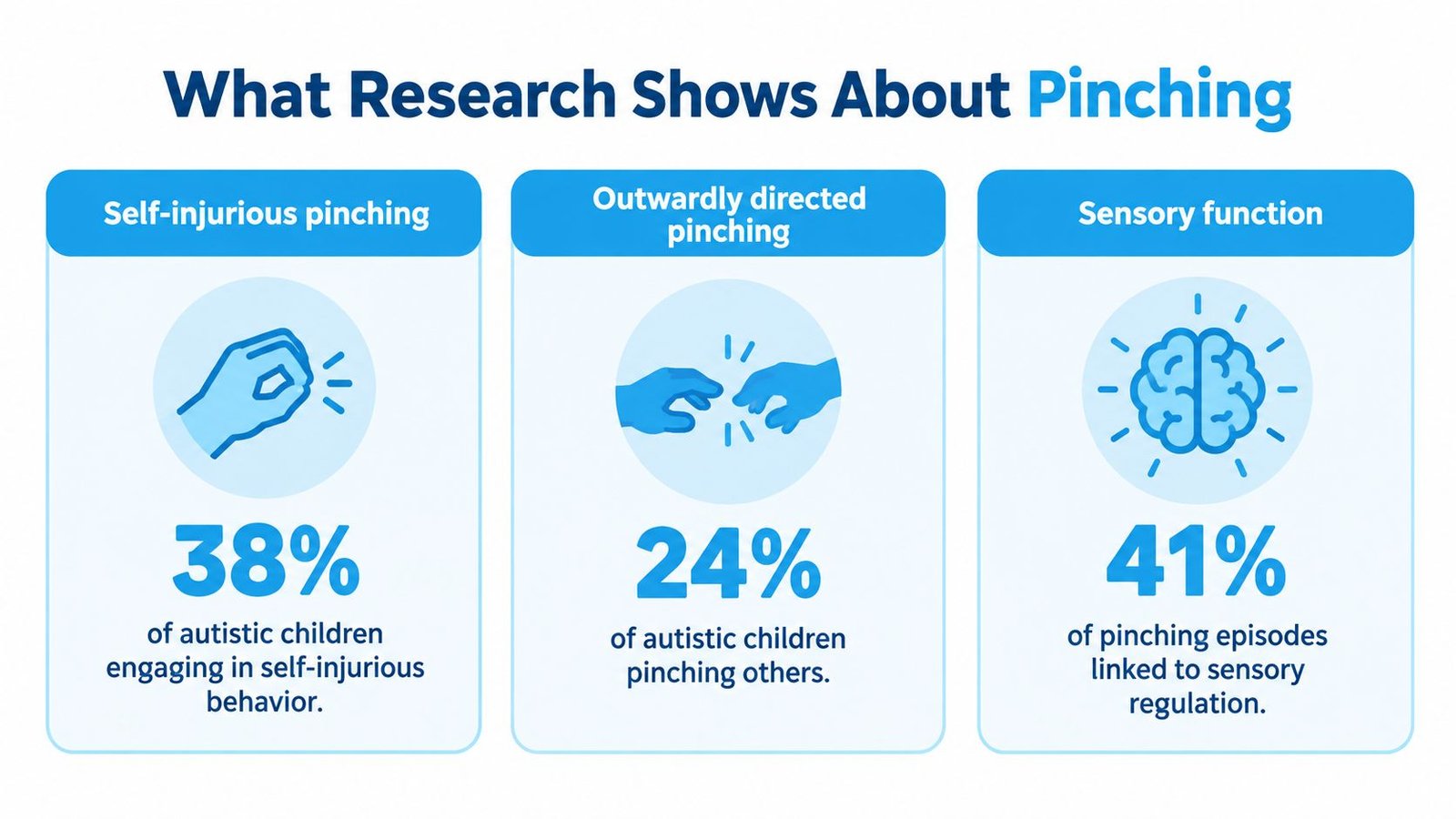
Pinching falls into two overlapping categories. Self-injurious behavior involves pinching one's own skin. Other-injurious or aggressive behavior involves pinching another person. The same hand movement can carry different risks and serve different functions, so the category helps guide safer assessment and support.
A 2020 meta-analysis of 37 studies and 14,379 autistic participants estimated that self-injurious behavior occurred in 42% of participants, with a 95% confidence interval of 38% to 47% (the meta-analysis on self-injurious behavior in autism). The figure includes self-hitting, biting, scratching, head banging, and other behaviors. It is not a prevalence rate for pinching specifically.
The same meta-analysis found that, among autistic participants who had displayed self-injury at the initial assessment, the behavior remained present in 44% over a 10-year period, while 56% experienced remission. A recurring pinch therefore deserves observation and a practical support plan, rather than a quick assumption that it will disappear on its own.
Why reported rates can look so different
Who observes the behavior and where it occurs can change the reported rate. In a study of 74 children and adolescents with autism, caregivers reported other-injurious behavior in 43 participants, or 58%, while parents reported it in 25 participants, or 34%. Researchers included pinching or holding others tightly among the prominent behaviors. During blood drawing, 15 of 64 autistic participants, or 23%, displayed biting, slapping, or pinching shortly after venepuncture, compared with none of the typically developing controls (the study of other-injurious behavior and venepuncture responses).
These findings do not identify one universal cause. They show why a family record can be more useful than a broad statistic. Note who observed the episode, where it occurred, what came immediately before it, and what followed. That small record turns “pinching happens a lot” into a pattern a care team can examine and use.
Why Autistic Children Pinch in the First Place
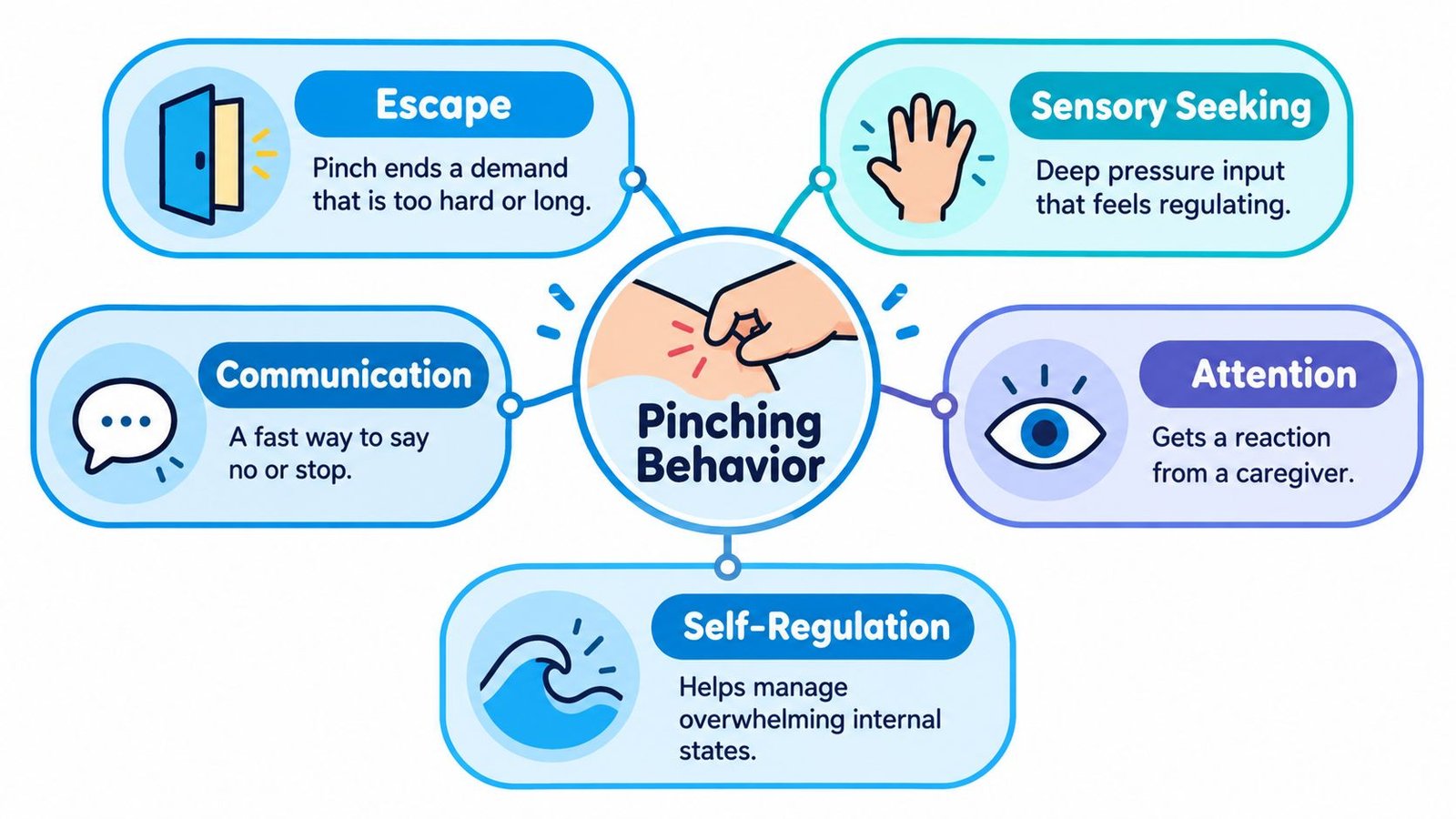
A pinch during a noisy transition may serve a different purpose from a pinch during dressing, a difficult task, or close physical contact. Pinching has no single universal explanation. Treat each episode as a specific behavior to decode: form a working hypothesis, compare it with what happens before and after, then revise it as the pattern changes.
Escape from a difficult or overwhelming demand
A worksheet, haircut, dressing routine, or transition can become too demanding. If the task stops immediately after a pinch, the child may learn that pinching reliably creates an escape. This does not mean the child is calculating or manipulative. The consequence has made the behavior effective.
Offer a simpler break signal before distress peaks. A child might hand over a break card, point to “help,” or use an AAC button. Shortening the task, clarifying the first step, and showing a visual sequence can also make the demand easier to approach.
Attention and connection
Some children pinch because it brings an adult close quickly. A child who cannot easily say “help,” “look at me,” or “stay with me” may discover that a pinch produces eye contact, words, touch, or movement. The behavior can function like an emergency call, even when it hurts.
Teach a replacement that communicates the same need clearly. A tap on a caregiver's open palm, a picture card, a gesture, or an AAC button can request attention without injuring anyone. Practice it when the child is calm, so it is available before frustration rises.
Sensory input and regulation
Pinching creates predictable pressure and a strong body sensation. Some children seek that input when they feel under-alert or disconnected from their body. Others use pressure while coping with overwhelming sound, light, movement, or proximity.
A firm cushion, therapy putty, or textured object may offer a safer way to get useful input. Pressure should follow the child's preferences and, when appropriate, guidance from an occupational therapist. Observe the direction of the need. Does the child seek pressure, avoid touch, or settle when the environment becomes quieter? Information about autism touch sensitivity can help distinguish sensory discomfort from pressure seeking.
Communication and emotional overload
Pinching may communicate “no,” “stop,” “too close,” “help,” or “I do not know what to do.” It can also appear when anger, frustration, anxiety, or pain becomes too intense for speech, signs, or AAC. The visible action is the topography. The message underneath still needs investigation.
In the same preschool sample noted earlier, 7.6% of autistic children were reported to pinch someone when angry, compared with 2.3% of non-autistic children. The reported odds ratio was 3.55, with a 95% confidence interval of 1.90 to 6.63. Anger may be part of the context, but it does not prove that anger is always the cause.
The useful question is what changed immediately before the pinch and what the child gained or avoided afterward. That functional-behavior-assessment lens turns a distressing moment into information for choosing a safer replacement skill.
A Calm Safety Plan for the Moment It Happens
When pinching starts, theory can wait. Your first responsibility is to reduce injury and lower the amount of stimulation around the child. Keep your voice brief and even. A long explanation often adds demands when the child already has too much to process.
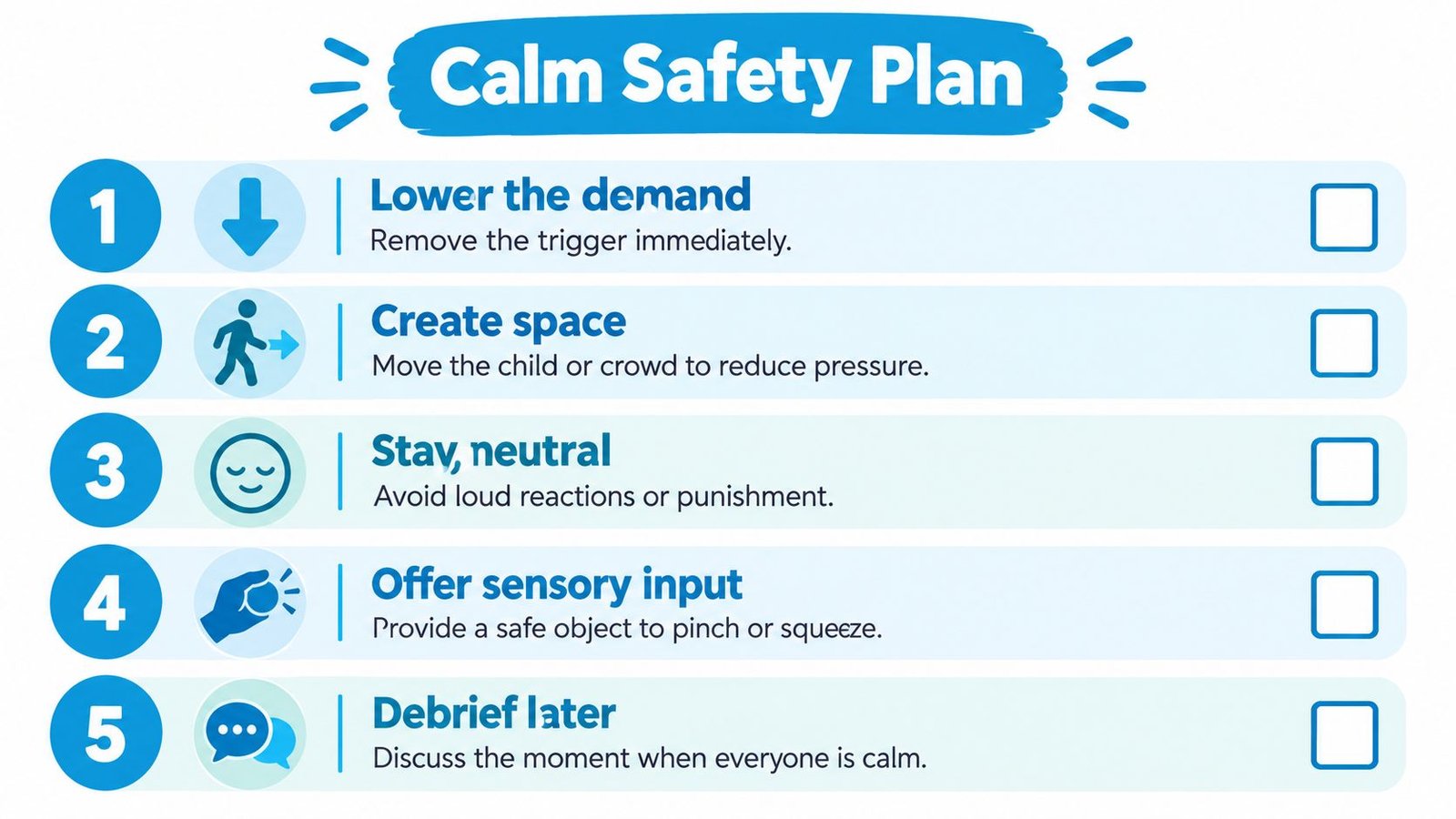
Use this sequence as a flexible guide:
- Lower the demand. Pause the instruction, reduce words, and remove the immediate trigger when doing so is safe. You can return to the task after recovery.
- Create space. Move the child, siblings, or nearby adults away from one another. Reduce crowding, noise, bright light, and unexpected touch.
- Protect without grabbing. Place a flat hand, cushion, folded clothing, or another safe barrier between skin and the child's fingers when possible. Avoid pulling, squeezing, or restraining the child unless a trained professional has established a lawful, individualized safety procedure.
- Use a neutral phrase. Say, “I'm keeping bodies safe,” or “Hands safe. Break.” Keep your face and voice calm rather than adding punishment or a dramatic reaction.
- Check for injury. Look for broken skin, bleeding, swelling, bruising, severe pain, or signs that the child may have injured themselves elsewhere. Seek urgent medical help for serious wounds, uncontrolled bleeding, breathing difficulty, loss of consciousness, or immediate danger.
During the episode, safety is the intervention. Teaching comes later.
If pinching is recurring, causes injury, or involves vulnerable people, families and organizations may also need clear incident documentation and safeguarding procedures. A practical guide for NDIS providers and participants can help clarify reporting considerations in relevant Australian care settings.
After the child is calm, write a two-minute note: what happened immediately before, who was present, where the pinch landed, what you did, and what changed afterward. Resources on co-regulation techniques can support the recovery period, but don't turn the calm moment into a lecture or forced conversation.
Replacement Behaviors That Work Better Than Suppression
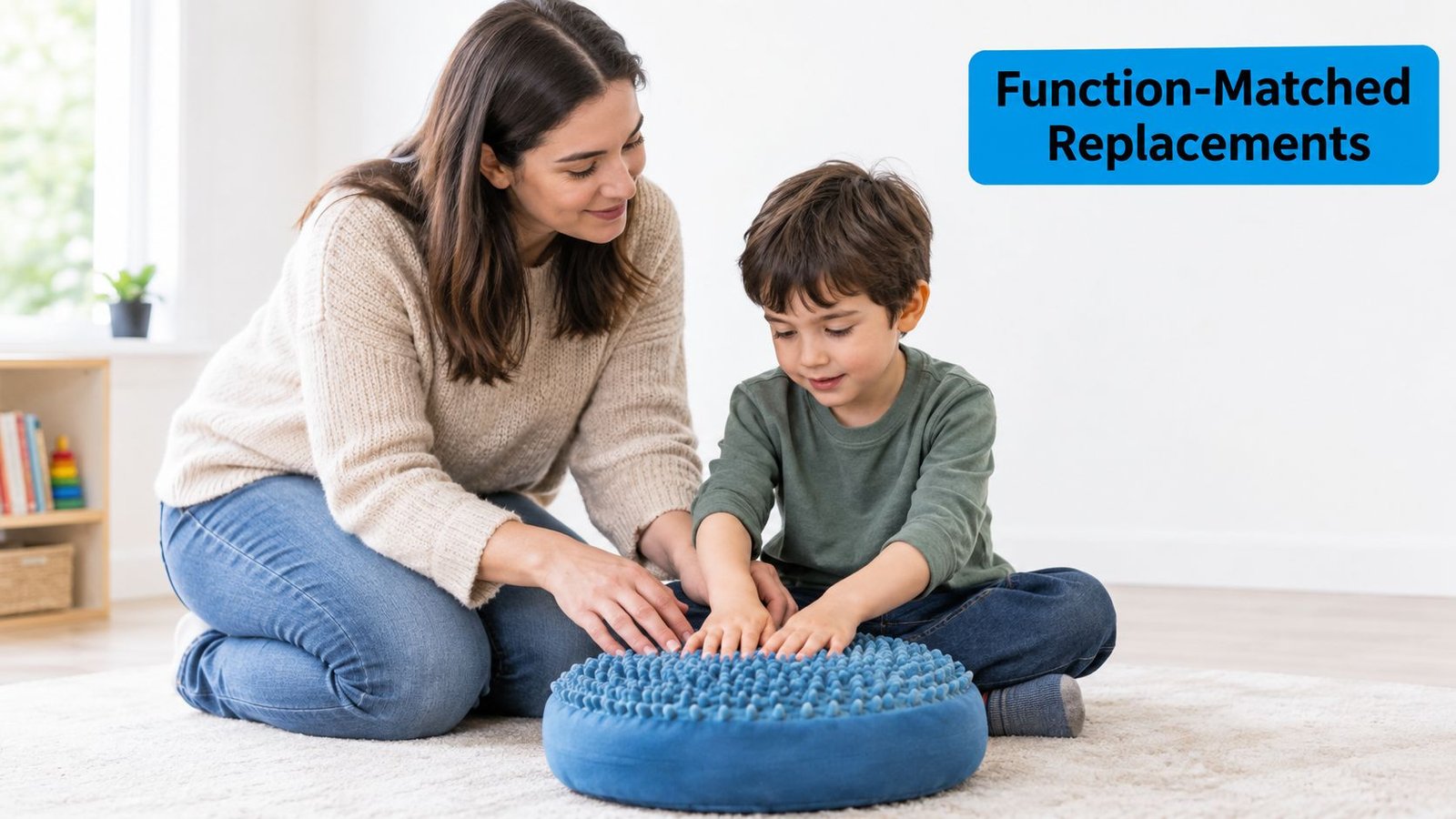
“Stop pinching” is a boundary, not a replacement skill. If pinching removes a demand, brings an adult closer, or creates needed sensory input, blocking it leaves the original need unanswered. A replacement works when it produces the same useful outcome with less effort and less harm.
Functional Communication Training, or FCT, provides a practical frame. First, identify the likely function. Then teach a simple communication response that produces that outcome. Finally, reinforce the replacement quickly and consistently, especially before the child reaches crisis.
Match the replacement to the function
| If pinching usually… | Teach a response such as… | Change the environment by… |
|---|---|---|
| Ends difficult work | A break card, “stop” gesture, or “help” request | Shortening tasks and offering clear first steps |
| Brings an adult closer | Tapping an open palm or using an attention card | Giving regular positive attention before distress |
| Produces strong pressure | “Squeeze” request or access to a safe sensory object | Offering sensory input before predictable transitions |
| Communicates refusal | “No,” “finished,” or “not now” through speech, signs, pictures, or AAC | Honoring reasonable communication while keeping essential limits |
The response must be easier than pinching at the exact moment it is needed. A complex communication board won't help if the child can't reach it, doesn't understand it, or must wait for an adult to interpret it. Start with one response, prompt it early, and reinforce it immediately.
A systematic review documented a 7-year-old autistic boy whose self-pinching and other self-injurious behaviors decreased by 67% when FCT was paired with response restriction (the systematic review of FCT and self-injury). That result comes from a single study record, not a universal prediction for every child.
Track both sides of the change. Count pinching episodes in a consistent way, such as frequency per hour or per opportunity, while also recording whether the child used the break request, how quickly help arrived, injury severity, and whether the skill worked with different caregivers. Bring those observations to a BCBA, speech-language pathologist, occupational therapist, or pediatrician for individualized assessment.
The evidence needs careful interpretation. A 2024 systematic review found no randomized trials or single-case experimental studies evaluating FCT specifically for self-injurious behavior in autistic people under 18, so effectiveness for that exact population and outcome remains unknown (the 2024 review of communication-based interventions). FCT is a useful framework, not a promise.
Turning Observations Into Patterns Over Time
Memory compresses difficult weeks into a single impression: “The pinching is getting worse.” A short, consistent record can reveal whether episodes cluster around particular demands, people, locations, times, or sensory conditions.
The National Autistic Society includes scratching and pinching among self-injurious behaviors and recommends recording antecedents, behavior, and consequences to clarify their purpose (guidance on self-injury in autism). Use that structure, but make each part specific enough for another person to understand.
Record what matters
Before the pinch, note:
- Setting and people: Home, school, shop, car, waiting room, sibling, parent, therapist, or unfamiliar adult.
- Immediate trigger: Demand, transition, denied item, unexpected touch, waiting, noise, light, crowd, or medical procedure.
- Communication access: Speech, signs, pictures, AAC device, choice board, or no accessible system in that moment.
- Physical context: Hunger, tiredness, illness, pain, poor sleep, or a recent medication change.
Describe the behavior itself:
- Frequency: How many pinches occurred.
- Duration: How long the episode lasted.
- Location: Own arm, hand, face, another person's arm, or another body area.
- Force and injury: Light contact, strong pressure, redness, bruising, broken skin, or bleeding.
Then record what happened within roughly one minute afterward. Did the task stop? Did an adult provide attention? Did the child receive a preferred item, sensory input, space, or help? Also note recovery time and what helped the child return to ordinary activity.
Read the consequence carefully
If pinching is repeatedly followed by task removal, escape may be part of the pattern. If it reliably brings adult interaction, attention may be involved. If it occurs during sensory overload and drops after moving to a quieter space, environmental regulation deserves attention.
These are hypotheses, not diagnoses. Review patterns across weeks rather than making a major change after one episode. Examples of pattern recognition can help families organize observations before discussing them with a qualified clinician.
Keeping the Data Without Burning Out the Family
A tracking plan that exhausts the caregiver won't last. You don't need a detailed form during a meltdown, a bedtime struggle, or a rushed school morning. You need a record that captures the parts most likely to guide the next decision.
A voice note can be enough: “After dinner, transition from tablet to bath, brother nearby, three pinches to his arm, no skin mark, bath delayed, calmed after quiet space.” Add a quick photograph of a visible mark when it helps a clinician understand injury, while protecting the child's privacy and storing the image securely.
Keep the fields short:
- Trigger
- Intensity
- Duration
- Suspected purpose
- People present
- Location
- Injury
- What happened next
- Recovery
Weekly review is often more sustainable than trying to analyze every entry immediately. Look for repeated combinations, such as pinching after sleep disruption and difficult transitions, or pinching only when a specific communication device isn't available.
Guiding Growth can turn a spoken recap into structured entries for behavior, sleep, meals, mood, medications, and other parts of the child's day. A parent reviews and corrects the captured information before saving it, then can use behavior records and summaries when preparing for a doctor visit, therapy session, IEP meeting, or behavioral consultation.
The purpose of data isn't to prove that a child is behaving badly. It's to give caregivers and clinicians a shared picture of what the child experiences and which supports make a difference.
When to Bring in a Professional
Some pinching can be managed initially with safety, observation, communication support, and environmental changes. Professional input becomes important when the behavior is repeated, worsening, injurious, sudden, or difficult to interpret.
Contact a pediatrician or qualified clinician when you notice:
- Skin damage: Repeated bruising, broken skin, bleeding, swelling, or marks that don't heal.
- Increasing force: Pinches become stronger, last longer, occur more often, or spread to new body areas.
- Safety risks: The behavior targets infants, older adults, siblings, peers, staff, or anyone unable to move away safely.
- A sudden change: New self-pinching or outward pinching appears without an obvious environmental explanation.
- Possible physical distress: Sleep disruption, dental pain, ear or skin problems, gastrointestinal symptoms, constipation, illness, or medication effects.
- Communication breakdown: The child can't reliably request a break, help, attention, sensory input, or medical assistance.
A pediatrician can help rule out medical contributors. A speech-language pathologist can build accessible AAC or other communication alternatives. An occupational therapist can assess sensory needs and safer input. A behavior professional can conduct a functional behavior assessment that tests what happens before and after pinching instead of guessing from appearance alone.
A 2025 report described approximately 65% higher emergency-department visits for self-harm among autistic children and adults than among a comparison group without autism, intellectual disability, or ADHD (the report discussed in guidance on aggressive behavior and autism). This figure isn't a reason to panic over one isolated pinch. It is a reason to take recurrent or escalating self-injury seriously.
Bring your log, photographs of injuries when appropriate, medication and sleep information, communication tools, and examples of what happened after the behavior. If you're looking for specialist care, information about haven medical autism specialists may help you prepare questions about assessment and coordinated support.
Ask the care team: What function do we suspect? How will we protect everyone now? What replacement response will we teach? How will we measure whether it works? When should we change the plan? Those questions keep the focus on safety, communication, and the child's quality of life.
Guiding Growth gives families one place to log pinching episodes, triggers, intensity, duration, purpose, people, location, injury, and outcomes, including quick voice entries that can be reviewed and shared with a care team. Visit Guiding Growth to turn scattered observations into a clearer record for your next appointment, therapy session, or school meeting.