It's 3 a.m., your child is awake again, and you're trying to remember whether you already went into their room or only dreamed that you did. By morning, the details blur. A sleep tracker journal shouldn't become another exhausting parenting assignment. It should help you remember what happened, notice what repeats, and explain your concerns without reconstructing the night in an appointment chair.
Table of Contents
- Why a Sleep Tracker Journal Beats Memory
- What to Record Each Morning
- Templates and Prompts That Fit Real Evenings
- Reading the Patterns in Your Entries
- Choosing How to Track Sleep
- Sharing Your Journal with Doctors and Therapists
- Starting Your First Week of Tracking
Why a Sleep Tracker Journal Beats Memory
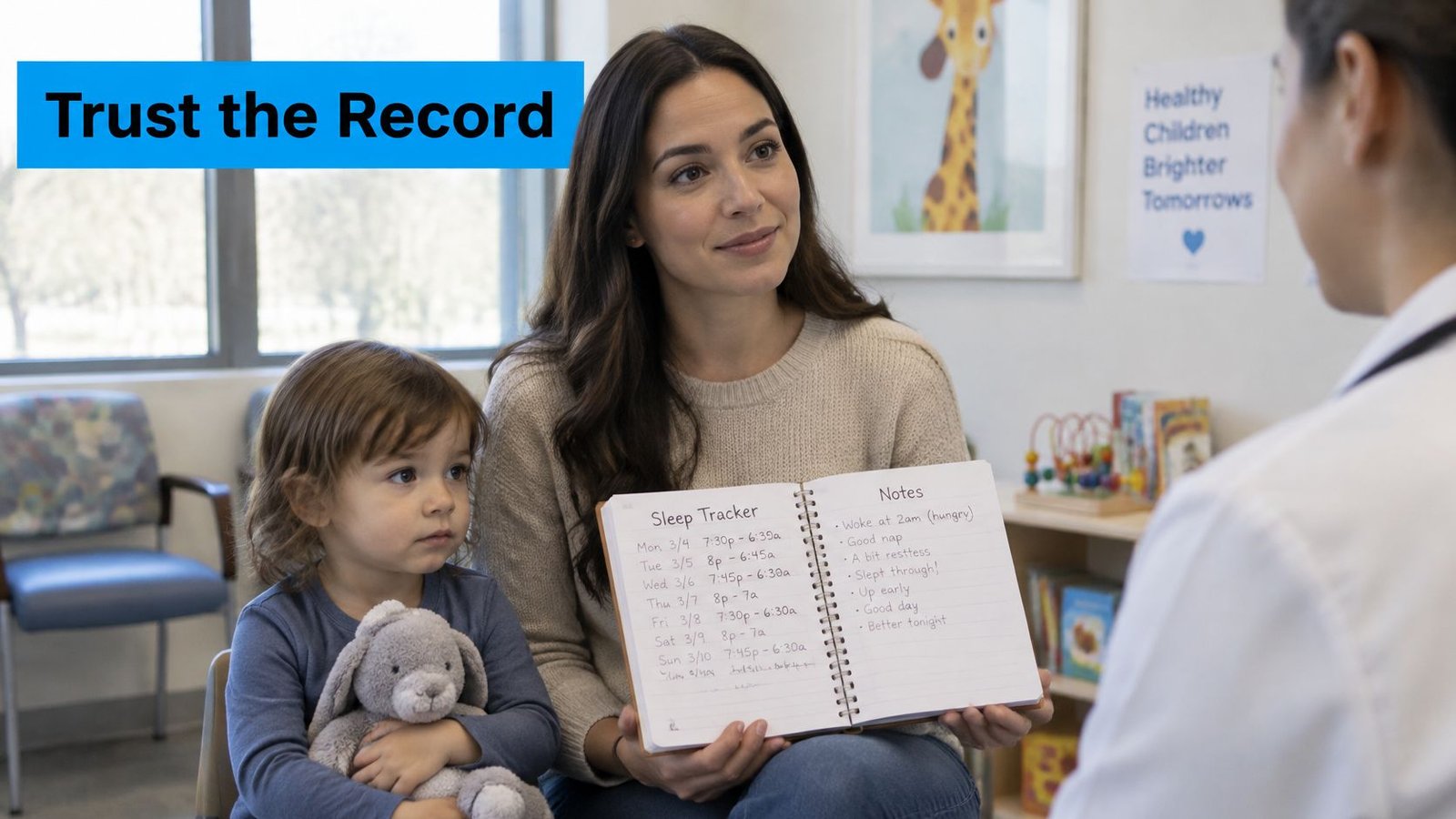
At a pediatric appointment, someone asks how many nights your child woke early last week. You remember the hardest night clearly, but the others run together. Was your child awake for a long stretch, or did you make several short trips down the hallway?
A journal separates what you observed from what you're trying to reconstruct. That distinction matters when different caregivers handle bedtime and morning routines. Neither person necessarily sees the whole night.
A simple record can give the pediatrician something concrete to discuss.
Consistent Questions Make Entries Useful
Sleep experts began developing the Consensus Sleep Diary in 2005, with drafts tested through six focus groups involving healthy sleepers, people with insomnia, and people with sleep apnea. Its standardized questions help clinicians compare sleep patterns across people and treatment periods, as described in this account of the Consensus Sleep Diary's development.
At home, the useful part isn't the research terminology. It's asking the same questions each morning instead of writing a detailed account after a difficult night and nothing after an ordinary one.
- Record observations: Note when your child called out, left bed, or needed support.
- Label estimates: Write “sleep onset uncertain” when you didn't see your child fall asleep.
- Keep context: Distinguish a quiet waking from a distressed waking that required your presence.
A useful journal doesn't prove that a night was difficult. It helps you explain what made it difficult.
For broader routine ideas, Seven Oaks Dentistry and Sleep Medicine offers better sleep advice for Wesley Chapel residents. Keep general advice separate from your record: an observation belongs in the journal; a proposed change belongs in a discussion with your child's care team.
The practical result should be modest: a short field list, a repeatable template, and a summary you can hand to a clinician. You don't need a detailed nighttime autobiography.
What to Record Each Morning
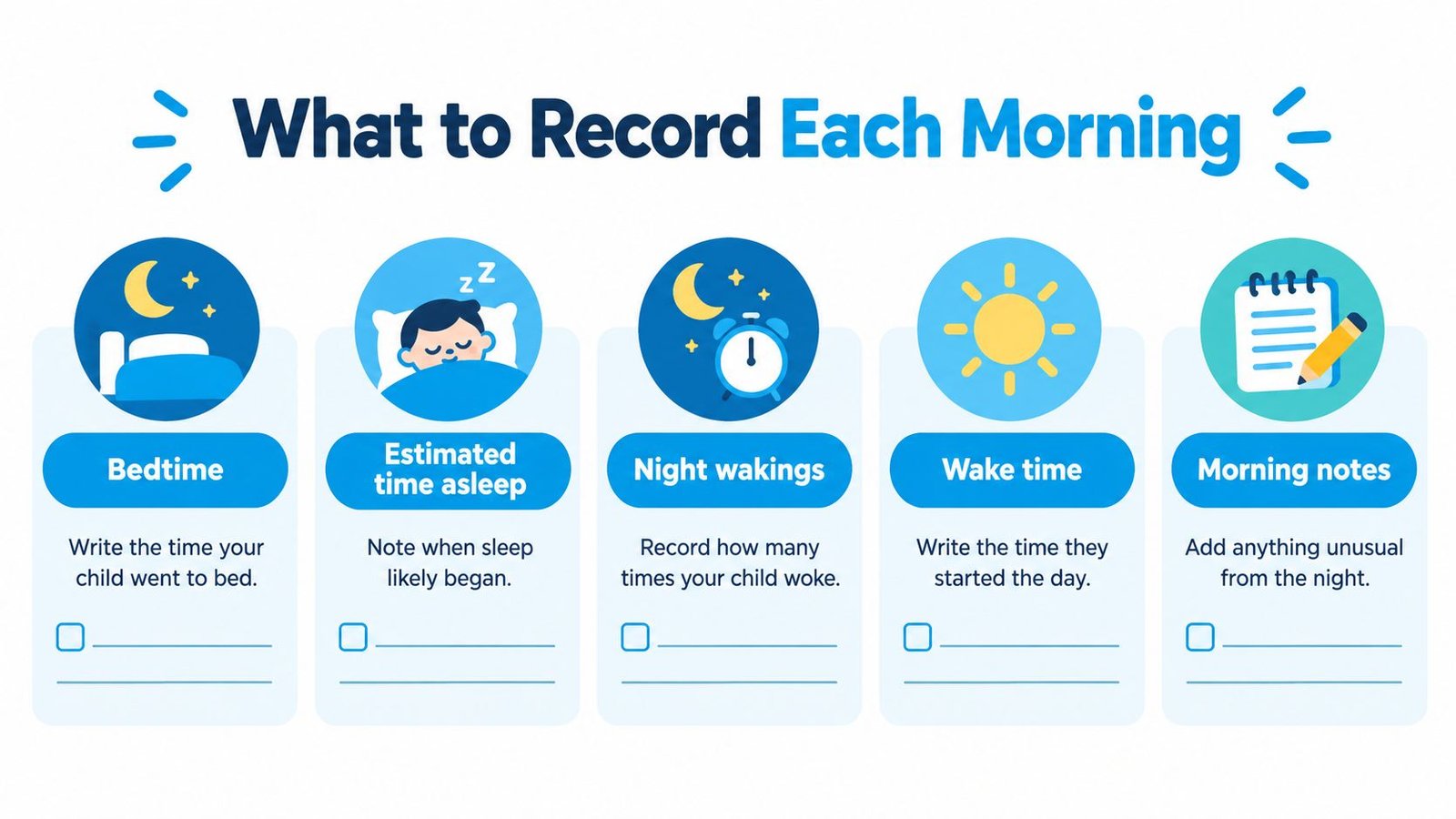
Anchor the entry to the morning, while the sequence is still accessible. Record the overnight information shortly after waking, then add naps and daytime functioning when they happen rather than predicting them.
Use this checklist as your starting point.
The Minimum Useful Entry
- Bedtime and sleep onset: When your child went to bed and your estimate of how long falling asleep took.
- Night wakings: The number you noticed, their estimated duration, and any uncertain stretches.
- Morning timing: Final wake time and when your child got out of bed.
- Naps and sleep quality: Daytime sleep, your child's description when available, and your own observations.
- Support and context: Staying nearby, rocking, relocating, sensory discomfort, illness, and medication or supplement timing.
- Daytime impact: Morning mood, regulation difficulties, school attendance, and therapy participation.
For environmental notes, use concrete descriptions such as hallway light, unfamiliar noise, or uncomfortable bedding. The guide to sensory-friendly sleep environments can help you identify details worth recording without changing everything at once.
Calculate Carefully
Use a consistent definition of time in bed, from bedtime to getting out of bed. Then calculate:
- Total sleep time: Time in bed minus estimated time to fall asleep and total awake time afterward, including wakefulness before getting up.
- Sleep efficiency: Total sleep time divided by time in bed, multiplied by 100, following the diary calculations described in sleep assessment guidance.
Keep event time separate from entry time. If you complete yesterday's record late, preserve that fact instead of making it look like a fresh morning entry.
A hypothetical completed note might read:
Example, not patient data: Bedtime and final wake time recorded; sleep onset estimated; no nap reported. Child was awake and distressed for 40 minutes, needed a caregiver nearby, and later returned to bed. Wearable reported continuous sleep during that interval. Morning mood was unsettled; medication timing unchanged.
Use the actual times you know and mark the rest uncertain. Don't manufacture precision to fill a box.
For a video companion, use the embedded resource below.
Templates and Prompts That Fit Real Evenings
The right template is the one you can complete while finding clean socks and getting breakfast started. A beautifully designed tracker won't help if filling it out requires more energy than you have.
A Paper Version You Can Copy
Put your child's name, the tracking dates, the usual routine, and the question you're investigating at the top. That question might be whether waking is recurring or whether bedtime settling has changed.
Use a row for each night:
| Night | Bedtime and estimated sleep onset | Wakings and support | Final wake and out-of-bed time | Naps | Quality and daytime notes |
|---|---|---|---|---|---|
| Date | Actual times or marked estimates | Observed events and approximate duration | Record separately | Add when known | Brief observations |
Keep longer context notes on the back rather than squeezing them into tiny boxes. If you missed a night, write missing; if you remember only part of it, identify which part.
A blank is more honest than a plausible guess. It also lets the person reviewing the journal distinguish an uneventful night from an undocumented one.
A Phone Version for Full Hands
With Guiding Growth, a parent can describe the night aloud instead of completing separate forms. Quick Log extracts organized entries for sleep, behavior, meals, mood, screen time, and medications, including information about different children in the same recording.
Review the extracted entries before saving. Check the child, the timing, and whether an estimate has accidentally become a definite statement.
These prompts keep either format focused:
- Who helped? Record which caregiver responded and whether they stayed.
- How did settling happen? Note independent settling, reassurance, movement, or relocation.
- What was unusual? Describe room temperature, light, noise, illness, or a disrupted routine.
- What happened afterward? Add observable morning functioning rather than a broad label such as “bad day.”
Practical rule: Write enough that another caregiver could understand the night without needing you to explain every sentence.
Keep the workload short, but don't treat speed as a test you can fail. A partial entry with clear uncertainty is more useful than abandoning the record because you couldn't complete every field.
Before handing the template to another caregiver, agree on what “bedtime” means. Otherwise, one person may record the start of the routine while another records lights out.
Reading the Patterns in Your Entries
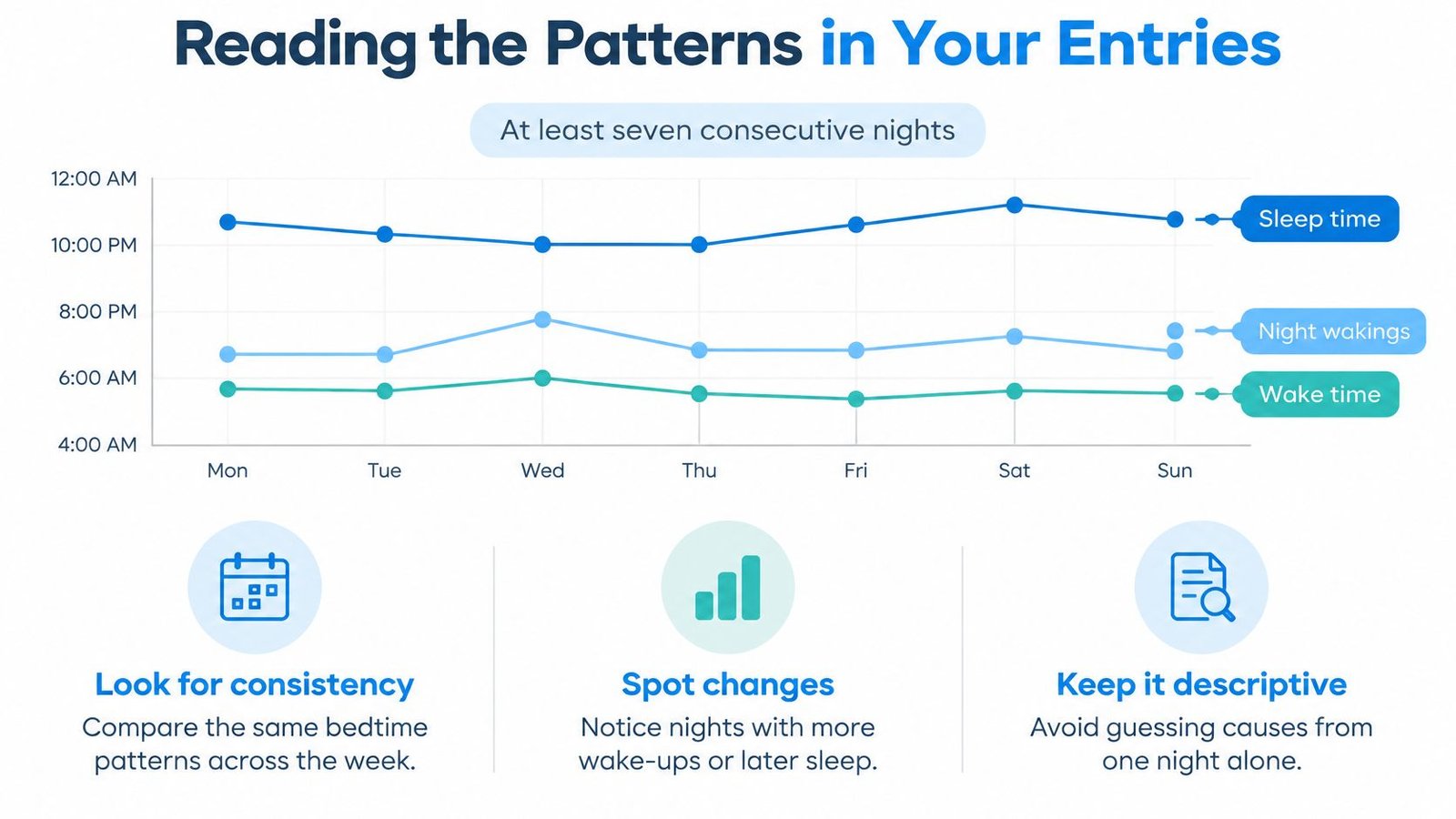
A difficult night deserves attention, but it doesn't automatically establish a pattern. Start with a 5–7-night baseline, treating the shorter end as preliminary: research summarized in this study of sleep-diary sampling duration supports reliable estimates of selected measures across five weekday nights, while sleep-duration reliability reached at least 0.70 after seven consecutive days.
Include ordinary nights, not just the ones you're worried about. Keep missing entries visible rather than filling them with an average.
This visual provides a way to organize the review.
Read Duration, Variation, and Timing Separately
- Average sleep duration: Use the same recent window each time, and state how many valid nights contributed.
- Night-to-night variation: Check whether the average hides alternating short and long nights.
- Waking patterns: Look for repeated timing, while acknowledging that unobserved wakings remain unknown.
The guide to visualizing daily data offers ways to display entries without burying the pattern in narrative notes. A simple timeline may be more informative than a crowded dashboard.
If late bedtimes and difficult mornings appear together, describe that association. Don't conclude that bedtime caused the behavior; illness, schedule changes, and other circumstances may also matter.
When the Wearable Disagrees
In a 28-day comparison with actigraphy, diary estimates showed strong agreement for total sleep time (r = .850), but weak agreement for wake after sleep onset (r = −.049) and awakening counts (r = .114). These findings from the diary-versus-actigraphy comparison support caution about treating remembered sleep fragmentation as a precise measurement.
Suppose a wearable reports ten hours of sleep, but you were supporting your awake child for two of those hours. Keep both records, label the device estimate, and document your direct observation separately.
Don't average them into a compromise figure. Your observation describes what happened while you were present; the device provides a different estimate, not a correction that automatically overrides you.
Choosing How to Track Sleep
Choose a tool according to what you need to bring to the next appointment. If the question concerns bedtime timing, a notebook may be sufficient. If the concern involves sleep alongside medication, sensory events, and school functioning, you'll need somewhere to keep that context.
Sleep Tracking Options Compared for Autism Families
| Option | Sleep fields captured | Behavior and daily context | Multi-caregiver access | Exportable summary | Daily effort |
|---|---|---|---|---|---|
| Paper notebook | Whatever you include | Flexible handwritten notes | Requires a handoff or shared location | Usually prepared manually | Writing and later summarizing |
| Generic sleep app | Varies by app | Check for custom notes and relevant fields | Check sharing permissions | Depends on the app | Form entry and corrections |
| Consumer wearable | Device-estimated sleep measures | Usually needs a separate context record | Account-dependent | Depends on device and app | Wearing, syncing, and reviewing |
| Guiding Growth | Logged sleep duration, quality, and notes | Sleep alongside behavior, meals, medications, and therapy | Collaborator permissions | Smart Summaries with PDF export | Voice logging and review |
A notebook is flexible and needs no charging, but you must organize it yourself and keep it accessible. A generic sleep app may provide convenient timing fields, yet you should check whether it has room for caregiver support or a medication change rather than assuming it does.
Device Data Isn't Clinical Measurement
A 2025 meta-analysis of 24 studies involving 798 patients found significant differences between consumer wrist trackers and polysomnography for several sleep measures. The authors of the consumer tracker meta-analysis concluded that trackers may help identify broad patterns but shouldn't replace clinical measurement.
If a clinician raises testing, Pain and Sleep Therapy Center's discussion of the limits of home sleep testing offers additional context for that conversation. Ask the clinician which assessment fits your child rather than selecting a test from a tracker score.
Guiding Growth is an option when you want sleep stored beside the rest of your child's day. Its analytics dashboard displays behavior frequency, logged triggers, and time-of-day clustering; those displays can support questions about the record, not establish medical causes.
Before choosing, ask:
- Can everyone contribute? Check whether caregivers can add observations without sharing unrestricted access.
- Can I retrieve the information? Make sure appointment preparation won't require copying every entry by hand.
- Will I use it when tired? Choose a workflow you can maintain without making nighttime harder.
Sharing Your Journal with Doctors and Therapists
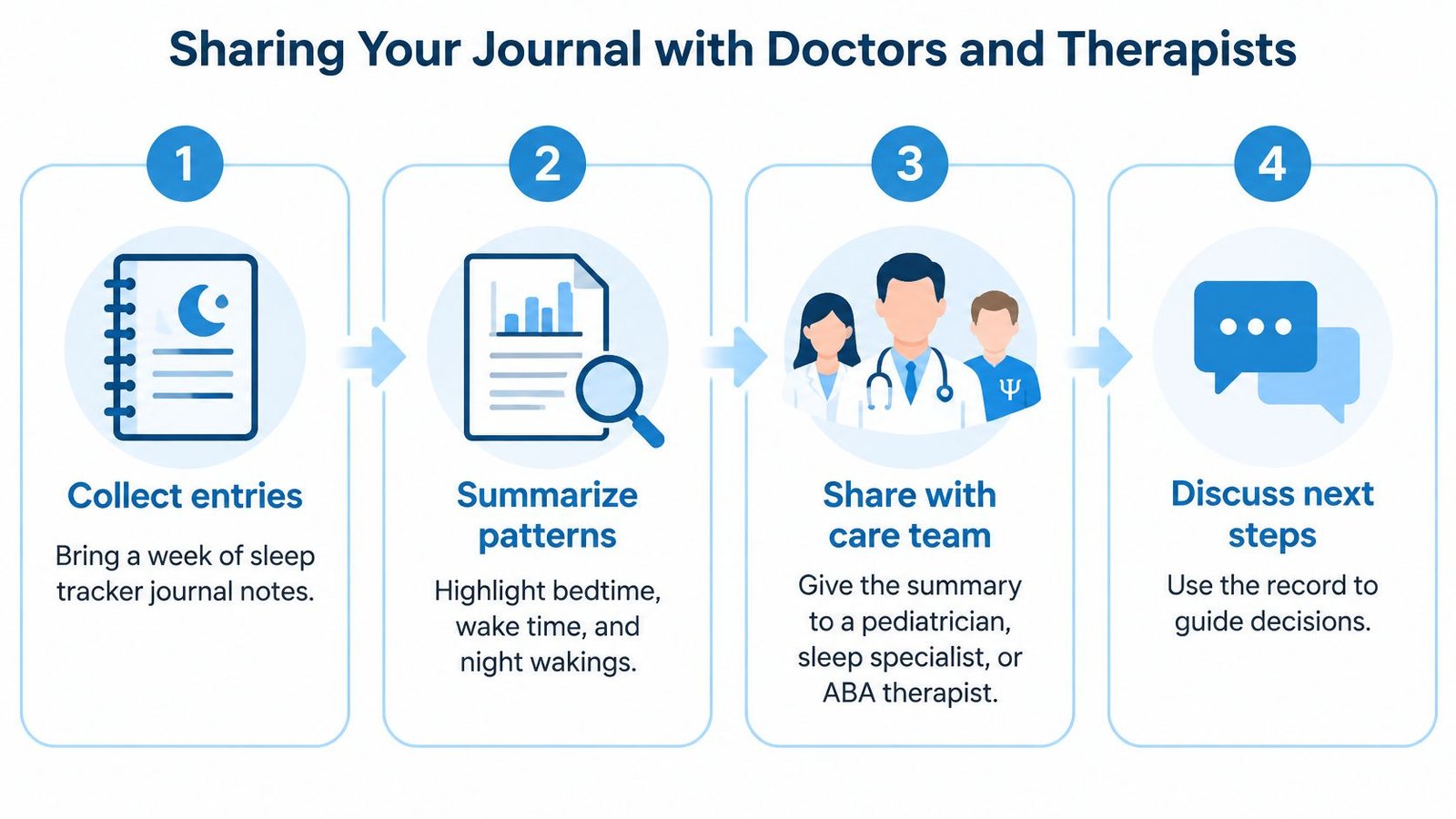
Bring a one-page overview, with the detailed entries available if someone needs them. A pediatrician, sleep specialist, ABA therapist, and school team may ask different questions, but all need to understand what you measured and how certain you are.
Use this sequence to prepare the handoff.
Build a Defensible Summary
Start with your main concern in plain language: prolonged settling, recurring waking, difficult mornings, or uncertainty about a device estimate. Then include the essentials.
- Coverage: Date range, valid-night count, missing nights, and entries completed late.
- Sleep measures: Average estimated total sleep time and sleep efficiency, with the calculation method identified.
- Variability: Whether timing and duration stayed similar or changed substantially between nights.
- Relevant context: Illness, medication changes, unusual routines, and the support your child needed.
- Daytime observations: Specific changes in participation, mood, or regulation, without claiming a cause.
Leave out decorative sleep-stage scores and long strings of unrelated daily events. Keep your child's own description when they can provide it, clearly separated from caregiver interpretation.
For a therapy discussion, the principles in data collection in ABA can help you frame observable events. A therapist may help refine what to record, while medical sleep concerns still belong with an appropriate healthcare professional.
Use the Report to Ask a Question
In Guiding Growth, select the date range, event types, and meeting type for a Smart Summary, then export the report as a PDF. Review it before sharing, particularly estimated times and wording that could sound more certain than the underlying entries.
Useful questions include:
- About assessment: Does this pattern warrant further sleep evaluation?
- About measurement: Which field would help answer the clinical question more clearly?
- About next steps: What change, if any, should we monitor, and when should we review it?
“These are caregiver estimates. The waking notes describe what we observed, and the device readings are listed separately.”
That's an honest way to introduce the record. As the earlier diary comparison illustrates, useful information doesn't have to be perfectly precise.
Agree on a stop rule rather than tracking indefinitely. Once the original question has been answered, pause unless your clinician recommends continued monitoring; repeat a focused window after a relevant medication, routine, illness, or sleep-intervention change.
Starting Your First Week of Tracking
Pick a start date and a format tonight. Use the short baseline described above, record the core fields each morning, and add context when something unusual happens. Aim to understand your child's nights, not produce a flawless spreadsheet.
Sleep concerns deserve that attention: a systematic review of sleep disturbance in autistic people reported estimates ranging from 40% to 83%, with parent-reported problems reaching 95% among autistic children aged 2–6 in one included study. Those figures don't tell you what's happening for your child, but they reinforce why recurring concerns merit a clear record and clinical discussion.
Compare Against Age, Not a Device Score
The American Academy of Sleep Medicine's child sleep recommendations suggest 9–12 hours for children aged 6–12 and 8–10 hours for teenagers aged 13–18, across a full 24-hour period, including naps. These are comparison ranges, not individual diagnostic cutoffs.
- For younger siblings: Bornbir's week-by-week newborn sleep guide is a separate age-specific resource, not a benchmark for an older child.
- For your tracking question: Decide what would make the record useful enough to pause.
- For tonight: Open Guiding Growth and log sleep alongside the rest of your child's day.
A journal supports conversations with qualified clinicians. It doesn't replace medical assessment, and you don't have to finish a tracking window before raising a persistent concern.
Guiding Growth lets you record sleep alongside behavior, meals, medications, and daily context, then prepare a shareable summary for appointments. Visit Guiding Growth to start tonight's entry, review what was captured, and build a record your care team can discuss with you.